Space digest — 2026-10-13
Top line: CRS-35 flew on schedule — the October 13, 6:33 AM EDT launch from SLC-40 carried the final iROSA arrays to the ISS, the pre-dawn ascent produced a "space jellyfish" plume visible along much of the East Coast (with praise from NASA Administrator Jared Isaacman and photos shot from orbit by astronaut Anil Menon), and sonic booms from the booster landing served as a coastal alarm clock. On Starship, the story broadened from hardware to hardware-plus-regulation and then hardened into an open docket: the FAA formally opened the environmental review of SpaceX's plan for up to 456 Starship launches and 912 landings per year at Starbase — the full cadence weekdays only, with a Phase 1 of 100 launches and 200 landings per year across all seven days — and SPCX fell ~5% on the announcement (October 13). Hardware kept moving alongside it: Booster 23 rolled to Massey's for cryo testing overnight into October 13, Raptor 3 RVAC 106 returned to McGregor with a tested Raptor 3 (engine 272) heading back the same evening, and Ships 42, 43 and 44 now stand vertical alongside the recovered Ship 40 in Mega Bay 2. Financially, the launch-bottleneck theme went macro — a $100B-plus space-spending year, framed in market coverage as fueled by SpaceX rideshare scarcity from 2028, the Falcon 9 retirement and the SpaceX IPO — while Rocket Lab's tape picked up a new catalyst (a CFO stock sale) and its backlog ($2.36B) and Neutron-fairing-at-Wallops layer held.
1. Rocket Lab: backlog past 100 missions ($2.36B), fairing at Wallops — and now two downgrades on the "missing Neutron catalyst"
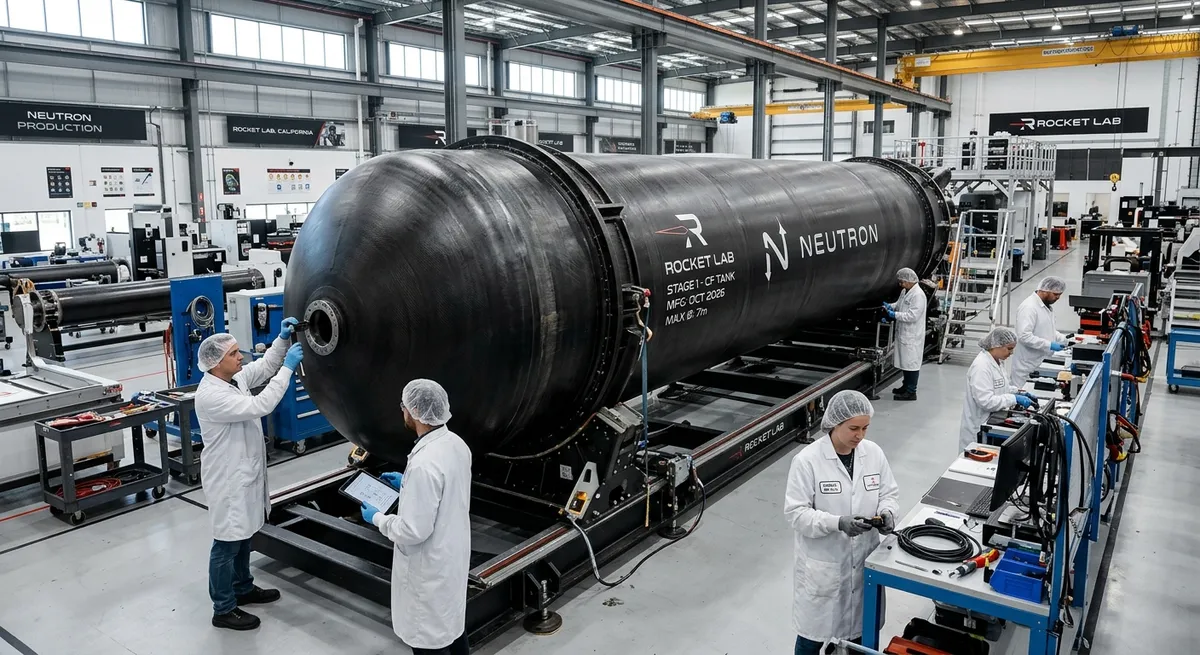
What happened: RKLB slipped even as Electron pushes toward its 100th launch, with retail coverage centered on Neutron delays. Monday's tape added a new catalyst: the stock fell 4% to $65.71 on October 12 with a CFO stock sale named among the drivers alongside the SpaceX-competition risks (CoinCentral). The company's anchors were reiterated: a 20-launch Synspective deal has pushed the launch backlog above 100 missions — German-language market coverage now pegs that backlog at $2.36 billion — and Neutron's first-stage tank is targeted for pad delivery in Q4, with the end-of-year first-launch goal on the page and in doubt at the same time. Separately, the same market coverage reports Neutron's fairing has reached Wallops, Virginia — the first on-record signal that Wallops-side integration hardware is arriving. The sell side has doubled down: a Seeking Alpha piece downgrades the stock explicitly on the "missing Neutron catalyst," arguing SpaceX's next Starship test — expected no later than early November — could put further pressure on Neutron's vehicle validation and stretch the gap between the two companies for future Neutron demand; and TD Cowen trimmed its RKLB target to $90 (Ad hoc News). Meanwhile the Electron cadence side of the ledger keeps growing: 18 launches completed this year with 9 to go, and plans to put roughly 30% more satellites into orbit in 2026 than last year (Yahoo Finance market piece).
What's genuinely new: The Synspective order, the >100-mission backlog, and the October 10 layer (RKLB down ~9% over two days, Neutron slipping again, the $30B lunar procurement backdrop) are already on the storyline's record, as is the 2026-10-13 downgrade layer. New facts today are the CFO stock sale as a named decline catalyst (new in the window), the fresh year-to-date launch count (18 done / 9 to go — implying a 27-launch year) and the ~30% uplift in satellites-to-orbit, alongside the already-recorded $2.36B backlog figure, the Wallops fairing arrival, and the two-shop downgrade column. This is a development of the existing thread "space — Rocket Lab × Iridium: the ~$8B combination."
Watch: Whether the Q4 tank-delivery target holds (already a dated prediction: slip or slip-confirmation is the watch); any Neutron first-flight date; Wallops-side fairing/first-stage integration steps; whether the CFO-sale disclosure draws further selling; SpaceX's next test timing (the "no later than early November" frame); and the Iridium FCC/GAO/close runway that still sits under the whole thread.
Links: MSN · Seeking Alpha · Ad hoc News · CoinCentral · Yahoo Finance
2. Starship: FAA opens the environmental review of a 456-launch/912-landing Starbase plan; SPCX −5%; Ships 42–44 join Ship 40 vertical in Mega Bay 2; Booster 23 cryo; Raptors cycling McGregor
What happened: The regulatory lane now has an open docket. SpaceX's request to dramatically expand Starship operations at its South Texas launch complex — previously on the record as a filing targeting up to 456 Starship launches per year — is formally under review: a Federal Register notice has opened a full environmental review of the proposal for up to 456 Starship launches and 912 landings per year at the Boca Chica site (TeslaNorth, October 13), and regulators announced the review Tuesday, October 13, with SPCX stock dropping ~5% on the day (Stocktwits). The structure on record: the full cadence (roughly 1.7 launches and 3.5 landings per day) applies weekdays only as the plan's second phase, while Phase 1 would run 100 launches and 200 landings per year across all seven days — "very early days, assessments and evaluations have to take place — but it's the first time such a cadence has been written down officially" (Ryan Caton, NSF RT, 1:08 PM ET October 13). Earlier-in-day coverage of the filing request itself: MSN, Yahoo Finance (which cites the FAA filing for the 456-launches/912-landings figures), and Chron's South Texas piece on what "even more rocket launches" would mean for the area. The hardware pipeline stayed busy alongside it: Ship 40 — the Flight 13 recovery ship that returned by sea on October 7 after roughly 80 days and over 12,000 nautical miles — was lifted vertical inside Mega Bay 2 on October 12, hooked to the bay's bridge cranes, back where its journey started on July 23, and a SpaceX evening post (NSF RT, 5:59 PM ET October 13) frames it as "the first Starship to return to its launch site," now vertical alongside three other Starships — Ships 42, 43 and 44 — in a Megabay at Starbase, where it "will provide first-of-its-kind data on a flown Starship heatshield, Raptor engines." Booster 23 rolled from the Starbase production site to Massey's overnight into the morning of October 13, ahead of its initial round of cryogenic testing (roll RTs at 12:47 AM and 1:32 AM EDT, with a road delay en route), and McGregor cycled Raptors all day: Raptor 3 RVAC 106 returned to the test site (10:03 AM EDT October 13), and Raptor 3 engine 272 completed its testing and was seen heading back (NSF RT of Rhin0, 5:16 PM ET October 13 — a completion datapoint, versus prior coverage that had only tracked arrivals). At the Cape, SpaceX installed the roof section atop the Starship tower at Launch Complex 39A on the morning of October 12. Test-site commentary raises Booster 23 as a candidate to be the first booster to launch from LC-39A — speculation from observers, not a plan on the record. Unrelated but noted: NSF's feed carried reports of a power outage at Starbase overnight, with the Starfactory visibly dark.
What's genuinely new: The 456-per-year request was already on the record; the genuinely new layer is the FAA formally opening the review (Federal Register notice), the 912-landings figure, the weekdays-only full-rate constraint, the two-phase structure (100 launches/200 landings in Phase 1), and the ~5% SPCX drawdown on the announcement. Booster 23's Massey's roll, RVAC 106, and now Raptor 272's completed-test return are the hardware datapoints, Ship 42–44-in-MB2 is a new fleet-position datapoint with SpaceX's flown-heatshield-data framing, and the 39A tower roof installation continues the Cape pad-race record. This is a development of the existing thread "space — Starship cadence: Starbase + Cape pad race."
Watch: The environmental-review runway — comment/scoping phases and any timeline attached to the 456-launch/912-landing request; the Phase 1 (100/200) framing as the near-term ceiling; what Ship 40 is being prepped for and what data its flown heatshield yields; Booster 23's cryo results and whether it is ever shipped to Florida; the Flight 15 catch bracket (Nov 7–21) still standing from the memory record; the F16 39A debut vs the Dec 10 unofficial slot; whether the Starfactory outage was routine.
Links: MSN — 456/year filing · Yahoo Finance — FAA filing · Chron — South Texas · TeslaNorth — Federal Register PEIS · Stocktwits — SPCX −5% · NSF RT — Ryan Caton phasing · NSF RT — Ships 42–44 with Ship 40 · NSF RT — Ship 40 vertical · NSF RT — 39A tower roof · NSF RT — Raptors at McGregor · NSF RT — Boostel 23 roll · NSF RT — RVAC 106 · NSF RT — Raptor 272 return
3. CRS-35 launched: final iROSA arrays en route to the ISS, "space jellyfish" across the East Coast, sonic booms on landing — with the NASA Administrator and a crewmate watching from orbit
What happened: SpaceX's CRS-35 cargo mission launched successfully October 13 at 6:33 AM EDT from SLC-40 — NSF's broadcast post confirms the Falcon 9 flying the 35th cargo Dragon mission to the station (SpaceNews via Foust: "Falcon 9 launches 35th cargo Dragon mission to ISS"). The Cargo Dragon carries fresh food, science gear, equipment and crew supplies, including two roll-out solar arrays that complete the station's major power upgrade — the final iROSA arrays — flying to a station fresh off the Crew-12 handover. The pre-dawn ascent delivered the promised spectacle: the "space jellyfish" plume became visible across the eastern US roughly 3 minutes 20 seconds after launch as the rocket entered sunlight (NSF RT of John Kraus, 6:38 AM EDT), with sightings reported from Tybee Island, Georgia (expanded-exhaust-plume explainer), across Marion, Sumter and Lake counties in Florida (Orlando Sentinel wraps the sonic booms and the plume over Central Florida and beyond), in North Carolina skies, and in a photo round-up of the display up and down the East Coast. The booster landing added its own effect — sonic booms that locals treated as an alarm clock (NSF RT of Julia Bergeron, 6:59 AM EDT, which also captured the ISS passing just left of the re-entry burn), and the Chicago Tribune's wrap ties the sonic boom and jellyfish to the same launch. Official reaction followed: NASA Administrator Jared Isaacman (NSF RT, 5:43 PM ET October 13) — "Sometimes one extraordinary view is all it takes to remind us how incredible spaceflight is, and how much we still have to explore" — passed along astronaut Anil Menon's photos from the ground and from space capturing the launch, with Expedition 75 "eagerly awaiting" a Dragon carrying "important science … as well as critical hardware for extending the life of" the station.
What's genuinely new: The launch itself is now confirmed on the record rather than scheduled; the genuinely new layer on top of the previously recorded payload/tease detail is the flight outcome and the spectacle's geographic spread — Tybee Island, central Florida three-county visibility, North Carolina, the East Coast photo round-up — plus the sonic-boom landing effect, the ISS-passing capture, and the Isaacman/Menon/Expedition 75 reaction layer, which puts a named NASA source behind the event. This stays unclustered: no existing storyline thread in the memory covers routine Dragon resupply (the ISS logistics thread tracks Progress; the ISS-endgame thread covers deorbit and the successor race).
Watch: Berthing; confirmation of the final iROSA installation and the completed power-upgrade milestone in station planning.
Links: NSF broadcast · SpaceNews RT · Chicago Tribune · Orlando Sentinel · MSN — East Coast photos · NSF RT — Isaacman/Menon · PrimeTimer — Tybee Island · Ocala News · MSN — NC sightings · MSN — cargó Dragon payload · NSF RT — Bergeron sonic booms · NSF RT — Kraus jellyfish
Brief
- The launch bottleneck goes macro: a commercial launch shortage has spurred an unprecedented wave of investment in space infrastructure and applications ("A SpaceX launch shortage is fueling a $100 billion investing spree," MSN, October 13); TipRanks headlined global space-sector funding surpassing $100 billion for the first time in 2026, tying the spending wave to the SpaceX IPO and Falcon 9 retirement as catalysts for rival rocket makers like Blue Origin (TipRanks); Spanish-language market coverage adds a concrete date to the scarcity thesis — the prospect of SpaceX limiting its rideshare launch services from 2028 is accelerating the investment plans (Dolarhoy; USD 100,000 millones = $100 billion, Dolarhoy) (MSN). Italian-language market coverage adds the same frame from the IPO side: the SpaceX IPO that kicked off the summer of 2026 in the defence and space-infrastructure sector has seeded a $100B boom in space investments (Il Sole 24 Ore, October 13, ~4:20 PM ET), and the Seattle Times pegs 2026 as the first year space investment is on track to exceed $100 billion ever in a given year (Il Sole 24 Ore, Seattle Times). This is unclustered — no existing storyline covers the industry-wide funding spigot — though its scarcity logic is the same SpaceX-gap frame the Rocket Lab downgrade column runs on.
- Starlink 15-25 flew — a Falcon 9 launched 27 Starlink satellites from Vandenberg on October 12 (NSF broadcast post); SpaceX's own recap frames it as the first Starlink-specific mission in more than three weeks (MSN photo piece), IBTimes pegs the gap at 23 days, and a Vandenberg Falcon 9 was separately counted down through T-20 minutes into the evening of October 12 (live coverage). Routine cadence recorded, with the gap nuance a real datapoint against the fiction of unbroken cadence. IBTimes SG
- The SpaceX-spectrum market leg spread to three tickers: Piper Sandler downgraded AST SpaceMobile to Neutral on the SpaceX direct-to-cell threat — Seeking Alpha News carries the same action with the causal frame "SpaceX competition and launch constraints delay rollout and cut forecasts" — with shares sinking 9% to $46.58 in morning trading October 13 (247wallst); a new shop and a new action on the same threat frame the thread's market layer carries, with the Oct 29 FCC auction vote still the dated watch (Seeking Alpha News). The same day produced the counter-read: a Seeking Alpha analysis argues "the bad news may be overstated," citing LEO satellites delivering 200 Mbps to phones and SpaceX spectrum as factors supporting the ASTS investment thesis (Seeking Alpha); separately, Bernstein warns SpaceX's Starlink is putting enough pressure on AT&T to risk a credit-rating cut (Traders Union). 247wallst · Traders Union
- AST vs. RKLB side-by-side: a Yahoo Finance comparison piece frames AST SpaceMobile (direct-to-phone constellation) against Rocket Lab (rocket builder) as two cash-burning space stocks with sharply diverging paths to profitability — retail context adjacent to both threads; no new facts in capture. Yahoo Finance
- Bezos cadence aspiration: a profile piece (MSN, October 13) has Jeff Bezos framing Blue Origin's goal as "a flight to space every minute" — "They think I'm crazy. I've seen crazy things come true." A goal statement, announced not flown; adjacent to the "space — Blue Origin: New Glenn cadence and the ground-infrastructure constraint" thread, recorded as framing. MSN
- Firefly's far-side layer: Firefly Aerospace (NSF RT, 4:48 PM ET October 13) shows its Elytra orbiter in the cleanroom — the transfer vehicle and communications bridge for "Riders 2 the Dark," billed as America's first mission to land on the Moon's far side, relaying between Blue Ghost and Earth where direct line-of-sight is impossible. Vendor framing inside the "space — Moon-base logistics: NASA's $30B permanent lunar base + bulk launch procurement" thread's vendor field. NSF RT
- SLS engine test on the clock: NASA is targeting Wednesday, October 14 for its next RS-25 engine hot fire on the Fred Haise Test Stand at Stennis, window 2–4 PM CDT (3–5 PM Eastern) (NSF RT, 4:31 PM ET October 13). NSF RT
- Quiet-week manifest: NSF's launch preview casts the week as a relatively quiet one, with SpaceX's Falcon 9 and ZhuQue-2E making up much of the manifest (October 13). NSF
- AT&T Business picked Amazon Leo over Starlink for an enterprise broadband service designed to complement its fibre and 5G offerings — the first named B2B adoption datapoint for Leo, a development of the "space — Amazon Leo: Ariane 6 consolidation + India market entry" thread. Mobile World Live
- Rocket Lab's Electron pace quantified: 18 launches completed this year, 9 to go, with plans to orbit roughly 30% more satellites in 2026 than last year (October 13) — a cadence datapoint inside the Rocket Lab thread, complementary to the section 1 layer. Yahoo Finance
- Voyager Technologies' Griffin-1 completed acceptance testing at NASA JPL, passing its environmental test campaign — an "enormous step toward launch" supporting NASA's Moon Base Program, per the company ($VOYG). Vendor-posted; treat as vendor framing inside the "space — Moon-base logistics: NASA's $30B permanent lunar base + bulk launch procurement" thread's vendor field. NSF RT
- ESA member states signal support for new European human spaceflight plans (SpaceNews, 3:00 AM ET October 13) — a new lane, unclustered from any existing storyline; recorded as-is pending the substantive piece. NSF RT
- "Can India find its own Starlink moment?" (Business Today cover story, October 13): a market-frame piece arguing India's private space companies have built the technology but must now find customers, achieve scale, and compete — adjacent to the "space — SpaceX as a US carrier" India storyline but not a fact-bearing development of it; recorded as context. Business Today
- Canada Rocket Company: $22.5M raised, reusable rocket in Etobicoke (October 12): a small Canadian startup with no launches yet aiming at orbit and framing itself against SpaceX — new name, unclustered from any existing storyline; treated as early-stage vendor framing. Tesla North
- "NASA wants more than 70 moon landings in the next decade — but how?" (October 13): a continuation of the existing thread "space — Moon-base logistics: NASA's $30B permanent lunar base + bulk launch procurement" — same open question ("but how?") the thread's bulk-procurement watch already carries; no new procurement facts in capture. MSN
- Relativity Space posts its September progress roundup: downcomer installed in the stage 1 flight tank, stage 2 wet dress rehearsal complete at Stennis building toward first hot fire, all 13 engines through integrated gimbal testing, and launch-site work at 530-foot lightning tower height with pad power energized — the LC-14/16 first-flight lane inside the "space — Starship cadence: Starbase + Cape pad race" thread's competitor field. Company-posted; treat as vendor framing. NSF RT
- A SpaceX-branded subscription bundle, per Teslarati: a report published October 13 (~8:20 PM ET) says SpaceX "Super Intelligence" has rolled out "The X Subscription," a single plan combining Grok, Grok Bot, Cursor and X — thin capture, vendor framing, noted as-is pending substance. Teslarati
Dropped
- "[Subscribers Only] Ship 40 back in Megabay 2" — paywalled duplicate of the covered Ship 40 vertical item; no independent facts.
- "RT Max Evans: good evening from the secondary residence" — no factual content.
- "This Week In Spaceflight with Elysia Segal" — show promotion, not news.
- "SpaceX Launches Falcon 9 with Starlink 15-25" broadcast link and "T-20 minute vent" — folded into Brief as routine cadence.
- Duplicate CRS-35 tweet preview — superseded by the full NASASpaceflight article above.