AI social digest — 2026-10-16
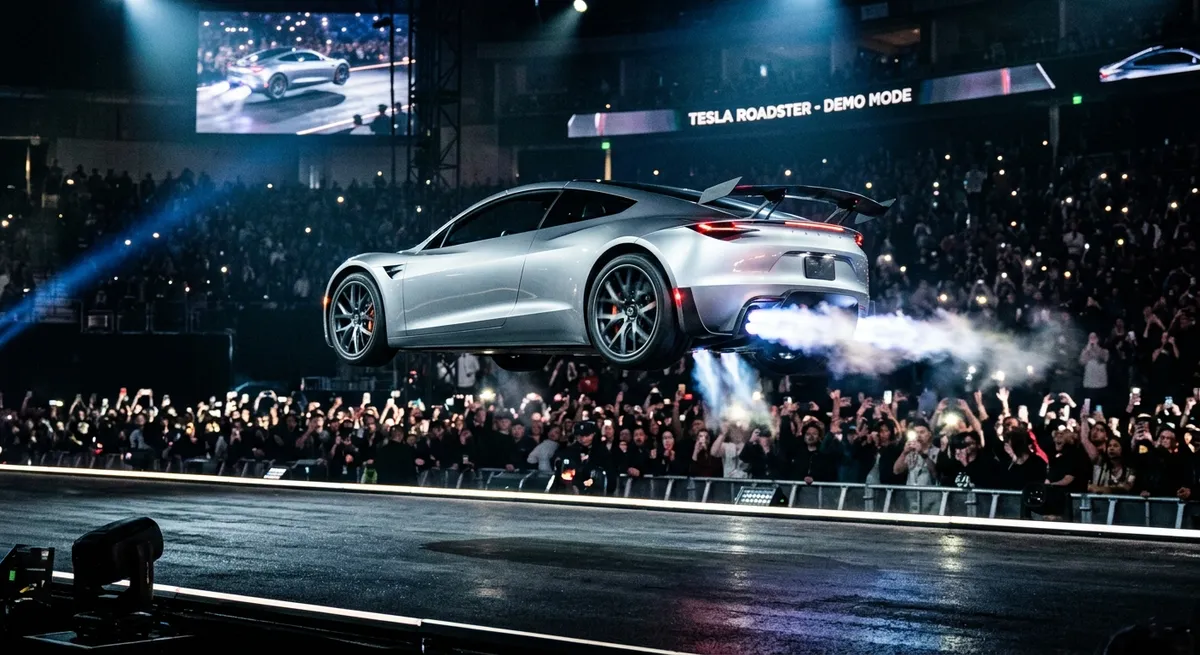
Top line: The window's substance is one launch: Tesla put the long-delayed Roadster on a stage Wednesday night and it flew — thrusters, suction downforce, F1-class passive aero — and the Musk feed erupted into the year's biggest car-demo moment. The claims are demo-stage, not delivered-product, and the technical detail (1 MW drive unit, Optimus actuators driving the wing) is the real news beneath the spectacle. Tesla has since put its own 0–60 figure — 0.81 seconds — on record, firming the third-party attestations, and the technical close-out now has a named Tesla executive on it: VP of Hardware Engineering Lars Moravy tells Hagerty the car borrows SpaceX cold-gas thrusters (a 200 L nitrogen vessel at 10,000 PSI, ~80 kN of thrust) with Optimus leg actuators managing the downforce wing — and quotes a 0.55-second best-case 0–60 that sits under the company's own 0.81. The day's second current is model-and-agent shipping: GPT-6 Astra Pro upgraded in ChatGPT with multiple agents working a task in parallel (Pro users, Chat tab), a development of the Astra rollout thread — and the Astra-adjacent "dot" surface gets its first on-call-triage anecdote from OpenAI's own developers account; Gemini 4 Argon's post-ship accumulation continues (a WANDR SoTA claimed by Perplexity, a four-agent Minecraft clear in 27 hours with no human help, and the launch safety report surfacing); pplx-decider v1.2's numbers land, Flash is claimed top-4B on the Decision Index itself, and by evening the family picks up two named distribution channels (OpenRouter, then Vercel's AI Gateway); and OpenClaw ships terminal-free setup out of the box on NVIDIA's new RTX Spark laptops — the harness-platform thread meeting the record's Arm-laptop thread. Grok Bot's @chat inbox capability is vendor-live, and Grok Bot takes a vendor-claimed speed-and-polish pass (computer tasks "3x sooner," replies in "less than half the time"); the SpaceXSI Super tier ($100) of the new X Subscription gets a named price, and SpaceXSI's Haggle Bot goes to business with a claimed $100,000 first-week savings figure plus a first practitioner datapoint (Brian Roemmele's client work); Perplexity Computer adds a Plaid "Personal CFO" connector and a Reverse-Engineer-Anything skill — and turns the Roadster demo into its own adoption echo, a Computer-built "physics behind the roadster" explainer; Elorian's "Glimpse" visual thinking model debuts by social announcement; CERN and Mistral announce a "Large Physics Model" partnership; OpenClaw quantifies its power users (steipete averaging 423 merged PRs/day, "Donna burns a trillion tokens a month"). The brief section also now carries Grok Bot's speed-and-polish update, OpenAI's dot on an on-call incident, the Roemmele Haggle Bot practitioner claim, and the CERN–Mistral particle-physics pairing. Earlier briefs stand: AdaJEPA on LeCun's NYU line, Nadella's amplification of Microsoft's 2–6-week weather claim, an Anthropic STEM Fellows quantum-circuit design claim, the portable context-vault ("data backpack") adoption pattern, Tesla's supervised self-driving approval in Slovakia, and a Sam Altman-amplified interpretability teaser — plus the Reuters White-House attribution for the Starshield throttle order, Grok Bot shown controlling a Tesla, the Anthropic engineer-name-redaction observation, the Arthur Mensch European-frontier-AI essay via LeCun's RT, and Mistral Large 4's STEMBench claim.
1. Tesla's Roadster demo: the car flew, the claims have numbers, and the engineering has a named voice
What happened: On the evening of Wednesday, October 15, 2026 (Musk's first amplifications ~9:12 PM ET), Tesla ran a public Roadster demonstration broadcast, and the vehicle performed a powered hop/fly maneuver — "Real life, baby," per the company's own post (~9:59 PM ET). The demo drew immediate third-party attestation, most credibly from Steve Jurvetson (~9:44 PM ET): 0–60 mph in 0.8 seconds "thanks to thrusters and suction for tire grip," top speed of Mach 0.5, "and it can fly." Tesla's own account then put the headline number on record — 0–60 mph in 0.81 seconds (~1:19 AM ET October 16) — turning the third-party figure into the company's official claim. Edmunds' account in the feed concurs the vehicle is real, present in person, and flies. Carmack's on-record caution (~10:41 PM ET) is the honest frame: the demo "involved a non trivial chance of embarrassing failure," and he is ordering only "the baseline model."
What's genuinely new: This storyline is a debut — nothing like it exists in the storylines memory, which is notable given how long the Roadster has been a vapor shadow. The substance, beyond the hop: (1) Tesla's Track Mode framing — passive downforce "approaching F1 levels," with wing actuation driven by the Optimus actuator system (~9:26 PM ET), tying the humanoid program's actuator line to the car; (2) the powertrain claim via Sawyer Merritt — a 1 MW battery-and-drive-unit package, one-third more powerful than the Model S Plaid's at half the mass (~11:21 PM ET); (3) Musk's own spec color, relayed by DogeDesigner: attitude-control and main thrusters in the rear, rolls and "gymnastics," an air tank that self-recharges, and an admission the car is "not necessarily a safety-optimized" or necessarily road-legal in all jurisdictions. Musk also noted the OG cherry Roadster "is still orbiting" (12:13 AM ET October 16), closing the lineage loop. Tobi Lutke's verdict — "Tesla really did it. This isn't AI" (~10:32 PM ET) — is the tech-world framing of the night. The window's biggest technical add arrives October 16 (~4:13 PM ET): Tesla VP of Hardware Engineering Lars Moravy, in a Hagerty interview relayed via Trung Phan RT on Musk's channel, puts the thruster system on record — a ~200 L carbon-over-wrapped pressure vessel behind the seat holding nitrogen at 10,000 PSI; ~80 kN of thrust ("equivalent to a single fighter jet engine"); the same cold-gas approach satellites use, nitrogen chosen because "it just seemed wrong to put fuel into a car"; refills currently 6–7 hours with Tesla working toward 30 minutes; and Optimus leg actuators managing downforce on the wing. Moravy's engineering claim — 0–60 "possible in 0.55 seconds" — sits below Tesla's own official 0.81, a discrepancy to watch rather than resolve; this is the thread's first named-executive, non-Musk-channel artifact (a Hagerty video), and the first in-window confirmation of the Optimus-actuator tie from company personnel — still not independent confirmation. A closing adoption echo: Arav Srinivas (~8:59 PM ET October 16) shared "the physics behind the roadster" — a Perplexity Computer-built explainer page at roadster.pplx.app — the demo's first recorded third-party build artifact, vendor-adjoining in both directions.
Watch: announced-versus-shipped discipline is the whole story here — this was a demonstration, not customer delivery, and the window contains no delivery date, no price, and no regulatory artifact for a flying road car. Whether any jurisdiction moves on legality, whether independent testers (not Musk-adjacent voices) replicate the 0–60 and downforce numbers — and which figure, 0.81 or Moravy's 0.55, they test first — and whether Optimus-actuator sourcing gets confirmed outside Tesla's own copy are the checkables.
Links: Tesla — "Real life, baby" · Steve Jurvetson · Tesla — "0-60 mph in 0.81 seconds" · Musk RT, Track Mode/Optimus actuators · Sawyer Merritt — 1 MW drive unit · John Carmack · Musk road-legal quote via DogeDesigner · Tobi Lutke · Lars Moravy's Hagerty breakdown via Trung Phan · Hagerty episode · Arav Srinivas — roadster.pplx.app
2. Google QuantumAI: first "magic state cultivation" on physical hardware
What happened: Sundar Pichai announced (~2:45 PM ET October 15, relayed via Demis Hassabis) that the GoogleQuantumAI team demonstrated "magic state cultivation" on physical hardware for the first time, published in Science the same day: a claimed 40x error reduction versus previous methods and a state-of-the-art 99.99% logical fidelity on the Willow processor, framed as "another step towards useful, error-corrected quantum computers."
What's genuinely new: A debut — the storylines memory has no Google-quantum thread, and this lands outside the agent-harness storylines that dominate the topic. The claim is company-announced via social; the Science publication is the verifiable anchor.
Watch: independent read of the Science paper's fidelity numbers, and whether "magic state" progress translates to any stated timeline for error-corrected utility.
Links: Sundar Pichai via Demis Hassabis
3. Gemini 4 Argon: a WANDR SoTA in Perplexity, a Minecraft clear, and the safety report
What happened: three datapoints on the Gemini 4 post-ship thread, all developments of "ai — Gemini 4: the Kavukcuoglu ship window" (Argon shipped September 30; developer/Pro access opened October 13). (1) Perplexity's Arav Srinivas (~11:05 AM ET October 16): "Gemini 4 Argon is a frontier model and has set a new SoTA on Wide-And-Deep-Research (WANDR) benchmark. Available now to all Perplexity users both on fast search and Computer (agent) modes" for Pro and Max subscribers — Argon landing inside a third-party harness with a harness-branded benchmark record. (2) Google DeepMind (~12:11 PM ET October 16): four Gemini 4 Argon agents beat Minecraft's Ender Dragon from scratch in 27 hours — "Operating in a sandbox using only code and text, they wrote 2,783 programs, divided up jobs over chat, shared notes, and debugged errors together - all with no human help" — the multi-agent claim sourced to Maxence Faldor's thread. (3) Back-filled in the window from October 13 (~2:22 PM ET): Anca Dragan's post relayed on the GoogleDeepMind account — "We did a lot to understand Gemini 4's capabilities and propensities, and to improve our mitigations for this launch" — pointing to the Gemini 4 model-safety blog and the gemini_4_safety_report.pdf.
Watch: the WANDR SoTA is vendor-adjacent on both sides (Argon scored by a Perplexity that now resells it); Minecraft is a sandbox demonstration, not an external eval, and the safety report is unread in the window — the thread's standing watch, independent replication of the board claims once access opens, is unmet. Separate watch: Perplexity's WANDR record is also new evidence for the Perplexity-thread question of how harness-bramed benchmarks travel as model evidence.
Links: Arav Srinivas — WANDR SoTA · Google DeepMind — Minecraft agents · Maxence Faldor · Anca Dragan via GoogleDeepMind
4. Perplexity ships the next generation of its open decision models — pplx-decider v1.2, now with vision, and by evening on OpenRouter and Vercel
What happened: Perplexity Developers (~10:42 AM ET): "Our next generation of open weights multimodal decision models comes in two sizes, pplx-decider-v1.2 and pplx-decider-flash-v1.2. Text and vision scores improve. Inference is up to 5x faster: all questions in a request run in one pass. Flash is the top 4B on the Decision Index." Arav Srinivas amplified the launch (~2:42 PM ET) and then pointed builders at the official quickstart docs (~4:32 PM ET): https://docs.perplexity.ai/docs/decisions/quickstart — the second open-weights generation of the decision-model family, multimodal from launch, with numbers and a documentation path attached.
What's genuinely new: The record's decision-models thread has three families now (TypeSafe's Jev, these, plus what the Artificial Analysis Decision Index scored Tuesday); the genuinely new pieces are vision in a decision model — the routing/judgment role gaining eyes — the speed of the generation (v1.2 under a week after the index's first outing), and the shape of the evidence: the top-4B claim is scored on the Decision Index itself, the vendor citing the field's independent runner rather than a house benchmark. The record's runner remains its independent check. Distribution then widens through the evening: Arav Srinivas (~5:35 PM ET October 16) — "Openrouter is the best place to use Perplexity Decider models," with OpenRouter's listing carrying the family's first on-record sizes: Decider v1.2 a new 27B checkpoint succeeding v1.1; Flash v1.2 at 4B, faster and half the cost framing; then (~9:21 PM ET October 16): the same two models listed on Vercel's AI Gateway — perplexity/pplx-decider-v1.2 "for complex agent workflows" and pplx-decider-flash-v1.2 "for ultra-fast decisions" — per Vercel's changelog. The open-weights distribution thesis now has two named third-party channel placements the same day as launch.
Watch: the published model cards (whether the 27B/4B sizes and benchmark rows match the OpenRouter and Vercel listings, and whether the "Flash top 4B" row is the same Decision Index the runner scored Tuesday), whether v1.2 answers the index's "less accurate on knowledge" finding, uptake in the record's own runner — and whether gateway/reseller distribution outruns independent evaluation the way it did for Argon.
Links: Perplexity Developers — the v1.2 family · Arav Srinivas — quickstart docs · Perplexity Developers · Arav Srinivas — OpenRouter listing, 27B/4B sizes · Arav Srinivas — Vercel AI Gateway · Vercel changelog
5. GPT-6 Astra Pro: multi-agent parallel work ships into ChatGPT
What happened: OpenAI (~4:27 PM ET October 16): "GPT-6 Astra Pro in ChatGPT got an upgrade with faster responses and improved use of plugins and tools. And now, multiple agents can tackle different parts of a task in parallel. You can follow each agent's progress and open completed tasks to review their work. Now available to Pro users in the Chat tab."
What's genuinely new: A development of the "ai — GPT-6 Astra rollout" storyline (the Sept 3 launch, customer-proof layer, and the Sol/Luna tier split are on record) — the thread's first multi-agent-parallel consumer surface, arriving the same week as Gemini 4 Argon's four-agent Minecraft clear in section 3. Vendor-shipped in present tense, with an explicit availability gate: Pro users, Chat tab. The parallel-agent framing carries no benchmark, artifact, or usage-limit disclosure in the window.
Watch: how the Pro gating holds (any quota language), whether parallel-agent output can be independently inspected, and OpenAI's benchmark answer to Argon's post-ship board claims.
Links: OpenAI
6. OpenClaw ships out of the box on NVIDIA's RTX Spark laptops
What happened: OpenClaw (~4:21 PM ET October 16): "Set up OpenClaw out of the box on the new @nvidia RTX Spark laptops. Choose a local model or connect a cloud provider, and follow the guided setup without opening a terminal. Thanks to the NVIDIA and @Microsoft teams who worked with us on this" — riding NVIDIA's RTX Spark availability announcement; steipete amplified the same hour.
What's genuinely new: A development of two threads at once — the "ai — Agent-harness race: OpenClaw 2.0 and xAI Grok Build" storyline (the distribution layer) and the record's Nvidia RTX Spark N1X Arm-laptop storyline, where The Verge's October 16 hands-on found local AI on these machines "not yet" credible (~10% battery per local-LLM briefing, fans on basic queries). The harness is the first recorded resident claiming terminal-free setup on the new fleet; the tension between that claim and the hands-on's local-AI findings is the story. The record's other Nvidia threads are infrastructure; this cross is client-side.
Watch: whether local-model setup on the N1X performs better in practice than the hands-on's testing suggested, and uptake numbers from either side.
Links: OpenClaw · steipete RT · NVIDIA newsroom
Brief
- Starshield/Starlink order attributed to the White House — a development of the tick-2026-10-14-starlink-ukraine-drone-throttling thread: Yaroslav Trofimov relayed Reuters reporting (~7:38 PM ET October 15) that "the order to throttle Starshield/Starlink for Ukraine came from the White House" — the first named institutional source, up from the earlier general Ukrainian allegations with a silent SpaceX. https://x.com/ylecun/status/2110948165922828332 · Reuters
- Anthropic redacts engineer full-names on its engineering blogs — a debut observation with no matching thread in the storylines memory: Gergely Orosz, via steipete RT (~12:50 PM ET October 15), notes "Anthropic started to hide the full names of engineers on its engineering blogs... never seen this happen in tech before," and reads it against "the OpenAI espionage story" — "clearly shows eng at an AI lab is high stakes." Single RT, no company artifact in the window; the referenced espionage story is likewise not on record for this topic. https://x.com/steipete/status/2110990268094963881
- Grok Bot controls hardware — a development of the "ai — Agent-harness race: OpenClaw 2.0 and xAI Grok Build" thread: Connor Boyack (~7:19 PM ET October 15) describes his Grok Bot monitoring his calendar and pre-conditioning his Tesla when his flight lands, followed by summoning the vehicle; commenters note Tesla's developer API grants $10/month of free calls. The prior record covered commerce and scheduling; this extends the Grok Bot surface into physical-vehicle control. https://x.com/elonmusk/status/2110931414212346190 — correction, the Boyack post: https://x.com/elonmusk/status/2110945559003423108
- Grok Bot @chat inbox management goes live; the Super-tier X Subscription gets a price; templates land in a marketplace — three developments of the same harness thread, October 16 morning window: (1) Musk RTs Paul Vann (~10:39 AM ET): Grok Bot "able to access your @chat messages and message requests to help manage busy inboxes... excited to share this is now live!" — with Vann's bot "reviewing new message requests all week, approving them"; a native comms capability on top of the email/browser record (vendor-live claim). (2) Musk RTs Peter Yang's giveaway post (~11:49 AM ET) naming the Super tier ($100) of SpaceXSI's new X Subscription — "It combines X, Grok, Grok Bot, and Cursor into one subscription"; first on-record USD price for the unified bundle. (3) An RT (~8:37 AM ET) of monokern's walkthrough of the SpaceXAI-built Grok Bot template marketplace — ten named specialist setups (dr eggbot, Lingxi's Engineer Bot supervising cloud-coding agents, Stalk Bot, Haggle Bot, Proto Bot, a Video Editor, figma bro, Distro Bot, Startup QA Bot, Signal Prospector) importable per job; marketplace framing is user-relayed, no company artifact in the window. https://x.com/elonmusk/status/2111145862080442541 · https://x.com/elonmusk/status/2111135460861038952 · https://x.com/elonmusk/status/2111110917177954747
- OpenClaw power-user layer gets numbers — a development of the same harness thread: RoboClaw (steipete RT, ~6:51 AM ET October 16) tells steipete "Turns out 60 a day was underselling it 😅 — You averaged 423 PRs/day over the last 30 days, and 386 over 90, across openclaw + steipete. That's PRs you merged... Public repos only, counting full UTC days"; then OpenClaw's own account (~12:50 PM ET October 16): "Donna burns a trillion tokens a month / She runs loops you haven't even conceived of," with McBain crediting power user @ArkStabler for helping businesses grow and for bringing Donna to power-user status. Platform-self-reported adoption statistics in marketing framing; no independent verification in the window. https://x.com/steipete/status/2111118316811264084 · https://x.com/openclaw/status/2111137678406381614
- Perplexity Computer: Plaid "Personal CFO" connector and a Reverse-Engineer-Anything skill — developments of the "ai — Perplexity: search index as agent infrastructure" thread: Arav Srinivas (~1:06 PM ET October 16): "Perplexity can be your Personal CFO with @Plaid connector set up inside Computer," with Plaid's own post on the trust framing ("Asking people to connect their financial accounts takes trust") and a Q&A at pla.id/perplexity — the connector ledger extending from market data to financial-account access; same morning (~11:59 AM ET), Arav: morluto's REA (Reverse Engineer Anything) "is now a skill in Computer" — "Ask Computer to reverse-engineer an app and it inspects how the app works without its source code, then builds a working version" — free through October 31 with up to a 10,000-credit bootstrapping balance. Vendor-shipped claims; no financial-data handling detail in the window. https://x.com/AravSrinivas/status/2111141678027608364 · https://x.com/AravSrinivas/status/2111124769450135880
- Glimpse: Elorian's "visual thinking" model — a debut with no matching thread in the storylines memory and an unfamiliar lab name on this record: Jeff Dean amplifies Andrew M. Dai (~1:29 PM ET October 16): "Spent years watching models ace a single image and completely whiff on anything that moves or changes angle. Today we're fixing that. Try Glimpse now, our first visual thinking model with competitive frontier performance compared to Astra on key public visual reasoning" — announced, not shipped as verifiable product; no benchmark table, artifact, or independent coverage in the window. https://x.com/JeffDean/status/2111147597159415874
- Portable context vault ("data backpack") adoption pattern — a debut observation with no matching thread in the storylines memory: Akshay Kothari's "personal agent-maxing" post (RT'd by nichochar, ~3:18 AM ET October 16) describes a portable Notion vault every AI agent connects to and writes memories, skills and preferences back into, syncing each morning — "whenever I try a new agent, the first thing I do is connect my vault, and it instantly gets all my preferences in one shot"; a follow-up tutorial (~1:07 PM ET October 16) credits @steipete's earlier "data backpack" ideas and adds "separate the brain from the hands so you can use any and all of the awesome ai providers." User-engineered continuity across harnesses, no company artifact; the watch is whether the vault pattern gets productized by any harness. https://x.com/nichochar/status/2111141986795393324
- Tesla supervised self-driving approved in Slovakia — a development of the topic's Tesla-autonomy layer (the story previously carried user Waymo-vs-Tesla ride-time comparison, Ryan Petersen): Tesla Europe, Middle East & Africa's own account (~12:25 PM ET October 16): "Now approved in Slovakia 🇸🇰 — Rollout begins soon," RT'd by Musk; a new European regulatory approval for supervised self-driving, with "soon" an undated rollout promise. https://x.com/elonmusk/status/2111131436191199660
- Sam Altman amplifies an interpretability claim — a debut on this record: Nick (~12:22 PM ET October 16): "interpretability might be the most important scientific problem in the world right now, as I don't think we can solve alignment if we don't know what we're building. I think I have good news about it. I co-authored early work in mechanistic interpretability at OpenAI and came" — the post truncated mid-sentence in capture; the "good news" is teased, not shown, and Altman's endorsement ("Very happy to see this from Nick!") carries no artifact in the window. https://x.com/sama/status/2111130577789493706
- OpenClaw v2026.10.4 — development of the same harness-race thread: a patch release (~11:22 PM ET October 15) with update/recovery fixes, chats unstuck after updates, messaging and sign-in repairs, and 49 credited contributors — housekeeping under the release cadence already on record, not a feature beat. https://x.com/openclaw/status/2110934479569379617
- Arthur Mensch essay: don't leave frontier AI to the Americans and the Chinese — a debut on this record, amplified by Yann LeCun's RT (~3:05 AM ET October 16): "Should Europe leave frontier AI to the Americans and the Chinese? The idea has gained ground in Europe. It is a fundamental mistake.... Build or surrender: for now, the choice is still ours." The window's delta framing ties it to an earlier European-standard-appeal item that was dropped here as non-AI political commentary; no European-AI-strategy storyline exists in the storylines memory, and the full text sits behind an X article link with no independent coverage in the window. https://x.com/ylecun/status/2111054554301112639
- Mistral Large 4 claims STEMBench strength — a development of the "ai — Efficient tier: GLM 5.3/Flash + the cheap-frontier race" thread, where Mistral Large 4 ("Le Chonk," 1T-parameter open weights) is already on record with a blind Surge AI human eval: Mistral's own post (~7:29 AM ET October 16) — "Turns out le Chonk is into rocket science" — says the model is "scoring well in engineering and astronomy" on Ulam's private STEMBench benchmark. Vendor claim on a private benchmark, no scores shown; the thread's independent-eval watch applies. https://x.com/MistralAI/status/2111056939841163336
- AdaJEPA: a world model that keeps learning after training ends (NYU, LeCun line) — a development of the "ai — World models" storyline's JEPA layer (MotionJEPA, H-JEPA, RoboJEPA and the V-JEPA lineage are all on record): NYU Center for Data Science, amplified by LeCun's RT (~3:24 PM ET October 16), introduces AdaJEPA — built by CDS PhD student Ying Wang with LeCun and CDS assistant professor Mengye Ren — "a world model that keeps learning after training ends," built "to adapt during planning" (Medium write-up). Academic release, not a lab announcement; no benchmark claims graded in the window. https://x.com/ylecun/status/2111200521201537026
- Microsoft's 2–6-week weather claim gets Nadella amplification — recirculation of the tick-2026-10-14-ai-weather-models thread (the Nature publication and the two-to-six-weeks figure are the October 14 record): Satya Nadella (~5:17 PM ET October 16) reprises "In @Nature this week, our new research shows how machine learning can improve weather forecasts two to six weeks out, a timeframe that's historically been very difficult to predict," links a Microsoft Research story page, and layers a new framing — "the future may not just be about ever-more-capable models, but about building intelligent verification systems around them." Same claim, new voice and artifact link; the storyline's independent-evaluation watch stands. https://x.com/satyanadella/status/2111204941801128366
- Anthropic STEM Fellows: Claude Mythos 5 designs quantum circuits — development of the Claude-led-science genre on record in the "ai — Anthropic's wet lab" storyline (the enzyme system, the nine-loop amplitude, BootLoops): Anthropic (~1:47 PM ET October 16) reports the STEM Fellows Program had Claude Mythos 5 design quantum circuits that "improve on the best published ones, sometimes by an order of magnitude or more," framed as bringing quantum-computing applications in chemistry and materials science within reach sooner, with a research-post artifact. Company-graded claim, no independent physics read in the window. https://x.com/AnthropicAI/status/2111152183240511640
- SpaceXSI's Grok Bot goes to business: the Haggle Bot tier — development of the "ai — Agent-harness race: OpenClaw 2.0 and xAI Grok Build" thread: Musk RT of an X Freeze post (~2:57 PM ET October 16): "SpaceXSI is putting serious effort into Grok Bot for businesses" — SpaceXSI's internal Haggle Bot claimed to have identified over $100,000 in savings in its first week by analyzing vendor contracts, unused software subscriptions and recurring purchases; a specialized business Hagglebot targeted at improving enterprise cost-efficiency by 5% or more, which Musk scaled to "up to $6 trillion/year in savings" applied to global GDP; SpaceXSI's own-team bots to become available through the marketplace. Vendor-adjacent self-report throughout; the $100,000 figure is unsubstantiated in the window, and the marketplace-as-business-channel framing rides the user-relayed marketplace item above. https://x.com/elonmusk/status/2111171700209619195
- A practitioner datapoint arrives for Haggle Bot — further development of the same item, evening window (~3:54 PM ET October 16, Musk RT of Brian Roemmele): "I am already using Hagglebot by Grok Bot for 2 very large clients. We have found 100s of late 'guaranteed' shipments from overnight services and using @Grok @Bot to deal with it on their chat system on their website. I suspect the saving will be in the 10s of $1,000s of dollars! I'll update soon!" — the first named practitioner on the thread, single-source and self-reported, with the savings figure a suspicion rather than a result. https://x.com/elonmusk/status/2111238697370927596
- Grok Bot takes a speed-and-polish pass — development of the "ai — Agent-harness race: OpenClaw 2.0 and xAI Grok Build" thread, evening window: Grok Bot's own post, Musk RT (~3:55 PM ET October 16), "We've made some improvements to Grok Bot's quality, polish, and speed. Cards in chat have a new design with a cleaner layout"; then (~7:35 PM ET October 16) the vendor-quantified version — "Computer tasks finish 3x sooner on average, and replies to everything else arrive in less than half the time" — self-reported speedups with no methodology, benchmark, or independent check in the window; a voice-lane color addition rides the same hours (a user recommending the "Ara" voice at 1.25x/1.5x playback, Musk: "This is what I do, but at 1.5X," ~7:30 PM ET). https://x.com/elonmusk/status/2111239586873745604 · https://x.com/elonmusk/status/2111214691590750491 · https://x.com/elonmusk/status/2111238267878449283
- OpenAI's dot goes on call — development of the "ai — GPT-6 Astra rollout" storyline's dots layer: OpenAI Developers (~5:43 PM ET October 16): "Put your dot on call. Ali, an engineer at OpenAI, used his dot to triage an on-call incident at 3am. His dot investigated the issue and started a Codex thread, so he could steer the work from his phone in the ChatGPT app." A company-told anecdote — no artifact beyond the post — but the first on-call/production-incident use case on the record for the dot surface, and the dot-to-Codex handoff makes the harness lineage explicit. https://x.com/OpenAI/status/2111215293737599284
- CERN and Mistral join forces on a "Large Physics Model" — a debut with no matching thread in the storylines memory: Mistral's own account (~6:50 AM ET October 15): "What can large-scale AI models bring to the growing complexity of particle physics? @CERN and Mistral join forces to explore this question. The ambition: a single Large Physics Model, trained on billions of simulated collisions." Company-announced partnership joining an intergovernmental physics lab to the cheap-frontier thread's vendor; no scope, timeline, funding, or deliverable detail in the window — announced, not shipped. https://x.com/MistralAI/status/2110684732103041474
Dropped
- Rothmus/NEVI charging stat (Tesla's 40,000+ ports vs 384 NEVI chargers): EV-infrastructure politics, not the AI beat, and a single-source talking-point RT.
- Kenneth Roth ICC-sanctions, Trump-era photo, EU–INC standard appeal, X Holding Corp shareholder-list claim, and DC autonomous-vehicle ordinance items: non-AI political commentary riding the Musk-RT channel; no independent sourcing in the window.
- Reaction color ("Even in real life it doesn't look real," Franz's "Roadster!", Everyday Astronaut, "most insane product demo," "Where we're going, we don't need roads," DogeDesigner "18 years apart," "Do a kickflip!"): pure spectacle amplification, folded into the lead where it earns its line; noise alone does not.
- "Gave it a prompt and went to bed" (story 7588): unverifiable one-liner, no artifact shown in the window.
- Carmack Steam-launcher performance thread (story 7517): gaming-client engineering color, no AI-news substance.
- Late-window spectacle and off-beat RTs: Tesla's "Holy smokes" and "Out of this world" posts, beeple's "ROADSTER," the M.C.A. Hogarth flying-car-defense essay, the Adams/Musk pre-unveil hype repost (October 14), the Kardashev alien-scale riff, the "SCREAM IT FROM THE ROOFTOPS LORD TORVALDS" RT, and SpaceX's routine Falcon 9 USSF-481 launch from California — amplification, discourse color, or off-channel volume; the lead and watch lines already carry the demo's substance, and the launch is space-beat material.
- Google DeepMind disease/science roundup post (~5:15 AM ET October 16, "helping make disease more detectable, treatable, and preventable," from rare genetic variants to drug discovery, with a goo.gle link): vendor marketing roundup carrying no new claim, artifact, or named result in the window.
- Southwest Airlines Starlink fleetwide rollout (DogeDesigner via Musk RT, ~2:42 PM ET October 16, entire fleet by fall 2027, "first major U.S. airline to complete a fleetwide Starlink rollout"): aviation/telecom commercial news riding the Musk-RT channel, not the AI beat — airline deal detail and timeline belong to the space-beat coverage.
- X advertising "reasonable esthetic standard" (Musk, ~12:24 PM and ~1:24 PM ET October 16, "all advertising on 𝕏 will be subject to a reasonable esthetic standard... Advertisers who post ads that are ugly, shrill, strident or overstate claims... will be barred," with a @Ads reporting ask): platform ad-policy, not the AI beat.
- Hassabis RT of AshutoshShrivastava's Gemini 4 Argon 3D praise (~5:57 AM ET October 16): single-user color, the demo wave is already covered; noise alone does not.
- Smoke-away thrusters RT (~3:34 PM ET October 16) and Sam Altman's "the new roadster looks quite amazing, good job @elonmusk" (~12:26 PM ET October 16): amplification of the Roadster demo already carried in the lead and watch.
- Kris Kashtanova Grok Bot comment-tracking use case (~12:10 PM ET October 16, bot links unanswered comments for manual replies): single-user adoption color; the thread already carries its capability layer.
- nichochar's "go and read Dungeon Crawler Carl" recommendation (~1:00 PM ET October 16): personal reading note, no AI-news substance.
- LeCun's second-pass political RT chain (Kenneth Roth: Trump calling Ukraine's oil-refinery attacks a "disgrace"; Thomas L. Friedman's NYT "Democracy-for-Diesel Deal" op-ed; Raphaël Glucksmann on GRU/SVR disinformation targeting French presidential candidates; Steve Rattner's gas-price, factory-construction, drug-price ("$300–700% down" claim vs 3.9% actual) and business-investment ("$21 trillion" claim vs $14.5T/$6.7T actual) charts, ~11:39 AM–5:28 PM ET October 16): politics and Trump-economy commentary, not the AI beat; continuation of the same Musk-free LeCun-amplification channel already dropped above.
- Roadster-echo RTs on the second pass (Teslaconomics' "greatest product unveil we've ever witnessed" praise, X Freeze's "16 years ago... Tesla's IPO day" nostalgia, Asmongold's disbelief-reaction clip, ~9:47 AM–3:25 PM ET October 16): amplification of the Roadster demo already carried in the lead; noise alone does not.
- Capture-lane leftovers: a filtered Musk RT of a "javier fan" Claude-song post (dated October 11, stale in this window), and a Musk RT of his own Hagglebot reply duplicating the RT carried in the brief — capture noise, no standalone news.
-
Late-evening filtered/off-channel items (October 16): the White House "We really got flying cars before GTA 6" Roadster RT (~7:35 PM ET), Musk's "Re @Grummz Cool" and "Re @alx @sama Indeed" replies, the Kash Patel "Thank a cop" RT (~10:08 AM ET), Musk's Neuralink ALS-user-testimony post ("Neuralink will help millions of people," ~7:26 PM ET), the Musk "Re @MrAndyNgo"/"Re @christopherrufo" political replies (~10:07–10:24 PM ET), and Musk's Grok Bot "@chat"/DMs tip (~7:33 PM ET) duplicating the @chat item above — amplification, politics, or off-beat volume.
-
GPT-6 Astra Pro upgraded + multi-agent parallel work (OpenAI, ~4:27 PM ET): faster responses, improved plugins/tools use, and "multiple agents can tackle different parts of a task in parallel" shipped into ChatGPT — vendor-shipped (present tense), the harness-lane's frontier-counter move. https://x.com/OpenAI
- OpenClaw out-of-the-box on RTX Spark (OpenClaw, ~4:21 PM ET): guided setup (local model or cloud provider) on the N1X laptops "without opening a terminal" — the record's harness platform meeting the record's Arm-laptop thread; one cross item, both threads updated. https://x.com/openclaw
- "SpaceXSI" is now the working company name in its own coverage; Haggle Bot goes to business (Musk RTs, ~2:57 PM ET): "SpaceXSI is putting serious effort into Grok Bot for businesses" + the internal "Haggle Bot identified [deals]" + "specialized Hagglebot for business use... enterprise cost-efficiency by 5% or more" — the rebrand thread's first artifact-level name adoption and the agent-commerce lane's enterprise tier. https://x.com/elonmusk
Roadster-day echo clips and the Starlink-India regulator-cooperation restatement — a recirculation; the India leg stands as filed. LeCun's Washington/energy/ICC RT chain — politics, not the beat. Hassabis RT on AI-for-disease detection — a restatement.