Energy digest — 2026-10-20
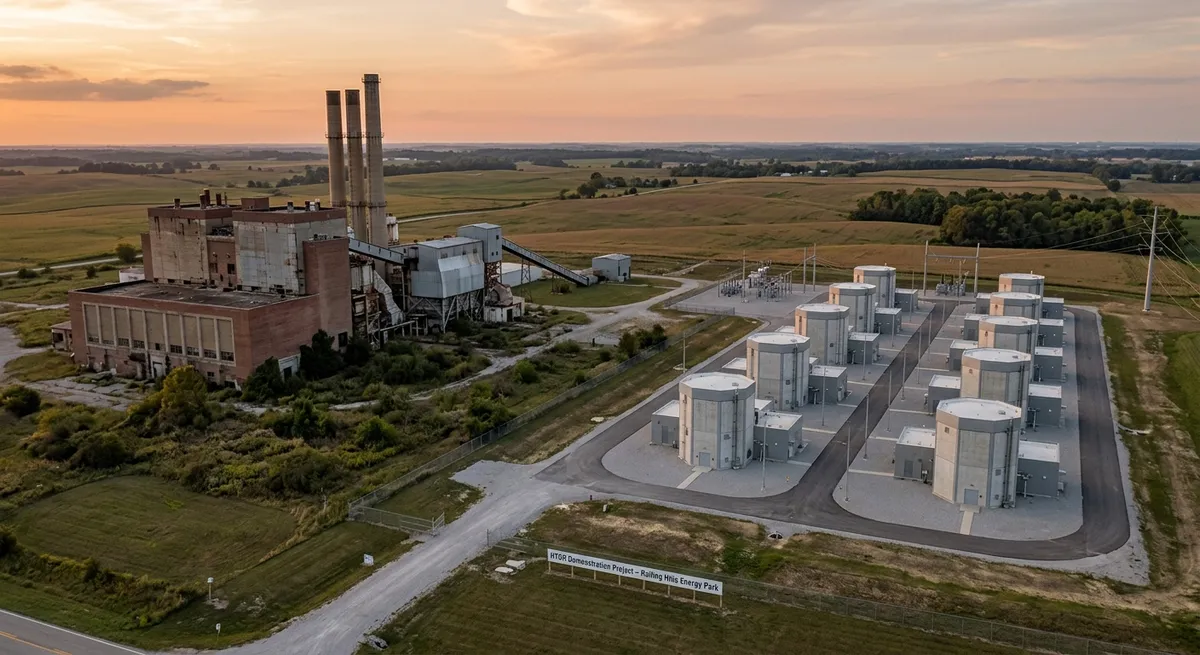
Top line: The Indiana story multiplied a day later. Beside the Amazon–AEP–X-energy joint development agreement announced Oct 19, 2026 to explore a 960-MW Xe-100 project at the former Breed coal plant, Indiana is now considering a separate and far larger project — up to eight Candu units totaling 6 GW — with AtkinsRéalis, the Hoosier Energy rural electric cooperative and the State itself, reported Oct 20. Two more additions: the NRC's own assessment of its first 100 days after a sweeping reorganization, and South Korea's warning that a proposed EU "Made in EU" act could squeeze non-EU countries out of the EU nuclear market even as the Czech Dukovany build stays on schedule. The Philippines item below stands as the day's other debut.
1. Amazon, AEP and X-energy explore a 960-MW Xe-100 plant at a retired Indiana coal site
What happened: On Oct 19, 2026, Amazon, American Electric Power and X-energy announced a joint development agreement to study the feasibility of a nuclear power plant at the former Breed coal-fired plant in Sullivan County, western Indiana. The concept would deploy twelve of X-energy's Xe-100 high-temperature gas-cooled reactors for a combined 960 MW, and would make Indiana home to its first commercial nuclear generation. Details beyond that are minimal — this is an exploration-stage agreement, and nothing has been built, financed, or licensed yet.
What's genuinely new: This is a development of the existing storyline newgen — Big Tech goes to uprates: Amazon × Constellation, Google × Georgia Power, which since its Oct 2 opening has tracked hyperscalers buying nuclear megawatts — Amazon–Constellation at Calvert Cliffs, Google–Georgia Power at Vogtle/Hatch, Google–Constellation across 11 PJM reactors — and whose watch line explicitly asked for "more Amazon-X-energy-style equity moves vs PPA moves," i.e., whether Amazon's next instrument would be a new build with X-energy rather than another output PPA. This is that answer: with AEP (a regulated utility whose service territory includes Indiana and Ohio) as the utility partner, the move is a new-build JDA on a retired coal site rather than an uprate — a coal-to-nuclear siting pattern distinct from everything else in the thread. It also extends the newgen — SMR industrial base: fuel cycle + supply chain stacking storyline, which already carries Amazon's $500M standing investment in X-energy and the TRISO-X fuel facility in Oak Ridge: the Xe-100 now has a named US utility-scale siting effort alongside the UK Generic Design Assessment being tracked in the NRC-overhaul thread.
Watch: Whether the JDA graduates from feasibility study to a concrete step — site control, an NRC construction-permit application, or a power-purchase structure between Amazon and AEP. Also whether AEP seeks the same DOE debt window that financed Vistra's uprate program (Oct 6 entry), and how Indiana — which became an Agreement State per the record's Sep 29 entry — handles its first commercial nuclear siting. Indiana's first-in-state framing will draw stateHOUSE-level coverage worth watching for cost and schedule detail the announcement did not provide.
Links: American Nuclear Society
2. Philippines builds the groundwork for a first nuclear project — 1.2 GW by 2032, 4.8 GW by 2050
What happened: At the World Nuclear Supply Chain conference in Manila, the Philippines' effort to establish the policy, regulatory and commercial foundations for its first nuclear power project was outlined, per reporting published Oct 20, 2026 by World Nuclear News. The stated target is 1.2 GW of nuclear capacity by 2032, with a longer-term ambition of 4.8 GW by 2050. No site, reactor vendor, financing structure, or grid-connection timeline appears in the capture — this is national groundwork, not a reactor procurement announcement.
What's genuinely new: A debut. No prior coverage of Philippine nuclear planning exists in any of the record's atomic threads, which have so far centered on US SMR siting, fuel-cycle consolidation, and allied financing frameworks (Korea–US, Poland). A Southeast Asian first-nuclear program adds a new geography to the new-build queue — and, at 1.2 GW by 2032, an unusually ambitious timeline for a country with no operating regulatory track.
Watch: Which site and technology the policy framework ultimately attaches to, any vendor-selection or financing detail as the "commercial foundations" take shape, and whether the 2032 target survives contact with regulatory-construction timelines seen elsewhere in this record — the NRC's permitted BWRX-300 at Clinch River, approved Sep 29, 2026, marks the pace a mature regulator allows.
Links: World Nuclear News
3. Indiana considers a second nuclear project: up to eight Candu units, 6 GW
What happened: On Oct 20, 2026, per World Nuclear News reporting published that morning (9:54 AM ET), AtkinsRéalis Group, Hoosier Energy Rural Electric Cooperative and the State of Indiana are to explore a potential project of up to eight Candu nuclear power units with a combined capacity of 6 GW. No site, cost, schedule, or offtake details appear in the capture — this is an exploration agreement, not a procurement or construction commitment.
What's genuinely new: A debut. No earlier coverage of a Candu-track Indiana project exists in any of the record's atomic threads, which otherwise carry the Amazon–AEP–X-energy feasibility work at Sullivan County (Oct 19) and the Clinch River buildout. It lands one day after that announcement and involves a different utility model — a rural electric cooperative rather than a regulated utility — so Indiana now has two parallel nuclear exploration efforts, and its first-in-state framing is no longer unique to the X-energy concept. The scale gap is notable: 6 GW of large Candu units versus the 960-MW small-reactor concept.
Watch: Site selection and any state-level endorsement; cost and schedule detail the announcement did not provide; and how Indiana — which became an Agreement State in late September 2026 — handles two competing exploration tracks at once.
Links: World Nuclear News
4. NRC holds its own review of the first 100 days after reorganization
What happened: Roughly 100 days after beginning a massive structural reorganization — including a reorganization around core business lines and the creation of two new offices, the Office of the Chief Nuclear Reactor Inspector and the Office of Advanced Reactors — NRC officials and staff met with the agency's five commissioners on Oct 15, 2026, at the NRC Region IV offices in Arlington, Texas, to assess the successes and challenges resulting from the change, per reporting published Oct 20, 2026 (8:40 AM ET) by the American Nuclear Society.
What's genuinely new: A development of the existing storyline newgen — NRC overhaul watch: breakneck pace meets first pushback, which since Oct 2 has tracked the accelerating deregulatory pace and the oversight responses to it — proposed overhaul rulemaking in mid-September, formal Democratic information requests Sep 28, and a GAO workforce audit Oct 5. The Oct 15 internal assessment adds an on-the-record self-review to that ledger: the first item in the thread in which the NRC itself evaluates the reorganization before its commissioners, rather than outside auditors or legislators.
Watch: What the Oct 15 assessment produces — any staffing, structure or process changes announced afterward — whether the GAO's recommended workforce metrics get adopted, and how the two new offices perform against the record's construction-permit and licensing timelines.
Links: American Nuclear Society
5. South Korea worries an EU "Made in EU" act will wall off EU nuclear projects — as Dukovany stays on schedule
What happened: Per World Nuclear News (published Oct 20, 2026, 7:56 AM ET), progress on the Dukovany new nuclear project is continuing on schedule, but South Korea has raised concerns about the potential impact of the European Union's proposed Industrial Accelerator Act on non-member countries participating in the EU's nuclear power market — the act widely framed as a "Made in EU" push.
What's genuinely new: A debut. No prior coverage in the record's atomic threads addresses EU market-access policy for foreign suppliers, which have so far centered on US SMR siting, fuel-cycle consolidation and allied financing frameworks. It is the same Korean export program the existing newgen — Korea–US nuclear framework: $120B for eight large US reactors storyline tracks, but aimed at a different regulatory arena: whether EU-market participation by non-member countries gets constrained by the act's final language.
Watch: How the act's market-access provisions evolve through the EU legislative process, whether Korean participation terms in EU-member projects change in response, and whether other non-EU nuclear suppliers go on record with similar concerns.
Links: World Nuclear News
Dropped
- ANS (Oct 20, 2026) — the same Indiana CANDU exploration already recorded above (item 3), reporting the MOU among the State of Indiana, Hoosier Energy and Montreal-based AtkinsRéalis for up to eight reactors and up to 6 GW of capacity; no detail beyond what the World Nuclear News item carries.
- ESG Today (Oct 20, 2026) — the same Amazon–AEP–X-energy Indiana announcement already recorded above under the ANS item; no additional detail in its summary.
- American Nuclear Society (Oct 20, 2026) — "Choosing the Right LTO Partner Matters Now More Than Ever": a general explainer on long-term operation programs gaining momentum among US utilities amid rising demand; framing and commentary, with no new deal, uprate or regulatory fact in the summary.
- American Nuclear Society (Oct 20, 2026) — Savannah River Site's Saltstone Disposal Unit 6, the first of seven mega-volume disposal units, has been filled with grouted legacy tank waste per the Department of Energy: a waste-cleanup milestone on the DOE environmental-management side, outside this record's generation threads and separate from the NLIC waste-campus storyline.
- American Nuclear Society (Oct 20, 2026) — a historical piece on Homestake Mining Company's Grants Reclamation Project near Grants and Milan, N.M., tracing the site from the 1950s uranium boom to present-day remediation under multiple regulators; background on a legacy uranium-mill cleanup with no new generation, siting or licensing fact for this record's threads.
- World Nuclear News (Oct 20, 2026) — Aura Energy targets a final investment decision by the end of 2026 for its Tiris uranium project in Mauritania on the strength of a bankable feasibility study, while Deep Yellow says current equity market conditions don't support an FID for its Tumas project in Namibia this quarter: uranium-mining project economics, distinct from the record's enrichment and fuel-fabrication threads.
- Thansettakij (published Oct 20, 2026, ~8:25 PM ET) — a Thai-language commentary column ("Nuclear Safety Compass") retelling the already-recorded Amazon–AEP–X-energy 960-MW SMR project at the former Breed coal site in Indiana as evidence for regulatory-vision and policy proposals aimed at laying groundwork for SMRs in Thailand; opinion and advocacy with no new project fact beyond what the Oct 19 announcement carried (https://www.thansettakij.com/blogs/columnist/nuclear-safety-compass/671878).