Robots digest — Oct 28, 2026
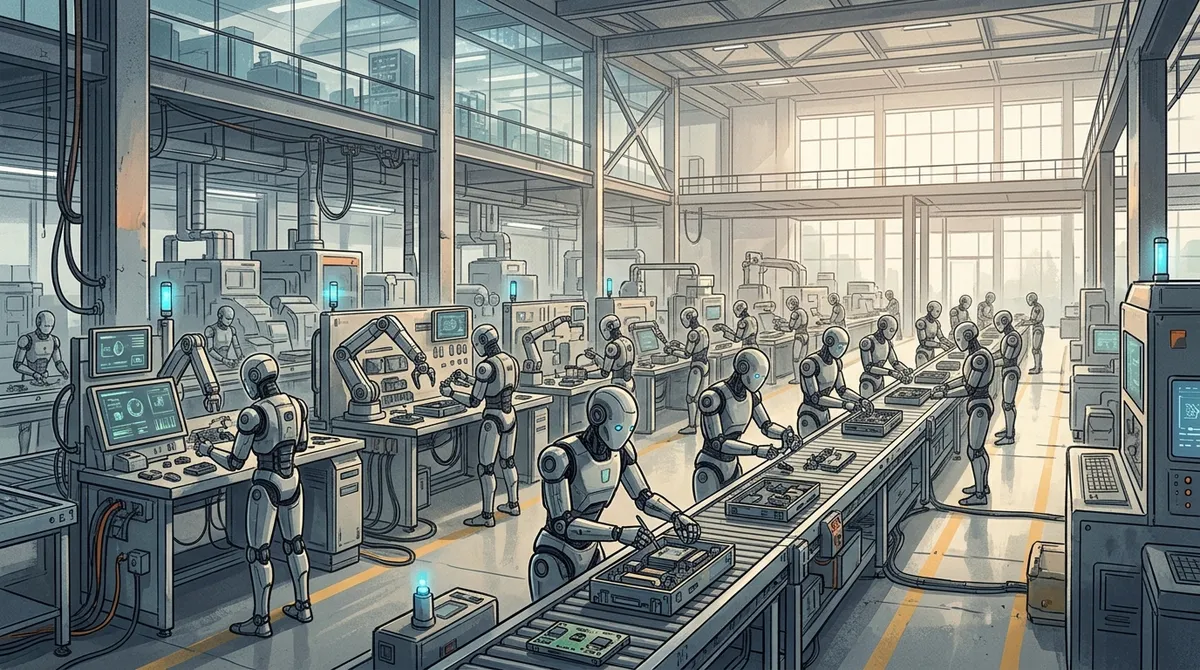
Top line: Shanghai's new smart-manufacturing plan targets 8,000 humanoid robots in local factories by 2028, and North American factories ordered 24.8% more robots in Q3. Unitree's first post-IPO results put growth and profit in tension — revenue up about 70%, profit down 17.4% — while Boston Dynamics employees keep up the protest against a robot-dog sale to ICE and Faraday Future's chairman says its humanoid sourcing is shifting from China to US manufacturing. Elon Musk's Optimus folding-clothes demo came with the admission the robot wasn't operating autonomously, a former Tesla employee calls the expanded Houston Robotaxi map partly "fake," and Amazon workers inside the Tracy, California robotic warehouse describe the machines changing their jobs.
1. Shanghai's action plan targets 8,000 humanoid robots in factories by 2028
What happened: Shanghai has issued a next-generation smart-manufacturing action plan with a concrete deployment target: 8,000 humanoid robots working in the city's factories by 2028, per Yicaiglobal (published October 28, ~4:45 AM ET).
What's genuinely new: A dated municipal quota at real unit scale — 8,000 humanoids inside Shanghai factory walls within two years. The storyline so far has tracked national demand targets and company production lines, not a named city putting a numeric humanoid count on its manufacturing policy.
Watch: How the 8,000 figure is funded and phased, which robot makers and factory tenants fill it, and whether other major manufacturing cities match the quota.
Sources Yicaiglobal
2. A Xiaomi robotic hand built from 1,827 factory SOPs — with China's spy law in tow
What happened: The original reporting behind the syndicated copy is Gasgoo (published October 28): Xiaomi has opted out of the degrees-of-freedom race, where dexterous hands have been a numbers game — 6, 12, 22 DOF, with research versions pushing as high as 42 — and instead built its hand by first watching how real workers work. The syndicated version carried by MSN specifies the recipe as 1,827 actual factory operating procedures rather than academic benchmarks, and argues the security concerns raised by China's state-espionage legislation travel with the hardware.
What's genuinely new: Xiaomi named as a robot-hardware program with a distinctive data recipe — documented human factory procedures as the training source instead of labs or teleoperation — now anchored to its original outlet, which frames the choice as a deliberate rejection of the DOF-spec arms race rather than a spec-sheet entry. A legal-political angle would still complicate any Western deployment of Xiaomi-made robotic hardware.
Watch: Which Xiaomi robot actually carries the hand, independent corroboration of the 1,827-procedure sourcing, and how the spy-law argument interacts with the US import restrictions already aimed at Chinese robots.
3. Toyota's humanoid push turns to commercialization, with supply chain in frame
What happened: A finance-market report (BigGo Finance, October 28, ~4:46 AM ET) frames Toyota's humanoid robot program as gaining traction: Toyota says it will leverage 20 years of robotics R&D to drive commercialization of intelligent robots, and the coverage singles out IKKA-KY's supply-chain position as a beneficiary of that push.
What's genuinely new: The stated intent to move from two decades of R&D into commercialization, beyond the testing-in-Japanese-factories and ¥1T-per-year (~$6.4B) automation budget lines already known — and a named supplier, IKKA-KY, positioned in the program for the first time.
Watch: Which factories host the trials, what "commercialization" turns into in orders or pilot sites, and how much of Toyota's 400,000-robot bet goes to humanoids rather than arms and carts.
Sources BigGo Finance
4. The Manhattan humanoid gets a name: Futurist
What happened: A humanoid robot named Futurist strolled through Manhattan on Tuesday, October 27, drawing a mix of fascination and unease from passersby, per a video report carried on MSN (published October 28, ~4:45 AM ET). In an interview published the same day (~4:50 PM ET), Robotics & Automation News has Faraday Future — best known as an electric-vehicle company — positioning robotics as a growing part of the business and moving from Chinese robot sourcing toward US-based manufacturing, while companion MSN coverage (~4:50 PM ET) of the weekend New York promotion prices the machine at $90,000.
What's genuinely new: The company-level strategy behind the roadshow robot — a chairman interview stating the shift from Chinese robot sourcing to US manufacturing, and a second reported price point ($90,000) beside the $89,000 figure from the October 25 Brooklyn Bridge Park debut. The machine is running a visible public-roadshow pattern rather than a factory or warehouse deployment.
Watch: Whether the sourcing shift produces named US plants, suppliers, or dates, any named deployment or customer behind the public outings, and investor-day disclosures from the company's newly listed robotics unit.
Sources MSN Robotics & Automation News MSN
5. Neo1: China's 13-foot humanoid, billed to lift 500 kg, gets its explainer
What happened: Moneycontrol (published October 28, ~4:46 AM ET) examines Neo1, China's 13-foot humanoid robot from maker NeodraDynam, developed for heavy industrial work and billed with a 500 kg (≈1,100 lb) lifting capacity — a machine drawing Transformers comparisons, with the piece walking through how the giant robot works.
What's genuinely new: A specific model name and headline spec for a giant humanoid previously known only by its maker — Neo1 at 13 feet with a stated 500 kg lift aimed at heavy industrial jobs, a scale-and-task profile no humanoid in the current field carries.
Watch: Independent verification of the 500 kg lift, any named customer, factory, or deployment behind the machine, and video evidence of real work against the stated specs.
Sources Moneycontrol
6. Workers inside Amazon's Tracy, California robotic warehouse tell it themselves
Thread: robots — Amazon: one million warehouse robots, ~1.5 million workers · continuing
What happened: Business Insider (published October 28, ~8:48 AM ET) takes readers inside Amazon's robotic warehouse in Tracy, California, where workers describe in their own words how the machine fleet is transforming their jobs. A same-day companion (International Business Times UK, published October 28, ~12:54 PM ET) carries the management side of the same story: an Amazon manager asked whether the robots could eventually replace warehouse jobs — including his own — with the piece answering "who knows?" while robots handle the repetitive tasks and workers move into technical roles.
What's genuinely new: First first-hand accounts from a named site, on the floor and now at management level. Earlier coverage of Amazon's million-robot fleet held the fleet-versus-worker benchmark, the injury-safety scrutiny, and analyst margin commentary, but not the people inside a specific warehouse describing what the change feels like — nor a manager musing about his own replacement.
Watch: Whether the Tracy accounts turn into staffing or pace-of-work changes at the site, whether other Amazon locations speak up, and whether the safety questions raised in October get concrete answers.
Sources Business Insider International Business Times UK
7. XPeng's IRON gets its battery milestone: solid-state cells off the line in small batches
What happened: At the 2026 Embodied Intelligence Robot Conference on October 28, XPeng Group vice president Gu Jie said the solid-state battery designed for the IRON humanoid has begun rolling off the production line in small batches, with scale manufacturing targeted by year-end, per BigGo Finance (~8:47 AM ET) and CnEVPost (~5:11 AM ET). The robot itself remains in pre-production.
What's genuinely new: The battery component now has its own production milestone and a dated scale target, named to a specific executive at a specific conference — previous coverage had the robot's Guangzhou line commissioned and mass production promised for end-2026, but no separate status for the energy side. A small-batch battery line is not scale manufacturing, and the year-end battery target plus the year-end mass-production promise are now two dated claims to test against the calendar.
Watch: Whether battery scale manufacturing actually lands by December 31, whether the IRON mass-production promise holds with the battery supply in view, and IRON's first external deployment.
Sources BigGo Finance CnEVPost
8. Unitree's first post-IPO results: revenue up about 70%, profit down 17.4%
Thread: robots — Unitree: the reported $6.2B IPO pursuit · continuing
What happened: Unitree's first results since going public show quarterly revenue surging about 70% while profit fell 17.4%, per RobotsBeat (published October 28, ~11:09 AM ET), with the earnings squeeze attributed to a jump in spending on embodied-AI models, computing and research staff.
What's genuinely new: Unitree's first earnings print since its IPO — the growth-versus-profitability tension now measurable in numbers: sales up about 70%, quarterly profit down 17.4%, and the AI-heavy R&D bill named as the cause rather than left as an open question.
Watch: Whether the R&D-heavy spending converts into shipment growth and capability gains, whether the profit slide reverses in the next quarterly print, and any disclosure of humanoid unit volumes.
Sources RobotsBeat
9. A former Tesla employee rides the expanded Houston Robotaxi map and calls it partly "fake"
Thread: robots — Cybercab rollout under federal audit (NHTSA FMVSS self-certification) · continuing
What happened: Tesla's rocket-shaped Houston service-area expansion includes downtown blocks where the service won't actually pick riders up, according to Ethan McKanna, creator of Robotaxi Tracker and a former Tesla employee, per Electrek (published October 28, ~11:18 AM ET). McKanna rode the service after the October 26 expansion and called Houston "by far the most egregious 'fake' AV service area" he had seen; one trip quote had him spending about 40 minutes in a Robotaxi to go two blocks.
What's genuinely new: The first named, first-hand account challenging the functionality of the expansion map — a direct contradiction of the geofence-growth framing, from a tracker creator with an inside history at Tesla. Earlier coverage of the Houston rollout carried expansions and fleet numbers; this carries a documentable map-versus-service discrepancy.
Watch: Whether Tesla revises the Houston pickup map or the app's service boundaries, rider reports from inside the areas that do work, and whether the discrepancy draws any regulator attention.
Sources Electrek
10. Musk shows Optimus folding clothes — with the admission it wasn't autonomous
Thread: robots — Tesla Optimus: production starts, on-brand hype gap · continuing
What happened: Coverage carried by MSN (published October 28, ~12:56 PM ET) re-sets Elon Musk's Optimus folding-clothes demonstration beside his admission that the robot was not operating autonomously while doing it, and compares the clip with Figure AI — the OpenAI-, Nvidia-, Microsoft- and Jeff Bezos-backed startup — demonstrating a humanoid responding to spoken instructions.
What's genuinely new: The non-autonomy admission attached to a specific household-task demo — a one-line statement of the demo-versus-capability gap in Tesla's humanoid story, landing days after the company said initial Optimus mass production had begun at Fremont and put outside customer deliveries around late 2027.
Watch: Whether Tesla shows an autonomous version of the folding-clothes task, and how the demo-gap framing weighs on the late-2027 outside-customer timeline.
Sources MSN
11. Boston Dynamics employees keep up the protest over a robot-dog sale to ICE
Thread: robots — Boston Dynamics: the employee petition to block a robot-dog sale to ICE · continuing
What happened: The controversy began in late August, when reports said US Immigration and Customs Enforcement planned to spend up to $2 million on Spot robot devices made by Boston Dynamics, per CNET (published October 28, ~4:49 PM ET) — against which hundreds of Boston Dynamics employees have signed a petition calling for the sale's halt.
What's genuinely new: A dollar figure and a start date for the dispute — the $2 million ICE procurement plan from late August — behind the employee petition reported October 26.
Watch: Whether the sale halts or proceeds, the company's response, and the petition's final size.
Sources CNET
12. North American robot orders climb 24.8% in Q3, with automotive components nearly doubling
What happened: Robot orders in North America climbed 24.8% year over year in the third quarter of 2026, per A3 data reported by The Robot Report (published October 28, ~2:59 PM ET). Demand from automotive component manufacturers nearly doubled in the quarter, with other sectors posting strong gains.
What's genuinely new: Current-quarter order data with a headline rate — 24.8% growth — and a named driver: automotive component makers, whose orders nearly doubled in Q3.
Watch: Whether Q4 data sustains the pace, which non-automotive sectors are contributing, and whether order growth converts into installations.
Sources The Robot Report
13. Google's Gemini Robotics ER 2 enters a cloud public preview
What happened: Google has opened Gemini Robotics ER 2 to enterprise users in a public preview on Google Cloud, focused on robot task planning and collaboration, per eWeek (published October 28, ~4:53 PM ET).
What's genuinely new: A public — announced, not final — preview of a Gemini Robotics model as a cloud product for enterprise users, extending DeepMind's robotics work from research demonstrations into an offering developers can sign up for.
Watch: Enterprise adoption during the preview, which robot platforms integrate ER 2, and when the preview leaves public-preview status.
Sources eWeek
Brief
- An executive at BlackBerry says the company sees QNX software growth where industrial robots are actually deployed and is betting on "software-defined factories" beyond automotive (MSN).
- Reporting details a Cybercab battery-pack design choice: Tesla built the pack with spare room for a future switch to cheaper LFP cells, framed as a path to even lower robotaxi costs (Teslarati).
- Xinhua reports Shenzhen's humanoid-robot production surged 83.1% year on year in 2025, with the city's robotics sector pushing embodied-AI robots into real-world use (Xinhua).
- Intel and SAP ran a demonstration in China of an "open robotics architecture" for physical AI, pitching open choice across robotic systems and deployments (SDxCentral).
- A video shows Unitree's G1 humanoid climbing ladders, vaulting obstacles and recovering from falls on a single learned control policy from ETH Zurich (Yahoo).
- Curabotics has entered a national contract with Capstone Health Alliance, bringing healthcare robotics and automation to hundreds of hospitals — vendor press-release grade (Business Insider Markets).
- A survey of 250 supply-chain leaders commissioned by warehouse-robotics maker Exotec finds 25% regret their warehouse-automation decision and 94% say switching would be prohibitively expensive (Yahoo Finance).
- ANYbotics has started shipping ANYmal X quadrupeds for inspection of explosive industrial sites, with RobotsBeat naming Equinor and DSM-Firmenich among the customers receiving the robots.
- BMW and Embotech report their in-plant driverless-vehicle system has passed one million autonomous moves — about 3,500 vehicle movements a day across four European factories — with the Spartanburg plant scheduled to follow in 2027 (RobotsBeat).
- Wonder is expanding Avride's Grubhub robot delivery to Jersey City, Hoboken, Arlington County and Philadelphia, adding dozens of participating merchants (RobotsBeat).
- Foundry Robotics raised a $100 million Series A led by Marlinspike Partners to expand a 130,000-square-foot Emeryville factory for AI-powered hardware assembly (RobotsBeat).
- Crunchbase puts Q3 robotics startup funding at $9.9 billion, up roughly 185% across January–September, with China and the United States leading (RobotsBeat).
- Bedrock Robotics targets a triple-digit fleet of autonomous construction machines working in 2027 as it expands field operations and explores further heavy-equipment uses (RobotsBeat).
- Syndicated coverage adds specs to Realbotix's Echo humanoid line launched October 26: ultra-realistic silicone skin, 39 degrees of freedom, and a $60,000 price for the flagship (MSN).
- Researchers at Binghamton University demonstrated robot safety-testing in action: coverage showing an AI-driven robot stabbing a fake human hand to make the hidden-failure-mode point (Fox News).
- Warp Sciences, a robotics startup for automated drug research with co-founders from OpenAI and Meta, emerged from stealth with funding to build US infrastructure for automated drug discovery (The Robot Report).
- Majority staff of the House Education and Workforce Committee visited Agility Robotics' RoboFab factory in Salem, Oregon on October 28 for a look at how the company builds its American-made humanoid and how customers use Digit (Agility Robotics on X).
- Agility Robotics says its senior director of robotics safety, Kevin Reese, is project leader of ISO 25785-1, a safety standard under development for dynamically stable industrial mobile robots (Agility Robotics on X).