Space digest — Oct 15, 2026
Top line: The lead stands — Arianespace has drawn the next date on the Amazon Leo supply line: the tenth Ariane 6 flight is set for November 23 at the earliest, carrying 36 new Amazon Leo satellites from Kourou, with a companion report adding that the 36 satellites are already stacked. Beyond it, the window adds seven genuine facts: the Neutron selloff got its full-session print (Yahoo Finance puts RKLB down 13% at $51.42 at the October 15 close, tempering the overnight −14.8% premarket flash recorded earlier in the day), with the day's first named analyst repricing stacked on top (Motley Fool reports the intraday plunge reached ~16% and KeyBanc cut its RKLB target to $100 from $135) — plus a later Yahoo round-up carrying a conflicting lower print (down 6.64%/~7%, ~8:20 PM ET October 15) and a second Motley Fool analysis tying management's positive adjusted-EBITDA schedule to Neutron's first flight; Starfish Space's Otter Pup 2 now regularly operating fully autonomously ~200 m from Gilmour Space's ElaraSat in close proximity operations; NSF's report of S43.1's crumpled nosecone tip during Massey's testing; evening NSF ops putting Booster 23 through cryo testing at Massey's with a hedged float that it could be the booster headed to pad 39A; NASA's own post-flight confirmation that the Artemis II Orion heat shield performed as expected through its Mach 39 reentry (694,481 miles around the Moon); and United's tracking site showing Starlink connectivity on 48% of the airline's departures — plus a single low-tier blog claim that the SpaceX–Nvidia "Star Mind" space-grade AI computer is targeted for volume production in 2027, held unverified. The conflicting Investor's Business Daily account of the Neutron delay (an engine rupture during a January test, target rendered only as "Q4") remains unverified against the official 2027 record, Florida Today's Cape-side Starship timeline stands, and the rest of the window is same-day echo: a Rocket Lab syndication wall, single-aggregator Tesla–SpaceX merger chatter, Starshield and moon-landing explainers, the Boca Chica PEIS recirculating, a classified Space Force Falcon launch watch item, and site-ops visuals. The Brief also logs a NASA moon-base conversation and the CRS-35 Dragon docking.
- Ariane 6 draws its next date: 36 more Amazon Leo satellites, November 23 at the earliest
- NASA confirms the Artemis II heat shield "performed as expected" — Mach 39 reentry verified post-flight
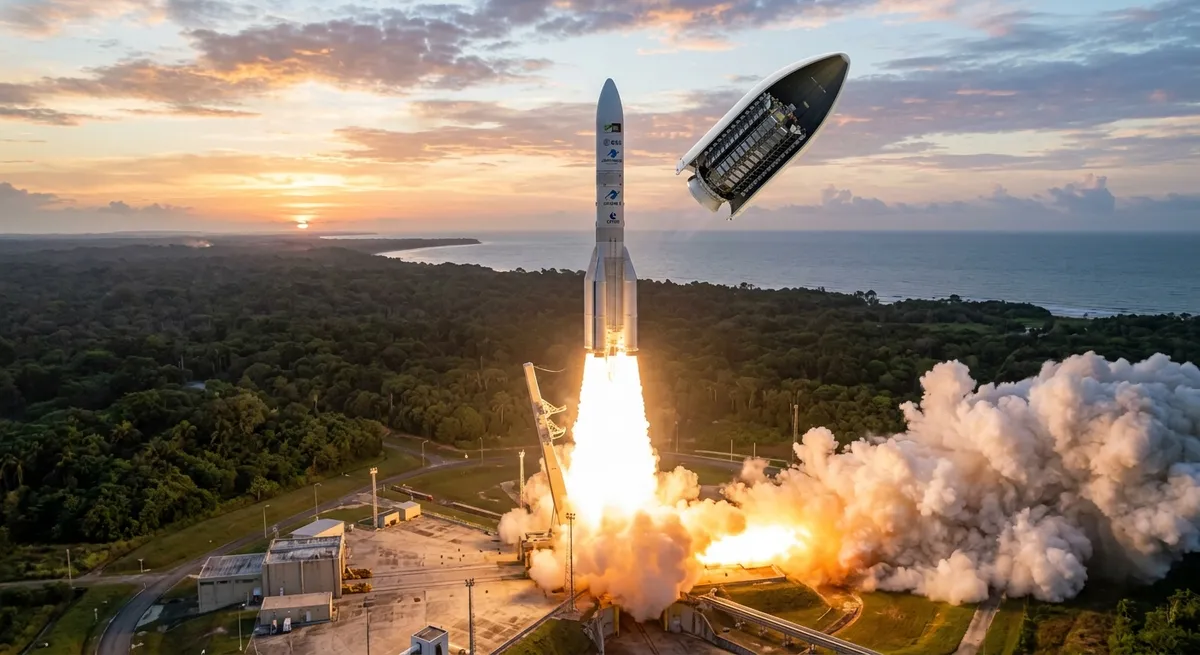
Ariane 6 draws its next date: 36 more Amazon Leo satellites, November 23 at the earliest
Sources MSN (fr) telesatellite.com (fr)
What happened: A French-language report (MSN syndication, published ~12:20 AM ET October 15) says Arianespace has set the tenth Ariane 6 flight for November 23 at the earliest. Launching from Kourou, the European launcher will carry 36 new Amazon Leo satellites. A companion French report (telesatellite.com, same minute, naming the mission LE-04) adds that the 36 satellites are already stacked on the vehicle.
What's genuinely new: The date. This is a development of the space — Amazon Leo: Ariane 6 consolidation + India market entry thread (open since 2026-09-09), where prior coverage placed the next Ariane 6 Leo flight only "on the horizon." The thread's supply-side cadence — 24+ launches ordered on availability grounds, with 100 Leo satellites already placed across three Ariane 64 launches as of mid-September — now has its next scheduled launch event, hedged ("au plus tôt"), with integration already underway.
Watch: Whether the November 23 target holds, whether the in-orbit count moves materially past the ~400 recorded in October, and the still-open service-start conflict on the demand side of the thread (the ledgered 2026 target versus coverage framing Leo's launch "by 2027").
NASA confirms the Artemis II heat shield "performed as expected" — Mach 39 reentry verified post-flight
Sources NASA Artemis statement (Foust RT) NASA Artemis II heat-shield image
What happened: NASA's post-flight analysis (relay by Jeff Foust, ~11:04 AM ET October 15) confirms the Artemis II Orion heat shield performed as expected during its Mach 39 reentry, protecting the spacecraft and the astronauts aboard as they returned from the 694,481-mile journey around the Moon. In the same hour (~10:48–10:59 AM ET October 15), NASA released the recovered heat shield's post-inspection imagery, with NSF-side commentary setting it against Artemis I's shield — "the improvements on Artemis II really are visible."
What's genuinely new: the agency's own quantified post-flight statement. The Artemis hardware record already carried ASAP-side validation of the heat-shield mitigation; this is NASA's confirmation with reentry metrics, closing the loop on the fix that carried Artemis II's lunar flyby. A development of the space — Artemis hardware cadence: II fix validated, III stacking, IV flow thread, not a new storyline.
Watch: whether the reworked, vent-capable Avcoat debuts on Artemis III as planned next year, and whether the ESA-recorded "late 2027" Artemis III window holds.
Brief
- The Neutron slip prices in at session close: Yahoo Finance (~12:21 PM ET October 15) puts RKLB down 13% at $51.42 on October 15 as the market digests the 2027 Neutron delay, against the overnight premarket prints — a KuCoin News flash carrying HuoXing Finance had it down 14.8% (~12:20 AM ET October 15). Yahoo names the trigger as small air pockets between carbon-fiber layers in a forward propellant dome, with the manufacturing process since changed — consistent with the carbon-fiber dome cause already on the ledger under space — Rocket Lab × Iridium: the ~$8B combination; no new technical fact beyond the October 14 record. Yahoo's own later "Stock Market Today" round-up (~8:20 PM ET October 15) carries a conflicting lower quantification — down 6.64% (headline: ~7%) on the delay — leaving the outlet's accounts of the day's cumulative loss unreconciled; no new fact either way. Link · KuCoin flash · Yahoo Stock Market Today
- A second — and conflicting — account of the Neutron delay: Investor's Business Daily (published ~12:20 AM ET October 15) says the launch target was pushed after an engine ruptured during a January test, and renders the new target timeline only as "Q4." That runs against the ledgered record under space — Rocket Lab × Iridium: the ~$8B combination — carbon-fiber dome lay-up issues since addressed, first flight officially 2027, and Q1 2027 targeted to finish and qualify first-stage tank structures. Single-source, and its "Q4" framing is inconsistent with the 2027 first-flight record (it may reflect an earlier stage of the delay history); treat as an unverified secondary account pending Rocket Lab on-record reconciliation. Link
- First in-record Cape-side launch timeline: Florida Today (published ~12:20 AM ET October 15) reports Starship could launch from Florida before the end of the year as pads, facilities and hardware progress at Kennedy Space Center — a development of the space — Starship cadence: Starbase + Cape pad race thread, whose launch-side coverage to date has tracked Starbase, Texas operations and the Boca Chica PEIS. Watch: whether the end-of-year window holds and what regulatory steps are named for the Cape. Link
- United's Starlink share approaches half of departures: PCMag (~12:20 PM ET October 15) reports 48% of United Airlines departures now feature Starlink connectivity, per a reading of the airline's own tracking site (published Wednesday, October 14; the summary capture truncates the second figure, leaving only the 48% outbound share). A development of the aviation leg under space — SpaceX as a US carrier: Starlink Mobile gets FCC clearance — the install ramp that thread tracked is now being measured day-to-day by United's site. Watch: fleet-wide completion pace against the aviation Wi-Fi targets already on the record. Link
- NASA's moon-base planning, from inside the agency: SpaceNews (~11:14 AM ET October 15) publishes Mike Gruss's conversation with Shatel Bhakta, NASA's principal systems engineer for Moon Base, on what's needed between now and 2028 and the incremental steps in between — a development of the moon-base/surface-logistics layer under the Artemis record rather than a new dated commitment; no specific 2028 milestone named in the reporting. Link
- CRS-35 Dragon docked with the ISS: NSF (~10:11 AM ET October 15) tracked the Dragon's final approach — "Draco thrusters dancing to fine-tune the approach" — and confirms docking complete (~10:28 AM ET). No open thread on file; a standalone cargo-ops event for the record. Link
- KeyBanc reprices the Neutron slip; the intraday plunge reached ~16%: The Motley Fool (~4:20 PM ET October 15) reports RKLB plummeted as much as 16% on October 15 as the Neutron delay was digested, and KeyBanc cut its RKLB price target to $100 from $135, maintaining an overweight rating — the window's first named analyst move against the 2027 first-flight record. Consistent with the session close in the first bullet above (−13% at $51.42); no new technical fact. Link
- The delay's financial frame: EBITDA and the 65%-off math: Motley Fool (~8:20 PM ET October 15) prices the slip's downstream stakes — management's schedule for positive adjusted EBITDA hinges on that first Neutron launch, with the analysis asking whether the sell-off has priced in the wait for a stock trading ~65% below its record. Analytic context rather than a company statement or named-analyst move; joins the KeyBanc repricing on the Neutron market wall under space — Rocket Lab × Iridium: the ~$8B combination. Link
- Starfish's Otter Pup 2: autonomous close-proximity operations at ~200 m: NSF RT of Starfish Space (~1:17 PM ET October 15): Otter Pup 2 is "now regularly operating" fully autonomously roughly "two football fields" (~200 m) from Gilmour Space's ElaraSat, conducting close proximity operations around it and capturing images from 200 m that it uses to track and predict ElaraSat's position and orientation on an ongoing basis, with the company saying it is "not done getting closer." Single-source company post; the servicing lane's first proximity milestone in the record since the full-scale Otter rode Transporter-18 (October 1). Link
- S43.1 shows test damage at Massey's: NSF (~2:17 PM ET October 15) reports S43.1's nosecone tip appears slightly crumpled during testing at Massey's — it is currently unclear when the damage occurred or how it will affect the test tank's remaining tests. Starbase ops color under the pad-race thread; no programmatic delta beyond the damage itself. Link
- Starbase evening ops, with a Cape float on Booster 23: NSF (~5:17 PM ET October 15): "Starship Flight 16: Booster 23 with a bellyful of cryo at Massey's. This could be the booster that goes to 39A!" — the first in-record linkage of a specific booster to the Florida pad, hedged and single-source, with a relay confirming the cryogenic testing in progress five minutes later. Same evening: a Ship completed its return journey joining three future flight vehicles inside Mega Bay 2 (~6:00 PM ET), and one of the Starbase Gigabay bridge cranes was lifted for installation (~7:00 PM ET). Ops color under space — Starship cadence: Starbase + Cape pad race; no programmatic commitment in any capture. Booster 23 at Massey's · cryo-test relay · Mega Bay 2 · Gigabay crane lift
- "Star Mind" gets a production date — from a single blog: basenor.com (~4:20 PM ET October 15) claims Elon Musk confirmed — the article dates the confirmation to Wednesday, October 14 — that Star Mind, the space-grade AI computer co-engineered by SpaceX and Nvidia, is targeted for volume production in 2027. The program's first in-record appearance under a product name with a production date; a mid/low-tier blog source with no primary Musk statement, SpaceX or Nvidia acknowledgment in the reporting — treat as an announced-claim, unverified against the Starmind lineage's pressroom gap, not ledger-grade. Link