Energy digest — Nov 3, 2026
Top line: Russia has agreed to work with Ghana on the country's first nuclear power plant, with a 2,000-MW project among the announced commitments. Urenco USA produced its first commercial cylinder of LEU+, billed as a Western-world first, and Bruce Power began revamping its fifth unit. Fusion funding figures, Israel's fusion strategy and Japan's industry-government push join Brief.
Russia agrees to work with Ghana on its first nuclear power plant
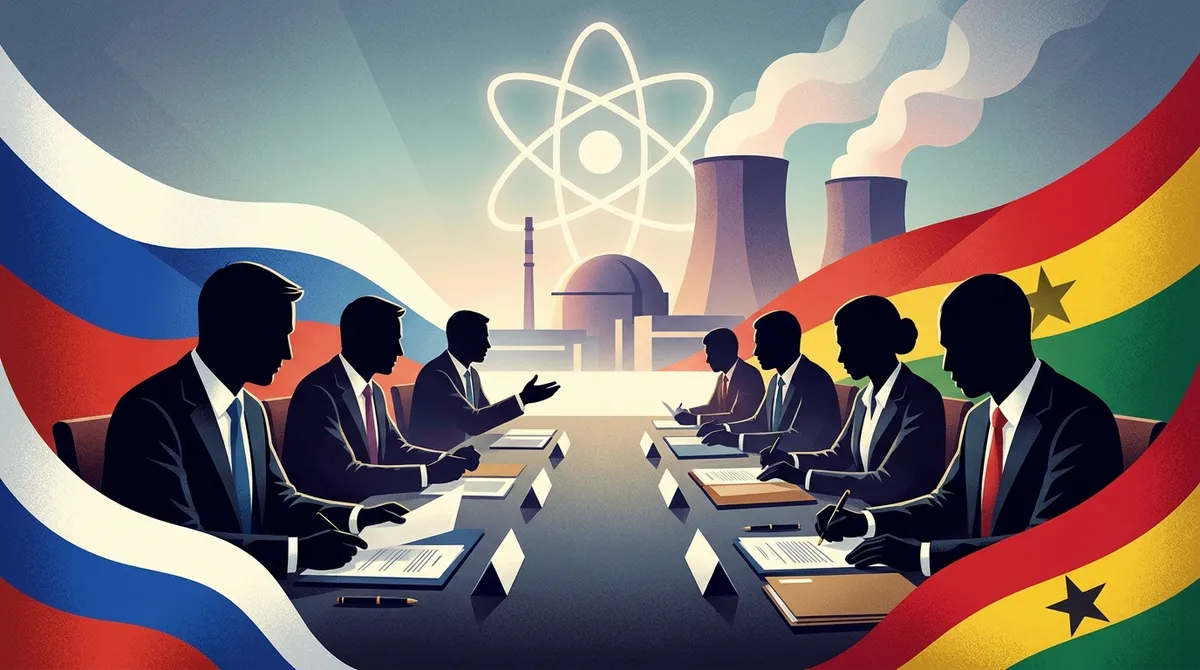
What happened: Ghanaian Foreign Minister Samuel Okudzeto Ablakwa announced that Ghana has secured "concrete commitments" with Russia on cooperation toward the country's first nuclear power plant, including plans to build a 2,000-MW plant (American Nuclear Society).
What's genuinely new: Ghana's first nuclear power plant moves from historical aspiration — President Kwame Nkrumah considered nuclear energy in the 1960s — to a stated cooperation commitment with Russia, and Russia's African civil-nuclear push gains a West African country at the power-plant stage, alongside its work in East and Southern Africa.
Watch: the vendor, financing and contract terms behind the commitments; whether the 2,000-MW plan firms into signed agreements; site and technology selection.
Links: American Nuclear Society · Nov 3, 2:54 PM ET
Brief
- Wedbush analysts set an Outperform rating and a $36 price target on Oklo and an Outperform rating with an $18 target on Nano Nuclear Energy, citing surging AI data-center power demand as the driver of the bull case for advanced-reactor developers; the firm rated NuScale Power Underperform with a $5 target, pointing to a lack of funded reactor projects (Stocktwits).
- Urenco USA has produced its first cylinder of LEU+, which the company calls the first commercial production of the material in the Western world and the start of a new era of fuel options (World Nuclear News).
- German and Japanese fusion organizations announced several new cooperation agreements coinciding with a German–Japanese joint declaration on advanced technology — including collaboration on stellarator and laser-based fusion — issued during Chancellor Friedrich Merz's visit last week to Prime Minister Sanae Takaichi (American Nuclear Society).
- Federal R&D money for fusion took shape at $389 million across four companies under Commerce Department letters of intent, including $175 million for Helion Energy and $85 million for Commonwealth Fusion Systems, aimed at advancing domestic semiconductor innovation, critical supply chains, and commercial fusion technologies (Reuters).
- The Department of Energy announced $8.5 million in awards across 28 projects under its INFUSE program, which gives fusion companies access to capabilities at US universities and national laboratories to help them overcome scientific and technological hurdles (American Nuclear Society).
- Israel's Ministry of Energy and Infrastructure released a strategy outlining three investment pathways for a domestic fusion industry, with proposed funding ranging from NIS 50 million to NIS 2 billion — roughly US$15 million to US$600 million — over five to ten years, focused on expanding research, building infrastructure, public–private partnerships, and strengthening Israel's role in the global fusion supply chain (Jerusalem Post, Fusion Industry Association).
- Japan's government reaffirmed support for private-sector fusion commercialization, with Deputy Chief Cabinet Secretary Yusuke Nakanishi citing the goal of demonstrating fusion electricity generation in the 2030s during a meeting at the Prime Minister's office (NHK); separately, the Fusion Industry Association and the Japan Fusion Energy Council announced a partnership in Tokyo to strengthen global collaboration as Japan pushes for commercial fusion deployment by the 2030s (Fusion Industry Association).
- Brookhaven National Laboratory, working with other US Department of Energy facilities and AI hardware start-up Great Sky, has produced a superconducting chip designed to monitor fusion plasma in real time (Scientific American).
- Bruce Power took Bruce 5 off-line on November 1 to begin its Major Component Replacement outage, the fourth unit refurbished under the plan to renew six of the eight units at the Ontario site (World Nuclear News).
- Saltfoss, developer of a molten salt power barge, has notified the US Nuclear Regulatory Commission of its intent to begin pre-application engagement toward US licensing for the floating plant (World Nuclear News).
- On October 26, Wyoming Gov. Mark Gordon and the Federal Permitting Improvement Steering Council's executive director signed a memorandum of understanding to bring the state's infrastructure projects — including uranium mining — under the expedited permitting requirements of FAST-41 (American Nuclear Society).
- Rosatom says a site has been selected and design work under way for a nuclear processing plant with a capacity of 11,000 tonnes of uranium oxide per year (World Nuclear News).
- Turkey and South Korea agreed on a framework to evaluate potential cooperation on financing nuclear power projects, among several energy initiatives between the two governments (World Nuclear News).
- The VTT Technical Research Centre of Finland and the Singapore Nuclear Research and Safety Institute signed a five-year memorandum of understanding on nuclear safety cooperation and building capability to assess emerging nuclear technologies (World Nuclear News).