Space digest — Nov 5, 2026
Top line: NASA has committed in writing to an Artemis III Earth-orbit rehearsal in 2027 and a 2028 Moon landing, and announced a new X-70 research aircraft meant to fly before late 2028. Separately, researchers found the Artemis II launch disturbed the ionosphere enough to cause GPS errors of several meters.
- NASA puts the accelerated Artemis plan in print: 2027 test flight, 2028 landing
- NASA's next X-plane: the X-70 Fractal
NASA puts the accelerated Artemis plan in print: 2027 test flight, 2028 landing
Sources Mirage News Primetimer
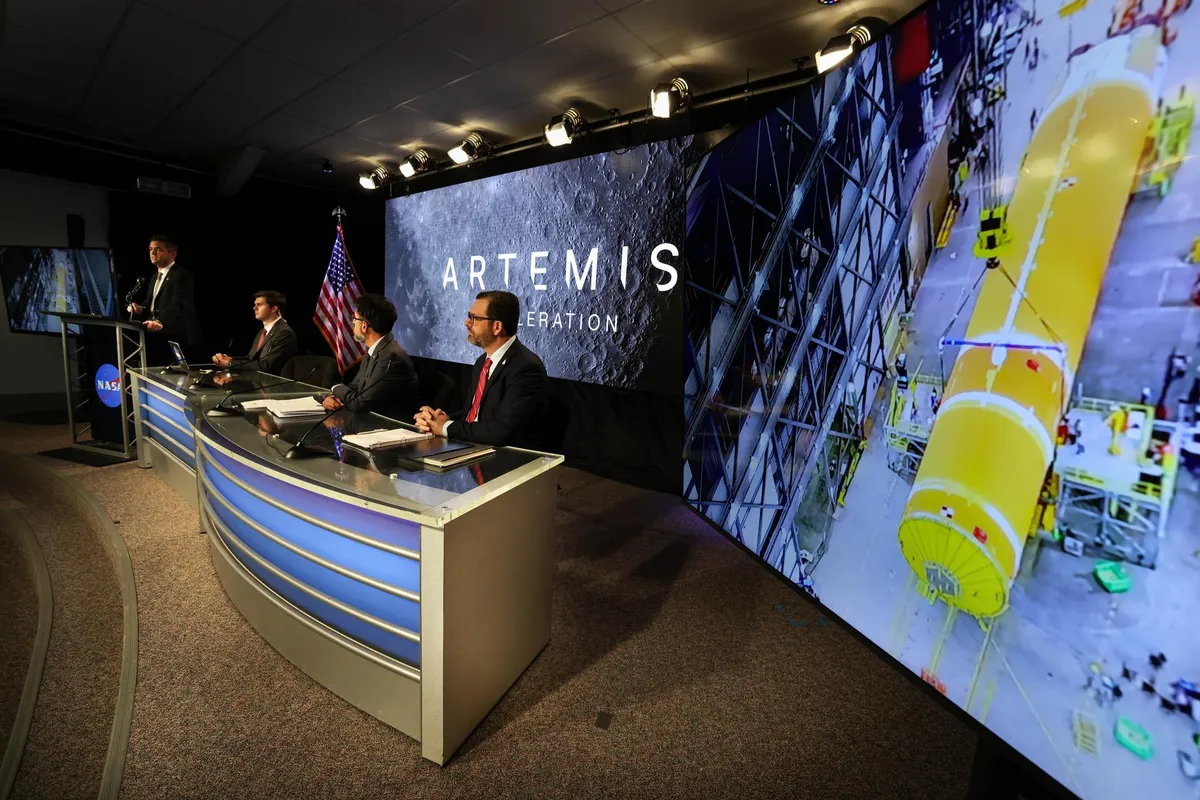
What happened: NASA detailed its accelerated path back to the Moon in an October 23 update: Artemis III flies in 2027 as a planned 14-day Earth-orbit mission in which four astronauts aboard Orion, launched on the SLS rocket, dock with test articles of both SpaceX's Starship lander and Blue Origin's Blue Moon; Artemis IV in 2028 carries the first Moon landing, with both companies targeting the ability to support a crewed lunar landing that year. NASA is also developing a lighter "Sortie suit" with Axiom Space — roughly half the weight of its primary suit — for the first moonwalks.
What's genuinely new: the agency's own release confirms the targets previously relayed from the briefing and adds specifics: a critical fuel-line component redesigned, built and tested in-house in five months at roughly a tenth of an outside vendor's cost estimate; Artemis III processing timelines cut by about half; and both SLS upper-stage options — the current stage and a stretched Centaur V — kept in development to avoid a single point of dependency.
Watch: whether the 2027 rehearsal and 2028 landing dates hold against the remaining hardware flow, and how the two lander designs fare in the Earth-orbit tests that precede the landing selection.
NASA's next X-plane: the X-70 Fractal
What happened: NASA announced its next X-plane, the X-70 Fractal — a crewed research aircraft teased by Administrator Jared Isaacman ahead of the announcement. Per the programme readout relayed by NASASpaceflight, the aircraft has roughly a 4.5-tonne take-off weight, Mach 0.75 cruise speed, a 45,000 ft altitude ceiling and 1,500+ nautical miles of range, and is expected to fly for the agency before November 2028.
What's genuinely new: the aircraft's existence, name and full specification are first made public: "rapidly reconfigurable flight-control technology" that NASA says will let it "explore aircraft manoeuvrability in ways never before demonstrated in crewed flight", plus up to 900 kg of experimental payloads in internal and external positions. The only image released so far is AI-generated.
Watch: a real photograph or render from NASA, a flight-test schedule, and any Isaacman elaboration on the programme's goals.
Links: NASASpaceflight (X) · Nov 4, 9:19 PM ET
Brief
- Researchers at National Cheng Kung University in Taiwan traced the Artemis II SLS launch's wake through the ionosphere using ground-based GPS networks, per Space.com via UA.News: electron-density shifts equivalent to positioning errors of several meters, two disturbance zones stretching some 5,000 km across the continent, the strongest effects from upper-stage engine firings at around 185 km altitude — and disturbances up to ten times more intense than those measured after Starship test launches despite roughly half the launch thrust. The study is a preprint in Geophysical Research Letters.
- Starship ground work continues on both coasts, per NASASpaceflight (X) and NASASpaceflight (X): the Pad 39A tower chopsticks in Florida were exercised with the first Starship launch from the Space Coast — Flight 16 — as the target, while deluge testing pressed ahead at Starbase toward Flight 15.
- A Motley Fool comparison via AOL of Rocket Lab's and Intuitive Machines' quarterly revenue credits Rocket Lab with completing its 99th Electron flight and finalizing its largest commercial Electron launch contract to date — 20 launches — alongside the shareholder-approved Iridium acquisition and the shifted Neutron schedule.
- A Scoop opinion column argues Rocket Lab is now integral to US space militarisation, citing its August onboarding to the US Space Force's $981M NITE-STAR test-and-training program, a $190M contract for 20 HASTE hypersonic test flights with the Naval Surface Warfare Center Crane Division, and — attributed to a Defense News report — a September 15 Pentagon announcement that it now holds offensive capability in orbit. The column is openly activist in framing; the underlying items are its own tally rather than independently verified reporting here.
- The Government of Canada has appointed Alexander MacDonald president of the Canadian Space Agency (relayed by Jeff Foust), joining November 16, 2026.