Data-center backlash: the polling record
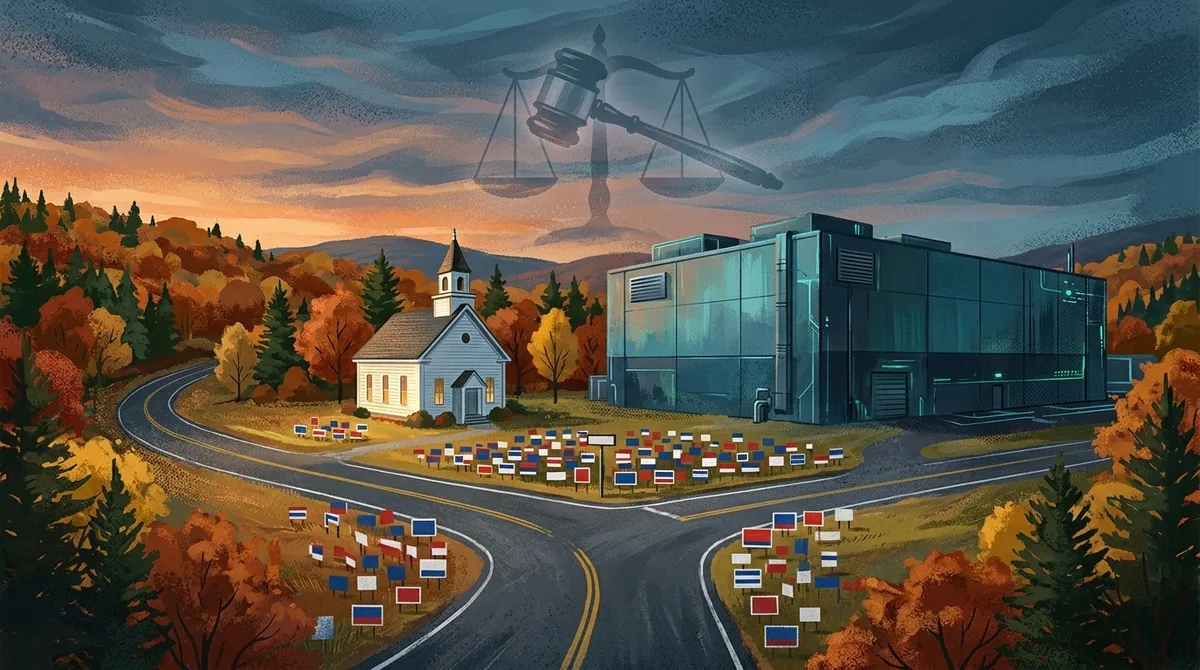
Where it stands: September polling found 61% of likely voters opposed construction of AI data centers, yet under 1% named it a top midterm issue. Since then California passed seven data-center bills, Virginia's governor moved to restrain approvals, and data centers became an issue in many 2026 races, with water worries growing in Arizona and air-pollution concerns in Texas. Watch whether that opposition turns into votes in November, including in Maine's Senate race.
Latest
- 2026-10-30(~7:00 AM ET, The Verge — theverge.com): the named-race watch reaches its highest-stakes instance — in the closing days of the 2026 midterm campaign, an audience member shouted at Sen. Susan Collins (R) during her final debate against Democratic challenger Troy Jackson that "AI data centers are destroying our climate. They are poisoning our water."; Collins brushed the outburst off, tying the man to Jackson. The Verge frames the race outright as one that could decide Senate control. Watch: the November result in Maine, whether the data-center frame travels to other Senate-level races, and whether the outcome shifts the storyline's moratoria-vs-federal-preemption balance.
AI image - 2026-10-29 (~6:00 AM ET, The Verge — theverge.com/cs): the environmental column gains its Arizona leg — an on-the-ground feature on AI's water draw in the desert, where data-center complexes keep adding buildings and TSMC's chip manufacturing sits in the same landscape. The storyline's water frame (32% of opponents citing environment/water in the September polling) now has a named, visited state beside the Texas air-pollution report of October 21 and the race-level politics of October 27. Watch: Arizona-side water disclosures and utility or regulatory response, whether other outlets follow into named complexes, and whether the visited places convert into November votes.
- 2026-10-27 (~6:00 AM ET, The Verge — theverge.com/policy): the salience question converts into campaign politics — data centers and the infrastructure construction and expenses that come with them have sparked local opposition in communities across the country and become a major issue in many 2026 congressional and gubernatorial races, activating kinds of voters who rarely agree, while tech money pours into the same races, led by Leading the Future, a super PAC backed by venture-capital money. The watch item — candidates campaigning on data-center bans in buildout states — is now live in actual campaigns. Watch: named races and candidates running on data-center limits, the super PAC's spending and targets, and whether November results show opposition converting into votes.
October 2026 · 3 updates
- 2026-10-21 (~6:33 PM ET, The Verge — theverge.com): the environmental-cost ledger gains an air-pollution leg — a new report warns the rush of data centers could push air pollution in Texas, "ground zero for the physical infrastructure behind generative AI," back to levels not seen since the 2000s; how developers and utilities meet new electricity demand (gas turbines vs renewables) determines how dirty it gets. Flanks this thread's environment/water opposition frame (32% of opponents' top reason): it is evidence that the physical-cost ledger, not just sentiment, is extending into public-health territory.
- 2026-10-02 the industry's counter-offensive arrives — AWS CEO Matt Garman's 3,000+ word blog (Verge ~7:52 AM ET): communities blocking data centers risk "irreparable harm to the US economy and national security"; jobs/power/competition named. The thread's first full-throated industry persuasion campaign — which is itself evidence of where the pain is. Counterpoint in the same day's coverage (Verge ~8:00 AM ET): the visibility problem from the other end — San Antonio's Galvan on hyperscale sprawl and the camouflaging of data centers.
- 2026-10-01 two artifacts — Utah and the mood. (1) The Verge's months-long Kevin O'Leary Utah investigation (~10:00 AM ET): Stratos — a 40,000-acre AI campus pitched at nine gigawatts, "more than double the average power usage of the entire state of Utah." The candidate-politics watch now has a famous plaintiff and a documented debacle to campaign on. (2) "We used AI to find out just how much Americans hate AI" (MSN syndication — verify the origin outlet): opposition to AI/data centers/Flock cameras as a bipartisan unifier — the salience question again, in series form.
September 2026 · 4 updates
- 2026-09-21 the watch item converts into law — Newsom signed seven data-center bills (Verge ~4:29 PM ET; LA Times earlier): the CPUC must create a new rate classification for data centers; data centers pay for local grid and water upgrades; proposed projects disclose estimated water use, energy efficiency and drought planning to local governments; consumption requirements gate the streamlined approval path. "While the Trump administration moves toward deregulation, communities are left to deal with the consequences." The moratoria-faster-than-federal-preemption prediction landed as binding law in the biggest host state, one week after the kill- switch EO. Mechanism note: a rate-class instrument, same shape as TVA's data-center rate class (data-center-rates thread) — punitive vs protective-revenue versions of one load-growth math. Posture is two-handed: kill switch EO + a faster-approval track for compliant builds.
- 2026-09-18 the backlash reaches the state that hosts the industry — Virginia Gov. Spanberger ordered an AI task force and moves to restrain data centers: empowering local communities, slowing approvals in "the data center capital" (The Verge, ~2:29 PM ET). The thread's salience-gap thesis now has a governing test case: opposition converting into executive action in the industry's home state, ahead of any federal move.
- 2026-09-16 opened from the ai digest. NYT/Siena (1,503 likely voters, fielded early September, mostly pre-pacing-week): 61% oppose construction of AI data centers, 14% strongly support; Trump 2024 voters split 49/45, Harris voters/non-voters 74/67 opposed. Among opponents: 56% prefer limits, 38% a total ban; reasons — environment/water 32%, local community 21%, distrust of AI 18%. Series context: NBC March (AI below ICE), Gallup May (~7 in 10 opposed local construction). Salience gap: <1% call it their top midterm issue (3% among 18–29).
- 2026-09-16 (late window): the environmental column gains an e-waste leg — Basel Action Network report (via Verge, 4:40 PM ET; advocacy- grade, broadest count yet): global e-waste tripling to up to 211M metric tons/yr by 2050, 15–20% attributed to AI — by counting full infrastructure (power, cooling, backup, networking, "AI Waste Contagion"), not just GPUs; <25% of e-waste formally collected today; US not a Basel Convention party. Joins water (32%) and energy as the physical-cost ledger the low-salience opposition draws on.
Background
- The thread: the political cost of AI's physical buildout, tracked through polling — opposition is broad and bipartisan-ish but low-salience, which is why candidates in buildout states can run against data centers without paying for it.
- Watch for: opposition converting into state/local moratoria faster than federal preemption, the environment/water frame (32%) overtaking the "AI itself" frame (18%), and 2026 candidates campaigning on data-center bans in buildout states.