Orbital data centers / space compute (Starmind lineage)
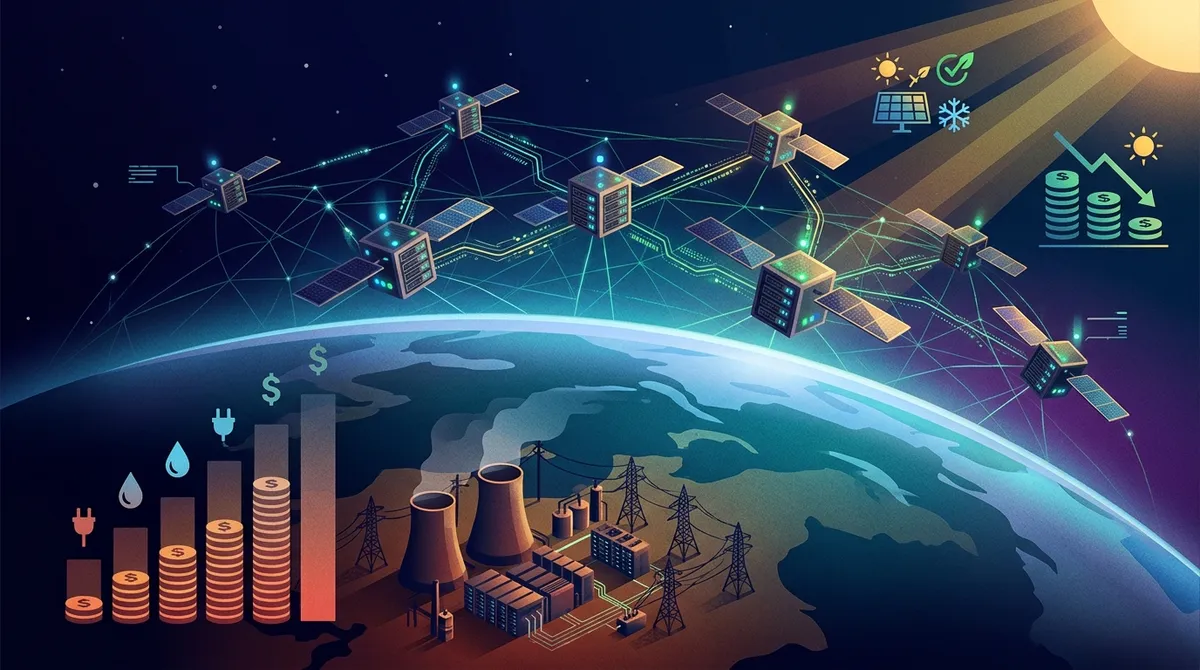
Where it stands: Google's Suncatcher prototype, launched October 1, booted four TPUs in orbit and ran its Gemma 4 model, returning a generated answer. A rival Indian orbital data center and a power-beaming prototype flew on the same launch, while SpaceX and Nvidia pursue AI satellites and a claimed 2027 volume-production target for a space computer. Next, watch radiation-tolerance results and Google's second prototype.
Latest
- 2026-11-01(Shattered — shattered.io): the thread's push gets its first named-executive cost skepticism — Google's energy chief puts orbital data centers at up to 100× their ground equivalents' cost, with the report's economics running through cooling, power and launch hurdles. Notable provenance: Google itself has hardware in this market, its TPU-equipped Project Suncatcher prototype having flown on Transporter-18 on October 1. Watch: a primary source and stated assumptions for the 100× figure, and Suncatcher's in-orbit results against the claim.
AI image - 2026-10-30(The Verge — theverge.com/tech): first orbital TPU boot and first on-orbit model response — Google reports the Suncatcher prototype satellite's TPUs booted successfully in orbit and the on-board Gemma 4 model answered a prompt (a haiku about being in space), with limericks and telemetry prompts also tried. The checkable step beyond the Oct 1 Transporter-18 ride: accelerators running and inference returning from orbit, though still a company-blog demo — no independent writeup yet, and no radiation-tolerance/qualification data (the artifact the flight was meant to produce). Watch: that qualification data; the second prototype (Google's published plan: two with Planet by early 2027); rival payloads' own on-orbit results.
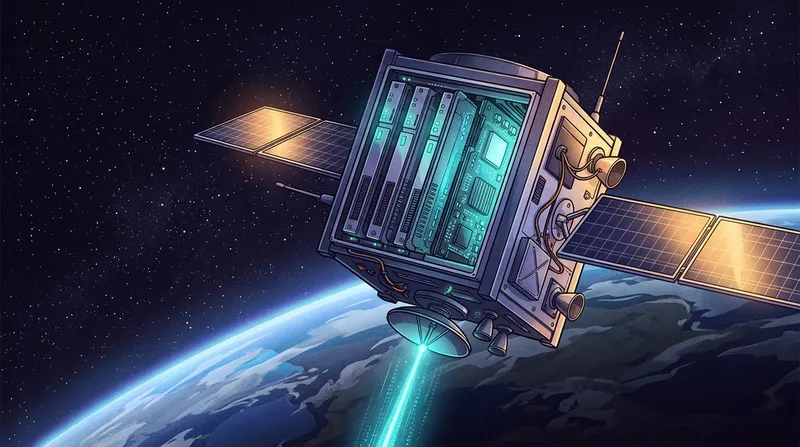
AI image - 2026-10-30 (the completion of the prototype's first test cycle): Google reports the Suncatcher prototype satellite's four TPUs booted in orbit and the onboard Gemma 4 model returned a processed response transmitted back to Earth — the initial goal being precisely that the chips could turn on, process a prompt and answer (AI Weekly; Google's announcement carried by Jeff Foust — x.com/jeff_foust). Next checkable artifact unchanged: published TPU-radiation/tolerance data. Watch: that data, and how scaling tracks the launch volume Google itself says the market needs.
Images in this thread
Claims to watch · 2 (1 pending, 0 slipped, 1 hit, 0 missed)
October 2026 · 6 updates
- 2026-10-15 (~4:20 PM ET, single low-tier source, flagged): basenor.com blog claims Musk confirmed (October 14) that "Star Mind" — the space-grade AI computer co-engineered by SpaceX and Nvidia — is targeted for volume production in 2027 (basenor.com/blogs). First in-record appearance of the program under a product name with a production date, against a thread whose defining anomaly has been the Starmind pressroom-shaped gap — but the source is a mid/low-tier blog with no primary Musk statement, no SpaceX or Nvidia acknowledgment in the reporting; treat as an announced-claim only, not ledger-grade, and not evidence anything shipped. Watch: any primary statement confirming the name, the co-engineering, and the 2027 volume-production claim; first Starship-flown AI1 hardware remains the thread's hardware check.
- 2026-10-13 (market/analyst layer): Musk RT (~5:38 PM ET) of Adam Jonas's new Morgan Stanley SpaceX note — the Distributed Inference Cloud "holds the greatest growth potential" and is "largely ignored/not contemplated by investors" — with Musk endorsing "True, this is a very big deal" (x.com/elonmusk). Companion RT (~5:35 PM ET): Musk contrasts the ambition with build difficulty — "getting money to build complex hardware systems with massive power, cooling & networking is not the same as doing it … even we find it very difficult!" (x.com/elonmusk). Analyst-validation datapoint for the thread; terrestrial framing, not satellite receipts.
- 2026-10-07 the SpaceX flank gets its finance layer — a report SpaceX is seeking $40B in new debt to fund NVIDIA chip purchases (space-compute capex; the stock slipped on it) and Morgan Stanley's note now treats the "AI compute business" as a valuation driver. The orbital-data-center thesis arriving as balance-sheet plumbing: debt, GPUs, and a satellite fleet to operate them. Watch: the debt instrument surfacing, what Gen3's onboard compute (250 kW/trade-grade, unverified) actually serves on orbit.
- 2026-10-04 (spec sheet, trade-grade): SatNews — Gen3 Starlink technical specifications disclosed Oct 1: 250 kW per satellite, 10 Tb/s throughput, onboard edge compute ("AI satellites"). Single trade outlet; primary (FCC filing) not verified in feed — verify before weighting the 250 kW figure. Pairs with F14's 26 production V3s (record): the per-satellite claims behind Google's 1,600-launch arithmetic now have numbers — the space-compute market's SpaceX flank is quantified. Watch: primary confirmation; what the onboard compute serves (routing/AI functions vs third-party workloads — smart router vs data-center node).
- 2026-10-01 (the rideshare executed — the market's whole first generation on-orbit in one launch): Transporter-18 lifted off from Vandenberg (~2:22 PM ET window; SpaceX RTs confirmed liftoff). Manifest as logged: Suncatcher's TPU prototype (ledger → hit; next checkable artifact: published TPU-radiation/tolerance data), TakeMe2Space MOI-1a (India), Star Catcher Protostar (power flank), Starfish's first full-scale Otter (servicing; orbital-servicing thread). Google's same-day framing piece puts the dependency on the record: Starship must launch ~1,600 times before space data centers get off the ground — the market is cadence-gated on the starship-cadence thread, where the forecast was cut the same day.
- 2026-10-01 (number provenance for the digest's 1,600 figure): the launch-count math has two converging derivations — (1) Google's own Suncatcher preprint (Agüera y Arcas, Beals, Manyika et al.; blog.google + arXiv, Nov 2025) estimates its scaled "learning in space" constellation (TPU-equipped, solar-powered satellites) in the ~1,600-Starship-launch range at the scale it sketches — per-launch satellite counts are the paper's own arithmetic; (2) independent mass math on SpaceX's 100k-satellite Gen3 FCC filing (2.0–2.5 t per sat, 200–250 t total) reaches the same order — spacedaily's audit flags the precise count as assumption-based (payload config unverified). Either way, today's first generation is measurement, not production. Provenance anchors: the TPU-radiation testing already published in the preprint; the blog's plan of two prototypes with Planet "by early 2027" — today's T-18 flight puts one prototype up early.
September 2026 · 7 updates
- 2026-09-30 manifest detail locks and the backlash frame arrives — Suncatcher's prototype rides Transporter-18 (Thu Oct 1) with Planet — four TPUs, ~15 minutes of test per orbit (Ars/Reuters coverage); a spin piece frames the whole project as Google "escaping data-center backlash" via orbit. TakeMe2Space MOI-1a and Star Catcher's Protostar on the same ride; Starfish's Otter (servicing) too. Check date: tomorrow — the Suncatcher ledger entry (due ~Oct 3) plus every other T-18 payload now has a verifiable launch-or-slip datum.
- 2026-09-29 the power flank gets its writeup — HotHardware re-covers Star Catcher: "SpaceX To Launch Prototype Laser Grid For AI Data Centers In Space" (Protostar, T-18 — same item as the Sep 28 Via Satellite read, now with the carrier detail). Nothing new beyond the manifest, but the checkable dates stack this week: Suncatcher ledgered "next week" (Sep 25), TakeMe2Space T-18 Oct 1 — first flights of all three continental flanks days away.
- 2026-09-28 the market widens again — TakeMe2Space (India) flies the country's first orbital data center: two 100-kg satellites with NVIDIA Thor GPUs, 100 TB storage, optical links (MOI-1a rides Transporter-18 Oct 1; the full mission 2028, Business Standard). Three continental flanks on the manifest: US (Starmind/Suncatcher), China (Chaozhisuan-1), India (TakeMe2Space). Also riding T-18: Star Catcher's Protostar power-beaming node (Via Satellite) — the energy-infra flank of the same market.
- 2026-09-25 (ai-beat cross-ref): Google's Project Suncatcher — a TPU-equipped prototype satellite — is set to launch "next week" aboard SpaceX Falcon 9 Transporter-18 (Verge; Sundar Pichai on-platform: "Can our TPUs survive and operate in space? Well, we're going to find out."). The Starmind lineage now has a competitive test flight on the manifest from the other Big Tech flank; launch window ledgered.
- 2026-09-23 (flagged): TechTimes (mid-tier): Chaozhisuan-1 (launched Sep 20) orbits as an AI compute node processing other satellites' EO data via laser link, returning analyzed results — backers include US-sanctioned SenseTime and Zhipu AI. The sanctioned-backer angle is new; single mid-tier outlet — hold weight until primary/tier-1 confirmation.
- 2026-09-20 the Chinese flank launches payloads. CAS Space's Lijian-1 Y18 (Sep 20, Dongfeng Commercial Aerospace Innovation Test Zone, 9 satellites) carried two computing-first payloads: Super AI Computing-1 (on-orbit AI data processing + target recognition) and Pengcheng First (PEGA-SUS1) (GalaxySpace + Peng Cheng Laboratory + SUSTech) — China's first satellite combining a 5G NTN base station, onboard AI computing, and a 100 Gbps satellite-to-ground laser link on one platform, pitched as 6G groundwork. Same report: Lijian-1 production capacity scaling to 30 rockets/year + a first sea launch planned off Guangdong (china-launch-tempo adjacency). The thread's ambition now exists as hardware in manifests on both sides of the Pacific.
- 2026-09-17 opened from the space digest — IM "eyes orbital data center opportunities" + syndicated analyst pushback on the late-2027 date ("real scale more likely a 2030s"). Musk's Q4 2027 claim ledgered (it accelerated from an earlier "2028" framing). Watch: F14's 26 V3 deployment as the power-distribution proof point, first AI1 satellite hardware, IM strategy specifics.
Background
- The thread: SpaceX's AI-satellite program (Musk: first Nvidia-powered AI satellites launching Q4 2027, up to 1M satellites filed, 150 kW peak power by end-2027 — announced Aug 24, Bloomberg; never entered the feed — the "Starmind" pressroom-shaped gap lineage) watched against the market forming around it: Intuitive Machines scanning the same market (SpaceNews, Sep 17, WSBW), analysts pushing the timeline to the 2030s, and the Terafab D3 rad-hard chip line as the supply side (cross-thread, ai).