Robots digest — Oct 25, 2026
Top line: Beijing's humanoid sector logs a certified headline feat and a public stumble hours apart — 110 robots set a Guinness world record for synchronized dancing, pitched as proof the industry can move from one-machine demos to coordinated fleets, while Unitree's newly unveiled "guardian" humanoid lost part of a leg mid-kung-fu demo and drew mixed reactions on Chinese social media. The gap between stage work and deployment picks up numbers from both sides: Teradyne Robotics and Sereact report hundreds of dual-arm Universal Robots already shipped to live customer sites across Europe, Rhenus switches on more than 100 AutoStore robots in a Polish automated warehouse, the Financial Times frames Toyota's humanoid push as a direct take-on of Tesla and China, TÜV SÜD, Accenture and NVIDIA announce a Physical AI Safety Suite moving safety certification to the front of the deployment pipeline, and buildings themselves begin adapting to robots (wider corridors, chargers) alongside browser-based layout testing before hardware is installed. Faraday Future shows an $89,000 humanoid working a crowd at Brooklyn Bridge Park, while the edges fill in with Australian robot founders on the Financial Review's Young Rich List, a University of Malta professor putting humanoid household chores "within a year," Hangzhou's Lingyan Technology raising tens of millions of yuan for a bionic robot face, and a finger-controlled robotic beetle with artificial muscles and two-way feedback.
- 110 humanoid robots set a Guinness world record for synchronized dancing
- Buildings adapt for robots: wider corridors, chargers
- Maltese professor: humanoid household chores "within a year"
- Lingyan Technology: two rounds for a bionic robot face
- Unitree's H2-X humanoid stumbles at its demo, losing part of a leg
- TÜV SÜD, Accenture and NVIDIA announce a Physical AI Safety Suite for robot certification
- Finger-controlled robotic beetle: artificial muscles and two-way feedback
- Teradyne–Sereact: hundreds of dual-arm UR robots already shipped to live European sites
- Australian robot founders join the Young Rich List
- Rhenus switches on 100+ AutoStore robots at a Polish automated warehouse
- Faraday Future shows an $89,000 humanoid in public at Brooklyn Bridge Park
- Financial Times: Toyota takes on Tesla and China in the humanoid robot race
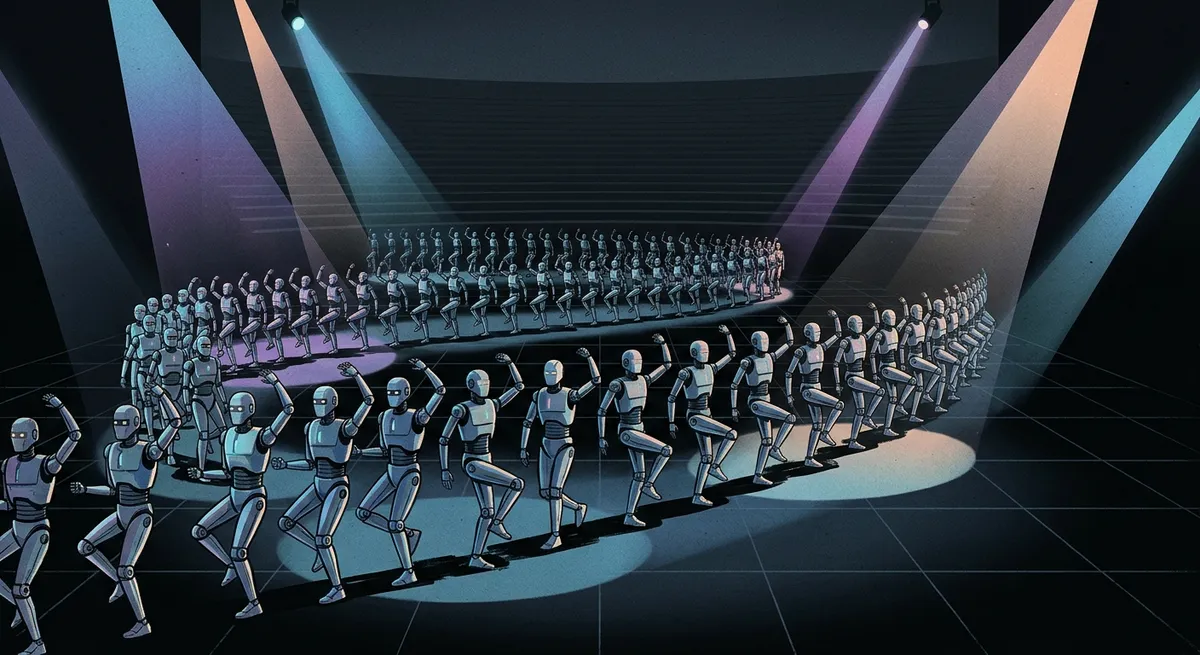
110 humanoid robots set a Guinness world record for synchronized dancing
Sources Global Times
What happened: A fleet of 110 humanoid robots in China set a Guinness world record for synchronized dancing, and the coverage frames the milestone as the industry moving from single-machine demonstration toward large-scale coordinated deployment (Global Times).
What's genuinely new: A certified, quantified spectacle milestone — 110 units in a coordinated performance, the largest figure in the running tally of Chinese humanoid stage performances, paired with an explicit pitch that coordinated fleets preview mass deployment. It lands a day after an analytical report (Oct 24) argued China's humanoids are impressive on stage but unproven in factories, making this a certified spectacle answer to the deployment-gap criticism rather than evidence of factory work.
Watch: which company supplied the 110 units and whether the same hardware shows up in named factory or facility deployments rather than performances; coordinated-fleet control claimed as a capability for commercial scale still needs deployment data behind it.
Buildings adapt for robots: wider corridors, chargers
Sources MSN Aving News
What happened: Houses and buildings have always been spaces designed for humans — floor heights, door widths, and corridor widths shaped around people — and that is now starting to change. Buildings are being adapted for robots, with wider corridors and chargers among the visible changes (MSN).
What's genuinely new: A first framing of architecture itself as the constraint on robot deployment: the article treats door widths, corridor widths, floor heights and power provisioning as the bottleneck, with chargers joining wider corridors as the concrete retrofit list. That's a different angle than robot capability or economics — it's the built-environment layer that any scaled deployment depends on.
Same day, the software layer: at the FIX 2026 event, VISIONSPACE demonstrated browser-based robot layout testing, aimed at the layout, throughput, interference and collision problems that typically surface only after robots and automation equipment have already been installed (Aving News). Virtual validation now sits beside wider corridors and chargers on the pre-deployment checklist: a space can be planned for robots in software before anything is rebuilt in physical plant.
Watch: named building projects, retrofit programs, or building codes adopting robot-friendly specs (charging points, corridor standards), and whether real-estate or facilities-management firms make public commitments — plus whether browser-based layout-testing tools enter the same facilities workflows as the physical retrofits.
Maltese professor: humanoid household chores "within a year"
Sources The Malta Independent
What happened: Professor Saviour Formosa, of the University of Malta's Department of Criminology, told The Malta Independent on Sunday that humanoid robots could be doing chores in Maltese households "within a year" (The Malta Independent), published October 25, 2026.
What's genuinely new: A concrete one-year timeline for household humanoids, sourced to a criminology academic rather than any robot vendor or lab, with no named product, company, or pilot behind it. It lands in direct opposition to the household-skeptic voices of recent weeks — among them Mark Cuban's October 18 Roomba comparison — and is checkable on a clock: by October 2027.
Watch: whether any named vendor, machine, or pilot deployment appears in a Maltese household within the year, or whether the claim ages as pure forecast.
Lingyan Technology: two rounds for a bionic robot face
Sources Shattered
What happened: Hangzhou Lingyan Technology has closed two funding rounds worth tens of millions of yuan (roughly a few million to over ten million US dollars) for FaceSoul Agent, its bionic dexterous robot face, with the coverage's headline counting two rounds and five backers (Shattered), published October 25, 2026.
What's genuinely new: First appearance of a robot-expressiveness hardware niche in the funding tally: a "bionic dexterous face" as the product raising, rather than an arm, hand, or whole humanoid. No per-round amounts, named backers, or valuation were given.
Watch: named backers and a valuation, and whether FaceSoul face hardware ships in a named consumer or service robot rather than staying a component story.
Unitree's H2-X humanoid stumbles at its demo, losing part of a leg
Sources Global Times
What happened: Unitree's newly unveiled H2-X humanoid robot lost part of a leg after stumbling during a kung fu demonstration, drawing mixed reactions on Chinese social media (Global Times).
What's genuinely new: The first reported failure of the machine Unitree billed as a "guardian" in its October 22 promotional video showing it disarming attackers, lifting cars and rescuing people — a reliability counterpoint landing within days of the marketing reel. It arrives the same day the 110-robot dancing world record (above) is pitched as proof of coordinated-fleet readiness, one day after an analytical report argued China's humanoids are impressive on stage but unproven in factories: the spectacle-versus-reliability tension playing out inside a single Chinese vendor's week.
Watch: whether Unitree attributes the stumble to hardware, choreography, or the demo surface, and whether the "guardian" repertoire gets an independent, unrehearsed demonstration rather than promotional footage.
TÜV SÜD, Accenture and NVIDIA announce a Physical AI Safety Suite for robot certification
Sources IndianWeb2
What happened: Testing firm TÜV SÜD, Accenture and NVIDIA have jointly launched the Physical AI Safety Suite, aimed at fast-tracking AI robot safety certification in factories and warehouses (IndianWeb2).
What's genuinely new: Certification and compliance move to the front of the robot-deployment pipeline as a named three-party program — a testing giant, a consultancy, and the dominant robotics-compute supplier combining around safety sign-off — rather than remaining an afterthought to capability announcements. No certification standard, timeline for a first certified robot, or pricing is given, and an announced program is not yet an operating one.
Watch: the named certification criteria behind the suite, the first robot or deployment certified through it, and whether vendors already framing safety as the gate for humanoid deployment (Agility's stated position) converge on this program.
Finger-controlled robotic beetle: artificial muscles and two-way feedback
Sources New Atlas
What happened: A finger-controlled robotic beetle with artificial muscles and two-way feedback is reported by New Atlas, taking cues from insects — small, agile machines that can squeeze into spaces larger robots cannot (New Atlas).
What's genuinely new: A concrete artificial-muscle hardware development with two-way feedback on an insect-scale platform — the bio-inspired robotics lane producing specific machinery rather than concept videos. No developer, specifications, or commercial path are named in the coverage.
Watch: whether the artificial-muscle-plus-feedback approach extends beyond lab demonstration to named products or deployments.
Teradyne–Sereact: hundreds of dual-arm UR robots already shipped to live European sites
Sources The Robot Report
What happened: The Robot Report's October 25, 2026 update on the Teradyne Robotics–Sereact partnership — Sereact's Cortex physical-AI platform paired with Universal Robots cobots for retail and logistics — carries a shipped-today figure the announcement lacked: the two companies have already shipped hundreds of UR robots in dual-arm systems to live customer sites across Europe (The Robot Report).
What's genuinely new: First quantified scale behind the partnership announced October 23 — hundreds of dual-arm UR systems in the field, with live customer sites named at geographic level (Europe) rather than customer level, moving the story from an announced vendor pairing to hardware already operating in quantity.
Watch: named joint deployments under the partnership — the Zalando × CEVA fashion-returns deployment tied to Sereact earlier in October is the one public deployment so far — and whether the hundreds-ship figure grows into a customer-by-customer count.
Australian robot founders join the Young Rich List
Sources The Australian Financial Review
What happened: The Australian Financial Review's Young Rich List takes in robotics founders — under the title "Move slow, break things," the feature argues that while China and the US dominate robotics, Australian entrepreneurs are creating robots for Australian needs (The Australian Financial Review), published October 25, 2026 US Eastern.
What's genuinely new: First entry for the Australian robotics lane in the coverage — founders being priced by a wealth list rather than judged by deployment data, with the pitch that the local industry builds for Australian conditions instead of competing head-on with China and the US. No founder names, companies, or net-worth figures appear in the available summary.
Watch: the named founders and companies behind the list placements, and whether the "robots for Australian needs" framing produces named hardware or deployments rather than wealth-list coverage.
Rhenus switches on 100+ AutoStore robots at a Polish automated warehouse
Sources Container News
What happened: Logistics group Rhenus has launched a major automated warehouse system in Poland — an AutoStore installation deploying more than 100 robots to strengthen automated warehousing and e-commerce fulfillment (Container News), published October 25, 2026 US Eastern.
What's genuinely new: A named logistics operator putting a triple-digit robot count into a single European installation — an operating deployment datapoint rather than a partnership announcement or a market forecast, landing the same evening as vendor-side scaling claims elsewhere on the day. The available summary carries no site location, throughput figures, or customer names.
Watch: the named site and its location, throughput figures, and whether Rhenus reports fulfillment numbers instead of leaving it as an installation announcement.
Faraday Future shows an $89,000 humanoid in public at Brooklyn Bridge Park
Sources NewsBytes
What happened: An $89,000 AI-powered humanoid robot was seen interacting with people at Brooklyn Bridge Park, reported as a Faraday Future debut, with the machine described as aiming to learn human behavior (NewsBytes), published October 25, 2026 US Eastern.
What's genuinely new: First public-space sighting of Faraday Future robot hardware at a price — $89,000, a far higher price point than the $2,490 FF Nova the company announced on October 15 as "America's first embodied AI humanoid," with the coverage drawing no link between the two machines. It is a park crowd, not a deployment: still no delivery, customer, or usage record for either machine.
Watch: which Faraday Future model the $89,000 unit is, and whether the public interactions translate into a named deployment or customer.
Financial Times: Toyota takes on Tesla and China in the humanoid robot race
Sources Financial Times
What happened: The Financial Times frames Toyota as a contestant in the humanoid robot race against Tesla and China's makers, recalling how, inside Toyota Arena Tokyo in April, the automaker gave a glimpse of its robotics prowess — its AI-powered black-and-red humanoid (Financial Times), published October 25, 2026 US Eastern.
What's genuinely new: Top-tier-outlet competitive framing that places Toyota's humanoid program — previously known through the ¥1 trillion (~$6.4 billion) annual automation estimate and the 400,000-robot program target — explicitly into the same race as Tesla and the Chinese shipment-table leaders, anchored to a named April demonstration event rather than a product announcement.
Watch: the named humanoid model and any factory trial sites, whether the April demonstration footage is matched by independent verification outside the automaker's showing, and the humanoid share of Toyota's 400,000-robot program.