Energy digest — Oct 27, 2026
Top line: The nuclear beat spreads across three fronts today, and a fourth opens. The first-ever IAEA ministerial nuclear conference is under way in South Korea, where Deputy Prime Minister Bae Kyung-hoon used the keynote to pledge accelerated SMR development and demonstration — a statement of intent, not a funded program — while the regulator separately approved a further decade of operation for Kori 3 and 4 ahead of restarts in 2027. In the US, microreactor developer Antares secured a BWXT fuel-fabrication deal and an initial DOE safety approval for its Mark-1, while Germany's PreussenElektra and NVIDIA began exploring former nuclear plant sites for AI factories; in a new storyline, officials in Wisconsin and Vermont have floated SMRs at retired reactor sites.
- First-ever IAEA ministerial nuclear conference lands in Korea — Seoul pledges to speed up SMR development
- South Korea clears Kori 3 and 4 for a further 10 years, with restarts set for 2027
- Antares lands BWXT fuel-fabrication deal and initial DOE safety approval for its Mark-1 microreactor
- PreussenElektra and NVIDIA to explore former German nuclear sites for AI factories
- Wisconsin and Vermont officials weigh SMRs at former nuclear plant sites
First-ever IAEA ministerial nuclear conference lands in Korea — Seoul pledges to speed up SMR development
Sources fnnews
Thread: IAEA ministerial in Korea: first-time host and the Seoul SMR acceleration pledge · new
What happened: An International Atomic Energy Agency ministerial conference on nuclear energy is being held in South Korea for the first time (fnnews, Oct 27, ~8:25 AM ET). Deputy Prime Minister and Minister of Science and ICT Bae Kyung-hoon delivered the keynote remarks, which were framed under the banner "SMR development and demonstration to accelerate."
What's genuinely new: The venue — an IAEA ministerial conference taking place in Korea for the first time — and the government's stated intent, from the deputy prime minister's own keynote, to speed up small modular reactor development and demonstration. No funding figure, named project, schedule, or vendor accompanies the pledge in this report.
Watch: Whether the acceleration pledge is followed by concrete commitments — a funded SMR demonstration program, named vendors, or regulatory steps — and how Korea's domestic SMR push sits alongside its separate $120 billion investment framework for building large US reactors.
South Korea clears Kori 3 and 4 for a further 10 years, with restarts set for 2027
Sources World Nuclear News
What happened: Korea Hydro & Nuclear Power has been given approval by South Korea's Nuclear Safety and Security Commission to continue operating Kori nuclear power plant units 3 and 4 for a further 10 years, with the units set for restarts in 2027 (World Nuclear News, Oct 27, ~10:18 AM ET).
What's genuinely new: The regulator's extension approval and the 2027 restart target — the first South Korean units in the restart cohort this storyline tracks, joining the US's Palisades and Crane restarts, Taiwan's Maanshan review and Ontario's Pickering refurbishment. The report carries no further detail on dates within 2027, fuel loading, or restart conditions.
Watch: The actual 2027 restart dates and any intervening licensing or fuel-loading steps, and whether more of KHNP's extended fleet follows.
Antares lands BWXT fuel-fabrication deal and initial DOE safety approval for its Mark-1 microreactor
Sources POWER Magazine
What happened: Antares Nuclear, the Torrance, California-based developer, announced on Oct 27 that it has secured a multi-year agreement with BWX Technologies (BWXT) for advanced nuclear fuel fabrication and has received initial Department of Energy safety approval for its Mark-1 microreactor (POWER Magazine, Oct 27, ~10:29 AM ET). The company frames both as key requirements for its planned transition from reactor testing to electricity production and military deployments.
What's genuinely new: The two dated company milestones — the BWXT fuel-fabrication agreement and the initial DOE safety approval. The fuel side pairs Antares with an established government-fuel manufacturer beside its existing prepaid multi-year HALEU contract with Centrus; the DOE step is an initial safety approval, not a licence or full authorization. The announcement is company-sourced with no independent verification of the milestones in this report.
Watch: The remaining stages of the DOE review, the fuel delivery schedule, and named deployment partners for electricity production and military use.
PreussenElektra and NVIDIA to explore former German nuclear sites for AI factories
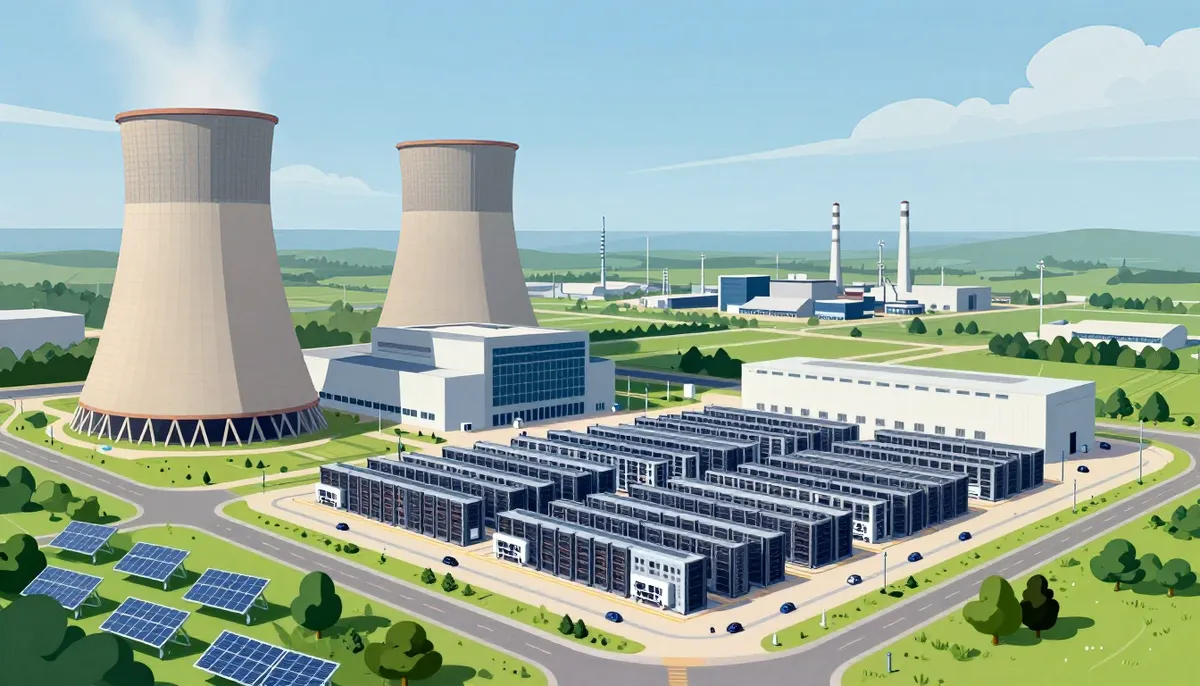
Sources World Nuclear News
What happened: Germany's PreussenElektra and NVIDIA are to explore whether PreussenElektra's former nuclear power plant sites are suitable for the construction of so-called AI factories (World Nuclear News, Oct 27, ~8:14 AM ET).
What's genuinely new: A named utility-and-chipmaker pairing turning to former nuclear sites — with grid connections already in place — as candidates for data-centre-scale AI builds, extending this storyline's siting genre beyond US new-build reactor campuses to European site reuse. It is an exploration commitment only: no named site, timeline, investment figure, or decision appears in coverage.
Watch: Whether any specific site is selected, the grid-connection and power plans behind it, and whether other European utilities with retired nuclear sites make similar moves.
Wisconsin and Vermont officials weigh SMRs at former nuclear plant sites
Sources ANS
What happened: Within the last week, officials in Wisconsin and Vermont have openly discussed the possibility of deploying small modular reactors at sites that formerly housed traditional, large nuclear reactors (ANS, Oct 27, ~1:48 PM ET).
What's genuinely new: Two US states entering the former-reactor-site SMR conversation — the talks are open-ended: no specific site, vendor, design, schedule, or government decision appears in the report.
Watch: Which retired sites are named, whether state agencies or utilities follow the talk with siting or feasibility studies, and which SMR vendors enter either state's discussion.
Brief
- A strategy analysis in Thai business daily Thansettakij (Thansettakij, published Monday, Oct 26, EST) makes the case for a 300-MW small modular reactor as a way for Thailand to cut through global energy-price pressure, decoding how state energy agencies — including the Electricity Generating Authority of Thailand (EGAT) — would act jointly within a national mechanism. It is expert commentary: no site, vendor, design choice, schedule, or government decision is announced, and the item is too thin for a full story entry. If Thailand's SMR planning produces a formal plan or a named vendor, that becomes a real story.
- Singapore's energy establishment is building its talent bench: the Ministry of Energy, Trade and Industry and the Energy Market Authority have launched schemes to develop "a strong pipeline of local expertise in nuclear energy" (World Nuclear News, Oct 27, ~7:54 AM ET). A workforce-building step, not a reactor decision — no reactor plan, site, vendor, or timeline appears in coverage.
- A YouGov poll commissioned by the grassroots organisation Nuclear for Australia suggests almost two-thirds of Australians believe nuclear should be considered part of the nation's energy future, with interest registered across party lines (World Nuclear News, Oct 27, ~4:59 AM ET). Survey-grade opinion data, not a policy action — it becomes a story if state or federal figures act on it.