Energy digest — Nov 7, 2026
Top line: Oklo shares jumped 23% as third-quarter revenue of $1.86 million beat estimates and the company said its first commercial Aurora fast reactor at Idaho National Laboratory has moved into structural construction. It also signed a deal reserving forging capacity for 27 reactor modules. Separately, the IAEA launched a network to monitor lake health using isotope data.
- Oklo shares jump 23% as Q3 revenue beats estimates and Aurora-Idaho moves into structural construction
- Groves-1 isotope test reactor reaches substantial completion in 229 days
- IAEA launches global network to monitor isotopes in lakes
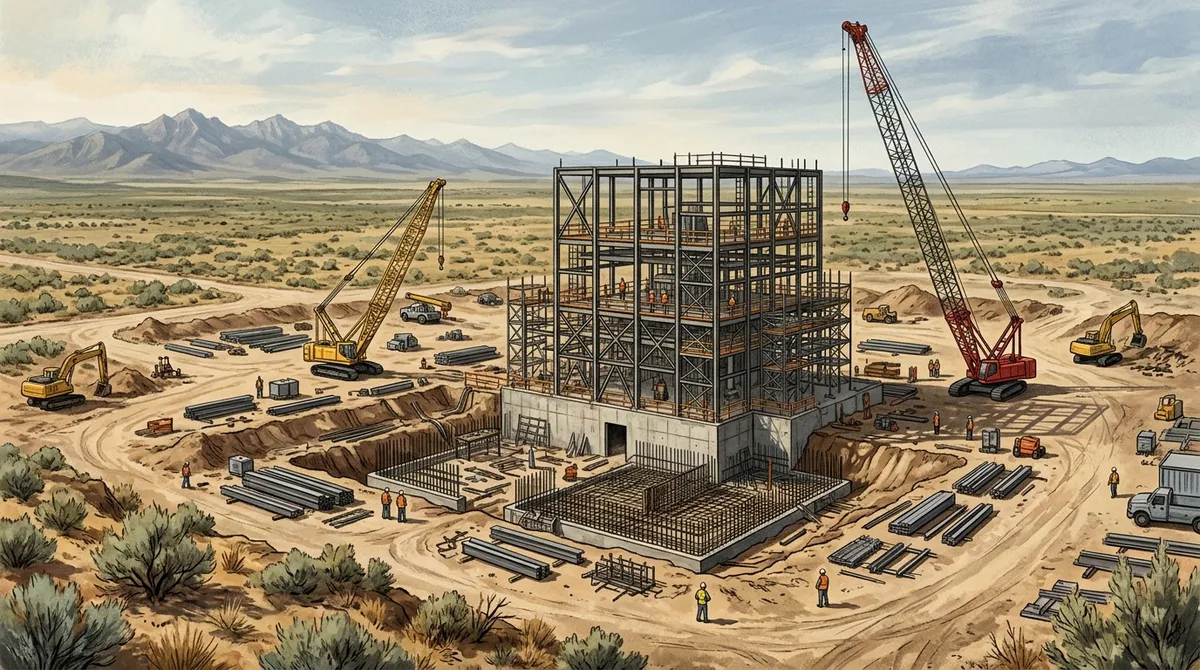
Oklo shares jump 23% as Q3 revenue beats estimates and Aurora-Idaho moves into structural construction
Sources BigGo News Financial News Motley Fool
What happened: Oklo's shares rose 23% on November 6, their sharpest one-day gain since September 2025, after the advanced nuclear developer reported third-quarter revenue of $1.86 million against a consensus of about $1.02 million, and said its first commercial project — the Aurora powerhouse at Idaho National Laboratory — has left site preparation behind and begun installing structural steel. A diluted loss per share of $0.22 came in below the $0.27 estimate; net loss widened to $41.7 million from $29.7 million a year earlier on higher spending. The company held $3.1 billion in cash, cash equivalents and marketable securities at September 30, after raising $2.3 billion through at-the-market offerings in the first three quarters of 2026.
What's genuinely new: As of November 4, crews had finished excavating the reactor area and begun installing vertical structural steel, with safety-related rebar work under way; the Department of Energy has approved the project's Preliminary Documented Safety Analysis, a checkpoint Oklo likens to a Nuclear Regulatory Commission construction permit. Oklo also signed a strategic manufacturing agreement with U.S. Forged Rings reserving capacity equivalent to 27 Aurora reactor modules for potential 2030–2035 deployments, with first deliveries expected in 2030 and contingent on the supplier qualifying a planned campus in Hertford County, North Carolina. Management reiterated a 2028–2029 target for commercial operation at Aurora. Separately, PJM Interconnection withdrew one of Oklo's Virginia interconnection applications, while the Ohio project — a campus of up to 1.2 gigawatts under an agreement with Meta, described as a development partnership rather than a conventional power purchase — proceeds, with the PJM process there expected to run roughly 24 months.
Watch: The remaining regulatory steps at Aurora — the final Documented Safety Analysis, a readiness review and startup authorization — and whether major reactor-component installation keeps the 2028–2029 commercial-operation target intact. Also whether the U.S. Forged Rings campus qualifies and the capacity reservation converts into binding orders.
Groves-1 isotope test reactor reaches substantial completion in 229 days
Sources BigGo News Financial News Motley Fool
What happened: Oklo said its Groves-1 isotope test reactor reached substantial construction completion after 229 days, at a build cost of roughly $65 million plus about $10 million for commercially sourced fuel — disclosed alongside the company's third-quarter results.
What's genuinely new: Groves-1's substantial construction completion is now measured, dated detail: a 229-day build duration, a roughly $65 million build cost, and about $10 million for commercially sourced fuel. Oklo also said it is preparing Groves-2, an integrated isotope production and processing facility selected for the Department of Energy's Nuclear Energy Launchpad, and expects its first contracted isotope delivery within 12 months.
Watch: The start of Groves-2 construction, the identity of the first isotope customers, and whether the first contracted delivery lands within the 12-month target.
IAEA launches global network to monitor isotopes in lakes
What happened: The International Atomic Energy Agency has launched the Global Network of Isotopes in Lakes (GNIL), which aims to build an international database of stable isotope measurements, water chemistry and environmental observations to help countries decide where conservation and restoration of freshwater systems would do the most good.
What's genuinely new: The network's launch itself, with 22 countries expressing interest in joining. Its initial phase focuses on common sampling protocols, governance arrangements and coordinated campaigns so results can be compared across regions and over time; it complements the IAEA's existing isotope networks for precipitation and rivers. Heavy isotopes of hydrogen and oxygen act as natural fingerprints revealing where lake water came from and how it moves, data the IAEA says will guide protection of drinking water, fisheries, biodiversity and lake ecosystems.
Watch: Which countries formally join, the first coordinated sampling campaigns, and whether a shared data platform emerges from the protocol-setting phase.
Links: American Nuclear Society · Nov 6, 4:28 PM ET
Brief
- None today.