Oklo shares jump 23% as Q3 revenue beats estimates and Aurora-Idaho moves into structural construction
From the Energy digest for Nov 7, 2026
Sources BigGo News Financial News Motley Fool
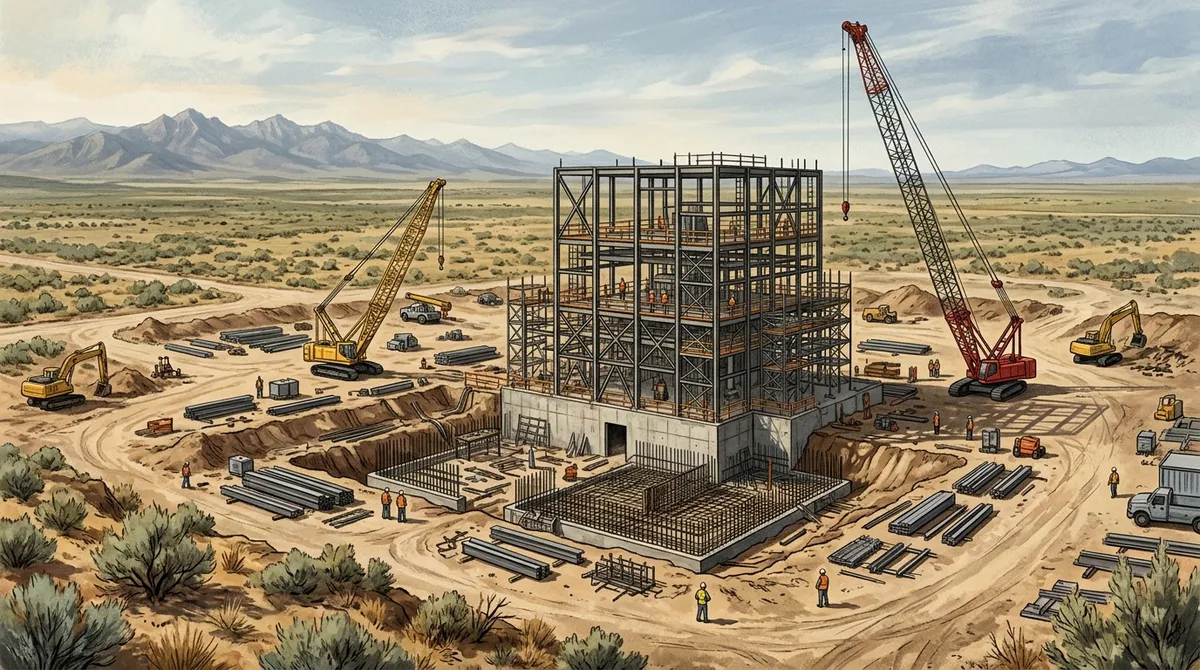
What happened: Oklo's shares rose 23% on November 6, their sharpest one-day gain since September 2025, after the advanced nuclear developer reported third-quarter revenue of $1.86 million against a consensus of about $1.02 million, and said its first commercial project — the Aurora powerhouse at Idaho National Laboratory — has left site preparation behind and begun installing structural steel. A diluted loss per share of $0.22 came in below the $0.27 estimate; net loss widened to $41.7 million from $29.7 million a year earlier on higher spending. The company held $3.1 billion in cash, cash equivalents and marketable securities at September 30, after raising $2.3 billion through at-the-market offerings in the first three quarters of 2026.
What's genuinely new: As of November 4, crews had finished excavating the reactor area and begun installing vertical structural steel, with safety-related rebar work under way; the Department of Energy has approved the project's Preliminary Documented Safety Analysis, a checkpoint Oklo likens to a Nuclear Regulatory Commission construction permit. Oklo also signed a strategic manufacturing agreement with U.S. Forged Rings reserving capacity equivalent to 27 Aurora reactor modules for potential 2030–2035 deployments, with first deliveries expected in 2030 and contingent on the supplier qualifying a planned campus in Hertford County, North Carolina. Management reiterated a 2028–2029 target for commercial operation at Aurora. Separately, PJM Interconnection withdrew one of Oklo's Virginia interconnection applications, while the Ohio project — a campus of up to 1.2 gigawatts under an agreement with Meta, described as a development partnership rather than a conventional power purchase — proceeds, with the PJM process there expected to run roughly 24 months.
Watch: The remaining regulatory steps at Aurora — the final Documented Safety Analysis, a readiness review and startup authorization — and whether major reactor-component installation keeps the 2028–2029 commercial-operation target intact. Also whether the U.S. Forged Rings campus qualifies and the capacity reservation converts into binding orders.