Robots digest — Nov 11, 2026
Top line: The Financial Times reports Foundation Future Industries is in talks to supply Israel's military with up to 1,000 Phantom MK1 humanoids for Gaza tunnel work, and Serve Robotics opened its 2,000-robot sidewalk delivery fleet to outside developers through a public API. Cathie Wood sizes humanoids at $26 trillion; a humanoid quit an Antarctic ultra after 3 km.
- Foundation Future Industries courts Israel's military for 1,000 humanoid robots
- Serve Robotics opens its delivery network for anyone to build on
Foundation Future Industries courts Israel's military for 1,000 humanoid robots
Sources Financial Times Traders Union
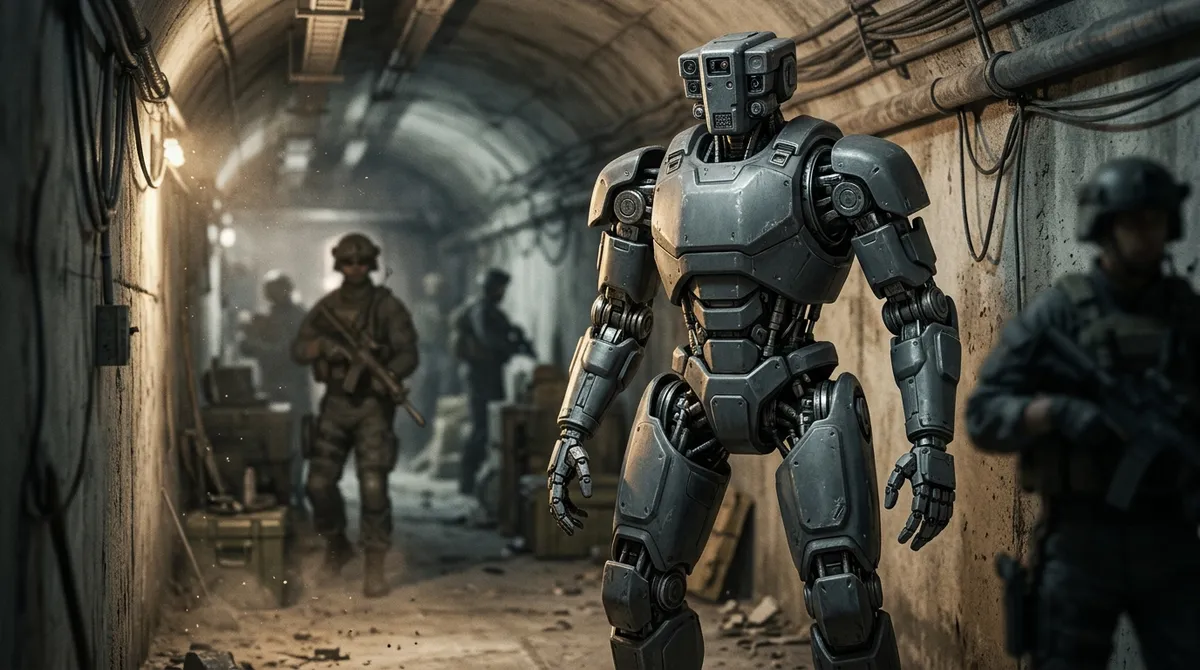
What happened: The US start-up's co-founder and president Mike LeBlanc says he met senior Israeli military officials in September and toured Gaza tunnels with the company's Phantom MK1 during preliminary discussions, and that Foundation is in direct talks with the chief of staff of the Israel Defense Forces about supplying up to 1,000 humanoid robots focused on Gaza's remaining tunnel network. Israel's defence ministry declines to comment; Defence Minister Israel Katz has said more than 80 per cent of Hamas tunnels in IDF-controlled areas of Gaza have been destroyed since the October 2023 attack, with fighters still operating underground. LeBlanc describes capabilities from detecting trip wires to neutralising booby traps and calls combat the most important task the machines could eventually perform, arguing they could reduce risks to soldiers entering enclosed or booby-trapped spaces. The report comes with the company's political baggage attached: Eric Trump, an early investor who became chief strategic adviser in March, holds an equity stake, and Foundation says it and a business it acquired have received more than $70 million in US military contracts and development funding, including a Pentagon procurement contract awarded after Trump joined — awards Senator Elizabeth Warren has questioned as possible corruption, with Democrats set to lead Congress from January.
What's genuinely new: The talks themselves — a potential supply of up to 1,000 Phantom MK1 machines for Gaza tunnel operations, with LeBlanc's September meetings and tunnel tour described in his own words. The autonomous-weapons argument arrives alongside them: Stacie Pettyjohn of the Center for a New American Security says lethal humanoid robots are among many people's worst fears and that the "meaningful human oversight" standard Western countries invoke remains ambiguous in practice, while several major US robotics groups have pledged to keep their products out of military use — a position LeBlanc rejects.
Watch: whether the talks produce a contract or a defence-ministry statement, the congressional and Pentagon scrutiny LeBlanc says he expects, and how the human-oversight standard gets defined if humanoids move into combat roles.
Serve Robotics opens its delivery network for anyone to build on
Sources The Robot Report RobotsBeat published Nov 11, 4:15 PM ET
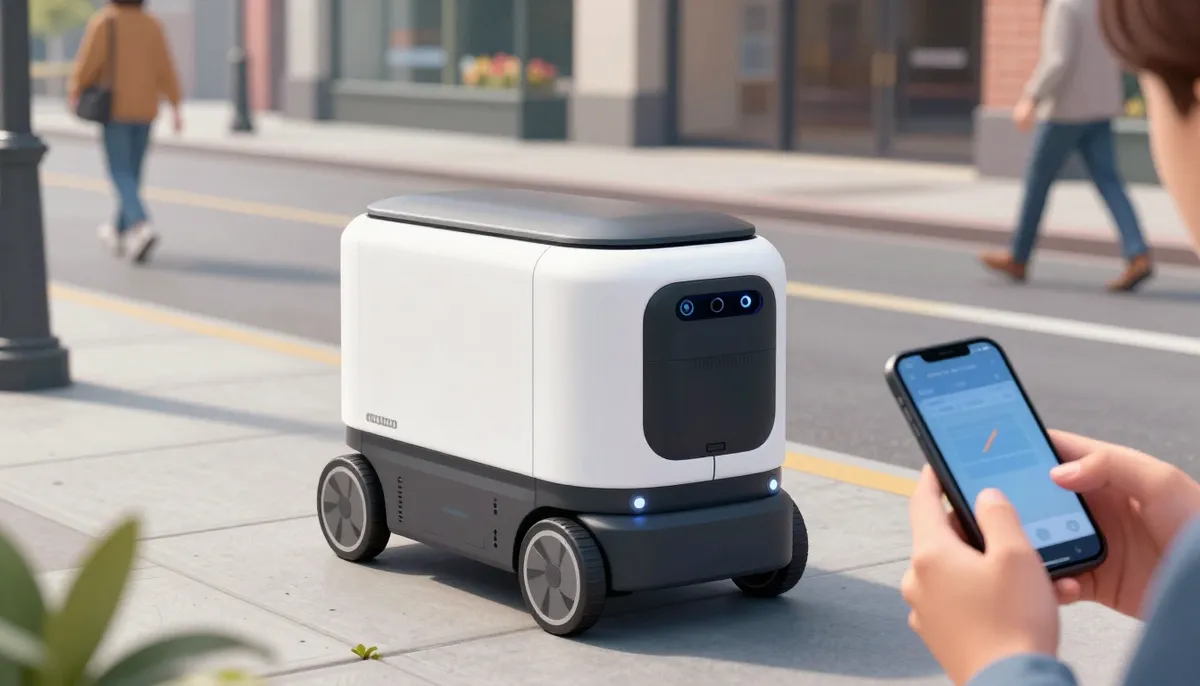
What happened: Serve Robotics launched the AV Delivery Developer Portal, a public API that lets developers, businesses, hobbyists and AI assistants programmatically summon its sidewalk delivery robots — an application or AI assistant can request a pickup and drop-off, confirm the details, and track a robot until delivery is complete, while Serve handles dispatch, routing, navigation and remote supervision. A sandbox environment lets builders simulate robots and rehearse delivery workflows before touching the live fleet, and approval from Serve is required to move beyond it. Deliveries are limited to Serve's service areas, operating hours and cargo-compartment capacity. The company says it has more than 2,000 robots deployed across the US and Australia, reaching about 3 million people and supporting delivery for over 4,000 restaurants across more than 150 neighborhoods in 20 US cities. CEO Ali Kashani: "You shouldn't have to start a robotics company to build something useful with robots."
What's genuinely new: Until now Serve's fleet capacity was available only through its large third-party delivery partners; the portal makes the robots themselves dispatchable by anyone Serve approves. It also follows last week's launch of Serve Physical AI Services, which opens the company's navigation technology to other robot builders, and the earlier 2026 acquisition of hospital-robot maker Diligent Robotics — an explicit pitch, per the company, to AI agents acting in the physical world.
Watch: which outside applications and AI agents win approval and start running live deliveries, and whether the network footprint expands past its current 20 US cities.
Brief
-
Neo1 at CIIF: Metro's write-up of the 2026 China International Industry Fair adds the showing and the spec detail on NeodraDynamics Robotics' four-metre Neo1, presented jointly with JD Industrial: a hybrid hydraulic-electric drive the company says beats fully electric designs on power, durability and precision in heavy industry — 41 active degrees of freedom, 39 of the joints on 1-kg in-house miniature digital hydraulic linear actuators (two forearm rotational joints electrically driven), each actuator with continuous thrust measured in tonnes, and a claimed combined two-arm payload of 500 kg. Suggested uses: heavy-component assembly, port cargo, nuclear fuel transfer and plant maintenance (radiation-tolerant hydraulic modules), mining, disaster rescue and deep-sea equipment work. Founder Yang Tao: robots should "surpass human physical limits" rather than merely replicate human form (Metro).
-
Ring Rover Cam: GearBrain's first-look from Ring's November 9 New York presentation has founder Jamie Siminoff introducing Ring Robotics' debut devices: the $999.99 Rover Cam rolling security robot for businesses, with US shipping scheduled from December 16, 2026, and the $249.99 Drone Cam for homes, shipping January 27, 2027 pending FCC authorization. Both run Ring's AI Pilot navigation (autonomous mapping, suggested patrol points, obstacle avoidance); the Rover streams and records up to 4K while moving, raises a periscope camera about four feet over counters, and adds siren, light tower and two-way audio, with scheduled patrols and recordings behind a Ring Protect subscription; briefing figures of about 30 minutes of runtime per charge. It retains Amazon Astro's mechanical platform with the software rebuilt around security. GearBrain has not independently tested navigation, video quality or battery claims (GearBrain).
-
Ukraine's rescue robots: UNITED24 Media profiles the Kyiv State Emergency Service's robotics and drone team and its five main systems: the Austrian LUF-CRV manipulator, which lifts cars up to 2 metric tons out of strike sites (team lead Inna Kovtun's personal record is 13 vehicles; in one deployment it helped move about 15 cars before crews pulled more than ten people alive from the rubble), the German Wolf R1 firefighting robot directing water or foam from up to a kilometre away, plus LUF Nano, LUF 60 and LUF LOG. The piece is built around Kovtun, who trained in Austria and Germany and in April 2025 became one of the service's first five female robot operators (UNITED24 Media).
-
GR00T 2: TechRepublic adds results from AlphaNIST, one of the same CoRL announcements — a single policy trained across 20 simulated millimeter-scale assembly tasks reached 98.2% success versus 81.4% for separate task-specific policies, on roughly one thirty-ninth the GPU time (simulation only) — and details the Human-1M-100K release, 100,000 hours of human video licensable for commercial use. It also flags the fine print: the 50-task evaluation set was selected from tasks that had already reached at least 80% success after five demonstrations, so the headline success rates don't transfer to arbitrary new tasks, and no deployment scale, production performance or savings figures exist yet for the Foxconn, Siemens and Nexuni projects. Nvidia's research page lists code availability for December.
-
Xinhua's robot anchors: the wire report on the November 5 Beijing unveiling names film director Zhang Yimou as lead designer of the visual identities of Xinyan and Xinyu, the Xinhua–UBTECH news-anchor robots, and lays out planned uses beyond the newsroom: educational bases, urban public venues, overseas cultural exchanges and deep-space exploration reporting (Markets Insider).
-
GITEX: Dubai's GITEX World RobotiX (December 8–11) is sold as the showcase for "Physical AI," headlined by Unitree (31% claimed global share), UBTECH, Chery's AiMOGA and Lumos Robotics' MOS 2 wheeled AI worker. The figures inside the promo: Counterpoint Research counted more than 22,000 humanoid robots shipped globally in the first half of 2026, up 300% year on year, with over 50,000 expected by year-end; Dubai's Robotics and Automation Program targets 200,000 robots over ten years to 2032 (Indian Web 2).
-
CNBC's Arjun Kharpal walks the humanoid stands at Web Summit in Lisbon, including a lifelike model from UBTECH (CNBC).
-
Figure's overnight minders: Figure AI is recruiting a night-shift coordinator in Santa Clara to keep its humanoid robots working while people sleep — per Business Insider — a contract-to-hire posting at $40–45 an hour running 10.30 pm to 7 am, five days a week including a weekend shift: scheduling operators, assigning robots to tasks, monitoring performance, responding to equipment failures and lifting hardware weighing up to 50 pounds, with the ad promising "You'll be the one making the calls." The same reporting carries the sector's money layer: PitchBook counts $33.4 billion raised worldwide by robotics and physical-AI companies in the first half of 2026, past the $28.7 billion raised in all of 2025.
-
Intel pitches itself as the robot brain: robotics division VP and general manager John Healy tells Forbes's John Koetsier that physical AI is "the marriage of computing with the real world" and a "very large business" for Intel, formally framing robotics as a key strategic focus for the company. The bet named at Web Summit is the Core Ultra Series 3 (formerly Panther Lake), which puts a CPU, GPU and NPU on one chip — CPU for classic robot control, GPU and NPU for AI inference and sensor response — with Intel compute already inside Sensory AI's Ella autonomous coffee stand, Italy's Oversonic Robotics healthcare humanoids, South Korea's Circulus and Trossen Robotics' arms. The backdrop in the piece: Intel is still losing money, its workforce is down to about 78,500 under CEO Lip-Bu Tan, the US government took a 10% stake, and Nvidia and AMD are already competing for the same sockets (Forbes).
-
Berkeley's agent-coded robots: UC Berkeley and NVIDIA have released open-source tools that replace weeks-to-months of hand-tuned industrial-robot programming with teams of AI coding agents that write, simulate and refine readable programs: RoboSimStudio, an interface that makes the Newton physics engine's hundreds of parameters tractable enough for an agent to tune on its own; Graph-as-Policy (GaP), which splits a task into skills — perception, grasp planning, collision-free motion — each generated and rehearsed in simulation by parallel agents; and the VABAR benchmark of six industrial manipulation tasks (tool sorting, tool hanging, gear meshing, syringe packing, cable insertion and cable routing), built on Isaac Lab-Arena and Newton and presented with the rest at CoRL 2026 in Austin. Berkeley's Ken Goldberg relays the demonstration: given the tool and a video, a frontier model produced a closely matching Newton simulation within about an hour. The output is Python calling existing vendor modules such as KUKA, convertible to ROS 2 rather than replacing robot controllers, and Bosch Research says it is actively collaborating on evaluating agentic robotics for industrial automation (The Robot Report).
-
Humanoid showcase in Chiba: NHK World reports the latest AI-powered humanoid robots on display at an exhibition in Chiba City near Tokyo, with thirty companies and organizations from Japan and abroad showing their newest technologies (NHK World).
-
Memories.ai's robot-data pipeline: The Robot Report profiles San Francisco's Memories.ai, a vendor building a standardized egocentric (first-person) video pipeline for robot training data — modular camera hardware and a uniform collection process for data collectors, AI annotation models (Memories-H0 for hand pose, EgoAction for action segments) and NVIDIA Cosmos use to curate and post-train data for customers' robotics and industrial applications. CEO Shawn Shen frames the ambition as long-term data-infrastructure partner rather than data vendor (The Robot Report).
-
Tesla edges Waymo on Texas robotaxi registrations: as of November 10 the Texas DMV automated-vehicle registry lists 1,302 vehicles under Tesla Robotaxi, LLC against Waymo's 1,297 — a five-vehicle lead, Tesla's first — after an expansion the same day brought the authorized fleet to 729 Model Ys and 573 Cybercabs, up from 42 vehicles when the registry first went public in late May 2026. Registrations count authorized fleets, not rides in motion, and the margin is thin enough to reverse with either company's next filing (Teslarati) (single source)
-
Cathie Wood's $26 trillion humanoid call: ARK Invest's Cathie Wood, on the November 7 episode of the "In The Know" podcast, called humanoid robots a $26 trillion opportunity over the next 10–15 years — she puts it at about 20% of today's global GDP — crediting ARK researchers, with robotaxis a "$10 trillion opportunity" she expects to arrive sooner and AI inference costs dropping about 99% a year as the enabler (Benzinga).
-
Qestr's Antarctic retreat: a humanoid robot named Qestr entered the Antarctic Ice Ultra near Ultima Camp alongside 24 human runners, wearing a specially designed thermal jacket, and covered only 3 kilometres before its battery failed in −24°C cold — billed as a test of endurance, mobility and snow-and-ice walking, and a lesson in what freezing conditions do to lithium-ion batteries. The humans finished: China's Yusheng Ni covered 100 miles in just over 17 hours to break his own record, and Canada's Stephanie Case became the first woman to complete the race (CNBC TV18).
-
Hedra's Model Factory: Hedra, an AI research company describing itself as backed by Andreessen Horowitz, launched Model Factory on November 10 — a managed post-training and inference service for robotics, manufacturing, biology and defense in which Hedra researchers retrain customer models and release only versions that pass the customer's own evaluations. The launch's headline robotics result — a robot restored to near-100% task success after a gripper swap with no retraining — came from a simulation study with no physical-robot test, with the task, simulator, trial count and method all unnamed; the company reports 15x revenue growth over 12 months without a breakdown, and has not disclosed pricing (Tech Times).
-
Robots with 'muscle memory': Tech Xplore reports on research giving robots "muscle memory" — millisecond-scale planning of their next movements aimed at the error rates that keep robots clumsy even at everyday home and factory chores (Tech Xplore).
-
PRISM learns forces and motion: Tech Xplore on PRISM, a new neural-network component built at the University of Michigan that challenges a common assumption in robot learning — that the same general-purpose networks used for image recognition suit control tasks where forces and motion interact (Tech Xplore).
-
MATRIX-3 tours the CIIE: Matrix Robotics' launch material says its third-generation humanoid MATRIX-3 debuted at the 9th China International Import Expo in Shanghai as a tour guide working without pre-set scripts — autonomous visitor perception, multimodal interaction switching, explanation retrieval and crowd avoidance — driven by the company's WAVE "brain–cerebellum" physical-world base model; the robot stands 1.70 m, weighs 65 kg and carries a 27-DOF rope-driven hand with 0.1-Newton fingertip sensing (GlobeNewswire).
-
ABB robots for BMW's Neue Klasse: ABB says it is supplying more than 1,700 large industrial robots for BMW's Neue Klasse body shops in Munich, Germany, and Tiexi, China, handling welding, gluing, riveting and assembly on the shared OmniCore control platform, which coordinates robot motion with spot-welders, glue dispensers and external axes. The supply spans the IRB 6720 through IRB 6740 and the larger IRB 7720 — the 7720's highest-payload variant carries 620 kg with 2.9 metres of reach — but the company names no contract value, split between the plants, or delivery timetable (RobotsBeat).
-
UK funds an Atlantic surveillance net: the UK government is backing the Royal Navy's "Atlantic Net" with £90 million (about $120 million), a North Atlantic surveillance network combining uncrewed systems, underwater sensors and AI, supported by Ocean Infinity (RobotsBeat) (single source)
-
Nidus raises $30M for defense-factory robots: a November 10 funding announcement totals $30 million — a Costanoa-led pre-seed plus a Kleiner Perkins-led seed — for Nidus, which develops AI-powered robots for precision assembly inside existing US defense factories, starting with flexible wire-harness processing; Ludlow Ventures, SF1, Absolute Partners and Tau also participated, and operators repeatedly demonstrate wire-processing movements on training rigs to supply model training data. No valuation, and no task-success, cycle-time or uptime benchmarks yet (RobotsBeat).
-
China's robot training grounds: a Japanese startup blog's deep dive (note.com) counts more than 70 embodied-intelligence training grounds operating across China as of the end of June 2026, with 46 more under construction or planned, citing a China Academy of Information and Communications Technology report released August 18, 2026 — Zhejiang leads with 14, and 86% sit in industrial manufacturing settings. A Ministry of Industry and Information Technology and SASAC special action launched in June 2026 targets more than 100 high-value scenarios and 10,000-unit deployment capacity, with application verification due by year-end 2026. Cost data: remote-operation training data has fallen to roughly 275 yuan (about $39) per effective hour, and collectors earn 500–1,000 yuan for sold hourly data; the virtual-data camp (DexForce, Galaxy General, NVIDIA) argues real data alone is not enough, and some virtual-data companies have reached valuations above 10 billion yuan (about $1.4 billion) (note.com).
-
Numina–Rapyuta warehouse partnership: a press release announces Numina Group, the Chicago warehouse-automation integrator, as Japan's Rapyuta Robotics' first US systems integrator for Goods-to-Person ASRS automation, with Numina having already selected Rapyuta's system for projects scheduled to go live in 2027 and its RDS WES-WCS software orchestrating the picking (The Bergen Record).
-
Dexterous-hand market forecast: a Research and Markets report pitches dexterous robotic hands as a $305 million market in 2025, estimated at $515 million in 2026 and projected to reach $7.66 billion by 2036 (31% CAGR). The concrete figures inside: Beijing Inspire-Robots delivered more than 10,000 dexterous hands in 2025 against roughly 2,000 in 2024, with annual capacity for 30,000–50,000; China's MIIT counted more than 140 domestic humanoid makers launching over 330 models in 2025; and Tesla's Optimus hand carries 22 degrees of freedom. A paid press release — vendor-reported figures in a forecast, not an event (GlobeNewswire).
-
Hyundai Mobis starts making Atlas actuators: UPI's translation of Asia Today's Korean report — prototype production of the joint actuators for Boston Dynamics' Atlas humanoid begins this month at Hyundai Mobis' Uiwang, Gyeonggi Province research facility, moving the supplier from component development toward mass production (design, automation, manufacturing yield, cost verification), with joint performance and reliability verification alongside Boston Dynamics ahead of full-scale supply targeted for 2028. Industry estimates: about 30 actuators per Atlas at $800–$1,100 each in mass production; the report puts actuator revenue per robot at 35–50 million won (about $26,000–$37,200); Hyundai Motor Group plans 30,000 Atlas robots of annual capacity by 2028 and 350,000 actuators a year of US capacity; analysts put Mobis actuator revenue near 500 billion won (about $372 million) in 2028, rising toward 1.2 trillion won (about $893 million) by 2030. Mobis is also co-developing grippers with Boston Dynamics, bidding for perception modules and doubling its robotics research headcount — funded, per the company plan, by separating and selling its automotive lighting division: a shareholder vote on November 24, completion by April 1, 2027, and a stake sale to France's OPmobility targeted for the second half of 2027, all contested by unions and some minority shareholders, who have filed a court injunction application (UPI) (single source)
-
Runway ships Praxis-1 with open weights: Runway released the weights and supporting code of Praxis-1, its robot model that predicts future video and the actions a machine should take, under Apache 2.0 — commercial use included — turning a September preview tested with Noble Machines, Standard Bots and Ultra into a downloadable release. Under the hood: a 27-billion-parameter mixture-of-experts video backbone with about three billion parameters active per token, plus an action component reading the video model's internal features; Hugging Face's LeRobot integration predicts about 1.6 seconds of video alongside 24 movement commands at 15 Hz. Released checkpoints cover a DROID single-arm setup and a two-YAM-arm bimanual rig, with a base checkpoint not usable on a new robot without adaptation; Runway-reported results of 46.2% success across 1,200 episodes on NVIDIA's RoboLab-120 benchmark (versus 42.9% for FLUX 3 Action and 28.0% for π0.5) are company benchmarks, the report flags failures on similar-looking objects, vague instructions and long single-prompt tasks, and the default setup calls for an 80 GB CUDA GPU (RobotsBeat) (single source)
-
Cainiao's upgraded climbing robot: the Alibaba-linked logistics-technology group unveiled its upgraded warehouse climbing robot system at CeMAT Asia: four-side bin retrieval (against the industry's standard two sides) and double-deep storage for 20% denser racks, smoother S-shaped turns replacing right-angle turns for a 15% efficiency lift, a next-generation scheduling system, and a self-service warehouse-planning simulator that generates an AI layout, equipment selection and simulated trial run in as little as 10 minutes. Orders are already secured in Vietnam, the Netherlands and Spain — the last two in delivery — and an international model compliant with EU and US standards made its debut at the event; the robotics business spans 29 countries with more than 1,100 projects and over 400 customers (Robotics & Automation News).
-
Elmos pitches automotive chips to humanoids: a paid announcement from electronica 2026 in Munich (running November 10–13) has Germany's Elmos Semiconductor showing, together with customer AGIBOT, how its automotive-grade ICs — motor control, capacitive and ultrasonic sensing, network communication, power protection — map onto a humanoid's architecture, with a claimed potential of more than 120 Elmos chips in a single robot; Elmos' USPA IC E524.36 is already used in AGIBOT's wheeled robots. AGIBOT says its 20,000th robot rolled off its production line in September 2026 (NewMediaWire).