Robots digest — Nov 10, 2026
Top line: Google DeepMind unveils Gemini Robotics 2.5 — a 96% success rate on one Mercedes-Benz parts task, with safety training that includes babies and pets — while Axon adds $1.2 billion to its Skydio stake, Path Robotics raises $300 million, and SoftBank talks to rescue its China-blocked $5.4 billion ABB robotics deal.
- Axon pays $1.2 billion for a fifth of drone maker Skydio — and its exclusive public-safety channel
- China blocks SoftBank's purchase of ABB's robotics business in China — rescue talks begin on the $5.4 billion deal
- Google DeepMind unveils Gemini Robotics 2.5: a 96% result on one Mercedes-Benz task, and safety training that includes babies and pets
- Path Robotics raises $300 million at a $2.45 billion valuation to move its welding robots beyond welding
- GR00T 2's learning recipe: five demos to 95%, cross-body skill transfer, and a Turbo version on a Unitree humanoid
- Ring, Amazon's security-camera arm, enters security robotics: a $250 flying Drone Cam and a $1,000 Rover patrol robot
Axon pays $1.2 billion for a fifth of drone maker Skydio — and its exclusive public-safety channel
Sources The Robot Report Axon Investor Relations Axon published Nov 10, 8:06 AM ET
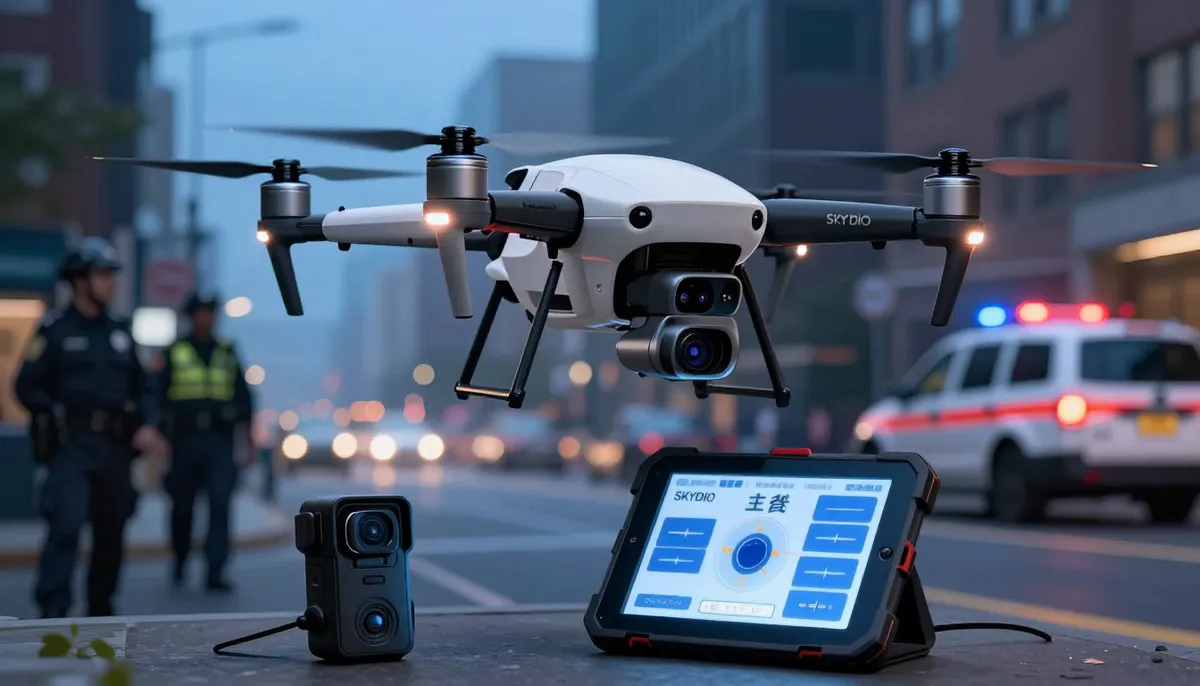
What happened: Axon Enterprise — the company behind police body cameras and the Taser — announced an additional $1.2 billion investment in Skydio, the San Mateo, California drone maker built on AI-backed autonomous flight — a deal that will add roughly 20% to Axon's fully diluted ownership at a $5.2 billion pre-money valuation and make the company Skydio's exclusive public-safety distributor across the US and Canada. The mix of cash and Axon stock, covering both primary capital for Skydio and purchases from existing shareholders, is expected to close in the fourth quarter of 2026 and the first quarter of 2027, pending closing conditions (Axon Investor Relations). Skydio serves more than 1,500 public-safety customers and says it expects about $1 billion in total bookings in its current fiscal year; Axon says more than 28 million Americans now live within two miles of a Drone as First Responder dock, where priority response times have fallen by as much as 65 percent and drones arrive before officers on about 80 percent of calls. Under the expanded partnership, Axon becomes Skydio's exclusive distributor for public safety in the U.S. and Canada, a channel Axon values at roughly $13 billion in total addressable market for Drone as First Responder across the two countries (Axon). Axon says more than 28 million Americans now live within two miles of a Skydio DFR dock, that drones arrive before officers on roughly 80% of calls where they are deployed, and that priority response times have fallen by as much as 65%, while Skydio — which counts more than 1,500 public safety customers — expects about $1 billion in total bookings this fiscal year (Axon Investor Relations).
What's genuinely new: ownership changes hands in public-safety drones — the dominant law-enforcement technology vendor converting its distribution relationship into an additional $1.2 billion investment that will lift its fully diluted ownership by roughly a fifth at a $5.2 billion pre-money valuation, with Axon pegging the US-and-Canada Drone as First Responder market at roughly $13 billion by its own estimate. The same report puts sector money behind the deal's timing: delivery-drone maker Zipline raised $1.5 billion in funding, and investors poured $33.4 billion into robotics and physical AI companies worldwide in the first half of 2026, per PitchBook, above the $28.7 billion raised in all of 2025.
Watch: the transactions closing in the fourth quarter of 2026 and first quarter of 2027, the DFR footprint growing beyond the 28 million Americans now within two miles of a dock, and whether other drone makers draw strategic investors of this size.
China blocks SoftBank's purchase of ABB's robotics business in China — rescue talks begin on the $5.4 billion deal

Sources Manufacturing Dive
What happened: China's Office of the Working Mechanism for Foreign Investment Security Review notified SoftBank on November 4 that it had prohibited the acquisition of ABB's robotics business in China, forcing the companies to regroup on their $5.4 billion transaction; SoftBank said on November 6 that both parties are "working constructively on the transaction," and industry experts expect a carve-out or compromise to salvage the acquisition, first reported by Bloomberg (Manufacturing Dive). ABB is one of the world's leading robotic-arm manufacturers; its robotics business generated $1.7 billion of revenue through the first nine months of 2026 with a $23 million net loss, and China accounts for about 30% of the segment's revenue and hosts its fully automated 721,000-square-foot Shanghai factory — the likely reason the transaction needed Chinese security-review approval. ABB first planned to spin the robotics business into a separately listed company in April 2025, then pivoted months later to selling it to Japan-based SoftBank by mid-to-late 2026; SoftBank's stated motive is doubling down on physical AI, with investments in more than 30 companies including Agile Robots and Berkshire Grey. The block lands in a tense trade climate: the US administration over the summer blocked imports of mobile robotic devices including humanoids and quadrupeds on national-security grounds, and lawmakers have added robot-related provisions to the defense-authorization bill. SoftBank also posted a quarterly loss driven by $3.7 billion in data-center equipment costs.
What's genuinely new: a Chinese national-security review blocking the China portion of a $5.4 billion robotics acquisition, and the two parties reopening talks on a structure — a carve-out, another buyer, or a compromise — that Beijing might approve; six-axis industrial robots have become a proxy in the wider AI contest between states.
Watch: the shape of the carve-out SoftBank and ABB land on, whether another China-approved buyer emerges, and whether the mid-to-late-2026 close target slips.
Google DeepMind unveils Gemini Robotics 2.5: a 96% result on one Mercedes-Benz task, and safety training that includes babies and pets
Sources RobotsBeat Xenospectrum The Telegraph Interesting Engineering Unite.ai IoT Tech News published Nov 10, 6:57 PM ET
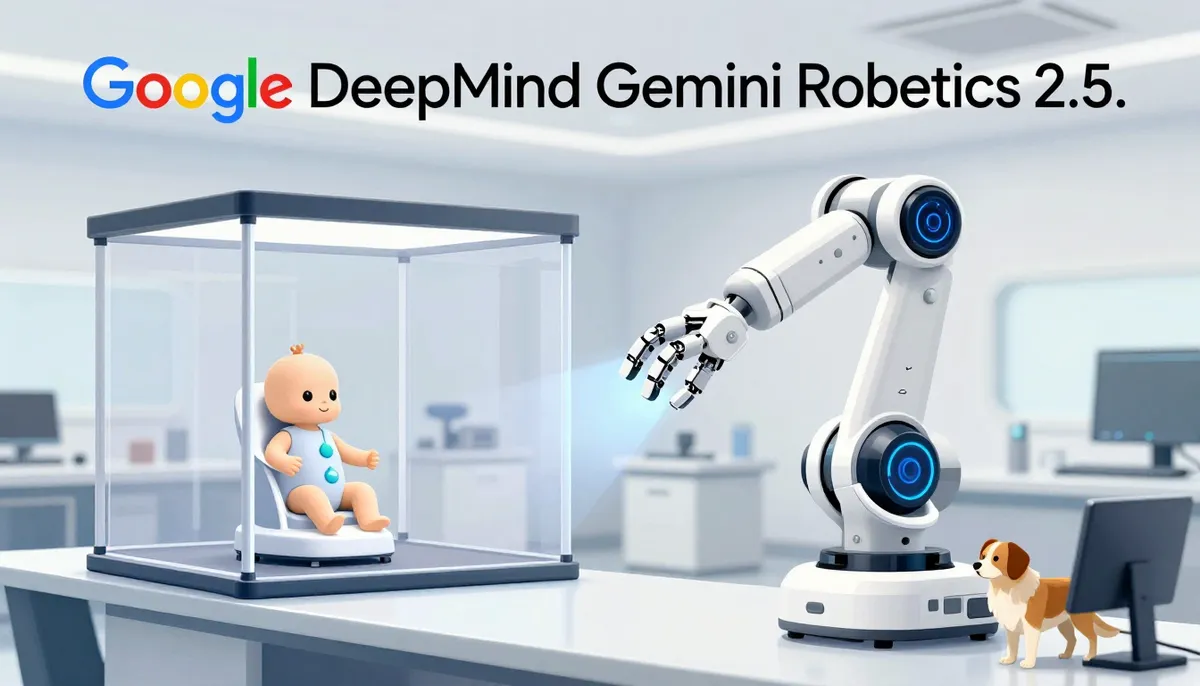
What happened: DeepMind's November 10 announcement introduces Gemini Robotics 2.5, the vision-language-action model the company calls its most capable for robots, pairing a high-level "Gemini Robotics ER" task tracker with a new action model that controls hand and arm movements. On live Mercedes-Benz production lines in Kecskemét, Hungary and Sindelfingen, Germany, Apptronik's Apollo 2 humanoid — fitted with a five-fingered, 22-degrees-of-freedom SharpaWave hand — sorted loosely tossed metal brackets into the sequence each vehicle needs at a reported 96% success rate (RobotsBeat; Xenospectrum). The model was evaluated on roughly 200 tasks — handling food with tongs, tying a gift bow, pipetting into a test tube — with success rates 30–100% above previous baselines and completion times 20–30% faster, and a training pipeline built on Gemini 4 Argon generates simulated practice scenarios from real camera footage. The announcement is explicit about limits: the 96% covers only the tested parts-preparation task, with no trial counts, evaluation period or human-intervention rate given, and the improvement figures are relative, not absolute rates. Safety reporting alongside the release (The Telegraph) describes a "profound escalation in risk" moving AI into the physical world: the robots are trained to avoid harming babies and pets within a taxonomy of 15 hazard categories, to refuse unsafe tasks and to ask for human help. External testers at Robocurve previously found physical-AI robots could be talked into dangerous actions — stabbing a baby doll, putting a flammable can on a hob — in 27% of trials, rising to 88% when camera footage was blurred. A third layer is hardware: Apollo 2 stops when objects enter a configured zone. Access begins with robotics partners and an early-access waitlist rather than a general developer rollout, and the model is pitched as nearing "human-level dexterity". Apptronik CEO Jeff Cardenas: "we saw the models improve dramatically in just a few weeks of post-training and carry over to Mercedes-Benz production with very little drop-off."
What's genuinely new: the caveats layer on the launch-day numbers — 96% scoped to a single kitting task, relative success gains rather than absolute ones, the 99.5% jailbreak-resistance score belonging to Gemini 4 Argon rather than Robotics 2.5 itself, and availability through a partner-plus-waitlist channel rather than open download — plus DeepMind naming babies, pets, biohazards, fire, chemicals and batteries among the hazards its robots are being trained to steer around as they leave the lab.
Watch: independent verification of the 96% Mercedes-Benz result and disclosure of how often humans intervened, whether the waitlist opens into general availability, whether ASIMOV-Jailbreak becomes a sector standard, and which partner deployments follow Apptronik's.
Path Robotics raises $300 million at a $2.45 billion valuation to move its welding robots beyond welding
Sources Securities.io Bastille Post
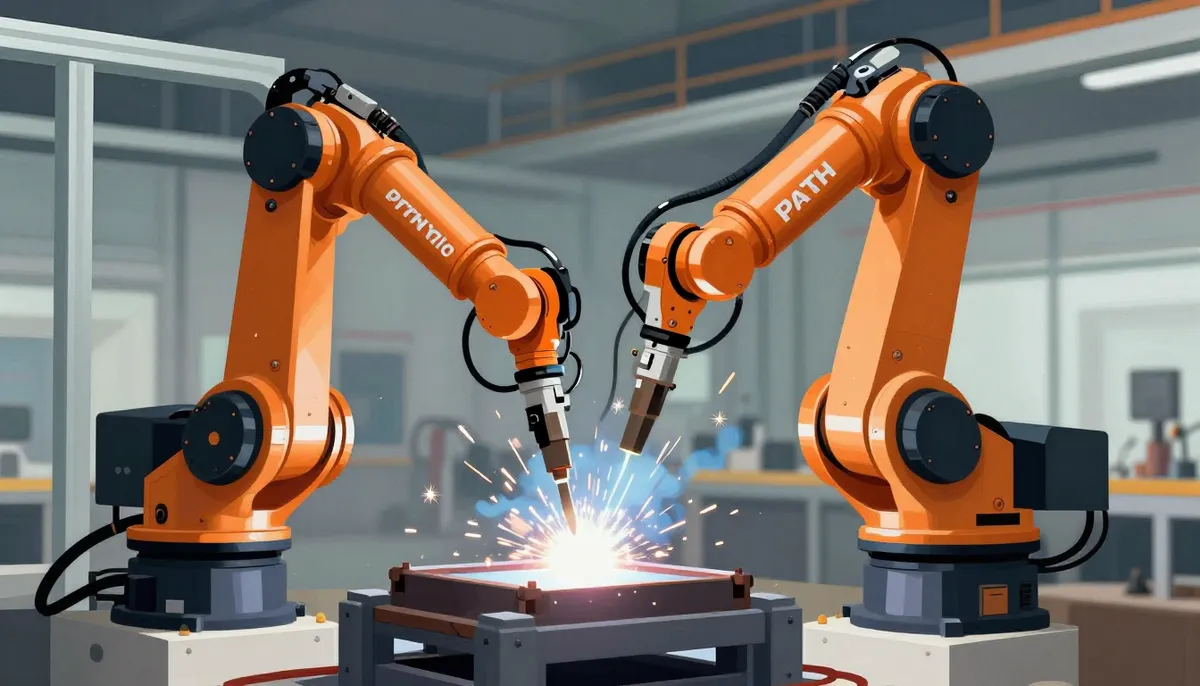
What happened: Path Robotics, the Columbus, Ohio company automating factory welding, announced $300 million in Series E financing at a $2.45 billion post-money valuation, led by Georgian, an AI-focused growth-equity firm whose partner Emily Walsh joins the board. Existing investors Addition, Drive Capital, IronArc Ventures, Tiger Global and Yamaha Motor Ventures (with affiliates) took part, alongside new investors D. E. Shaw Ventures and NAVER Ventures (Securities.io; Bastille Post). The round follows 18 months in which Path reports annual recurring revenue grew 17-fold as deployments scaled across North American manufacturers — the customer list includes shipbuilder HII, Lockheed Martin and Saronic, plus mid-sized makers such as EK Machine and TYCROP — while its workforce grew 97% year over year, targeting 400 employees by the end of 2026. Since its 2018 founding the company says it has raised more than $610 million. Its Obsidian model uses real welding data so robots can identify weld joints, plan and execute welds and adapt to changing conditions, and the Rove system introduced on April 16, 2026 puts Obsidian on a quadruped for large, immovable workpieces. CEO and co-founder Andy Lonsberry: "Our goal isn't to automate one step, but to automate the entire factory."
What's genuinely new: the $2.45 billion pricing and what the money is for — expansion beyond welding into new manufacturing tasks and robotic form factors, plus investment in data, compute and AI-model training. The financing lands on top of a $600 million performance-based production agreement with HII for US Navy shipbuilding: HII's August 6, 2026 announcement describes up to $900 million in combined shipbuilding work over seven years across Path and fellow robotics supplier GrayMatter Robotics, with awards contingent on hitting technology, manufacturing-readiness and performance milestones before delivery-phase sourcing can start with small steel structures and scale up.
Watch: the beyond-welding expansion producing named deployments and new form factors, HII delivery-phase sourcing after its milestone gates, and whether the 400-employee target holds by year-end.
GR00T 2's learning recipe: five demos to 95%, cross-body skill transfer, and a Turbo version on a Unitree humanoid
Sources Interesting Engineering Martín Cid NVIDIA GEAR The Robot Report
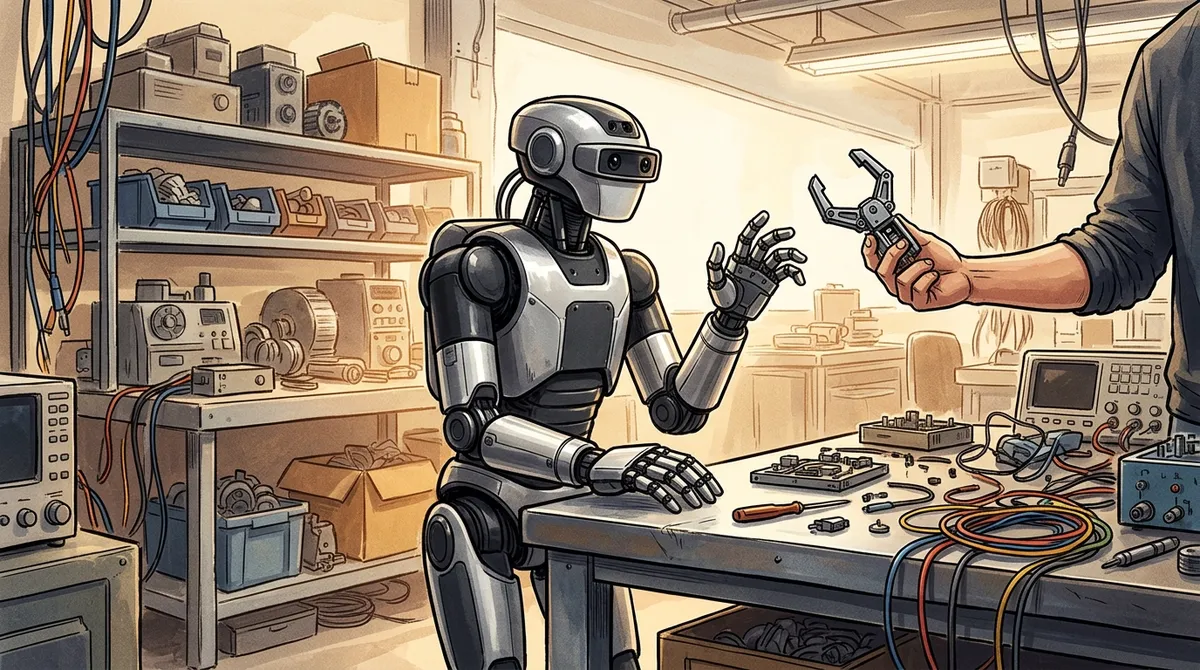
What happened: A day after Nvidia unveiled GR00T 2 at the Conference on Robot Learning in Austin on November 9, new reporting sets out how the robot foundation model actually learns. It predicts future video and robot movements together, and uses what Nvidia calls X-Adapt to move a skill shown by a human or a different robot body onto a machine that never practiced the task. Zero-shot, GR00T 2 succeeds in 40% of trials, completing 40 of the 50 unseen tasks at least once; one demo per task lifts average success to 71%, and five demos plus a 30-minute fine-tune on one RTX 5090 to 95% (NVIDIA GEAR). GR00T 2 is a world-action model that predicts future video and robot actions together, which NVIDIA says lets a robot learn a chemistry-lab task — lining a funnel with filter paper and wetting it with a wash bottle — shown to it only by humans, succeeding in 65% of trials with no teleoperated demonstration of that task (NVIDIA GEAR). NVIDIA says GR00T 2 ranks among the top three models on the RoboCasa365, RoboLab, RoboDojo and MolmoSpaces benchmarks, with Foxconn applying it to factory automation for server manufacturing and Siemens evaluating it across industrial use cases (The Robot Report).
What's genuinely new: the numbers behind the launch. Training drew on 402,730 hours of first-person human video (100,000 hours of the Human-1M dataset open), 10,184 hours of handheld-gripper demonstrations and 23,500 hours of teleoperation. In cross-body tests, a human-only demonstration of lining a lab funnel with filter paper was completed in 65% of trials by a five-fingered robot; a handheld gripper's toy-truck assembly demo transferred to a YAM arm that never saw the task, finishing 60% of trials; a finger-mirroring wearable taught two-handed tasks including match striking. Paired with reasoning models that chain and steer skills, GR00T 2 completed at least 97 of 100 trials on each of three toy assemblies and recovered from errors, while a visual-steering grasp-marking feature lifted short-task success from 40% to 92% on YAM. A smaller GR00T 2 Turbo runs onboard a Unitree G1's Jetson Thor at 124 milliseconds per prediction, serving popcorn in 48 of 48 trials and clearing a table in 93%. Further reporting adds the availability caveat: Nvidia describes the model as open, yet its weights had not appeared on the company's GitHub or Hugging Face pages — the newest download there remains the earlier GR00T N1.7 — with no date for public release, and the Isaac Lab 3.0 training framework it shipped alongside runs on the open Newton physics engine, measured up to 2.5 times the training throughput of Isaac Lab 2.3 in one hand-manipulation benchmark, and arrived with two new open benchmarks, DexBench and VABAR. No pricing or customer availability remains disclosed.
Watch: whether X-Adapt's human-to-robot results replicate outside Nvidia's own evaluations, how Turbo spreads beyond the Unitree G1, when the model's weights reach public download, and whether the Foxconn and Siemens industrial evaluations become deployments.
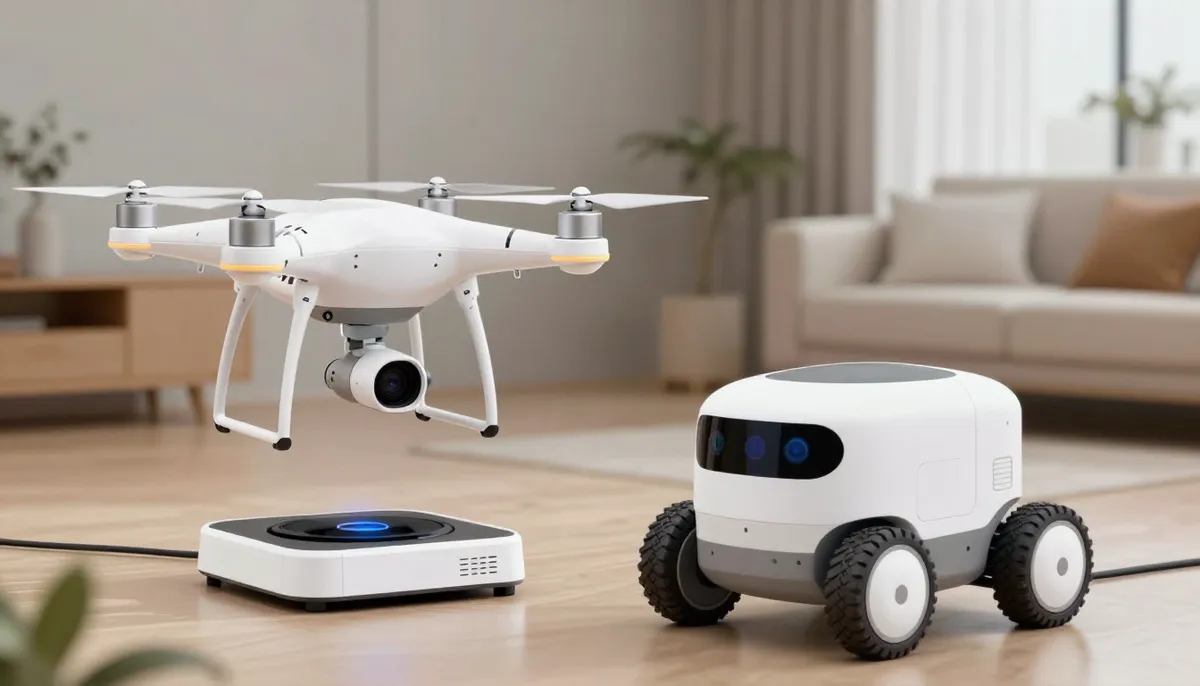
Ring, Amazon's security-camera arm, enters security robotics: a $250 flying Drone Cam and a $1,000 Rover patrol robot
Sources RobotsBeat TechBuzz published Nov 10, 4:08 PM ET
What happened: Ring, the Amazon-owned doorbell-camera company, announced it is shipping two autonomous security robots: a $250 Drone Cam — the company's first flying product, which patrols indoor spaces when homeowners are away and launches from a charging dock to investigate alerts — and a $1,000 Rover rolling patrol robot for businesses, with US shipping planned for December and January respectively and FCC approval still pending for the drone (RobotsBeat). Both integrate with Ring's existing camera ecosystem and mobile app and use computer vision to distinguish normal household activity from potential threats, an attempt to cut the false alarms that plague motion sensors; the home drone requires a subscription to Ring's Protect service for cloud storage and advanced AI features (RobotsBeat; TechBuzz). TechBuzz frames the launch as Amazon's most aggressive push into physical AI since acquiring Ring for more than $1 billion in 2018; the enterprise rover includes two-way audio so remote security personnel can speak with people on-site, positioning it against traditional guard patrols — a comparison that raises job-displacement questions in the security industry. Ring's history of criticism over law-enforcement partnerships and data sharing makes actively patrolling flying cameras in homes an obvious privacy flashpoint, from data storage and footage access to how the AI decides what counts as a threat.
What's genuinely new: pricing, categories and dates for a consumer-facing security-robot pair sold into one of the largest smart-home install bases — a $250 indoor flying camera and a $1,000 business rover, with shipping windows and an approval gate ahead — moving Amazon's security line from passive recording to active patrol.
Watch: FCC approval of the drone, whether the December and January shipping windows hold, the full subscription pricing, and the privacy and regulatory response to patrols inside homes.
Brief
-
Tesla hardware vice president Lars Moravy floated focused lasers as a windshield-wiper replacement to keep Robotaxi cameras clear in bad weather — the first named weather-workaround idea for the camera stack on Cybercab, the vehicle Musk's company is prioritizing after setting mid-2027 as the Cybertruck line's shutdown. Musk added that the Cybertruck order rate far exceeds the production rate ahead of the shutdown "in about 8 months," with deposits to be returned to many orderers.
-
Boston Dynamics put wheels on Atlas, sending the humanoid skating, drifting and through a full 360-degree jump — a research testbed, not a product, built around a control-engineering question rather than a sale: the team fitted scooter rims to the ankle actuators with a custom adapter and tuned its simulated motor model against real Actuator measurements so learned policies can't rely on moves physical motors can't make. The spinning jump began with a motion-capture recording of a person performing the move, and controls engineer Xiaoyu "Andy" Wu says the hardware attempt worked on its first try. Lessons are being adapted to Atlas in its standard configuration, with actuator-failure response named as an open research direction. (RobotsBeat)
-
A humanoid robot named Qestr joined roughly two dozen human runners (reports put the count at 24 or 25) in the Antarctic Ice Ultra near Ultima Camp on November 8 but quit after about three kilometres when its battery drained, highlighting how cold — temperatures reached minus 24°C — saps lithium-ion performance; a fuller account adds race distances of 50 km to 100 miles and that Chinese runner Yusheng Ni won the 100-mile distance in 17 hours 2 minutes 24 seconds (Tuko) (Moneycontrol)
-
At Web Summit, Agibot took public aim at its humanoid rivals, according to Forbes' John Koetsier: "Figure never dance, Optimus never seen, Unitree only dance, Agibot dance and work" — a competitor-claims speech with no independent verification of the working claim yet. (Forbes)
-
HD Hyundai Robotics unveiled at FIX 2026 in Daegu a dual-arm industrial robot with five-finger hands running the company's own robot foundation model onboard — it generates movements from its surroundings instead of task-by-task programming — starting with kitting and assembly and planning welding and painting, with a wheeled platform first and bipedal walking as a longer-term aim; the company also says its August-start Palantir collaboration has cut average robot problem-resolution time from 21.5 days to 7.9 days, and projects AI agents will cut robot programming costs by more than half — both figures company-reported. (Konsulteer)
-
Figure AI is hiring a night-shift coordinator in Santa Clara to oversee its humanoid robots through the graveyard shift — scheduling and coaching the human team, troubleshooting failures and safety issues, sometimes operating the machines itself — at $40 to $45 an hour, 10:30 p.m. to 7 a.m., plus weekend shifts and the ability to move hardware weighing up to 50 pounds; the role opens as a temporary contract with the possibility of permanent employment, and Italian coverage frames the posting as a profession taking shape (Il Messaggero). The company is also seeking humanoid robot operators to test and validate new behaviors. Context from the same report: investors put $33.4 billion into robotics and physical AI companies worldwide in the first half of 2026, per PitchBook, above the $28.7 billion raised in all of 2025, and Agility Robotics rival went public through a SPAC merger the prior week. (Business Insider)
-
Intel and Altera said they are jointly developing real-time sensor-bridge reference systems for edge and physical AI — pairing Intel compute, connectivity and software with Altera FPGAs to simplify wiring increasingly sensor-rich machines together — with robotics, healthcare and aerospace/defense named as first targets, and reference solutions to reach developers through Intel's Open Edge Platform SDK and an Altera SDK. (The Robot Report)
-
UC Berkeley researchers describe an "agentic robotics" method that has AI agents write robot-control programs, test them in Nvidia's Isaac simulator, and revise them after real-world failures: in one demonstration the system built a physics simulation from a short video of a sponge wiping ink off a metal bar, watched the physical robot knock the bar over, and corrected itself from the failure footage. A warehouse robotics customer applied the methods to parcel sorting and deployed the improvements across 30 percent of its US fleet, with the trial credited with more than 15,000 additional packages sorted per robot annually; open-source code and an industrial benchmark are planned. Immediate use is structured industrial settings, not arbitrary household tasks. (Interesting Engineering) (single source)
-
Impossible Metals says its autonomous Eureka robot recovered about 450 grams of polymetallic nodules from more than 4,000 meters down in the Pacific's Clarion-Clipperton Zone during a September scientific dive reported by Reuters — the vehicle hovered above the seabed, selected individual targets while leaving nodules with visible life in place, and lifted the sample by displacing water rather than using a riser pipe; a larger Eureka III environmental study with an independent scientific team and the German research vessel RV SONNE is planned for 2027, and the company has disclosed backing from In-Q-Tel and the FedEx Smith family. The 450-gram sample reflects a scientific, not commercial, purpose. (RobotsBeat)
-
NXP launched a unified robotics platform with an open-source software development kit and drone reference designs covering autonomy computing, flight management, sensor networking and motor control — available now for drones, with service robots and autonomous mobile robots on a second-half-2027 roadmap. (RobotsBeat)
-
Beni, Mondo Robotics' 4-pound self-righting camera robot for hands-free filming of runners and creators, went on sale November 10 at $799 for the Standard Combo ($959 Explore, with two extra batteries and off-road wheels) after a Kickstarter that raised more than $5 million from 7,926 backers; it records up to 4K video, tops out at a stated 17.9 mph and jumps up to 10 inches, and independent hands-on testing found it capable on varied terrain but prone to tracking losses and collisions with stationary objects — supervision required. (Gadget Review)
-
Dubai's GITEX World RobotiX (December 8–11) previews a humanoid showcase — headliners include Unitree, UBTECH, Lumos Robotics' MOS 2 wheeled "AI worker" and Raydiculous' Arabic- and English-speaking TP01 — carrying market data that more than 22,000 humanoid robots shipped globally in the first half of 2026, up 300 percent year on year, with shipments expected to exceed 50,000 units by year-end (Counterpoint Research), while Dubai targets 200,000 robots deployed over ten years to 2032. (Pan African Visions)
-
MIT and NYU researchers unveiled FLEX, a system that lets people correct robots in plain language: a warning about carrying coffee near a laptop becomes a general rule about avoiding electronics, via three operations (Add, Generalize, Mask) that edit the features guiding robot behavior — presented at the Conference on Robot Learning with a 12-person simulation study, not yet an autonomous home robot. (RobotsBeat)
-
China's robotics suppliers keep landing foreign development partners: The Information reports Meta built a humanoid prototype called Max with Shanghai's Fourier in about three months and is already working on a second version — following Nvidia's June open humanoid reference design pairing Unitree's H2 Plus body with its Jetson Thor platform and Isaac GR00T, Hitachi's May agreement with UBTECH to develop robot manufacturing solutions with on-site testing of the Walker S2 at a Hitachi elevator factory, and Intel China's January memorandum of understanding with JAKA Robotics; IDC puts Chinese makers at more than 95 percent of worldwide humanoid shipments in the first half (China Daily)
-
BYD demonstrated a robotic charging arm that finds a vehicle's charging port, opens the cover and plugs in without the driver touching a cable, shown in Abu Dhabi as part of an integrated solar-generation, battery-storage and Flash Charging system that can take a battery from 10% to 70% in five minutes; BYD plans 6,000 Flash Charging stations globally by the end of 2027 (Electrek)
-
Rainbow Dynamics, the US–UK warehouse-robotics startup whose 4D pallet shuttles and RackBot serve Nippon Express and Bosch, added Netherlands integrator Valor Material Handling as a partner and sells only through system integrators; founder and CEO Alfred Chen credits sub-six-month project promises and owning both its warehouse-control and warehouse-management software layers (TMCnet)
-
Dynamic Creatures — Boston Dynamics' hospitality and entertainment partner — is pairing with Sixth Wall Studio, the AI studio Hasbro launched in June 2026, to put Hasbro characters on its expressive robots for theme parks and resorts, combining Sixth Wall's CharacterOS voice-and-personality platform with Dynamic Creatures' movement and expression systems; deployments and venues are still unannounced (The Robot Report)
-
Elon Musk says Tesla will probably rent Optimus to businesses rather than sell it first — asked at investor Ron Baron's November 6 conference, with no price attached; his stated productivity bar for the robot is five times a human worker, mostly an hours argument (168-hour weeks), and outside companies aren't expected to get robots until the end of 2027 (Forbes)
-
Disney's exploratory parking robots — FieldAI systems floated to guide drivers through theme-park lots — are styled after Cars and WALL-E, per new reporting, with no deployment date or named resort confirmed (Gadget Review)