Gemini Robotics 2.5

Where it stands: Google DeepMind has launched Gemini Robotics 2.5 to robotics partners and an early-access waitlist, claiming 30–100% higher success and 20–30% faster task completion than earlier baselines across 200-plus tasks. A Mercedes-Benz proof of concept had Apptronik’s Apollo 2 perform automotive kitting at a claimed 96% success rate for that tested task, with trial counts and human-intervention rates undisclosed. Watch independent verification of those figures and wider named deployments.
Latest
- (Google DeepMind post, relayed by Demis Hassabis — x.com/demishassabis): development — a new robotics plugin for Google Antigravity running on Gemini 4 Hydrogen gives a user-facing workflow for teaching tasks: connect a supported robot arm, let it practice in MuJoCo simulation, then run the task in the real world via plain conversation. Supported-arms list, availability and pricing not yet published. Single source.
- Google DeepMind introduced Gemini Robotics 2.5, its most capable vision-language-action model, rolling out to its robotics partners — evaluated across 200+ distinct tasks (food serving with tongs, gift-bow tying, pipetting) at claims of 30–100% higher success rates and 20–30% faster task completion over previous baselines, with stronger handling of deformable and delicate objects. Named real-world deployment: a proof-of-concept on Mercedes-Benz production lines in Kecskemét, Hungary and Sindelfingen, Germany, where Apptronik's Apollo 2 humanoids autonomously performed automotive kitting at a 96% success rate. Safety claims: inference-time physical steerability lifted safe task completion 33% around obstacles and 43% around people, and the new open-source ASIMOV-Jailbreak benchmark shows 99.5% jailbreak resistance for Gemini 4 Argon versus 82% for the previous baseline. Development was accelerated using Gemini 4 Argon as a simulation engine. Watch: partner uptake in named deployments, independent verification of the Mercedes-Benz figures, whether ASIMOV-Jailbreak becomes standard, and partner pricing terms. (Google DeepMind)

AI image - development — the launch-day coverage adds the scope and safety caveats. The 96% Mercedes-Benz figure applies only to the tested parts-sorting/kitting task, with no trial counts, evaluation period or human-intervention rates disclosed; the 30–100% success and 20–30% speed gains are relative improvements over earlier baselines across roughly 200 tasks, not absolute rates; and ASIMOV-Jailbreak's 99.5% resistance score belongs to Gemini 4 Argon, not Robotics 2.5 itself. Access begins with robotics partners and an early-access waitlist, not a general developer rollout. Safety layer from DeepMind's own team: robots trained to avoid harming babies and pets within a 15-category hazard taxonomy, Apollo 2's hardware stop zones, and Robocurve tester findings that physical-AI robots can be talked into dangerous actions in 27% of trials, rising to 88% with blurred camera footage. Apptronik CEO Jeff Cardenas: the models improved dramatically in weeks of post-training and carried over to Mercedes-Benz production with little drop-off. Watch: independent verification of the 96%, intervention-rate disclosure, the waitlist opening to general availability, and ASIMOV-Jailbreak adoption as a standard.
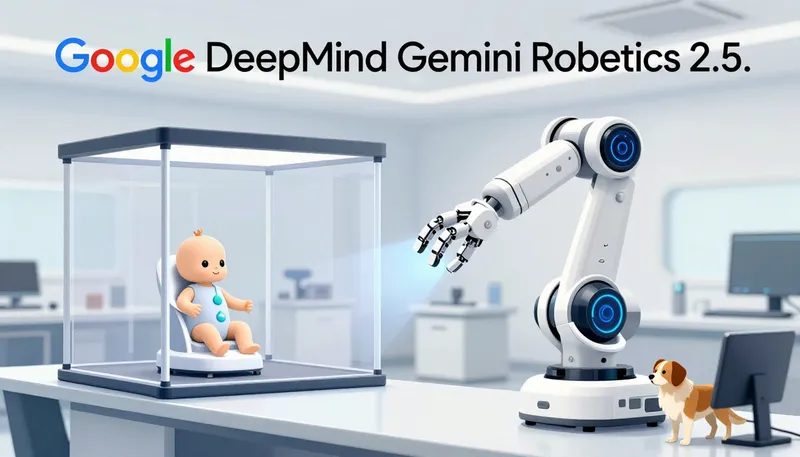
AI image RobotsBeat — robotsbeat.com Xenospectrum — xenospectrum.com/en The Telegraph via AOL — aol.com/articles