Google DeepMind unveils Gemini Robotics 2.5: a 96% result on one Mercedes-Benz task, and safety training that includes babies and pets
From the Robots digest for Nov 10, 2026
Sources RobotsBeat Xenospectrum The Telegraph Interesting Engineering Unite.ai IoT Tech News published Nov 10, 6:57 PM ET
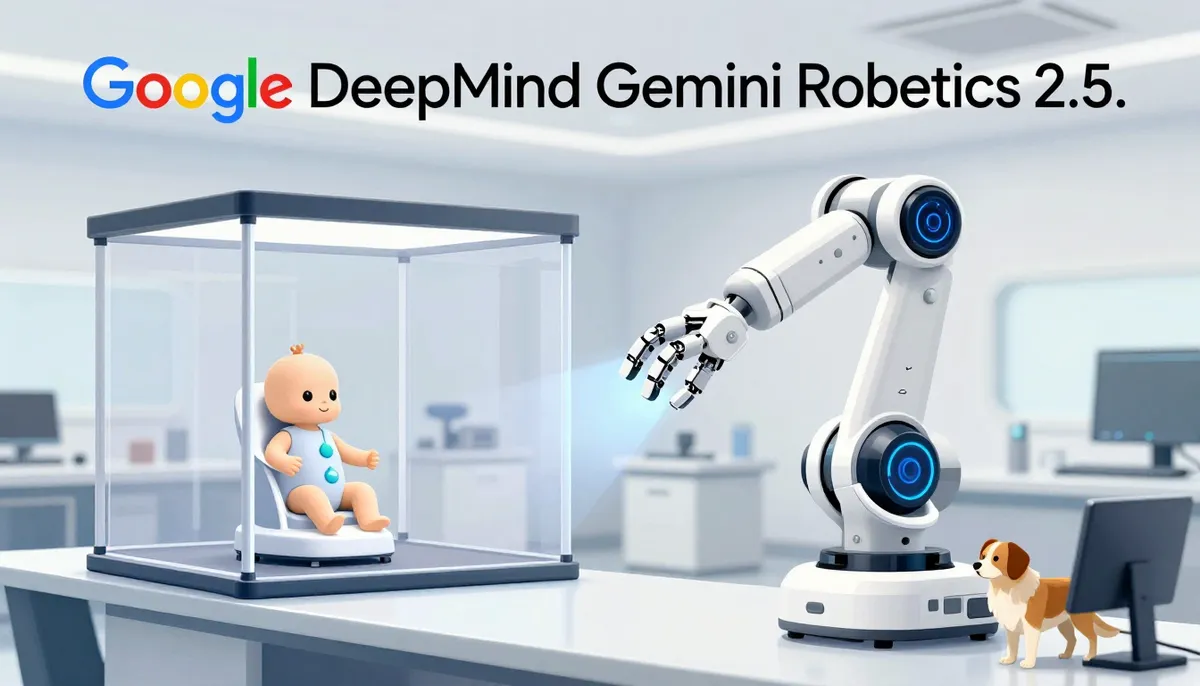
What happened: DeepMind's November 10 announcement introduces Gemini Robotics 2.5, the vision-language-action model the company calls its most capable for robots, pairing a high-level "Gemini Robotics ER" task tracker with a new action model that controls hand and arm movements. On live Mercedes-Benz production lines in Kecskemét, Hungary and Sindelfingen, Germany, Apptronik's Apollo 2 humanoid — fitted with a five-fingered, 22-degrees-of-freedom SharpaWave hand — sorted loosely tossed metal brackets into the sequence each vehicle needs at a reported 96% success rate (RobotsBeat; Xenospectrum). The model was evaluated on roughly 200 tasks — handling food with tongs, tying a gift bow, pipetting into a test tube — with success rates 30–100% above previous baselines and completion times 20–30% faster, and a training pipeline built on Gemini 4 Argon generates simulated practice scenarios from real camera footage. The announcement is explicit about limits: the 96% covers only the tested parts-preparation task, with no trial counts, evaluation period or human-intervention rate given, and the improvement figures are relative, not absolute rates. Safety reporting alongside the release (The Telegraph) describes a "profound escalation in risk" moving AI into the physical world: the robots are trained to avoid harming babies and pets within a taxonomy of 15 hazard categories, to refuse unsafe tasks and to ask for human help. External testers at Robocurve previously found physical-AI robots could be talked into dangerous actions — stabbing a baby doll, putting a flammable can on a hob — in 27% of trials, rising to 88% when camera footage was blurred. A third layer is hardware: Apollo 2 stops when objects enter a configured zone. Access begins with robotics partners and an early-access waitlist rather than a general developer rollout, and the model is pitched as nearing "human-level dexterity". Apptronik CEO Jeff Cardenas: "we saw the models improve dramatically in just a few weeks of post-training and carry over to Mercedes-Benz production with very little drop-off."
What's genuinely new: the caveats layer on the launch-day numbers — 96% scoped to a single kitting task, relative success gains rather than absolute ones, the 99.5% jailbreak-resistance score belonging to Gemini 4 Argon rather than Robotics 2.5 itself, and availability through a partner-plus-waitlist channel rather than open download — plus DeepMind naming babies, pets, biohazards, fire, chemicals and batteries among the hazards its robots are being trained to steer around as they leave the lab.
Watch: independent verification of the 96% Mercedes-Benz result and disclosure of how often humans intervened, whether the waitlist opens into general availability, whether ASIMOV-Jailbreak becomes a sector standard, and which partner deployments follow Apptronik's.