Robots digest — Nov 19, 2026
Top line: Tesla's Cybercab opens public rides in Dallas, its second US city after Austin, as Texas registrations pass 750. Foundation Future Industries, its payroll unpaid since October 30, is banking on a $150 million South Korean lifeline from Base Group. Rheinmetall says military humanoid prototypes could be ready in 15 to 18 months.
- Tesla Cybercab opens public rides in Dallas, its second city after Austin
- Rheinmetall CEO: military humanoid prototypes could be ready in 15 to 18 months
- Foundation Future Industries, payroll stopped, banks on a $150m South Korean lifeline
Tesla Cybercab opens public rides in Dallas, its second city after Austin

Sources Teslarati published Nov 19, 1:06 PM ET
What happened: Tesla made Dallas the second US city for public Cybercab rides after Austin, confirming the launch on November 19 with the post "Howdy Dallas. Cybercab has arrived in your city." Riders can book through the Tesla Robotaxi app; the two-seat, steering-wheel-free vehicle joins a city where Tesla's Model Y robotaxis have run unsupervised around the clock since November 11. Public Cybercab rides had been limited to Austin since early September, and Tesla's AI software chief promised Dallas on the October 21 earnings call.
What's genuinely new: Registration numbers frame the scale-up: Texas added a record 200 Cybercabs in a single day on November 17, lifting the state's Cybercab fleet past 750 and putting Tesla back ahead of Waymo on the state's driverless register, 1,507 vehicles to 1,321. Tesla aims to reach more cities by the end of 2026, is winding down Cybertruck production at Giga Texas by the end of summer 2027 to make room, and has invited select customers to buy Cybercabs for personal use at $29,990, with December deliveries targeted.
Watch: the next city, Dallas ride volumes and hours, and whether personal-use deliveries hold to December.
Rheinmetall CEO: military humanoid prototypes could be ready in 15 to 18 months
Sources Defence Industry EU
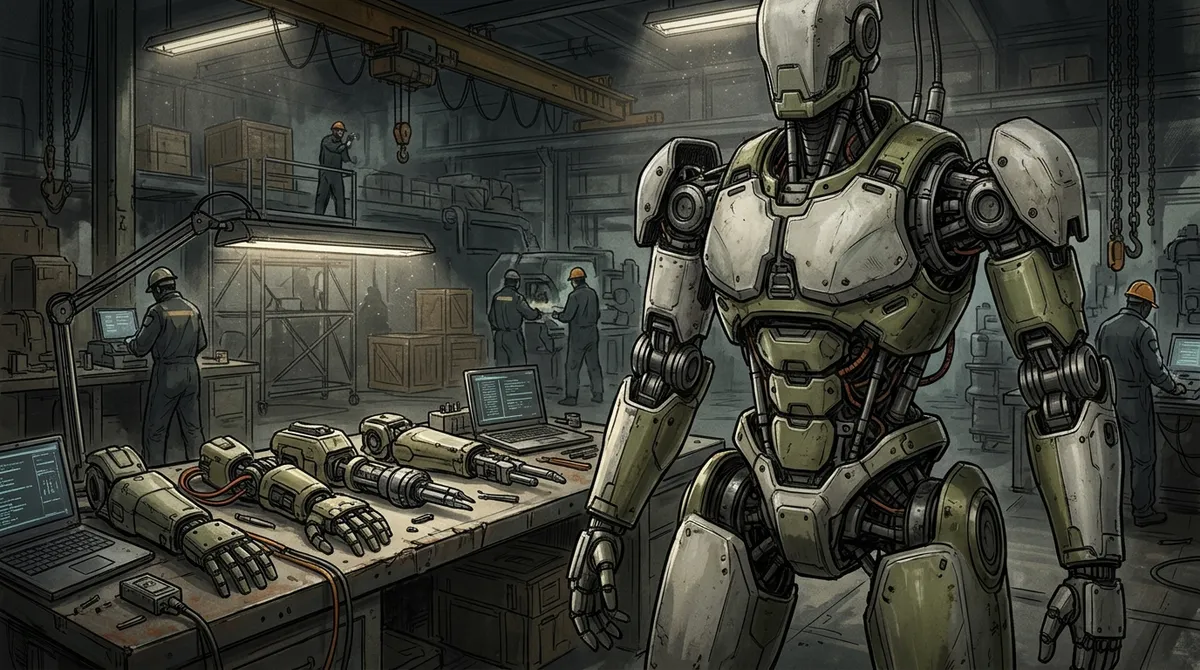
What happened: Rheinmetall is developing humanoid robots for the military, and chief executive Armin Papperger told RTL on November 16 that prototypes could be presented "relatively quickly, perhaps in 15 or 18 months." Engineers are concentrating on the robots' upper body for now, and the intended roles remain unclear — including whether the machines will be built for a single task or several.
What's genuinely new: The first dated prototype timeline from a major European arms maker on military humanoids. An analysis accompanying the interview names the robots' cognitive abilities — AI advanced enough to work effectively alongside soldiers — as the main technical hurdle, puts market introduction in the 2030s, more likely mid-decade, and floats logistics, combat and medical-support roles with interchangeable arms. Simpler robots could appear earlier for expendable support missions behind the front line; companies in the United States and China are building similar systems and would compete.
Watch: a prototype reveal around early-to-mid 2028, whether Rheinmetall names concrete roles and an interchangeable-arm configuration, and whether simpler rear-line support robots arrive before full humanoids.
Foundation Future Industries, payroll stopped, banks on a $150m South Korean lifeline
Sources Business Day (Reuters) 36kr
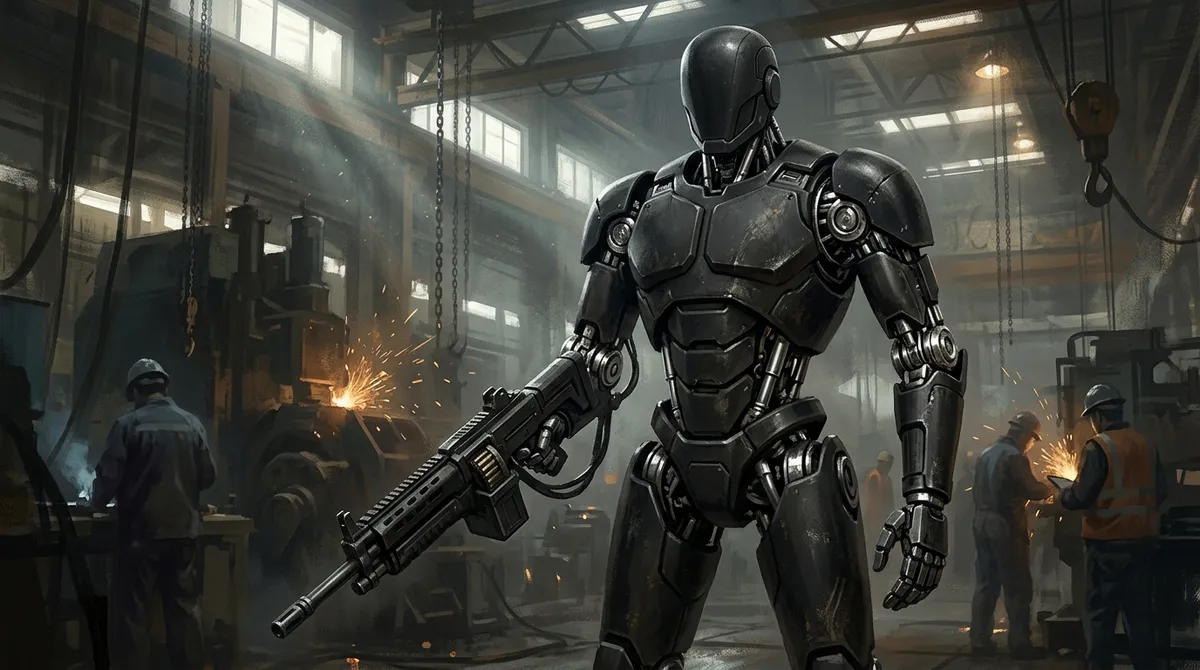
What happened: Foundation Future Industries — the Eric Trump-backed maker of gun-carrying humanoid "robot soldiers" — stopped paying employees in recent weeks, with pay due October 30 still unpaid, and is pinning its future on a $150 million investment from South Korean conglomerate Base Group, internal company emails show. Chief executive Sankaet Pathak wrote on November 8 that payroll was "a timing issue, not an existential one," and on November 12 that Base would also set up a joint venture to supply aluminium for the robots and lithium for their batteries. A Base spokesperson confirmed it is considering an investment.
What's genuinely new: The $150 million plan has not previously been reported, deepening Trump-family ties already under congressional scrutiny: Democratic senators are questioning whether a $2 million payment Base made to the Trump Organization in 2025 was connected to aluminium-tariff relief. The company launched its Phantom MKII on November 18, claiming an about 91 kg payload with production starting early 2027. Pathak, who borrowed a $4.6 million company loan in 2025 for a Sausalito mansion, denies ongoing procurement talks with the Israeli military, against the Financial Times' report of talks over up to 1,000 tunnel-patrol robots.
Watch: whether the Base investment completes and payroll resumes, the aluminium-lithium joint venture, any Israel contract, and the congressional scrutiny.
Brief
- Symbotic's eight-level automated warehouse at C&S Wholesale Grocers in Connecticut — toured for Rockwell Automation's Automation Fair 2026 — runs 155 SymBots that recharge with capacitors without stopping, taking in about 1,215 cases an hour per inbound cell and sending out up to 1,350, with store-layout-aware "smart pallets" built in four to six minutes; the tour also showed the BreakPack sub-case picking capability and the in-development SymMicro system for in-store micro-fulfillment, and put Symbotic's backlog at $22.5 billion (Control Engineering).
- Elon Musk made a 24-hour overnight stop at Giga Shanghai on November 19 during APEC Leaders' Week, thanking the China and Asia-Pacific teams and discussing progress on driver assistance and humanoid robots; Tesla vice president Grace Tao confirmed the visit (Teslarati).
- A Financial Times report looks at US manufacturers deploying robots to ease labour shortages, against the argument that US automation is still too slow to keep the country's manufacturing sector internationally competitive. Agility Robotics chief executive Peggy Johnson, quoted in the report, says manufacturers face "an existential problem with the labor that they can't get" — workers retiring, fewer replacing them, and reshoring adding demand.
- XPeng will hold its 2026 AI Day in Guangzhou on November 25 under the theme "Origin," with the Iron humanoid stepping onstage to interact live with the audience — the same day as Nio's tech day in the same city and Li Auto's third-quarter results; the company's report on the announcement adds CEO He Xiaopeng's November 16 earnings-call statement that Iron mass production should begin at the end of 2026 or in January 2027, with deliveries starting in Q2 2027 (CnEVPost).
- RealSense chief executive Nadav Orbach, in an Invezz interview, points to 2028 as a plausible inflection point for humanoid robotics — meaningful commercial revenue arriving first in manufacturing, warehousing and logistics, with general-purpose autonomous humanoids taking longer — following Cognex's acquisition of the Intel depth-camera spinout earlier this year, which he says will preserve the RealSense brand and run it with autonomy (Invezz).
- GENTO, the humanoid brand incubated by Shenzhen robot maker Tianji Intelligence, showed a 21-degree-of-freedom dexterous-hand prototype at CoRL 2026 in Austin: 750 grams, every joint backdrivable, an impact-tolerant linkage transmission rated for a million no-load grasp cycles and a rated fingertip force of 10 newtons — with no pricing or availability announced (Interesting Engineering).
- Tactilia, a Munich-based spin-off of gripper manufacturer Schunk, is building a modular robot hand for humanoid and industrial robots (Trending Topics).
- A relayed post carries Figure's chief executive wanting the company's humanoid doing long-duration work in homes within six months — an ambition, with realization unconfirmed (note.com).
- CEVA Logistics and the Singapore Institute of Technology have opened the Intelligent Logistics & Autonomous Systems lab in Singapore, a five-year collaboration backed by the Economic Development Board to automate repetitive warehouse tasks such as assembly, labelling and packing — with solutions expected at CEVA's Blue Hub facility within one to two years (Container News).
- A paid press release distributed via GlobeNewswire says Noitom Robotics ranked No. 1 in Asia on The Information's 2026 list of 50 most promising startups, with a valuation above $500 million and more than $10 million in revenue — the company supplies motion datasets used to train robots, and does not build robots itself.
- InPost has automated its fulfilment warehouse in Wola Bykowska, Poland: 118 AutoStore robots and 41,000 containers in stacks of up to 16 on a footprint of more than 1,400 square metres, delivering goods to staff at 24 workstations, with up to 1,600 orders an hour, about eight seconds to pick and pack a single item, support for roughly 6,600 stock-keeping units and carton-forming packaging that sizes each box to its contents — part of the logistics operator's expansion into end-to-end fulfilment services for online retailers (Trans INFO) (single source).
- Disney Imagineering and AWS have prototyped three robotic Star Wars Anzellans — Vilo Vele, Kado Bre'a and Jibu Bre'a — that react to visitors and to each other in real time without a puppeteer: fast decision models choose quick reactions, larger models supply broader context, and prerecorded, Imagineer-written dialogue is selected and paired with dynamic animation rather than generated; the characters are scheduled for the Customer Showcase at AWS re:Invent in Las Vegas from November 30 to December 4, with no theme-park rollout announced and no latency measurements released (RobotsBeat) (single source).
- HD Hyundai Robotics sold its first HDT1000-33 six-axis industrial robots — a 1,000 kg-payload arm the company calls South Korea's first domestically developed robot in the one-ton class, with claimed positioning error within 0.1 millimetre — to load heavy engine blocks into machining equipment at Hankook R&D in Ansan, South Korea, with wider applications planned in shipbuilding equipment, large vehicle components and battery packs; the unit count and contract value were not disclosed (RobotsBeat) (single source).
- KEENON Robotics is presenting commercial cleaning robots, delivery robots and its XMAN-R1 humanoid at the ISSA Show North America 2026 in Las Vegas, including a humanoid-assisted workflow in which the XMAN-R1 clears clutter before KLEENBOT floor cleaners sweep and scrub; the company says it has shipped more than 100,000 service robots across some 70 countries and ranked first worldwide in commercial service robot shipments in 2025 (PR Newswire).
- MegaRobo Technologies, whose infrastructure connects AI models and agents with robotic laboratories and physical experiments, has raised nearly $200 million from Oman Investment Authority, CMB International and existing investors to expand its AI for Science business internationally, bringing reported funding across rounds to about $600 million; the platform's Megalaxy Lab lets AI agents order experiments, track execution and retrieve structured results, and a protein-design competition plans wet-lab validation of more than 10,000 designs from December 2026 into April 2027 — no new valuation or lead investor disclosed (RobotsBeat) (single source).
- MIT researchers report a 1.29-gram insect-scale flying robot that controls its own flight with a 244-milligram onboard electronics package — microcontroller, inertial, optical-flow and height sensors — demonstrating hovering, point-to-point moves and a landing on a sunflower outside a motion-capture setup; the work went up alongside publication in Science Robotics, but the prototype still draws power from an external tether, takes high-level commands from a human operator, and leaves batteries, onboard object recognition and obstacle avoidance for future work (RobotsBeat) (single source).
- Shenzhen set a Guinness World Record on November 17 when 151 humanoid robots — ENGINEAI's full-size T800s alongside Unitree G1 and AGIBOT X2 units — performed a synchronized dance ahead of the APEC summit the city hosted November 18–19, beating the 110-robot target; the same T800 and PM01 robots appeared in APEC-week demonstrations of entertainment, reception and traffic duties (Interesting Engineering).
- The 11th World Intelligent Manufacturing Expo opened in Nanjing on November 19, drawing more than 600 exhibitors across some 55,000 square meters, with humanoid-robot performances and security-patrol robots among the displays (Global Times).