Robots digest — Nov 20, 2026
Top line: Medtronic's Hugo surgical robot wins US clearance for general surgery — a market of about 3.5 million operations a year. XPeng sets November 25 AI Day with its IRON humanoid as the centerpiece, and GlobalFoundries puts a date and a job description on Boston Dynamics' Atlas chip-plant trial: early 2027, starting with a task-and-readiness evaluation.
- FDA clears Medtronic's Hugo surgical robot for general surgery
- Robotics enters its post-Jensen Huang era
- GlobalFoundries sets the first chip-plant test of Boston Dynamics' Atlas
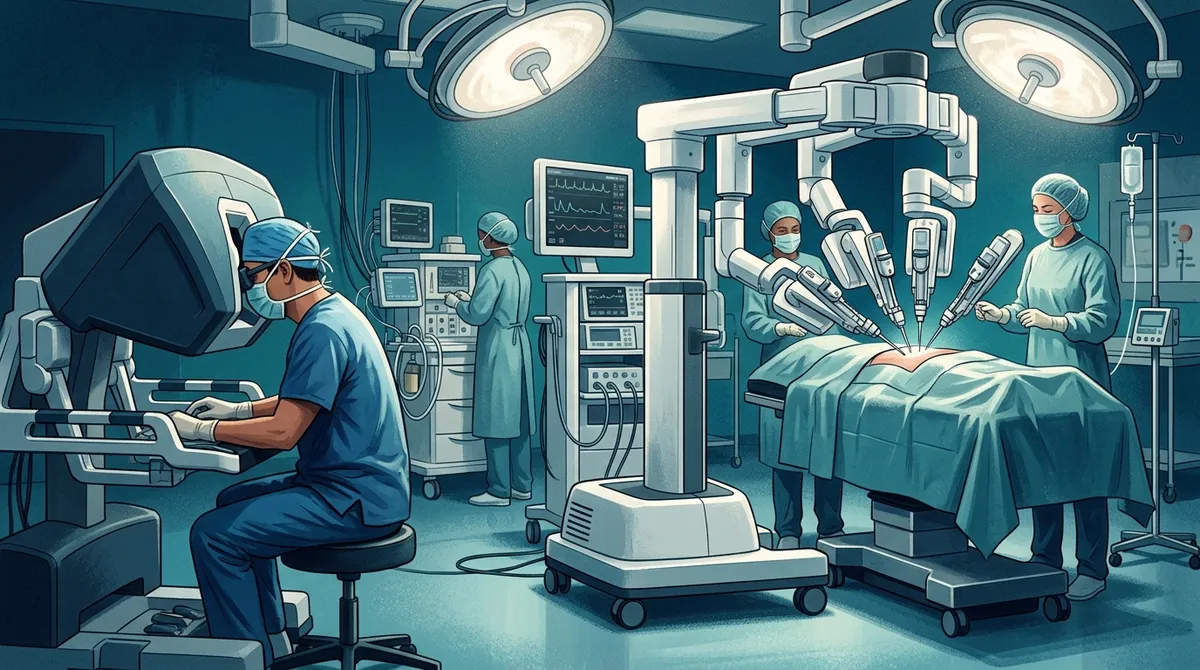
FDA clears Medtronic's Hugo surgical robot for general surgery
Sources The Robot Report published Nov 20, 7:55 PM ET
What happened: The US Food and Drug Administration has cleared Medtronic's Hugo robotic-assisted surgery system for general surgery, covering all upper abdominal procedures — gallbladder removal, Roux-en-Y gastric bypass, ventral hernia repair and small-bowel resection — plus lower abdominal inguinal hernia and appendectomy. Medtronic says these procedures account for about 3.5 million surgeries a year in the US, on top of the urology clearance Hugo received in December 2025.
What's genuinely new: Medtronic took two routes to the clearance: a US clinical study of Hugo for hernia repair that met its safety and effectiveness endpoints in 2025, and European clinical data — Hugo has carried CE marking for general surgery since 2022, and general surgery is now its fastest-growing procedural mix abroad. Globally, Hugo is on track to surpass 50,000 cumulative procedures by the end of Medtronic's fiscal year, and the company plans AI features on the platform, building on the Touch Surgery Aide operating-room compute system the FDA approved in June. An IDE study of Hugo in gynecology — hysterectomies, including for malignancies — is running in the US.
Watch: the gynecology study's outcome and how quickly the general-surgery clearance converts into hospital adoptions against incumbent surgical-robot platforms.
Robotics enters its post-Jensen Huang era

Sources The Robot Report SiliconANGLE published Nov 19, 10:06 PM ET
What happened: NVIDIA's board accepted CEO Jensen Huang's resignation on November 12, and the robotics industry is taking stock of what his departure removes: for years Huang used marquee keynote slots, development tools (Isaac, GR00T, Jetson) and strategic investments in companies like Figure AI and Serve Robotics to give a niche industry one of the biggest stages in technology. Colette Kress serves as interim CEO while the search for a permanent successor continues.
What's genuinely new: NVIDIA says its physical-AI revenue nearly tripled year over year and is on track to exceed $25 billion in fiscal 2027 — still only about 6% of a projected $400-plus billion in annual revenue. The pending $12.9 billion Hugging Face acquisition is named as the earliest test of the successor's robotics priorities; founders credit Huang's early-stage checks with keeping companies alive when no one else would; and one veteran warns robotics funding ultimately rides on data-center profits. Huang's son Spencer remains at NVIDIA as director of product management for robotics.
Watch: which robotics programs and startup investments keep funding under interim leadership, the fate of the Hugging Face acquisition, and the robotics posture of NVIDIA's next permanent CEO.
More context: The resignation followed the disclosure of "personal behavior inconsistent with the company's code of conduct, standards, and cultural norms," board chair Harvey Jones told investors, and the board said it does not intend to reinstate Huang, SiliconANGLE reports. On NVIDIA's first earnings call since the ouster, revenue more than doubled year over year and management raised its fiscal 2028 growth outlook to roughly 75%, SiliconANGLE reports.
GlobalFoundries sets the first chip-plant test of Boston Dynamics' Atlas
Sources eWeek Assembly Mag
What happened: GlobalFoundries will begin on-site tests of Boston Dynamics' Atlas humanoid at its fabs in early 2027 under the robot-maker's early adopter program — the first semiconductor maker, and Atlas's first customer outside the auto industry, to trial the robot. In parallel the chipmaker is scaling Spot deployments at Malta, New York; Burlington, Vermont; Dresden; and Singapore. In Singapore, two Spot robots have traveled nearly 900 km and completed more than 90,000 sub-fab inspections since April, with a reported 99 percent mission success rate.
What's genuinely new: The November 17 announcement lays out how the pilot will run: a skills development workshop that first evaluates potential human tasks, facility readiness and integration needs, then builds task-specific skills — so the 2027 start is a test, not a production rollout. Spot's record makes the practical case: it carries sensors to equipment for predictive maintenance instead of fixed sensors at every inspection point, with partner Levatas supplying computer vision to read gauges. Atlas's tasks, fleet size, pricing and production timetable stay undisclosed.
Watch: which tasks Atlas is assigned in the 2027 workshop and whether the trial produces a repeatable, named task rather than a demonstration.
Brief
- XPENG will stage its eighth annual AI Day in Guangzhou on November 25, themed "ORIGIN," with its latest IRON humanoid at the center of the program alongside robotaxi, intelligent-driving and flying-car updates — a preview of demonstrations to come, not a report of results; the company says IRON runs its physical AI model on three in-house Turing chips (up to 2,250 TOPS) without teleoperation, and it reiterated that the latest IRON came off a new production line on September 8 and the robotics business's August financing of more than $900 million at a valuation above $6.3 billion, with external-customer sales still targeted from the second half of 2027. No new pricing or sales-calendar revision came with the announcement (RobotsBeat) (single source).
- Hyundai Mobis, South Korea's largest auto-parts maker, has entered the humanoid-robot component business around Boston Dynamics' Atlas: prototype production of Atlas joint actuators began at its Uiwang research institute in November, with full-scale mass production and supply planned for 2028 after joint verification, per its third-quarter roadmap; the lineup is extending to robot hands, integrated controllers and sensor modules, and the company plans to supply humanoid makers outside the Hyundai group, pitching itself as a non-Chinese supplier with automotive-grade cost competitiveness — actuators typically run 40–60 percent of a humanoid's build cost (note.com).
- John Deere has acquired Orchard Robotics, the San Francisco company operating as Orchard AI, announced November 19, adding vehicle-mounted crop cameras and the FruitScope software platform that measure fruit counts, size, color and canopy at the level of individual plants to support yield estimates, spray prescriptions and variable-rate field work; purchase price and integration timetable undisclosed — plantation sensing and decision support today, with physical execution still human- or machine-led (RobotsBeat) (single source).
- Figure said in a company post that it is partnering with T-Mobile to bring its F.03 humanoids to the Formula 1 Las Vegas Grand Prix — a promotional appearance, announced November 20 (Figure).
- Elon Musk said at the TomorrowX conference on November 18 that Optimus will be "capable" of taking out the trash and putting away the dishes in about 12 to 18 months — a capability claim, not a ship or price date; the same write-up keeps first deliveries to outside companies around the end of 2027, puts Tesla's 2026 capital spending at about $20 billion (more than twice 2025's $8.5 billion), and notes analyst estimates through 2028 carry almost none of the robot's payoff (TIKR).
- An industry report released at the 2026 World Robot Conference puts China's first-half humanoid shipments above 40,000 units — 97 percent of global shipments — while customs figures show 16,559 robots exported as "intelligent bionic robots" from January to September, worrying analysts that Chinese humanoids are being bought mainly for research and display rather than productive work; a China Association of Robotics and Anhui Jianghuai report adds that only about 2,000 humanoid units were installed across China in 2025, most for research, exhibition and training use rather than factory floors. The report was covered by state media. (single source)
- Foundation Future Industries unveiled the Phantom MKII, its second-generation humanoid for military logistics and heavy outdoor work, claiming a 200-pound (91 kg) walking payload, rain/snow/dust sealing and a Cortex II control system that learns tasks from as few as 60 human demonstrations; CEO Sankaet Pathak says simplified assembly halves the bill-of-materials cost and says the company would consider arming the robot for the U.S. military under human-in-the-loop control, with early Bay Area production targeted for early 2027 — all company claims, arriving amid cash-flow pressure including a missed payroll in late October and reporting disagreements over how much the earlier Phantom MK-1 units actually operated in Ukraine (Interesting Engineering) (single source).
- Shenzhen set a new Guinness World Record for humanoid robots dancing in sync: 151 robots — EngineAI T800, Unitree G1 and AgiBot X2 models — completed the routine within the hour against a target of 110, in a showcase organized by the city's Longgang robotics bureau with EngineAI ahead of the APEC summit; the previous mark, 110 AgiBot robots, was set in Shandong on October 25 (heise).
- State Grid Changzhou Power Supply Company in Jiangsu province demonstrated a 65-pound (under 30 kg) robot that climbs live power lines of 35 kV and below and installs insulating sleeves without cutting service — 30 meters sleeved in 15 minutes, with a ground-based remote operator and onboard machine vision; company claims, with the utility's own post-work inspection said to confirm secure installation (Interesting Engineering) (single source).
- Robot control-software maker Mujin reports that Green Logistics has connected six of its robot cells to the automated warehouse at a new distribution center for outbound case picking and palletizing, with supplier-reported recognition of about 1,000 case types and roughly 500 cases per hour per robot, against a Japanese trade-press figure of about 2,500 cases per hour for the whole system (RobotsBeat) (single source).
- Sandia National Laboratories has built SPIINE, a tethered six-wheeled robot for inspecting 53-millimeter (two-inch) pipes at the Hanford nuclear-cleanup site: an October 22 paper in Robotics reports travel through more than 60 meters of test pipe including tight 90-degree elbows, plus 110 meters of verified power-and-video tether; Hanford field testing, camera cleaning and fail-safe recovery are still ahead (RobotsBeat) (single source).
- MassRobotics is building a marine robotics facility at Boston's historic Fish Pier with the Massachusetts Port Authority, planned to open in early 2028 with programming from through 2027 — a water tank, an alongside-pier float, lifting and launch gear for startups to test on the harbor, addressing what founders call the hardest hurdle in marine robotics (The Robot Report).
- University of Maryland's Team RoboScout won the $1.5 million DARPA Triage Challenge, using Spot to help emergency workers locate victims, assess injuries and prioritize lifesaving care (University of Maryland).