Energy digest — Nov 22, 2026
Top line: A Motley Fool head-to-head puts fresh numbers on the flagship SMR developers: Oklo holds $3.1 billion in cash with a 1.2-GW Ohio campus plan for Meta, while NuScale's $1.9 billion sits against heavier risks. Also worth noting: Türkiye's National Intelligence Agency... — correction, its National Intelligence Academy — has published a fusion strategy report.
Oklo vs NuScale: deep cash, deep losses — and each with a different route to a first reactor
Sources The Motley Fool
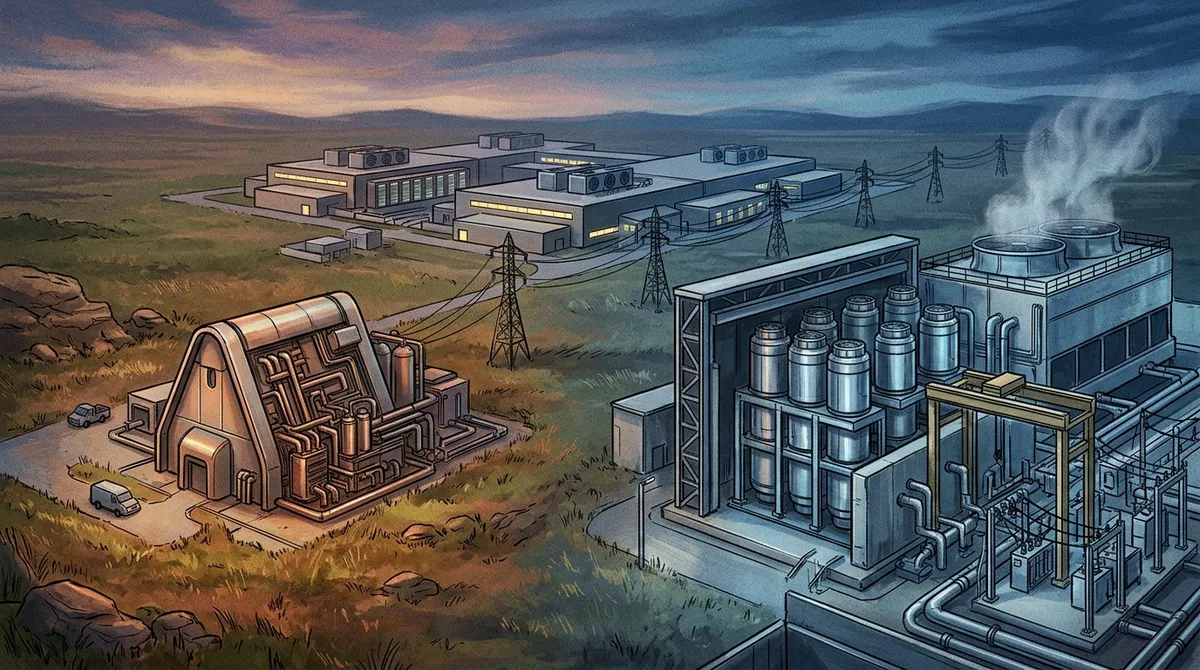
What happened: A comparison piece frames Oklo and NuScale Power as the two most prominent next-generation nuclear contenders courting power-hungry data centers, each still reporting essentially no revenue. Oklo ended the quarter ended September 30 with $3.1 billion in cash, equivalents and debt securities and a $123.3 million net loss for the first nine months of 2026; NuScale ended the quarter with $1.9 billion in cash, equivalents and investments and a $135.2 million nine-month net loss. Oklo targets long-term power agreements with Meta Platforms, Equinix and Diamondback Energy; NuScale relies on an exclusive global sales partnership with ENTRA1 and counts work with the Tennessee Valley Authority among its engagements.
What's genuinely new: The comparative financials are the new layer: Oklo's $3.1 billion cash position and its 1.2-GW Ohio power campus plan under which Meta can prepay for power and fund the project; NuScale's $1.9 billion cash, P/S ratios of 405 (NuScale) and 1,230 (Oklo), and a sharper statement of the risk split — Oklo's customer concentration and no binding power purchase agreements versus NuScale's class-action litigation and total dependence on ENTRA1. NuScale also remained the only NRC-certified small modular reactor design in the picture.
Watch: Whether either company converts cash into a binding power purchase agreement — Oklo with Meta or its other prospective customers, NuScale through the ENTRA1 pipeline on TVA sites — plus NuScale's securities litigation and any new federal licensing steps for Oklo's first Aurora powerhouse in Idaho.
Brief
- The American Bazaar carries a commentary column by Dr. Ajay Kothari arguing thorium molten salt reactors — advanced Generation IV designs descended from Oak Ridge National Laboratory's late-1960s work — could power AI data centers at atmospheric pressure without siting near water, drawing on roughly 600,000 tons of US thorium at Lemhi Pass, citing China's small TMSR-LF1 experiment in the Gobi Desert as running for two years, and proposing 10–50 MW modular units fueled by shipped U-233 salt. It is an argument for a technology, not a project: no company, site, funding, license or customer is named, and no independent report backs the deployment claim yet.
- A report by Türkiye's National Intelligence Academy, "Fusion Energy and Strategic Roadmap for Türkiye," (Daily Sabah) concludes fusion is not a short-term fix for Türkiye's energy imports or electricity generation gap, yet warns that staying outside the emerging fusion technology and supply ecosystem could create new forms of external dependency. The roadmap urges building capacity in advanced materials, powerful magnets, lasers, robotics, power electronics and precision manufacturing, expanding international cooperation and linking research with industry — rather than committing early to a single reactor design — and it points to nearer-term options including renewables, storage, grid investment and fission.