Robots digest — Nov 26, 2026
Top line: XPeng has priced its IRON humanoid at roughly the same as an electric car, with mass production from January and public sale in China in Q2 2027. Samsung's first in-house humanoid now has a hardware standard: 40 motors across two hands. In Denver, a vandal is boxing in Waymo robotaxis with traffic cones — 30 egg attacks and counting.
- XPeng prices its IRON humanoid: mass production in January, sale at "roughly the same as an EV"
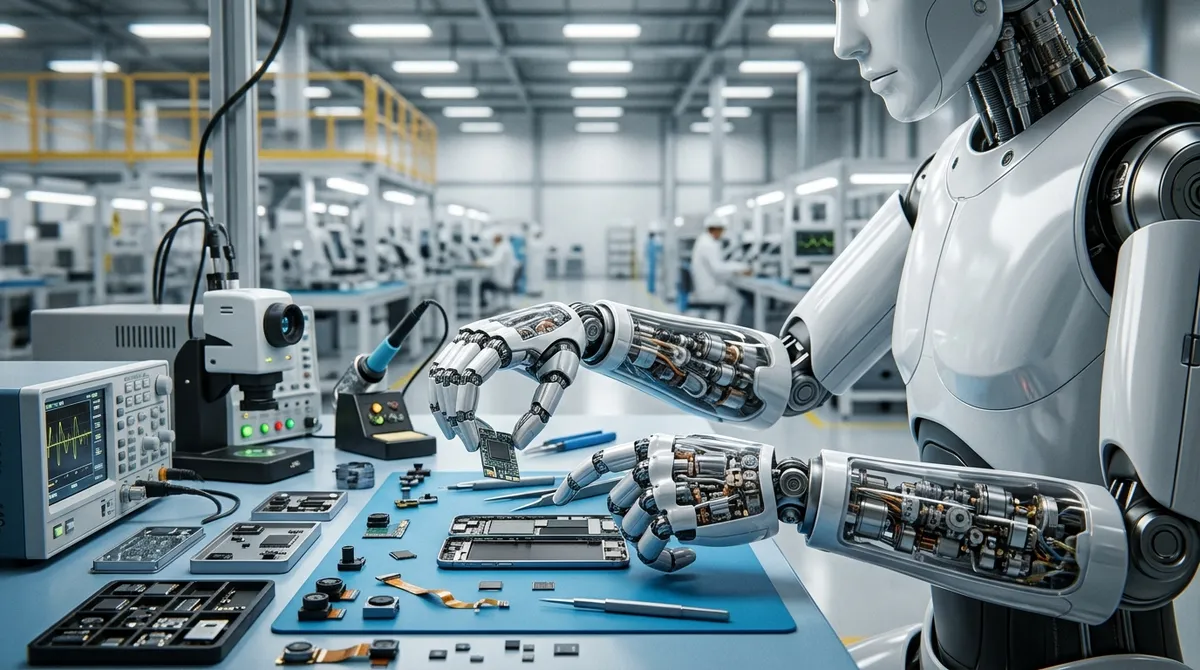
- Samsung's in-house humanoid takes shape: 40 motors across two hands, precision aimed at smartphone assembly
- Volvo starts factory training for Hexagon's AEON humanoids in Ghent
- A Denver vandal boxes in Waymo robotaxis with traffic cones, then eggs them
XPeng prices its IRON humanoid: mass production in January, sale at "roughly the same as an EV"

Sources Bloomberg Car Expert GlobeNewswire StartupFortune China Daily EV (eletric-vehicles.com) EVXL Digital Trends Manila Times / GlobeNewswire
What happened: XPeng's IRON humanoid, unveiled at the company's AI Day in Guangzhou on November 25, now has a price benchmark and a production calendar: hardware mass production begins January 2027, store-assistant pilots start in XPeng's own Chinese dealerships in the first quarter, and public sale in China opens in the second quarter of 2027 on a paid subscription with downloadable capability packages. Co-president Brian Gu told Bloomberg IRON will cost roughly the same as an electric car, without a figure; XPeng's own cars list from 119,800 yuan (about US$18,000) to 359,800 yuan (about US$54,000).
What's genuinely new: Home use could begin one to two years after successful commercial use, with safety around children, elderly people and pets among the open challenges, Gu said (Digital Trends). In a piece for The Economist's The World Ahead 2027 published on November 18, CEO He Xiaopeng argued humanoid robots need "multiple speeds of thought" — separate models for reflexes, motion, reasoning and safety (XPeng release via Manila Times). The Turing Physical AI Architecture (VLA 3.0) remains announced, not shipped; its first car feature, adaptive deceleration, is due over the air in December 2026.
Watch: whether the January mass-production start holds; the subscription price and the economics of the capability packages; the first paid deployment with a customer other than XPeng itself.
More context: China Daily reports Xpeng plans to begin hardware mass production of IRON in January 2027, have it work as a trainee sales guide in its own stores in the first quarter, and release it externally in the second quarter.
Samsung's in-house humanoid takes shape: 40 motors across two hands, precision aimed at smartphone assembly
Sources Insight Korea Financial News Solution News SME Daily
What happened: Samsung Electronics has set the development standard for its first in-house humanoid robot — 20 motors in each hand, 40 in total, with smartphone assembly fixed as the precision benchmark, according to industry sources. No finished demonstration has been shown. The program lives with the RX Business Team under Roh Tae-moon, who retained the role in the November 20 executive reshuffle, and the company has built a dedicated Hand Lab for robotic-hand development as the core of the push.
What's genuinely new: This is the first named hardware specification for the in-house humanoid, and the differentiation is deliberate: an industry official says basic motion demos are no longer new, so Samsung is betting on fine finger control — tiny smartphone components demand it in a way larger automotive or appliance parts do not — in a field already held by Hyundai's Atlas, Tesla's Optimus and LG's CLOiD. Chairman Lee Jae-yong reviewed the precision-manipulation work at the Seoul R&D campus on October 27; two humanoid specialists were promoted to executive vice president on November 24; Gumi is the production base alongside a joint 19 trillion won (about US$14 billion) Samsung Electronics–Samsung SDS investment, with the SDS AI data center for robot training begun November 2 and targeted for completion at the end of 2028. Foldable-phone hinge expertise is being applied to the joints.
Watch: the general-purpose prototype expected around CES 2027 in January, and whether its hand work runs autonomously or teleoperated; the Gumi pilot production line.
More context: Samsung plans to unveil its first self-developed humanoid at CES 2027 in Las Vegas next January, Financial News reports, with the machine reportedly designed to carry 20 motors in each hand and to use foldable-smartphone hinge technology in its joints. Two versions are said to be in development — a base model called "HR" (Human Reference) and a higher-performance "HE" (Humanoid Extreme) — with Samsung Display OLED panels in the face to produce expressions through the eyes and mouth, Solution News reports. Shares in Rainbow Robotics, the listed robot maker in which Samsung Electronics is the largest shareholder, rose 12.31% the day after the humanoid reports, SME Daily reports.
Volvo starts factory training for Hexagon's AEON humanoids in Ghent
Sources RobotsBeat InsideEVs published Nov 26, 10:07 AM ET
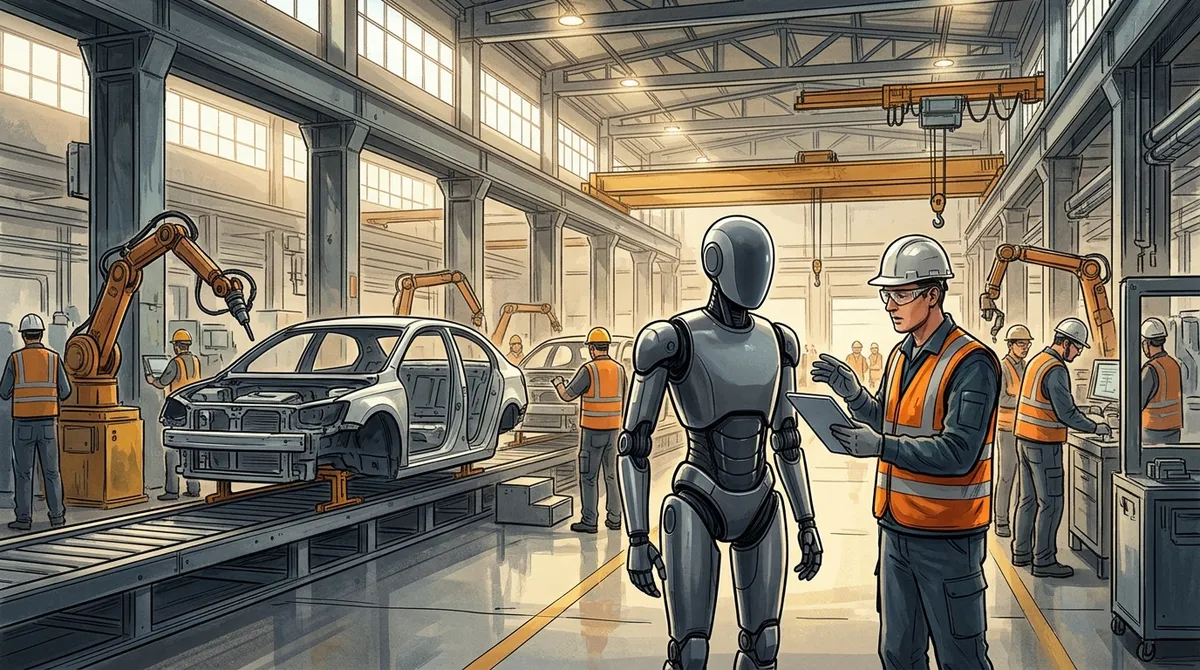
What happened: Volvo Cars has brought Hexagon Robotics' AEON humanoid robots to its car plant in Ghent, Belgium — the first Volvo factory to try humanoids — with the first robots set to work alongside humans on the factory floor from mid-2027. Volvo's own employees teach the machines by imitation learning; the first assignment is placing components into two fixtures with precision, with complexity to build up through more parts, movement through the production area and interaction with automated equipment, ahead of a larger factory pilot in the first half of 2027. Chief manufacturing officer Magnus Nilsson says the design fits the existing production line and automation.
What's genuinely new: Volvo is the second carmaker after BMW to put AEON through automotive evaluation, and the programme moves from general testing toward defined factory jobs where reliability can be measured. AEON is a wheeled, human-proportioned machine of 1.65 metres and 60 kg with 34 degrees of freedom, a top speed of 2.4 metres per second and a battery designed for automatic swapping; no task success rate, cycle time or fleet size has been disclosed.
Watch: whether the first-half 2027 factory pilot holds, the first measured task performance and fleet size, and the mid-2027 production start.
A Denver vandal boxes in Waymo robotaxis with traffic cones, then eggs them

Sources Electrek published Nov 26, 9:36 AM ET
What happened: A man in Denver has repeatedly trapped Waymo robotaxis with orange traffic cones and thrown eggs at them — at least 30 incidents, all believed to be the same person, per a Denver police report and Waymo's own count, reported by Electrek citing The New York Times. He pulls up in front of a robotaxi, rings it with cones so it cannot drive off — the driverless system is built to respect cones — then throws eggs; he leaves in a silver Toyota Corolla leased to Lyft drivers and has not been identified. Each egged vehicle needed about $2,000 of cleaning; at least one had a passenger inside.
What's genuinely new: The Denver District Attorney's Office declined criminal charges, calling the matter civil, but is collecting evidence on damage and working with the city attorney on "the most appropriate legal mechanism to make this behavior stop." Waymo opened Denver service to the public on September 1 and now runs more than 100 vehicles across 60 square miles of the city. The cone trick is a known weakness — San Francisco activists used it in 2023 — and it works because the car's deliberate caution leaves it unable to leave.
Watch: whether the city attorney finds a charge that fits, whether the vandal returns, and whether Waymo changes how the cars handle a cone encirclement.
Brief
- Orders keep outrunning builds in industrial robotics — members of the Japan Robot Association took orders for 67,003 robots in Q3 2026, 36.1% more than a year earlier, but built 51,414 — and a robot cell in a US plant running two shifts pays for itself in 13–18 months (cell cost $198,000–$263,000; average arm price $65,839 in Q3), per a Marketscreener-carrying investment analysis. Yet Japanese component makers fell hard in the week of November 20 (Nabtesco −25.2%, THK −22.4%, Harmonic Drive Systems −22.1%) on disappointing results even as their orders climbed, while Chinese rivals — already supplying 60% of servo motors sold in China, and rising in gearboxes (Nabtesco's share of China's RV-gearbox market fell from 54.8% in 2020 to 33.8% in 2024) — stand ready for the slowdown MIR Databank expects to hit orders in 2028. (Source: Marketscreener)
- LiDAR maker RoboSense's unaudited Q3 2026 results: revenue up 65.2% year on year, LiDAR sales up 210.1% to roughly 575,500 units, robotics-and-other shipments up 423% for the nine months to about 427,800 units, and a target of more than one million units in Q4 backed by a new Shenzhen production line rated at 500,000 units a year. The same results announcement adds a widening quarterly group loss of about 168 million yuan against 672.7 million yuan revenue, with gross margin down to 3.7% from 23.9% a year earlier. (Sources: Unite.AI, RobotsBeat)
- Dahua Robotics, the Chinese electric-gripper and precision-actuator maker whose investors include ByteDance and IDG, has filed its listing guidance with the Shenzhen securities regulator to begin A-share IPO preparations; it has shipped over 300,000 sets cumulatively (about 100,000 in 2025), and its grippers run in Hexagon's AEON humanoid pilot at BMW's Leipzig plant. (Source: 36kr)
- DHL Supply Chain is scaling a Brazilian peak-season operation — more than 37 million e-commerce items expected, about 2,600 extra temporary workers and five distribution centres expanded 67% to over 35,000 square metres — with a pilot at its Jandira site in Greater São Paulo running more than 70 assistant robots that shuttle loads between zones, credited with about a 14% productivity gain in that stage of the work. (Source: Click Petróleo e Gás)
- Electronics manufacturer Plexus has installed a Dematic-delivered AutoStore system at its Oradea, Romania plant — a fleet of 13 R5 robots serving 7,820 storage bins on a 150-square-metre grid with four goods-to-person ports — consolidating storage at its European hub. (Source: Supply Chain Digital)
- Chinese heavy-machinery maker Zoomlion launched what it calls the industry's first AI-powered excavation robot, shown at bauma CHINA 2026 in Shanghai on November 24: a vision-language-action model drives centimetre-level autonomous work such as wall building and pipe alignment, and the company is exhibiting its Z01 and Z03 humanoid robots, with Z01 bipedal units said to enter mass production soon and Z03 demonstrating millimetre-level sorting. Company release. (Source: Zoomlion via PR Newswire)
- Hellmann Worldwide Logistics will install Exotec's Skypod goods-to-person robot system at Siemens Smart Infrastructure Buildings' Nuremberg site, going live in mid-2027 with around 35,000 storage locations initially — another European buyer for the Skypod fleet Exotec most recently commissioned in Japan. (Source: Payload Asia)
- KLN Logistics Group and Hai Robotics have formalized a smart-warehousing partnership after three joint projects for international footwear brands in Shenzhen, Jiaxing and the Middle East, with KLN to deploy Hai Robotics' automated case-handling mobile robots across its global customer network. (Source: STAT Times)
- Elon Musk posted on X on November 26 that robots and superintelligence will solve healthcare — a compressed restatement of a thesis he has voiced before, with no product, trial or deployment behind the post. (Source: Basenor)
- Unitree founder Wang Xingxing says China's annual robot output could surpass car production within five to ten years if the technology matures — robots are smaller, so manufacturing could scale faster once the engineering works — against China's ~34.5 million vehicles produced in 2025; he separately puts widespread global robot adoption ten to twenty years out, with reliable fine manipulation still unfinished work. Founder-level forecast only, no unit target for Unitree itself. (Source: RobotsBeat, reporting his WISE2026 remarks in Beijing via Yicai)
- ROBOTERA's press release says 45 of its humanoid robots now work parcel induction at China Post's Hangzhou Postal District Center — billed as the largest postal-operations test deployment of its kind in China — with induction efficiency rising from 500–600 parcels an hour early in testing to about 1,200 in specific periods and accuracy above 90% (vendor figures); the site joins the 11 Guangdong hubs under China Post's Guangdong branch. (Source: PR Newswire via Yahoo Finance)
- AGIBOT showed a coordinated dance by multiple of its X2 humanoid robots switching formations, using its AGILE perception system to detect and avoid obstacles mid-routine and returning to their starting positions autonomously without manual repositioning — pitched as a step beyond fixed, pre-programmed routines, with the coverage noting the demo shows nothing about industrial deployment readiness. (Source: Interesting Engineering)
- Figure AI's answer to Elon Musk's moved-table apple example: founder Brett Adcock posted a November 23 video of the Figure 03 humanoid picking an apple up off a table, the table being moved with the apple, and the robot picking it up again adjusted to the new position — described as fully autonomous with no training for the scenario. X commenters question how many takes the video took, whether the robot was truly autonomous, and whether the task is too easy; Musk never specified whether the robot would already be in motion when the table moved. (Source: Notebookcheck)
- XPeng has also unveiled WorldGPT, a physical-AI model announced November 24 within its Turing World Model family: a cloud-based "teacher" meant to share learning across six machine types — cars, boats, drones, single-arm robots, dual-arm robots and humanoids — with knowledge distilled into smaller on-device models. The company claims twelve first-place benchmark results, including a 95.2% average on simulated manipulation (Meta-World MT50), while its technical report and a deployment timetable remain forthcoming; vendor figures. (Source: RobotsBeat)
- Samsung is reportedly preparing to automate more human work inside its semiconductor fabs: per ETNews reporting, a robotics team within the Device Solutions division would select external partners in 2026, evaluate their technology in 2027 and target deployments from 2028 for equipment maintenance, parts supply and factory operations, using automated guided vehicles, autonomous mobile robots and robotic arms — a semiconductor-specific step within Samsung's company-wide AI-driven-manufacturing-by-2030 strategy; no suppliers, robot counts or named fabs yet. (Source: RobotsBeat)
- Lute, a robotics startup with teams in Warsaw and San Mateo, has raised $20 million across seed and pre-seed rounds — the seed co-led by OTB Ventures and FORWARD.one, with Inovo VC, Borusan Ventures, ff Venture Capital and Naval Ravikant among the backers — to build touch sensors and robot foundation models; its first model, Lute-0, posts higher success rates than Physical Intelligence's π0.5 on five company-run retail tasks (50% to 98%, own evaluations), and its models run at an unnamed European automotive-parts distributor and in hospital corridors with remote human support. (Source: RobotsBeat)
- Lupa Robotics, a startup building glove-based human-dexterity data for robot manipulation, raised a reported $1.67 million seed round led by Long Journey Ventures, earmarked for engineering hires, tactile-sensing and data-collection systems and larger datasets; dataset licensing is the planned first commercial step, with no pilot date disclosed. (Source: RobotsBeat)