Robots digest — Nov 28, 2026
Top line: Goldman Sachs broke ranks with the humanoid hype, initiating Unitree Robotics at Sell with a target more than 50% below market — and the stock answered by surging 19.9%. On the factory floor, Toyota's wheeled ELEY has turned the legs-versus-wheels question into a standards fight against AgiBot, Tesla and Hyundai.
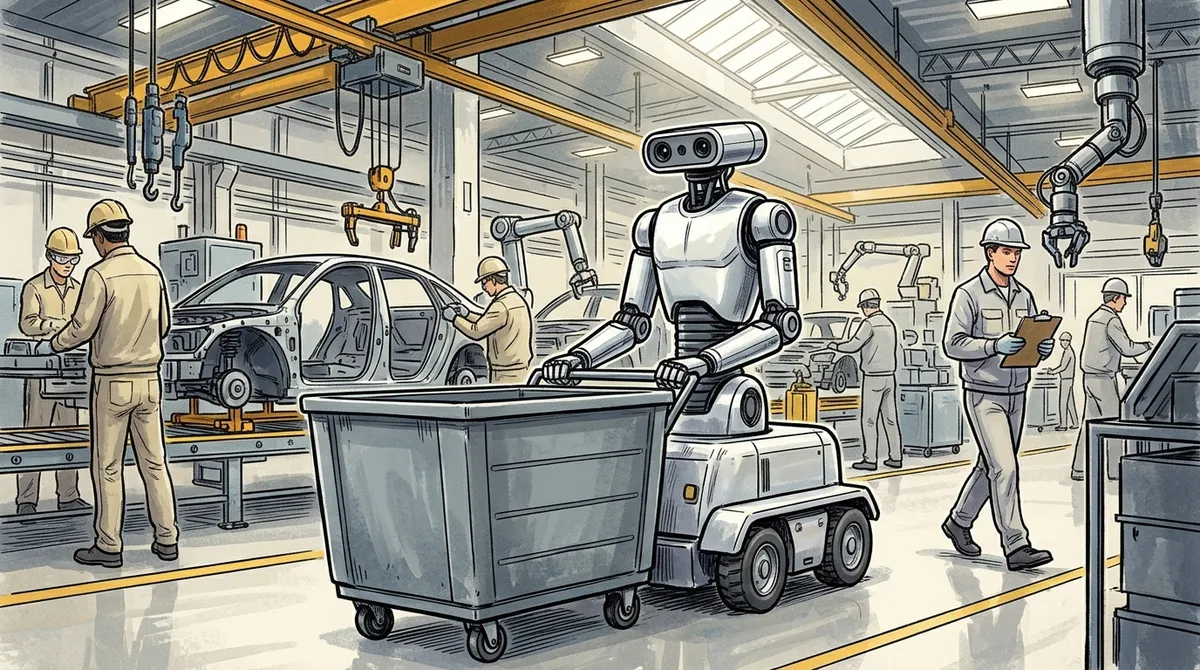
Toyota's wheeled humanoid turns the factory-robot build into a standards fight
Sources Chosun Ilbo BigGo Finance
What happened: Chosun Ilbo reports, citing work by Nikkei, that Toyota's factory humanoid bet now leans on wheels: the ELEY has a human-like upper body but moves on wheels, built to transport and organize parts alongside workers. It sits inside Toyota's plan to deploy 400,000 robots across its group companies and supplier network from 2028, with roughly ¥1 trillion (about $6.4 billion) of annual investment, a new robotics organization due in 2027, and Toyota aiming to turn robotics into a business beyond cars.
What's genuinely new: The mobility choice is now framed as a standards battle, with factory numbers on both sides. In China, AgiBot's wheeled G2 has worked electronics maker Longcheer Technology's tablet line since April — up to 310 units an hour with a success rate above 99% — and last year won a contract for roughly 100 wheeled humanoids from auto-parts maker Furun Precision; Britain's Humanoid trialled its wheeled HMND 01 at a Siemens electronics factory in Germany, handling 60 logistics boxes an hour. On the bipedal side, Tesla began initial Optimus production at its Fremont plant in October with external supply planned from late 2027, and Hyundai targets Atlas parts sorting at its Georgia plant in 2028. A wheeled lower body costs roughly half a bipedal one, which is pulling Japan, China and Europe toward wheels for flat factory floors.
Watch: Whether wheeled economics or bipedal flexibility sets the industrial standard; Toyota's 2027 robotics organization and its 2028 spending start; the humanoid share of the 400,000-unit target; and whether Tesla's planned late-2027 external Optimus supply materializes on time.
Brief
- Goldman Sachs initiated coverage of Unitree Robotics with a "Sell" rating and a 347.1-yuan (about US$50) target price — more than 50% below the market — in a report (BigGo Finance) that disputes the valuation, not the industry: it expects global humanoid shipments to rise from 75,000 units in 2026 to 6.5 million in 2035 (a $138 billion market), but projects Unitree's share falling from 36% in 2025 to a probability-weighted 6% by 2035, with gross margin compressing from 60% to 40% as prices drop from about ¥133,000 (about US$20,000) to ¥90,000 (about US$14,000); the bank says the price already assumes a global top-three finish with 15%-plus share and 25%-plus operating margins that remain unproven, and questions whether Unitree can turn its early advantages into reliable industrial applications (SCMP). Unitree's shares answered by surging 19.9% on November 27 to close at 798.70 yuan, lifting market value to about ¥323 billion (roughly US$48.5 billion) and widening the gap to Goldman's target to more than twofold.
- Yandex is preparing a humanoid delivery pilot by the end of 2026, Kommersant reports via Frontier India: an outdoor wheeled rover hands an order to a humanoid at the building entrance, which completes the final leg inside, with an initial test at about four locations. The software, Leshy OS, runs on China's Unitree G1 hardware; Yandex's rover fleet passed 1,000 machines in the second quarter, with more than 260,000 deliveries, and it wants 20,000 robots by the end of 2027. The company says several more years of development are needed for street use.
- A humanoid robot named Teledroid reached the International Space Station aboard Russia's Progress MS-36 cargo spacecraft on November 26 with about 2.5 tonnes of supplies, per Wake Up Singapore. The robot's human-like upper body with machine vision is meant to assist crews during spacewalks; no operational schedule was given.
- At the 28th China Hi-Tech Fair in Shenzhen (opened November 26), the robot zone shifted from spectacle to usefulness, home-robot maker KNOWIN's Wang Yunjie says the company tops the RoboDojo manipulation benchmark at an 82.3% success rate but needs above 90% to enter homes next year, and one company is betting on a home robot priced under US$1,400 (Bastille Post); Beijing Noetix's Ryan Yang says the whole industry is "waiting for a 'DeepSeek moment.'"
- Robotics & Automation News recaps XPeng's November 25 AI Day with one new design figure: at full capacity, the automated Guangzhou line is built to produce one IRON humanoid every 2.5 minutes, with more than 600 AI-powered inspection checkpoints, over 1,000 vehicle-grade tests and a 50,000 sq m training facility spanning 250 scenarios — ahead of the promised January 2027 mass-production start and first-quarter store-assistant training.
- NEURA Robotics plans a robot-training hub in Aragón, Spain, with logistics group Costa and the regional government (RobotsBeat): an announced memorandum of understanding, not a built facility, with investment in the tens of millions of euros (no budget breakdown) and a mid-2027 opening target. Businesses would bring their own industrial tasks, test them on NEURA's robots, simulation and Neuraverse platform before deploying, and could keep company-specific skills private or license them; universities such as Zaragoza would supply research and talent.
- Ukraine's ground robots, drones and soldiers increasingly work in battlefield relay chains — a "multi-stage logistics and evacuation system" in which uncrewed systems hand missions to one another so troops stay out of the dangerous "kill zone," the Da Vinci Wolves Battalion's robotic-systems head Oleksandr Yabchanka tells Business Insider: the 91st Separate Anti-Tank Battalion said a robot delivered ammunition that troops then loaded onto heavy attack drones, and in October the 93rd Mechanized Brigade moved food and water by robot to Vampire drone operators, onward by heavy drone, then the final few hundred metres by small drones. Ground robots evacuate wounded soldiers to points where armored vehicles take over, since their range can't cover the whole front (single source).
- A Maersk-operated warehouse in Torrance, California is running Los Angeles Times reports 170 AutoStore robots around the clock sorting Puma apparel for its stores — the fleet manages up to 175,000 boxes at a time and can process up to 20 million units a year, with 99.7% uptime — and starting next year the site becomes the first Maersk North American AutoStore warehouse to serve multiple brands. AutoStore, which counts 2,000 sites globally, says demand rises where minimum wages are high or workers are scarce, and that humanoids remain years from wide industrial use (single source).
- Caltech researchers built light-activated nanoscale "BrainBots" — biodegradable capsules about 250 nanometres wide, hundreds of times smaller than a human hair, propelled by gas and steered by DNA aptamers — that can carry chemotherapy across the blood–brain barrier in mice, delivering about five times more drug than an intravenous injection and slowing glioblastoma tumours while prolonging survival in a study in Science Robotics (Good News Network); human studies still lie ahead.
- Kawasaki Heavy Industries and Beckhoff Automation signed a memorandum of understanding at SPS 2026 in Nuremberg to explore open robot controls — EtherCAT connectivity and Beckhoff's PC-based TwinCAT architecture — for connecting industrial robots with sensors, machine controls and AI software (RobotsBeat); a joint working group follows, with no product timetable or supported models yet named.
- ROBOTERA says 45 humanoid robots have been testing parcel sorting at China Post's Hangzhou district center since April 2026, handling and rejecting irregular packages with reported rates rising from 500–600 to roughly 1,200 parcels an hour and accuracy above 90% (RobotsBeat); the figures are company-reported and unreconciled with its earlier Chinese-language claim of more than 1,500 an hour.