Huawei's Horinger campus shows China's AI compute gap
From the AI digest for Nov 6, 2026
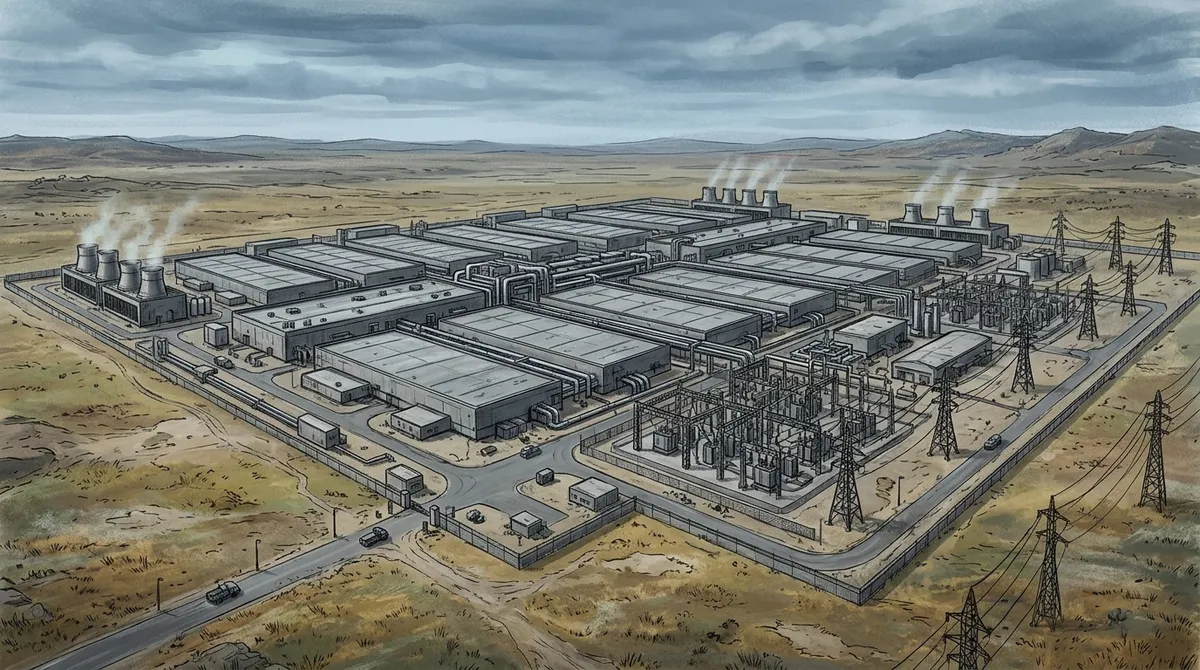
Sources Epoch AI Epoch AI, link 2
What happened: An Epoch AI study of Huawei's Horinger AI data center in Inner Mongolia — built under China's "East Data West Computing" initiative, with villages razed to make way — finds one of China's largest AI facilities holds less than one-tenth the capacity of the world's largest AI data center, Colossus 2 in Tennessee. Satellite imagery and a cooling-equipment model put its usable IT power at about 286 megawatts across four AI-specialized buildings (other estimates land in the same range: 304 MW from substation details, 230 MW from backup generators). Three of the four buildings appear operational; the fourth was complete but idle as of September 2026 and is estimated to come online by December. Huawei runs them mostly on its Ascend 910C chips, which the study pegs at about 0.76 of an Nvidia H100-equivalent in peak 8-bit performance, and Nvidia's B200 and B300 chips are about 2.5 times more energy-efficient — so a given amount of power capacity supports roughly 40% of the compute of leading US facilities. Huawei has deployed CloudMatrix384 supernodes at eight identified sites across China and plans at least 27 data center buildings at Horinger alone, with one source reporting up to 50.
What's genuinely new: the quantification. Satellite-based estimates now attach specific megawatt and chip-equivalence figures to China's flagship AI campus, turning "China has abundant energy but weaker chips" into measured numbers — a ~286 MW trailblazer that still trails the US frontier by an order of magnitude in computing capacity.
Watch: whether the fourth Horinger building comes online by December as estimated; how Huawei's next-generation Ascend chips fill the 27–50 planned buildings; and whether other large Chinese campuses get comparable independent estimates — the efficiency gap implies China's energy advantage alone won't close the distance.
Links: Epoch AI · Nov 5, 7:00 PM ET
More context: Epoch AI's satellite imagery and cooling-equipment model put Huawei's Horinger campus in Inner Mongolia at about 286 megawatts of AI-capable IT power across four dense-cooling buildings, yet at only around 81,000 H100-equivalents of computing capacity — roughly 7% of SpaceX's Colossus 2 in Tennessee (Epoch AI). Huawei's Ascend 910C reaches about 0.76 of an Nvidia H100-equivalent at peak 8-bit performance while Nvidia's B200 and B300 are about 2.5 times more energy-efficient, so a given amount of power in China supports roughly 40% of the compute of a leading US facility (Epoch AI). A planned Horinger building expected online around early 2028 would add more than 70% to the campus's compute, to about 141,000 H100-equivalents, but Epoch projects Colossus 2 will reach at least 1.8 million H100-equivalents by then (Epoch AI).