NASA's ESCAPADE pair fires for Mars after twin Earth flybys
From the Space digest for Nov 10, 2026
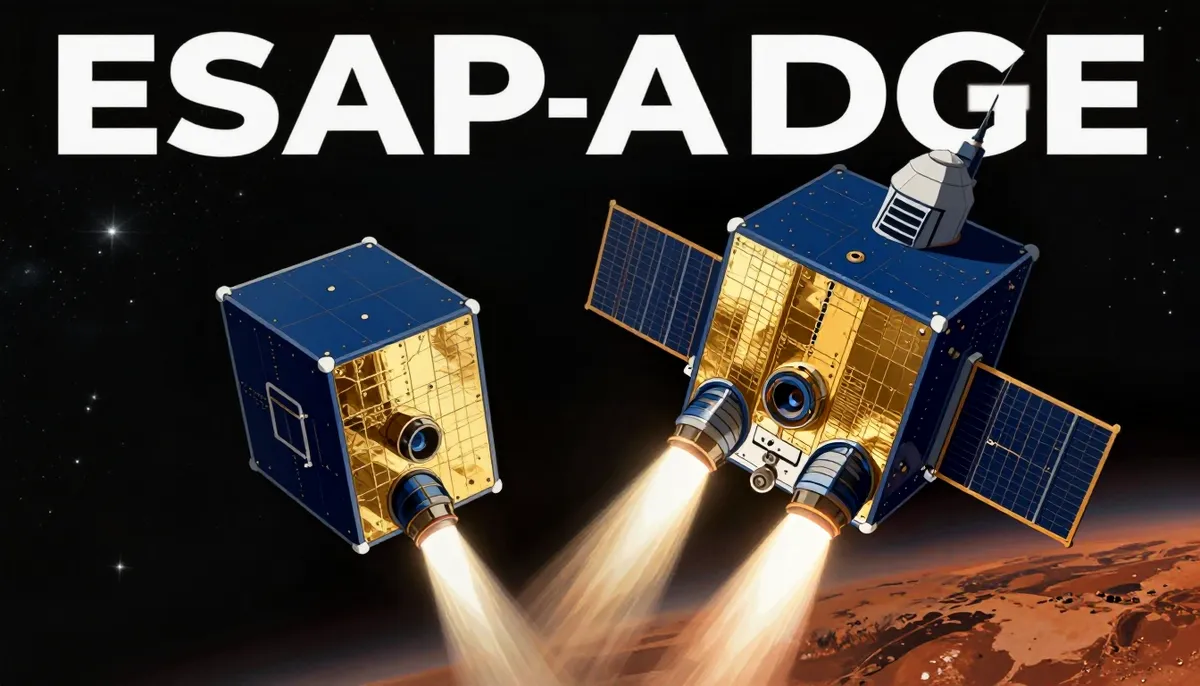
Sources SpaceNews Rocket Lab via MarketScreener Space.com note.com published Nov 10, 3:01 AM ET
What happened: Both of NASA's twin ESCAPADE spacecraft have completed powered Earth flybys and are now on trajectories to Mars — Blue on November 7, passing about 1,600 km up, and Gold on November 9, about 1,050 km up — each firing its main engine in a single continuous burn of roughly nine to ten minutes at closest approach. Using the Oberth effect, the burns pushed their speed from about 10.1 to about 10.8 kilometres per second, a gain of about 2,500 km/h. "This is the first time NASA has used a powered Earth flyby to propel a spacecraft toward Mars, and we've now executed this maneuver twice, flawlessly, in just two days," said Asal Naseri, acting associate flight director in NASA's heliophysics division (SpaceNews). Rocket Lab's own mission announcement adds the precision figures — the spacecraft executed the maneuvers autonomously, under operators at Rocket Lab and UC Berkeley, with better than 99% overall accuracy and a final attitude error of less than 1 degree; CEO Sir Peter Beck summed up: "Next stop, Mars" (Rocket Lab via MarketScreener). Principal investigator Rob Lillis told a November 9 meeting of the Mars Exploration Program Analysis Group that the burns were as critical as a Mars orbit-insertion burn, and "they were executed perfectly" (SpaceNews). The Rocket Lab-built spacecraft launched on November 13, 2025 on the second flight of Blue Origin's New Glenn, then loitered nearly a year near the Earth-sun L2 point — a trajectory designed by Advanced Space that opens Mars launch opportunities outside the usual two-year launch windows (SpaceNews).
What's genuinely new: confirmation that both burns fired on their dates and set the spacecraft on course, plus Rocket Lab's own announcement of the accuracy figures, the autonomy of the firings, and the plan for further interplanetary correction maneuvers during cruise. During the wait the pair also flew through the far end of Earth's magnetotail, reaching about 2 million kilometres out, farther than any previous spacecraft, with early data showing the tail tends to shrink under high solar-wind pressure (note.com); Space.com's report notes ESCAPADE is NASA's first dual-spacecraft mission to another planet and UC Berkeley's first planetary mission (Space.com). Arrival at Mars is set for September 7 and 9, 2027, each spacecraft performing an 11-minute burn to enter orbit, with the first science formation and observations of how the solar wind strips the Martian atmosphere expected from 2028 (SpaceNews).
Watch: trajectory-check results in the days after the burns, the September 2027 arrival dates holding, and the start of the twin-craft space-weather science.