Space digest — Nov 10, 2026
Top line: NASA's twin ESCAPADE spacecraft are bound for Mars after powered Earth flybys that both fired with better than 99% accuracy. Alarmed by a launch supply crunch as SpaceX stops taking commercial Falcon 9 orders, the Pentagon is lending rivals Rocket Lab and Stoke Space money for launch capacity.
- Flight 15's Booster 22 goes up on Starbase Pad 2 before the first double-catch attempt
- Pentagon starts lending to SpaceX's rivals as the launch supply crunch sharpens
- Rocket Lab reserves half of Neutron's capacity for itself as prices climb
- NASA's ESCAPADE pair fires for Mars after twin Earth flybys
Flight 15's Booster 22 goes up on Starbase Pad 2 before the first double-catch attempt
Sources NASASpaceflight on X NASASpaceflight on X, link 2 SpaceX autoevolution India Today Space.com published Nov 10, 1:26 PM ET
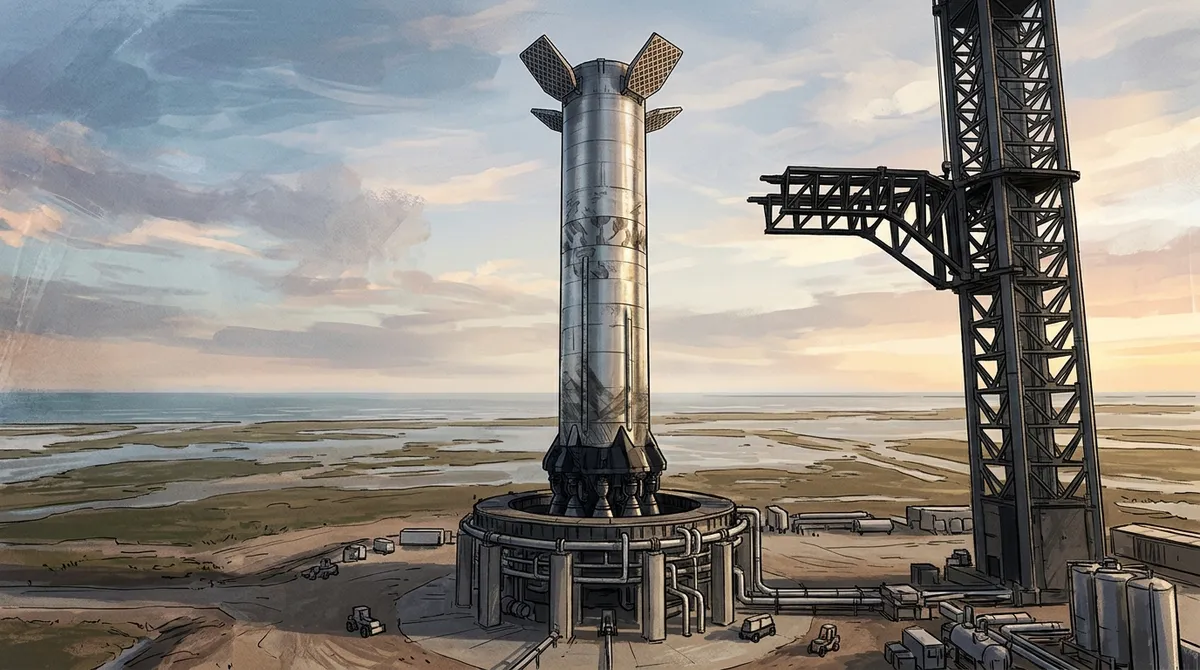
What happened: Flight 15's Super Heavy booster — Booster 22, carrying its 33 Raptor engines — is now seated back on the orbital launch mount at Starbase Pad 2 after its roll to the pad, NASASpaceflight relays, which also names Ship 42 as its flight partner, completing the move from pre-flight checks into physical pad integration for a mission targeted as early as November 13 pending regulatory approval (NASASpaceflight on X). SpaceX said the booster ran its final catch testing upon arrival — including a suspended squeeze test at catch height — and that it is the first Super Heavy V3 booster slated to return to the launch site for catch (Space.com). The booster and spacecraft have each completed their static-fire tests (India Today). SpaceX says Flight 15, launching as soon as Friday, November 13, in a 75-minute window opening at 4:45 p.m. CT, is planned as the first flight to return both the Starship upper stage and the Super Heavy booster to the launch site for catch — what the company calls "the first full recovery of an orbital launch system" (SpaceX). The upper stage is slated to orbit at roughly 275 km for more than 22 hours, completing about 14 orbits, and deploy 26 Starlink V3 satellites, each adding a Terabit of capacity, with the flight profile able to fall back on deorbit and ocean splashdowns at pre-set areas if systems misbehave (SpaceX). Coming back from the west, Starship's reentry path is set to cross populated parts of northern Mexico and southern Texas while steering around the major Rio Grande Valley cities before its final flip toward Pad 2, so sonic booms are expected (autoevolution). The ground track also carries Starship over parts of India several times during orbit, a rare set of viewing passes for skywatchers there, and a backup launch opportunity is planned the following day with contingency reentry over a cleared Indian Ocean area if orbital insertion is not reached (India Today). A separate 11,000-ft temporary flight restriction for a "high energy testing ground hazard" at Starbase takes effect November 12, published as a testing notice apart from the mission's launch and reentry restrictions (NASASpaceflight on X).
What's genuinely new: the booster seated on the Pad 2 launch mount — the roll away from check-out is done, with the ship to follow — plus the suspended squeeze test at catch height on the first V3 booster slated to return to the site, Ship 42's naming as the Flight 15 upper stage, the testing-only flight restriction over Starbase from November 12, and the India-visible ground track on the roughly 14-orbit plan. Flight 15 is set to carry 26 Starlink V3 satellites and attempt the first-ever catch of both stages, with the ship catch still gated by the FAA's licence modification and ocean-splashdown fallbacks as the planned contingency.
Watch: rollout of the combined stack, the FAA ship-catch licence modification, the November 13 launch attempt, and whether both stages are caught or the fallback trajectories are exercised.
Pentagon starts lending to SpaceX's rivals as the launch supply crunch sharpens
Sources Ars Technica 24/7 Wall St. Shattered
What happened: The Pentagon's Office of Strategic Capital has announced conditional loan commitments to two SpaceX competitors in recent weeks: a $150 million loan to Rocket Lab meant to raise the flight rate of Neutron — faster vehicle delivery and processing, an expanded fleet of maritime recovery vessels, manufacturing upgrades for composite structures and engines, and infrastructure that cuts turnaround time between launches — and a loan to Stoke Space supporting buildout of a second launch pad at Cape Canaveral Space Force Station for Nova Block 2, an upgraded version of its fully reusable Nova Pathfinder set to debut next year (Ars Technica). Both loans remain conditional on financial, legal, technical, investment and due-diligence requirements, and Rocket Lab has given no closing date; CFO Adam Spice called the terms "on very attractive terms" and, recalling them on the earnings call, about SOFR plus 100 basis points — "We always take it when we can get it. It gives us additional capital to scale key parts of our business, Neutron in particular" (24/7 Wall St.) — while CEO Peter Beck said "Launch is extremely constrained, and that is exactly the situation we predicted" (Ars Technica). The numbers behind the government's unease: SpaceX has stopped accepting commercial Falcon 9 orders for flights after 2028 as it turns to Starship (government customers such as NASA and the Space Force can keep booking through a contract that runs to 2029, with launches stretching to 2033); Quilty Space estimates a shortfall of about 150 launches through 2030 that could roughly double if military demand is counted, peaking in 2028; and the Space Force lifted its own demand forecasts — Lane 1 from roughly 30–60 launches to about 170, Lane 2 from 54 to 79, for missions ordered 2025–2029 (Shattered).
What's genuinely new: the crunch's government response turning concrete — two named conditional Pentagon loan commitments, Rocket Lab and Stoke — plus the crunch's size in numbers, Quilty's roughly 150-launch gap and the Space Force's sharply raised Lane 1 and Lane 2 forecasts, beside the commercial Falcon 9 order-book closure beyond 2028 that Ars's report confirms and its account of the Space Force's three satellite missions SpaceX declined to book.
Watch: financial close on either loan, which of the unflown rivals (Neutron set for 2027, Nova Block 2 next year) can actually field the gap, and whether SpaceX issues an official notice formalizing the end of commercial Falcon 9 bookings.
Rocket Lab reserves half of Neutron's capacity for itself as prices climb
Sources SpaceNews Seeking Alpha InvestorsHub Stocktwits MarketBeat Benzinga Benzinga, link 2 24/7 Wall St. Investor's Business Daily
What happened: Rocket Lab told analysts it deliberately took fewer Neutron bookings than demand allowed in the third quarter, trading volume for a higher selling price — CFO Adam Spice said the company "could have actually booked more launches" but "chose to go for higher ASP and lower volume," with the new $70 million base price (up from $55 million) already written into signed contracts. High demand is also lifting prices on the smaller Electron and HASTE rockets, Rocket Lab's launch-fee increases now spanning the whole lineup (SpaceNews). The quarter itself: revenue up 73% year over year to $267.8 million, above the roughly $257 million analyst estimate, a sixth straight quarterly record, backlog up 52% in a quarter to $3.57 billion, and positive GAAP operating cash flow of $7.2 million — but a wider-than-expected $0.12-a-share loss that sent the shares down more than 5% in premarket trading as Neutron spending ramps (InvestorsHub). One-time items drove most of that miss — a $27.26 million loss on retiring convertible notes and $21.34 million of Iridium acquisition costs — while non-GAAP gross margin slipped to 38.4% from 41.9% a year earlier (24/7 Wall St.). The stock then steadied: after sliding as much as 9% into the second session, it rebounded from the early slide to trade up about 2%, as analysts largely kept their ratings despite lowered targets (Investor's Business Daily).
What's genuinely new: a fuller round of analyst calls — Barclays (Overweight) cut its target to $82 from $85, Piper Sandler (Neutral) slashed its target to $58 from $83 saying Neutron's timing is the only near-term metric that matters, Roth (Buy) cut to $80 from $110 on market valuations, and Clear Street (Buy) raised its target $5 to $110 — alongside Cantor Fitzgerald's earlier $111 trim and the Electron and HASTE price increases (Investor's Business Daily); analysts also frame the shares as a beneficiary of SpaceX closing Falcon 9's commercial order book beyond 2028 (Benzinga). Management now puts Neutron's first launch in 2027, with the first 16 Neutron launches stretching into the 2030s (Seeking Alpha), alongside eight new Neutron missions from five constellation operators (ICEYE, Muon Space, Starcloud, Kepler and the Space Force's SB-AMTI program) worth more than $515 million. CEO Peter Beck declined to put a month or quarter on Neutron's debut until the replacement first-stage tank dome clears all qualification testing. The Department of War's Office of Strategic Capital loan commitment is priced at about SOFR plus 100 basis points. Twelve Rocket Lab-built spacecraft launched in the quarter, and the Iridium acquisition is fully funded through a completed at-the-market equity offering (Benzinga).
Watch: the size of the Electron and HASTE increases, the first-stage tank qualification gate ahead of a 2027 debut, Q4 execution against $270–290 million guidance, and the Iridium acquisition's close runway.
NASA's ESCAPADE pair fires for Mars after twin Earth flybys
Sources SpaceNews Rocket Lab via MarketScreener Space.com note.com published Nov 10, 3:01 AM ET
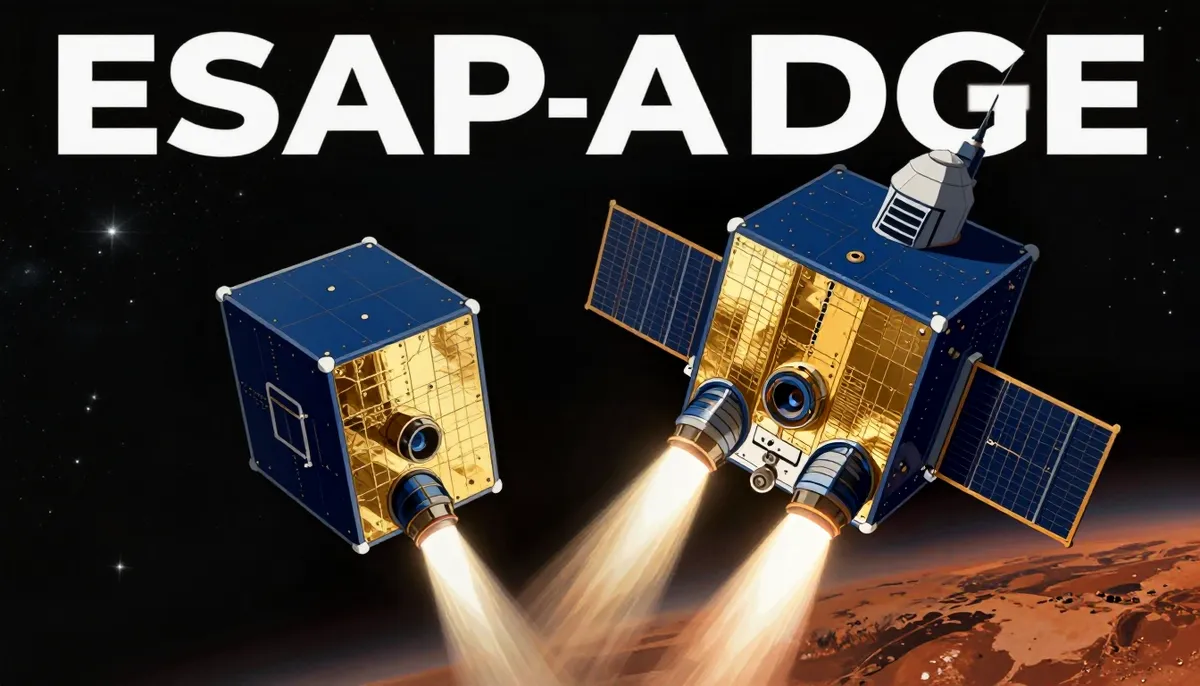
What happened: Both of NASA's twin ESCAPADE spacecraft have completed powered Earth flybys and are now on trajectories to Mars — Blue on November 7, passing about 1,600 km up, and Gold on November 9, about 1,050 km up — each firing its main engine in a single continuous burn of roughly nine to ten minutes at closest approach. Using the Oberth effect, the burns pushed their speed from about 10.1 to about 10.8 kilometres per second, a gain of about 2,500 km/h. "This is the first time NASA has used a powered Earth flyby to propel a spacecraft toward Mars, and we've now executed this maneuver twice, flawlessly, in just two days," said Asal Naseri, acting associate flight director in NASA's heliophysics division (SpaceNews). Rocket Lab's own mission announcement adds the precision figures — the spacecraft executed the maneuvers autonomously, under operators at Rocket Lab and UC Berkeley, with better than 99% overall accuracy and a final attitude error of less than 1 degree; CEO Sir Peter Beck summed up: "Next stop, Mars" (Rocket Lab via MarketScreener). Principal investigator Rob Lillis told a November 9 meeting of the Mars Exploration Program Analysis Group that the burns were as critical as a Mars orbit-insertion burn, and "they were executed perfectly" (SpaceNews). The Rocket Lab-built spacecraft launched on November 13, 2025 on the second flight of Blue Origin's New Glenn, then loitered nearly a year near the Earth-sun L2 point — a trajectory designed by Advanced Space that opens Mars launch opportunities outside the usual two-year launch windows (SpaceNews).
What's genuinely new: confirmation that both burns fired on their dates and set the spacecraft on course, plus Rocket Lab's own announcement of the accuracy figures, the autonomy of the firings, and the plan for further interplanetary correction maneuvers during cruise. During the wait the pair also flew through the far end of Earth's magnetotail, reaching about 2 million kilometres out, farther than any previous spacecraft, with early data showing the tail tends to shrink under high solar-wind pressure (note.com); Space.com's report notes ESCAPADE is NASA's first dual-spacecraft mission to another planet and UC Berkeley's first planetary mission (Space.com). Arrival at Mars is set for September 7 and 9, 2027, each spacecraft performing an 11-minute burn to enter orbit, with the first science formation and observations of how the solar wind strips the Martian atmosphere expected from 2028 (SpaceNews).
Watch: trajectory-check results in the days after the burns, the September 2027 arrival dates holding, and the start of the twin-craft space-weather science.
Brief
- Amazon Leo's first Vulcan flight (LV-01, 40 satellites) remains set for November 13 from SLC-41 at Cape Canaveral, and a second Vulcan (LV-02) is already being prepared in the VIF-G building to fly within weeks of it — the first of 38 Vulcan missions Amazon has on contract with ULA, carrying more than 1,500 first-generation satellites. LV-01 is the first Vulcan to fly with six GEM 63XL solid boosters and a shortened Centaur V upper stage, and the first ULA mission from the Amazon-funded VIF-A integration facility and new mobile launch platform, which let ULA stack two rockets in parallel; it also flies an improved booster-nozzle design after February's grounding. The constellation sits at 396 satellites with none launched since early July, against an FCC deadline of July 2029, and CEO Andy Jassy reiterated initial service this year on October 29. (Cryptopolitan)
- SpaceX plans two more classified U.S. Space Force missions on Falcon 9 from Vandenberg Space Force Base — USSF-627, scheduled for November 11 (Pacific), and USSF-317, for November 13–14 (Pacific) — both from SLC-4E with booster recovery on the droneship "Of Course I Still Love You." (USA TODAY · Vandenberg launch schedule)
- AST SpaceMobile's satellite build-out slipped again: the company now targets approximately 45 satellites in orbit by mid-2027 (previously by year-end 2026) — it has 13 in operation, the next three are waiting on SpaceX to set a launch date, another three ship in November for a Blue Origin launch early in the first quarter of 2027 (New Glenn's first flight since the May explosion), and five more fly in the first quarter of 2027 on the US government's DPAS-rated mission, with mobile-operator beta trials expected early 2027; the company still targets "intermittent" coverage by year-end in the US, Canada, Japan, Saudi Arabia and the UK (Light Reading · Seeking Alpha). Its own Blacklift rocket — a 20-tonne vehicle using Firefly Aerospace's Miranda engine, carrying up to five satellites per flight — is targeted to start flights in late 2028, with details due at a company event in New York on November 12. The stock fell after the report, Bank of America cut its price target to $45 from $80 with a Neutral rating citing the slower launch pace and execution risk on the rocket, Q3 revenue came in at $42.32 million against the roughly $46 million consensus, and a joint venture with Rakuten is to receive up to ¥148 billion (about $1 billion) to support a Japanese mid-band direct-to-device constellation operational by the end of March 2029 (24/7 Wall St. · AOL)
- Blue Origin's new Northstar booster engine — meant to replace the BE-4 on New Glenn's first stage — is produced more than 65% by in-house additive manufacturing, making it 30% lighter with 50% fewer parts, and delivers about 715,000 pounds-force of thrust against the BE-4's 640,000; CEO Dave Limp reportedly puts manufacturing cost at roughly 25% of the BE-4's, and the program went from approval to testing in eleven months (Metal AM) (single source)
- Kratos Defense & Security Solutions signed a long-term agreement with Seagate Space for the company's first Gateway offshore launch platform, supporting Kratos's first planned mission from it in 2027 for defense-related launch and target missions, as Seagate Space executed its first Gateway construction contract (SpaceNews)
- Firefly Aerospace signed Japanese satellite operator Synspective for up to 10 Alpha Block II launches through 2030, two StriX Earth-observation satellites per mission (Firefly Aerospace) (single source)
- Firefly Aerospace reported third-quarter results with a record $1.7 billion backlog, CEO Jason Kim calling the quarter proof of the company's "diversified and vertically-integrated business" (NASASpaceflight on X · Firefly investors)
- Starlink opened preorders by invitation in the US for the Mini 2, the next-generation portable terminal with a quick-swap battery rated for up to 4.5 hours of connectivity, USB-C power and built-in Wi-Fi (Starlink via NASASpaceflight on X)
- The FAA's environmental review of SpaceX's Starbase launch-rate plans moved its first public sessions online: the in-person scoping meetings set for November 17–19 have been converted to five virtual sessions, and the comment period on the Programmatic Environmental Impact Statement — which evaluates a phased rise from the 25 launches a year now authorized up to 456 launches and 912 landings a year at Boca Chica — closes December 7, 2026. (BASENOR)