Space digest — Nov 11, 2026
Top line: SpaceX lines up Starship Flight 15 for November 13 — the first attempt to catch both stages of an orbital rocket: a Super Heavy booster minutes after liftoff, the Ship a day later. Jared Isaacman explains NASA's SLS plan into the 2030s, and the Pentagon puts $300 million in launch loans behind Rocket Lab and Stoke Space.
- Isaacman lays out the SLS route into the 2030s
- SpaceX lines up the first two-stage Starship recovery for November 13
Isaacman lays out the SLS route into the 2030s
Sources NASASpaceflight Starlust published Nov 10, 11:02 PM ET
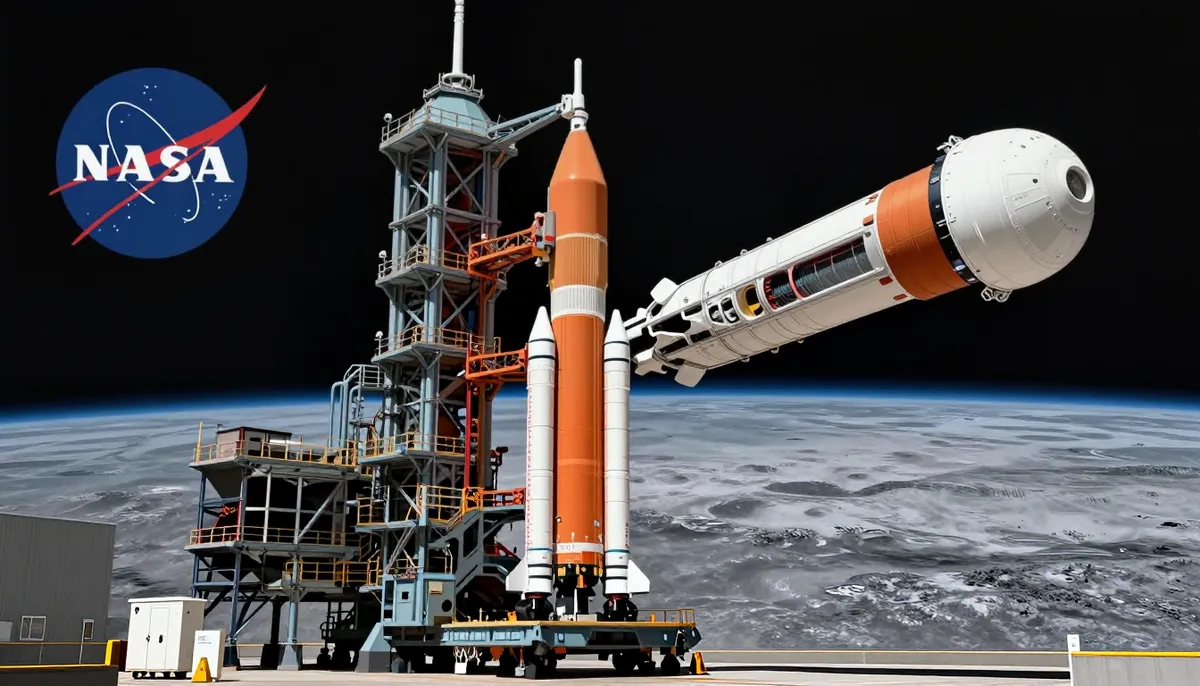
What happened: NASA Administrator Jared Isaacman explained the agency's decisions to standardize the Space Launch System, adopt a stretched Centaur V upper stage in place of the canceled Exploration Upper Stage, and stop work on Mobile Launcher 2 — all tied, he says, to flying SLS more often and more cheaply until commercial lunar transportation arrives in the 2030s. "There are a lot of ways to shake the $4 billion disposable rocket label that SLS has carried and one of which is launch more frequently," he said in an interview on NASASpaceflight's The Flame Trench show. In a separate interview with the Everyday Astronaut's Tim Dodd, he was blunter about what survives the transition: "Orion will clearly live on beyond SLS" — the capsule is "going to have its place for crewed deep space missions," carried by future launch vehicles, and Blue Origin's New Glenn 9x4 has been reported capable of flying Orion to the Moon.
What's genuinely new: Industry's responses to NASA's commercial lunar transportation request for information (issued in March, responses due April) pointed to the 2030s, with no end-to-end solution offered for 2028 or 2029 — which is why the existing architecture is being stretched rather than replaced. ML-2, stopped despite its near-complete structure, was "nowhere near as ready as people believe," and some of its components plus canceled-EUS hardware are going to Blue Origin as government-furnished equipment for its pad rebuild and landers. The EUS decision, Isaacman says, followed years of trouble: "Everything that touched that upper stage was a problem ... the stage adapter was way behind schedule and way over budget." With only one Interim Cryogenic Propulsion Stage left, the stretched Centaur is the lean for later flights. Artemis III itself will fly with no functional upper stage — a propulsion-less spacer sits between the core stage and Orion — and the mated core stage and boosters, the "short stack," are headed to Pad 39B for a crucial tanking test. Lockheed Martin said on November 5 it is expanding the Orion workforce and streamlining production for Artemis III, IV and V. On the Moon-side choreography, Isaacman expects a separate "kick stage" to do the trans-lunar injection burn, since docking Orion in low lunar orbit is far more fuel-efficient than the high elliptical orbit in NASA's published Blue Origin concept. NASA's November 4 update still lists both the final ICPS and the stretched Centaur V as options for Artemis IV, and no mission has been assigned to the new stage. Crew cadence goal: at least one flight a year, with two SLS launches possible in 2028.
Watch: Qualification testing of the stretched Centaur V — which Isaacman expects to fly on ULA's Vulcan for Defense Department missions too — the stage's first mission assignment, ML-1 modification progress, Orion's post-SLS launch vehicle, the kick-stage design, the Pad 39B tanking test, and whether the RFI responses mature into a commercial procurement.
SpaceX lines up the first two-stage Starship recovery for November 13
Sources USA Today Space.com Florida Today Benzinga The Week SpaceX The Motley Fool published Nov 11, 11:57 AM ET
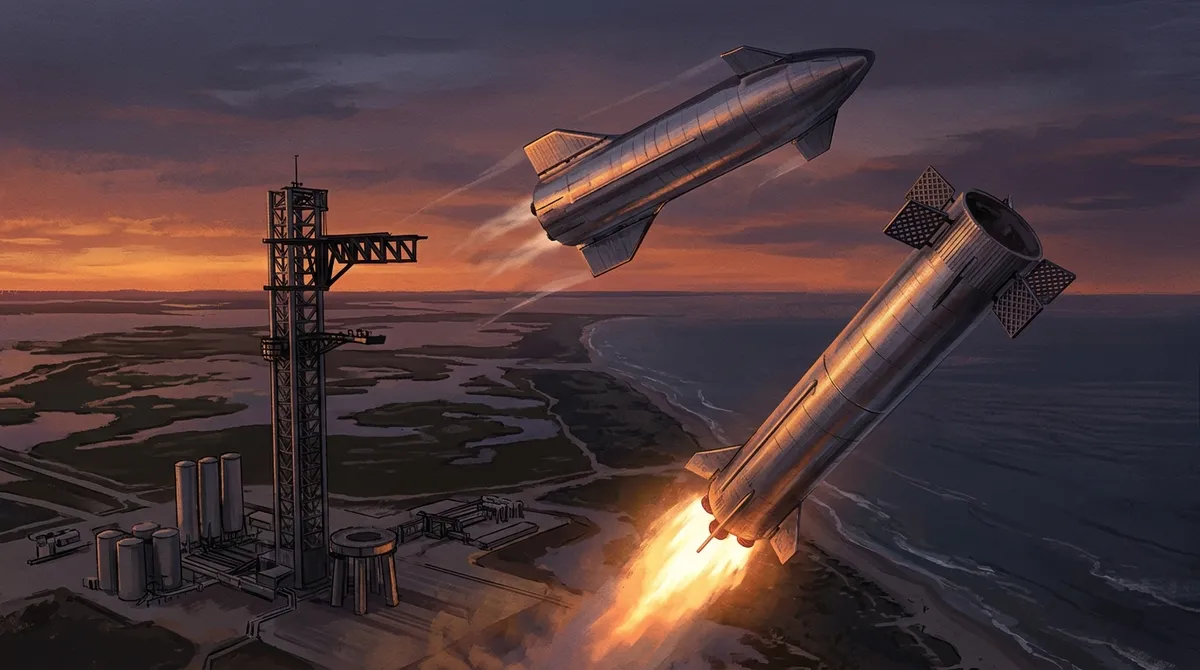
What happened: SpaceX is targeting Starship Flight 15 to lift off in a 75-minute window opening 5:45 p.m. EST on November 13 from Starbase's second launch pad — a pad that has never caught a rocket first — with FAA approval still required for both the launch and the Ship's return. Booster 22, the first Super Heavy V3 booster slated to fly back, is to be caught between the tower's mechanical arms about six and a half minutes after liftoff, the fourth booster catch and the first since March 2025. Ship 42 then climbs to roughly 275 kilometres, circles Earth up to 14 times over 22 or more hours and deploys 26 next-generation Starlink satellites before a deorbit burn and the first-ever attempt to catch an upper stage in a tower's arms, roughly 22.5 hours after liftoff — the first full recovery of an orbital rocket if both work. SpaceX's own launch manifest lists Starship Flight 15 as departing from Pad 2 at Starbase with a landing at "Mechazilla," the launch tower's catch arms, SpaceX.
What's genuinely new: The route home is unprecedented in another way: Ship reenters over populated parts of northern Mexico and South Texas for the first time, and SpaceX says it will approve the return only if the vehicle meets conditions cleared with the FAA, with ocean-splashdown aborts over the Indian and Pacific oceans as fallbacks. Prediction-market pricing on Polymarket puts the booster catch at 77% and the Ship catch at 47%, beside Elon Musk's "more likely than not" on the outcome from SpaceX's October earnings call; he has also called the recovery "the critical breakthrough needed to make life multiplanetary." Wall Street sees the stakes in market terms: Morgan Stanley analyst Adam Jonas has called a successful catch potentially "the biggest positive catalyst since the IPO." FAA temporary flight restrictions now published cover both the Friday launch and the potential catch of Ship 42 on Saturday, November 14. The prospect of what follows is taking shape in Florida, where a first Starship launch could come by the end of 2026: Pad 39A construction is complete and undergoing final tests, a launch tower stands at Cape Canaveral's LC-37 with a second rising, and the 380-foot Gigabay maintenance facility is nearing exterior completion — with Falcon 9 retired from Starlink deployments at Canaveral on August 25 and its V2 satellite work shifted wholly to California.
Watch: the FAA licence decision covering the Ship return, both catch attempts on November 13–14, and a Florida debut date.
Brief
- The Pentagon commits $300 million in conditional loans to Rocket Lab and Stoke Space through its Office of Strategic Capital: $150 million to Stoke Space, announced October 26, to build a second Nova launch pad at Cape Canaveral Space Force Station, and $150 million to Rocket Lab, committed November 10, to expand Neutron manufacturing, launch processing and maritime recovery equipment. CFO Adam Spice calls the terms attractive. The financing answers the military's assured-access-to-space concern as SpaceX closes commercial Falcon 9 bookings beyond 2028, with the Space Force now projecting as many as 249 launches through the early 2030s — more than twice its estimate of two years ago — and the same office has separately committed $150 million to satellite-tracking firm LeoLabs. Tech Times Single source.
- Blue Origin's New Glenn appears to have returned to flight: an MSN video account shows the first-stage booster landing on the company's drone ship and NASA's EscaPADE spacecraft deployed — a first success following engine work, pad damage and delays. No launch date or independent written mission report yet.
- AST SpaceMobile's Q3 report and quarterly filing: satellite production is ramping toward six second-generation BlueBirds a month by December, but only 12 satellites are in orbit, three delivered to the launch site in September still await a SpaceX launch date, and the constellation target has been re-dated from 45–60 satellites by end-2026 to around 45 by mid-2027. The 10-Q also prices April's BlueBird 7 mishap — launched to an unusable orbit on New Glenn — at about $126 million lost net of a $32.4 million insurance payout, with a replacement launch owed under contract. The filing's satellite costs are now being parsed: analyst Tim Farrar of TMF Associates puts BlueBirds 8, 9 and 10 at about $50 million each, worked from the quarterly filing's $271.2 million rise in the value of satellites in orbit (to $506.6 million after four BlueBirds began depreciating September 1), while AST's own guidance expects direct materials and launch costs to average $21–23 million per satellite across more than 90 Block 2 BlueBirds; the article also names the three satellites awaiting a SpaceX launch date as BlueBirds 14–16 and says Blue Origin launches the next three in early 2027. Stocktwits Single source.
- SpaceX plans roughly $24 billion of initial-phase investment in a gas-fired power plant and AI data centre at Starbase, per a Bloomberg-cited local hearing notice: the company ended Q3 with 1.7 GW of AI computing capacity, targets about 3 GW by end-2026 and as much as 10 GW by end-2027, and already runs two data centres near the Tennessee–Mississippi line. The project needs approvals from Texas environmental, utility and grid agencies — and lands after November 3's election installed a data-centre-moratorium advocate, Governor-elect Gina Hinojosa. In the same report Morgan Stanley reiterated its overweight rating.
- SpaceX has resubmitted its first coastal-use permit application (P20260831) for Starbase Louisiana after the state returned it, with the outline now showing five marsh-creation areas — previously one — plus much more detail on the long-planned Gulf wharf; the state logged a new "Application Received" entry on November 9. No independent confirmation of the revised scope yet. NASASpaceflight on X Single source.
- On Rocket Lab's third-quarter call, CFO Adam Spice said adjusted EBITDA should turn positive within about six months of Neutron's first successful flight — a first dated framing of the loss path from a company still guiding to a $14–20 million adjusted-EBITDA loss in the fourth quarter, and with Neutron's debut only pinned to 2027 until its replacement first-stage tank dome clears qualification. The Motley Fool Single source.
- Ookla's mid-year US Starlink network data shows the service improving as it grows — Speedtest samples up 41.8% year over year, median upload speeds up 42% to 20.73 Mbps, downloads up 12% to 119.71 Mbps and latency better across all 50 states and the District of Columbia — but median download speeds fell in 16 states and Washington, D.C., with Texas, Florida and Washington state among the relatively slow markets, and urban users grew at more than twice the rural rate between the first halves of 2025 and 2026; Ookla says the second half of the year will show whether network capacity keeps pace with customer growth. SpaceX counts on its V3 satellites, each said to carry about 10 times the downlink capacity of previous models, to expand it. Invezz Single source.