Space digest — Nov 12, 2026
Top line: Starship Flight 15 is set for November 13 and SpaceX's first attempt to catch both stages; ULA's Vulcan rolls to the pad for the same date with 40 Amazon Leo satellites after nine months grounded. Rocket Lab's record quarter drew a split Street verdict — Piper's $58 is the low target — and NASA's ESCAPADE probes are away for Mars.
- Starship Flight 15 goes for the first catch of both stages
- Rocket Lab's record quarter: analysts split around Neutron, Beck pitches a business beyond launch
- ESCAPADE's twin Mars probes are away for Mars
- ULA's Vulcan is back on the pad, carrying 40 Amazon Leo satellites
- A Senate panel will vote November 18 to fill NASA's vacant CFO and IG seats
- Piper Sandler cuts Rocket Lab to $58, the Street's lowest
Starship Flight 15 goes for the first catch of both stages
Sources The Motley Fool el-balad NASASpaceflight ABC News Detroit Free Press
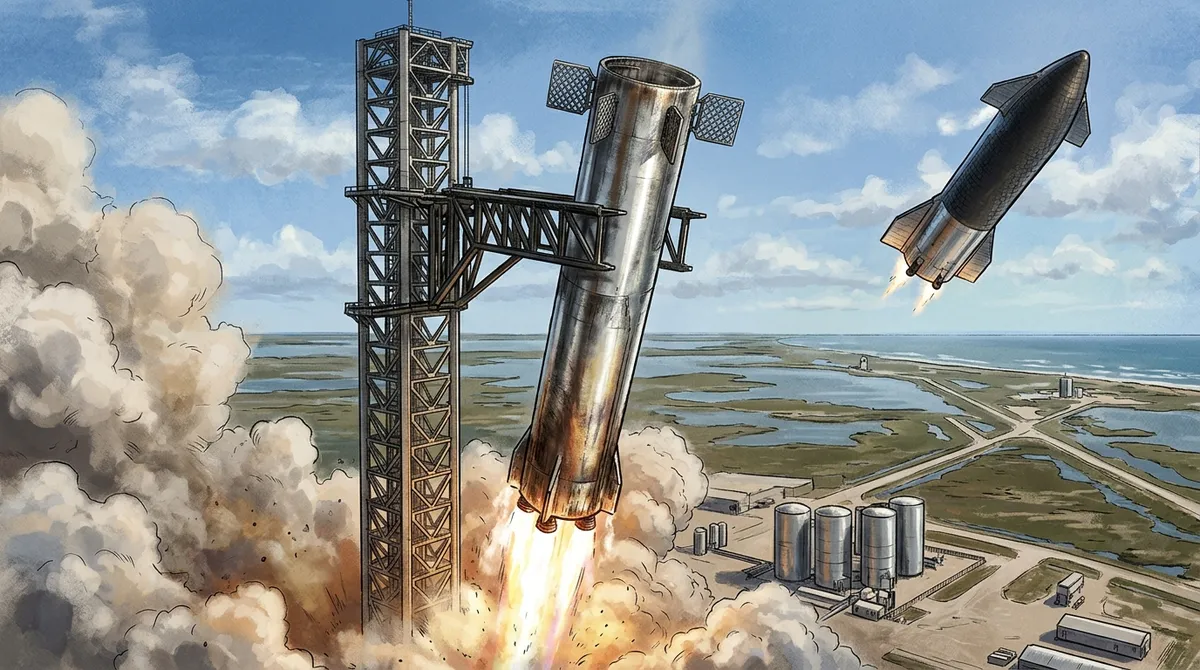
What happened: SpaceX's Flight 15 targets launch as early as November 13 from Starbase, Texas, in a 75-minute window opening 4:45 p.m. Central — the first attempt ever to recover both halves of the rocket with the launch tower. The Super Heavy booster is due back about 6.5 minutes after liftoff, a recovery SpaceX has done three times before; the harder half is the Ship upper stage, meant to orbit 14 times over more than 22 hours while deploying 26 Starlink V3 satellites before trying to land in the tower's arms on November 14 — a first for any upper stage, and a first full recovery of an orbital launch system if both catches succeed. The Ship returns to the tower only if the flight control team confirms its reentry and landing systems are healthy. A first NOTAM now covers Ship 42's reentry corridor over Mexico. Elon Musk said on the October 20 earnings call that success was "more likely than not," and president Gwynne Shotwell said the aim is to "refly the second stage by early next year." The Motley Fool frames the stakes for the company rather than the flight: SpaceX trades around a $1.9 trillion valuation, roughly 33 times sales, with the space segment at $1.8 billion of third-quarter revenue — about 12% of a $14.6 billion quarter — nearly break-even even as Starship R&D spending grew 44% year over year to $1.2 billion. If both catches succeed, Starship would become the first fully recovered orbital rocket in history, with the ship due back to the tower's arms around 4:15 p.m. ET on Saturday after a deorbit burn, per ABC News. The booster catch would be the fourth since October 2024, the first since March 2025, and the first for the latest version of Super Heavy, according to the Detroit Free Press. The hurdle to flying a recovered ship again quickly is its heat shield, whose thousands of tiles must be checked for cracks and repaired fast rather than inspected piece by piece over months, Casey Dreier of The Planetary Society told ABC News.
What's genuinely new: The eve-of-flight detail: the NOTAM over Ship 42's reentry corridor, Shotwell's "refly the second stage by early next year" aim from the October 20 call, and a fresh valuation read with the space segment nearly breaking even as Starship R&D spending keeps climbing.
Watch: Both catch outcomes on November 13–14, the FAA's decision covering the Ship's return, and whether a recovered Ship is reflown "by early next year."
Rocket Lab's record quarter: analysts split around Neutron, Beck pitches a business beyond launch
Sources TIKR Stocktwits Seeking Alpha SEC filing
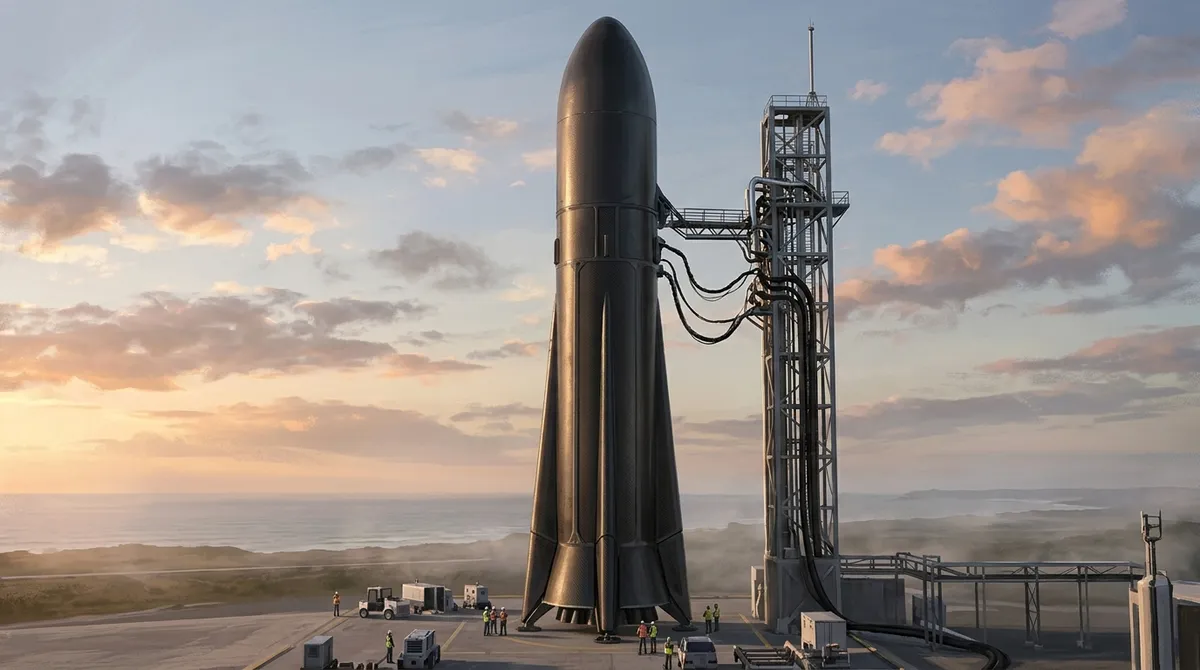
What happened: Two days after Rocket Lab's record third quarter — revenue of $267.8 million, backlog up 52% to $3.57 billion — the market story has found its shape: shares jumped 5.5% to $66.15 after Morgan Stanley kept an Overweight rating and trimmed its target to $103, TIKR reports, while Ark Invest added 72,709 Rocket Lab shares across November 10–11. The quarter's structure is now on the table too: TIKR says Space Systems carried more than 55 spacecraft in development or production and made $214.8 million of the quarter's revenue, and management guides that about $1.17 billion of the backlog converts in the next twelve months. Chief executive Peter Beck, in an interview with The Angry Astronaut carried by Stocktwits, said Rocket Lab would be "extremely profitable" without Neutron, plans to reserve roughly half of Neutron's long-term capacity for its own spacecraft missions, and sizes a space-services market of $350 billion growing toward $1 trillion. Rocket Lab reported record third-quarter revenue of $267.8 million, up 73% from a year earlier, alongside a record backlog of about $3.6 billion that rose 52% in the quarter (SEC filing). Sixteen Neutron missions are already booked ahead of its debut and several of the newly signed launch contracts carry a base price of $70 million, though the first flight is now targeted for no earlier than 2027 after hardware issues pushed back the schedule (SEC filing). Rocket Lab says it fully funded its pending Iridium acquisition through a completed at-the-market equity offering, and Iridium shareholders have approved the transaction (SEC filing).
What's genuinely new: Analysts now peg the stock's fate to a single metric — the Neutron debut date — but disagree on the direction. Several new Neutron contracts signed in the quarter carry a $70 million base price, up from $55 million, and Neutron's first 16 flights are booked with next slots in the 2030s. Rocket Lab now has more than 55 spacecraft in development or production; Beck's "extremely profitable without Neutron" framing and the half-capacity reservation for its own missions are new positions from him.
Watch: A firmer Neutron debut date, the first-stage tank qualification gate on the 2027 target, and the mid-2027 close of the Iridium acquisition.
ESCAPADE's twin Mars probes are away for Mars
Sources SpaceNews Generation NT NASA
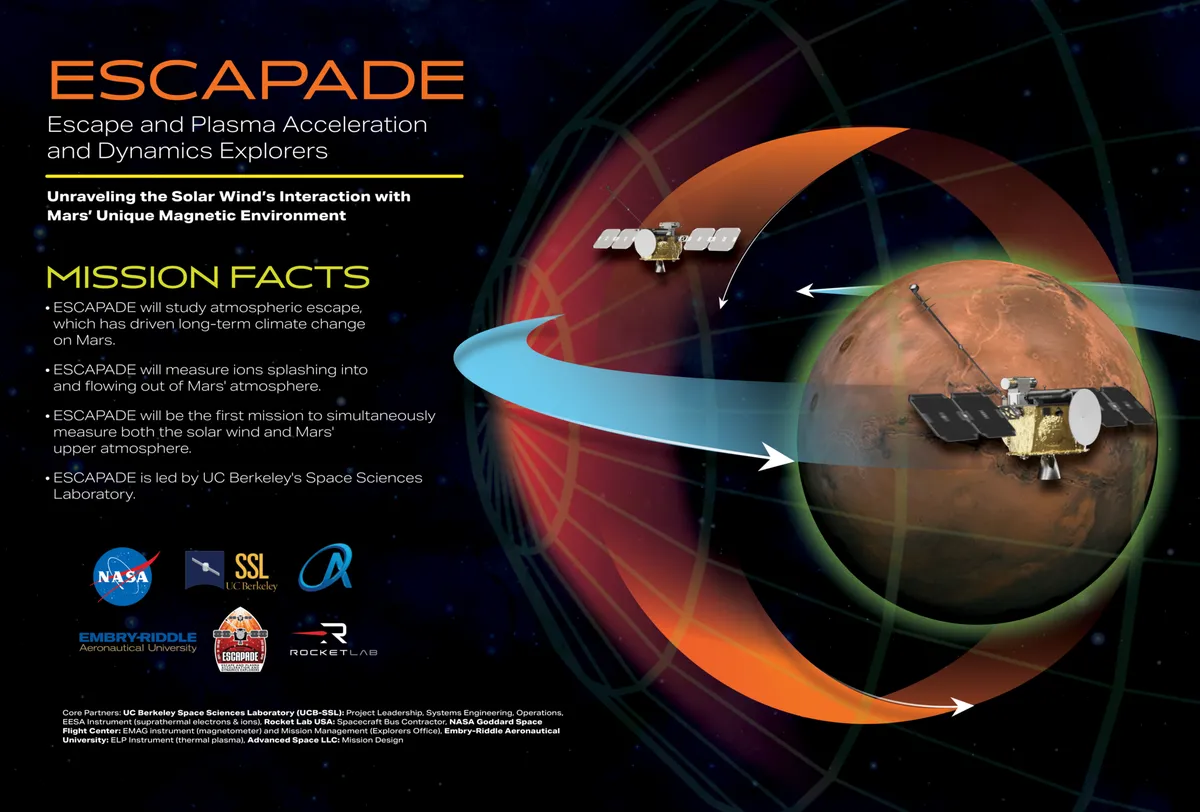
What happened: NASA's ESCAPADE orbiters Blue and Gold — built by Rocket Lab with UC Berkeley's Space Sciences Laboratory — have both fired their trans-Mars-injection burns during low Earth flybys, Generation NT reports, and are on course for a September 2027 Mars arrival. Blue ignited its engine over about nine minutes around 1,600 km up on November 7, 2026; Gold repeated the maneuver roughly 48 hours later at about 1,000 km, each combining the Earth's orbital speed with an Oberth burn. The pair is heading for Mars without waiting for the standard 26-month planetary alignment window, after spending nearly a year in a hold orbit near the Earth–Sun L2 point. Both craft must now fire their engines for about 11 minutes to slow into orbit after arriving a few days apart in September 2027, with science observations beginning in mid-2028 (NASA).
What's genuinely new: The escape maneuver itself is complete and worked: both burns executed, and SpaceNews (Rob Lillis, principal investigator) puts the pair on course for Mars. Generation NT adds the program-stakes read — the double success is a break for NASA's small-interplanetary-probe line after Janus was cancelled, Lunar Trailblazer was lost and LunaH-Map and Q-PACE failed. Arrivals are set for September 7 and 9, 2027, each followed by an 11-minute orbit-insertion burn.
Watch: Trajectory-check results in the days after the burns, the September 2027 arrival dates holding, and the June 2028 start of twin-craft space-weather science.
ULA's Vulcan is back on the pad, carrying 40 Amazon Leo satellites
Sources Orlando Sentinel GCN NASASpaceflight ULA via NASASpaceflight USA Today About Amazon published Nov 12, 9:38 AM ET
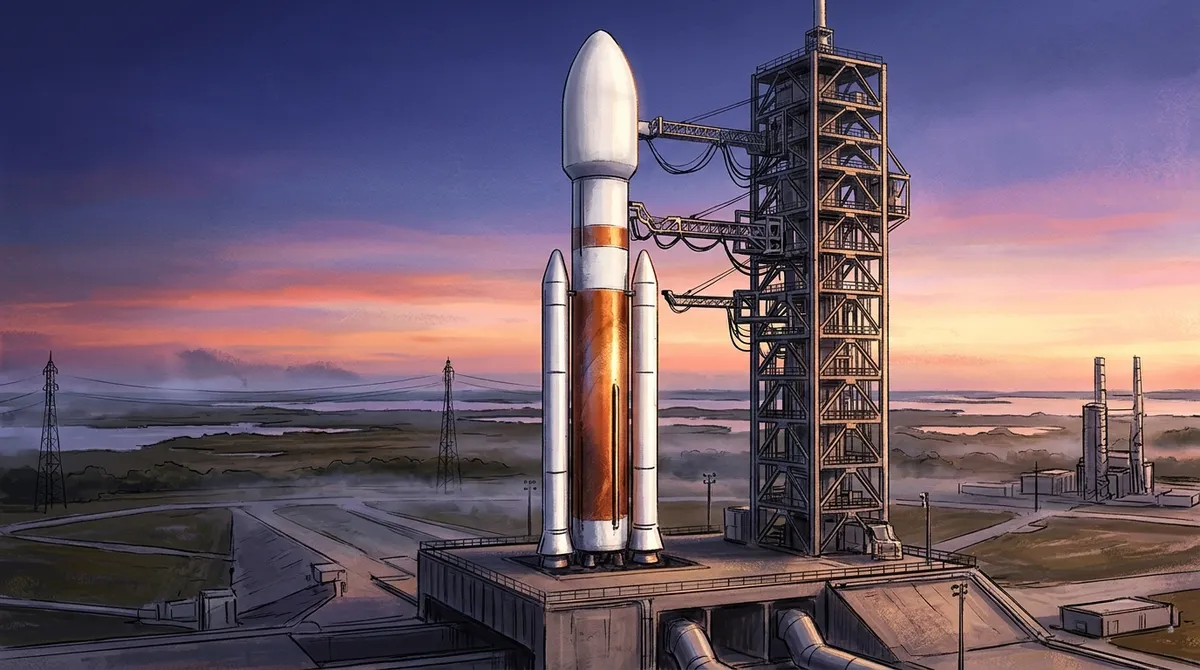
What happened: United Launch Alliance rolled its Vulcan to Space Launch Complex 41 at Cape Canaveral ahead of a liftoff at 12:54 p.m. on November 13, 2026, inside a 29-minute window — the rocket's first flight since February 12, 2026, when the nozzle on one of its Northrop Grumman-supplied solid rocket boosters burned off during ascent on Vulcan's second national-security mission — its first flew in August 2025 — which still delivered its Space Force payload. The flight carries 40 Amazon Leo broadband satellites to a near-circular orbit about 285 miles (460 km) up, inclined at 51.9 degrees — the first of 38 Vulcan missions Amazon bought to launch more than 1,500 of its 3,232 first-generation satellites, and the debut of the rocket's most powerful configuration, six boosters plus six first-stage engines producing more than 3.8 million pounds of thrust. ULA says it understands how the burn-through occurred and has made design and process fixes to the nozzle, without pinning down one culprit; the Space Force still has not said when it will trust payloads back on Vulcan, and all national-security launches have flowed to SpaceX in the interim. Amazon has just 396–398 satellites in orbit against FCC deployment requirements it missed — 1,616 by July 30, 2026, conditionally waived on June 5, 2026, with the full 3,232 first-generation fleet due by July 30, 2029 — and says initial service in the US, UK, France, Germany and Canada starts before the end of 2026. The Space Coast's cadence has fallen off 2025's record 109 orbital flights, with Blue Origin's New Glenn out until 2027 after the May pad explosion and SpaceX winding down its Falcon manifest, which limits government launch options after 2028, per Orlando Sentinel.
What's genuinely new: The rocket is on the pad and the flight is dated — the first of 38 Vulcan missions for Amazon, the VC6L heavy configuration's first flight, and the first on-flight test of the booster-nozzle fixes under a more demanding thrust profile. The deployment math behind the FCC's July 2029 deadline — thousands of satellites still to go on 80+ contracted launches across five rocket families — now rests on this cadence.
Watch: The November 13 launch and booster performance, the Space Force's clearance for Vulcan national-security missions, the FCC make-up schedule toward July 2029, and whether the end-2026 initial-service window for Amazon Leo holds.
A Senate panel will vote November 18 to fill NASA's vacant CFO and IG seats

Sources SpaceNews published Nov 11, 7:00 PM ET
What happened: The Senate Commerce Committee is set to advance the nominations of Joshua Shoemaker to be NASA's chief financial officer and Robert Steinau to be NASA's inspector general, SpaceNews reports, after a nomination hearing on November 10, 2026. Shoemaker, an accountant and formerly NASA Mission Support Directorate senior adviser, said he would focus on financial accountability, visibility into programs' budget and schedule performance, and modernizing the agency's financial systems. Steinau said he would focus on returning humans to the Moon, the transition from the space station to commercial stations, and cybersecurity.
What's genuinely new: The committee announced on November 11, 2026 it will meet November 18 to vote, sending them on approval to the full Senate. The chair has been empty in practice: NASA has had no Senate-confirmed CFO since January 2025 (a 2025 nomination returned without action) and no confirmed inspector general since Paul Martin's 2023 departure.
Watch: The November 18 committee vote, the Senate confirmation votes, and how the two nominees' stated priorities show up in agency decisions.
Piper Sandler cuts Rocket Lab to $58, the Street's lowest

Sources TIKR Investor's Business Daily
What happened: Piper Sandler analyst Alexander Potter cut Rocket Lab's target 30% to $58 from $83 on November 10 and kept a Neutral rating, TIKR reports — the lowest target among 22 analysts TIKR tracks, 13% below the Nov 10 close of $66.29 and 43% below the $102 Street average. Piper says Neutron's launch timing is the only near-term metric that matters, and Beck gave no launch date on the quarter's call until the first-stage propellant tank passes all its tests. Most of the cut reflects lower valuation multiples across space stocks.
What's genuinely new: The numbers beneath the cut. Rocket Lab lost 12 cents a share against 7 expected, and 2027 normalized-earnings consensus has slid from 16 cents a year ago to 3 cents as each Neutron delay pushes the earnings timeline out; the Street average target itself has slipped from $117 in July to $102.
Watch: When Neutron gets a firm launch date, and further consensus-target moves around it.
Brief
- SpaceX launched Falcon 9 B1103-7 from SLC-4E at Vandenberg on a USSF-627 military mission on November 11, 2026 (NASASpaceflight).
- Constellation Space, a Seattle startup founded by an ex-SpaceX Starlink engineer with Blue Origin and Capital One alumni, launched its machine-learning platform for running fleets of satellites and the ground networks serving them — forecasting weather, jamming, signal-to-noise and demand to optimize downlink passes (claimed gains up to 36% per pass) — with more than 10 customers including Amazon Web Services, $2.25 million in annual contract value this year and a $7.5 million seed round backed by Y Combinator, Nvidia, OpenAI and Samsung Next (GeekWire).
- AST SpaceMobile put its Blacklift rocket on public display at a New York media event — the first showing of hardware and renderings since the $1.3 billion Firefly engine deal announced November 6 — targeting a first flight in late 2028 on Miranda and Vira tap-off-cycle engines that have 175+ hot-fire tests but no orbital flight: Firefly's Eclipse rocket, now slated for 2027, must fly first, and at five BlueBirds per Blacklift flight, the 300-satellite fleet the company needs for global commercial service would take at least 60 launches; AST's FCC authorization covers a 248-satellite constellation (Tech Times).
- ESA explained why MaiaSpace's European Launcher Challenge contract remains unsigned: the company is the only one of four challengers that chose Component A launch-service-contract support — all €183.4 million (about USD 212 million) of its commitments — over the Component B development co-funding the other three took, a structural difference ESA space-transportation director Géraldine Naja said made negotiations "a little bit more sophisticated"; she called the signing "a question of days" on October 22, and it had still not been announced (European Spaceflight).
- Gama raised €15 million (about $17 million) for its large deployable solar arrays (SpaceNews).
- Caltech tested in-space robotic assembly techniques on a Momentus spacecraft (SpaceNews).