Space digest — Nov 13, 2026
Top line: Starship Flight 15 flew from Starbase on November 13: Ship 42 reached orbit and deployed 26 Starlink V3 satellites ahead of the first-ever Ship pad catch on November 14, but the booster catch was aborted into an offshore Gulf splashdown. ULA's Vulcan return to flight slipped to November 14 on a ground-systems power failure.
- Rocket Lab's Mars pair slingshots around Earth — the first powered Earth flyby on a Mars mission
- Vulcan slips to November 14 carrying the largest Amazon Leo shipment yet
- China lines up Pakistan's first astronaut to fly to Tiangong this month
- Starship Flight 15 stands on the pad for the first both-stages catch attempt
- Rocket Lab lines up its 100th Electron launch for November 14
- The Pentagon's $150 million Neutron loan gets its fuller policy readout
- AST SpaceMobile's Blacklift "unveiling" shows animations, not hardware — and a pad dispute
Rocket Lab's Mars pair slingshots around Earth — the first powered Earth flyby on a Mars mission
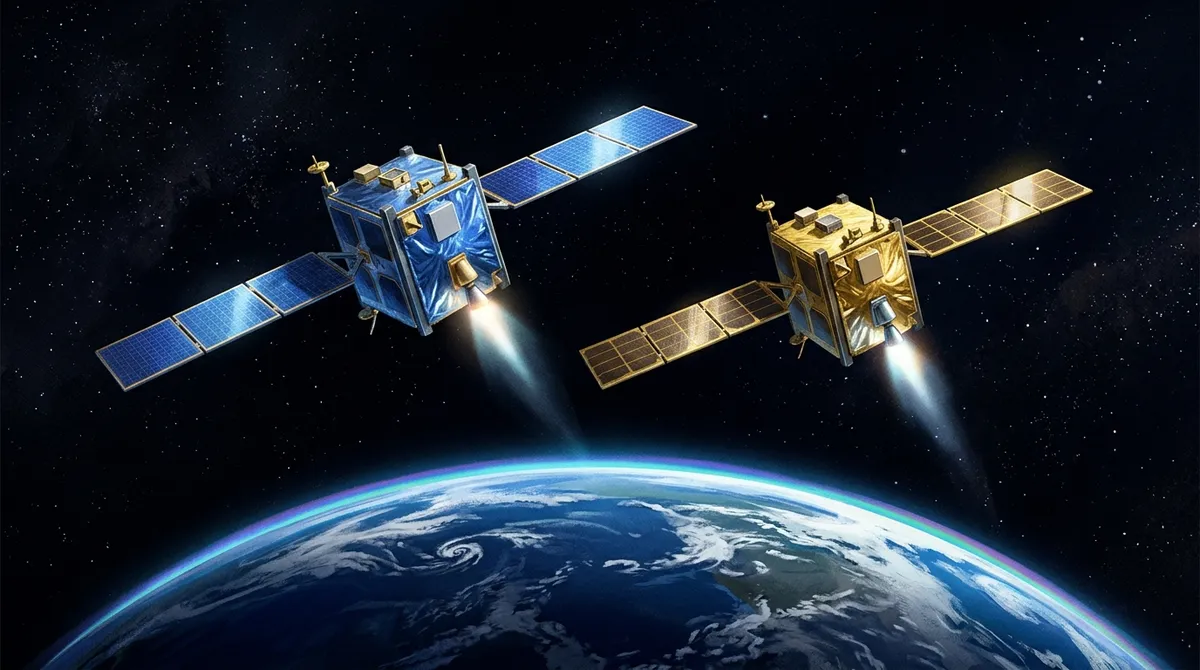
What happened: NASA's ESCAPADE spacecraft — Blue and Gold, built by Rocket Lab — fired their engines on November 7 and November 9 to slingshot around Earth after a year of loitering in space. Blue skimmed 1,000 km above the planet, Gold came within 1,600 km, and both accelerated from about 2.1 km per second to 10.4 and 10.9 km per second, five times faster. The pair, launched on Blue Origin's New Glenn on November 13, 2025 after that rocket missed the direct Mars window, is now on a 10-month cruise to Mars.
What's genuinely new: The manoeuvres are a first of their kind on a Mars trip — NASA's Asal Naseri called them the first time the agency has used a powered Earth flyby to send spacecraft toward Mars, executed "flawlessly" twice in two days. Mission designers at Advanced Space frame the loiter orbit near the Sun-Earth L2 point as a new strategy: launch almost any time and use Earth's gravity for the boost, rather than waiting for the planetary alignment that returns every 26 months. The spacecraft are expected to enter orbit around Mars in about 10 months, around September 2027, with science operations ready by early 2028 — measuring, from two vantage points at once, the solar wind that strips Mars's atmosphere. Programme director Sarah Blyde says 90% of the satellite buses were designed and built in-house by Rocket Lab, and the company is eyeing NASA's future Mars sample-return tender, which founder Peter Beck expects to be a multibillion-dollar opportunity.
Watch: Mars orbit insertion around September 2027, the first dual-point atmospheric observations in 2028, and Rocket Lab's bid for the Mars sample-return contract.
Vulcan slips to November 14 carrying the largest Amazon Leo shipment yet
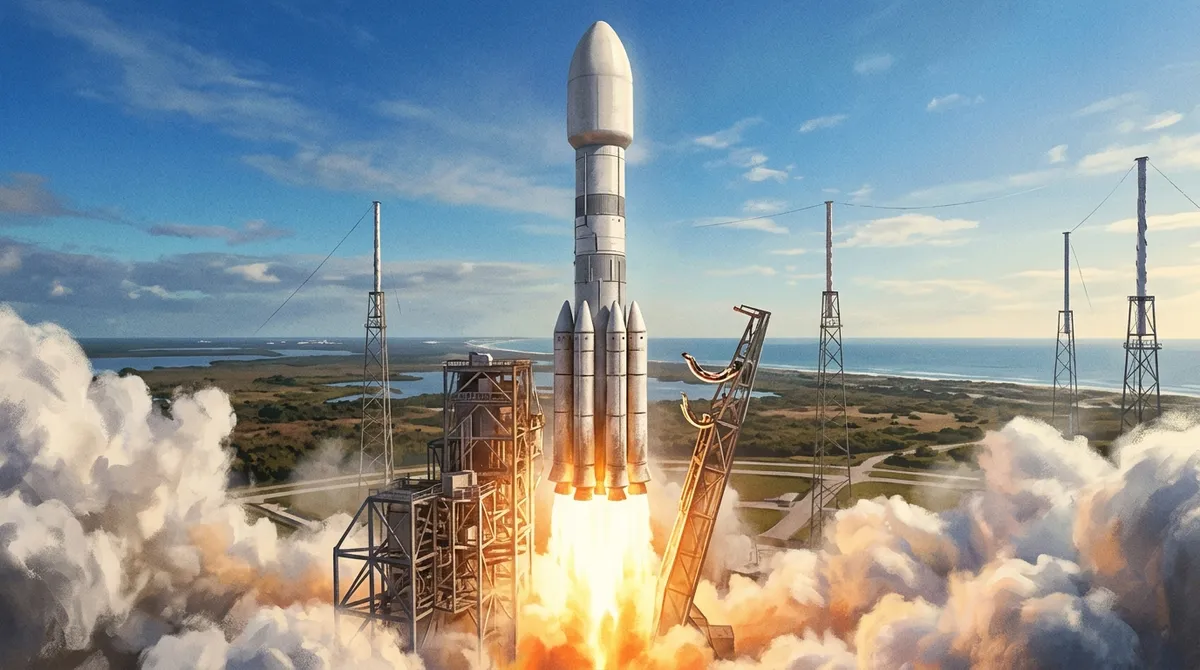
What happened: United Launch Alliance's Vulcan return to flight slipped a day: a power interruption at the Air Liquide plant that feeds gaseous nitrogen to the pad knocked out the high-pressure pumps, and ULA realigned the Amazon Leo LV-01 mission — 40 satellites on the six-booster VC6L, the most the constellation has ever deployed in one launch — to a backup window opening 12:32 p.m. Eastern on November 14 from Cape Canaveral's SLC-41. The vehicle and spacecraft are healthy.
What's genuinely new: The scrub itself, and its cause in ground support equipment rather than the rocket. The November 13 attempt had been set with the mission profile printed in full: 21 separate deployment events beginning just over an hour after liftoff with an upper-stage deorbit under two hours in, lifting the constellation past 400 satellites in orbit against 396 already deployed. The six GEM-63XL boosters fly the redesigned nozzles Northrop Grumman built after three identified causes of the February nozzle loss, with fixes to be validated in flight. It is the first of up to 38 Vulcan launches booked by Amazon, processed in the new Amazon-dedicated integration facility, and the Space Force is still to clear military Vulcan launches ahead of planned national-security missions.
Watch: The reset November 14 launch outcome and booster-nozzle performance, Amazon Leo's satellite count, and the Space Force's clearance of military Vulcan launches on the flight data.
Links: NASASpaceflight · USA Today · Nov 12, 12:44 PM ET · Palm Beach Post · Nov 13, 9:41 AM ET
China lines up Pakistan's first astronaut to fly to Tiangong this month

Sources Starlust China's Foreign Ministry on X
What happened: China is likely to send Pakistan's first astronaut to the Tiangong space station later this month. The visitor flies as a payload specialist on the Shenzhou-24 mission alongside two Chinese crewmates, who then spend about six months aboard as the station's next crew; the Pakistani guest stays roughly a week and returns on the Shenzhou-23 spacecraft. The candidates are Pakistan Air Force pilots Muhammad Zeeshan Ali and Khurram Daud, chosen from more than a dozen finalists and trained at the Astronaut Centre of China in Beijing. Launch would be on a Long March 2F rocket from Jiuquan in the Gobi Desert — the exact date and the final flier are still unconfirmed.
What's genuinely new: The flight would put the first foreign astronaut aboard Tiangong four years after the station reached full assembly, the first-ever joint crewed mission with foreign astronauts in China's human spaceflight program, under a February 2025 agreement signed in Islamabad. A November 7 China Manned Space Agency statement set the payload-specialist role, and China's foreign ministry publicly welcomed "the first ever joint mission of Chinese and foreign astronauts" on November 9. Pakistan's space agency SUPARCO says the visitor will carry four payloads to the station, and the visit sits at level two of China's four stated cooperation rungs — experiments, foreign-astronaut visits, foreign spacecraft docking and partner-built modules — with Pakistan already inside the China-led International Lunar Research Station program.
Watch: The Shenzhou-24 launch date and crew confirmation this month, what the four payloads are for, and whether more foreign astronauts follow on Tiangong.
Starship Flight 15 stands on the pad for the first both-stages catch attempt
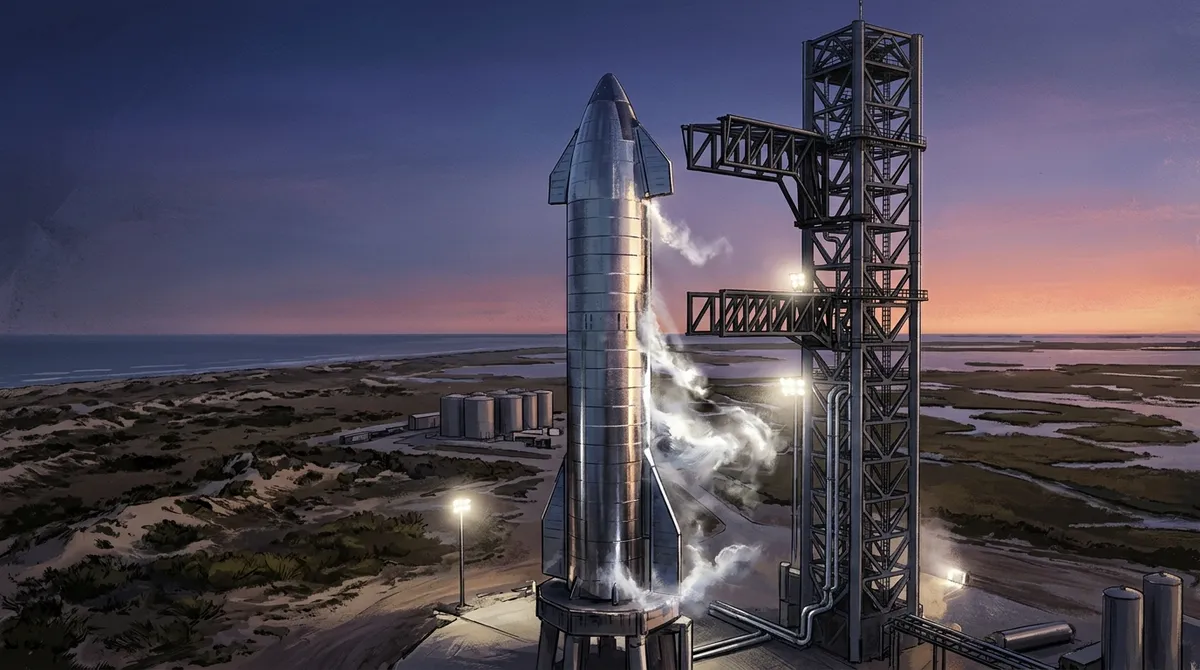
What happened: SpaceX launched Starship Flight 15 from Starbase, Texas, on November 13 at 5:47 p.m. EST. The Super Heavy booster's planned tower catch was called off before its landing burn and the booster diverted offshore to the Gulf of Mexico, where its descent ended in a fireball; SpaceX has not yet said what forced the abort. Ship 42 reached orbit and deployed all 26 Starlink V3 satellites, opening a coast of roughly 20 hours ahead of the program's first-ever attempt to catch a Starship upper stage on November 14.
What's genuinely new: The booster half of the first full-reusability attempt failed three flights after SpaceX's last successful Super Heavy catch, while the ship half stayed alive — controllers passed the first return checkpoint, and three of the deployed satellites carry cameras to photograph the heat shield during reentry. The deorbit burn is slated for 3:21 p.m. on November 14 ahead of a 56-minute descent and catch at Starbase. SpaceX frames the flight as potentially the last from Starbase before operations shift to Kennedy Space Center, where the pad 39A tower is due ready this month and a first Cape mission targets mid-2027.
Watch: The Ship's catch attempt and reentry over land on November 14, the cause of the booster abort, the first Kennedy Space Center launch, and the first reflight of a recovered Ship.
Links: NASASpaceflight · Starlust · CNN · Seeking Alpha · Scientific American · Nov 12, 11:24 PM ET · UPI · CBS News · AP · Orlando Sentinel · NASASpaceflight on X · Nov 13, 5:48 PM ET
Rocket Lab lines up its 100th Electron launch for November 14
Sources NZ Herald StreetInsider
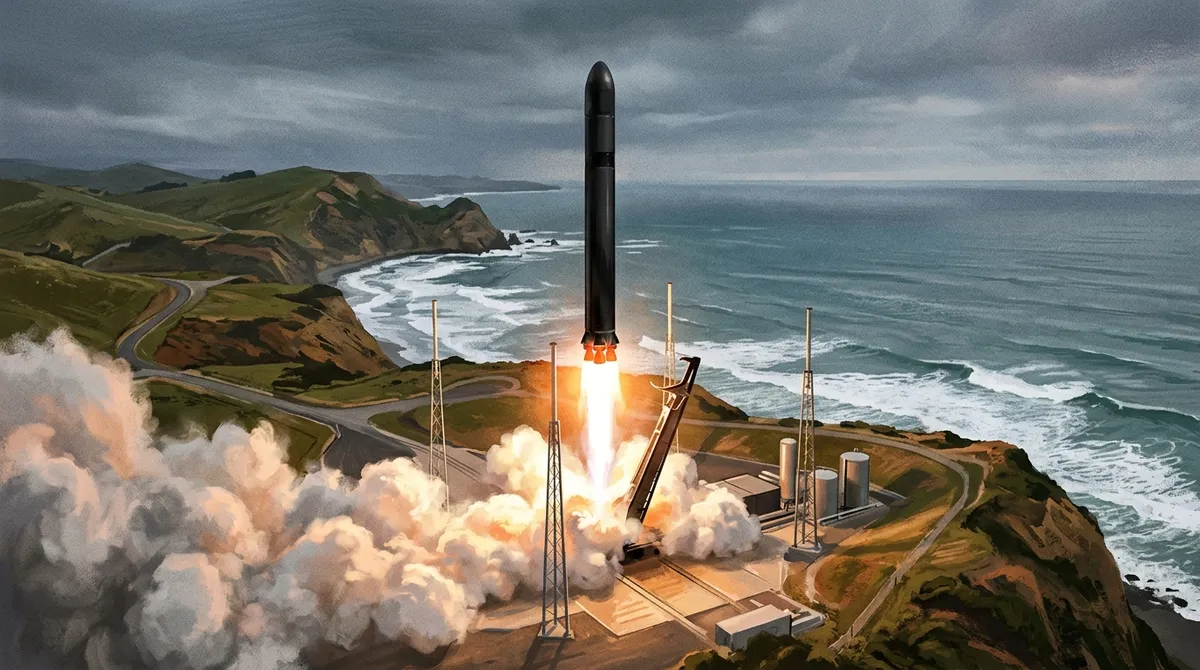
What happened: Rocket Lab has scheduled the 100th Electron launch — mission name "The Mountain God Rises" — for November 14 at 6:30 p.m. New Zealand Daylight Time (05:30 UTC) from Launch Complex 1 on the Mahia Peninsula, carrying a single Earth-imaging satellite for Japan's iQPS. Parts of the normally black rocket are painted gold for the milestone, and fans have organised watch parties at the Nūhaka viewing area.
What's genuinely new: The company's anniversary framing now has numbers beside it: 99 Electron flights since 2017 at roughly 96% mission success, about 3,500 employees worldwide, and the claim that Electron is the first commercially developed small-lift rocket — and the fastest — to reach 100 launches. Wet-dress rehearsal is complete.
Watch: The launch outcome and payload deployment on November 14, and whether the eight further iQPS bookings through 2030 fly on schedule.
The Pentagon's $150 million Neutron loan gets its fuller policy readout
Sources Air & Space Forces Magazine SpaceNews
What happened: The Pentagon's Office of Strategic Capital is giving Rocket Lab a $150 million conditional loan aimed at lifting Neutron's launch rate once the reusable medium-lift rocket enters service — support for faster vehicle delivery and processing, more recovery vessels, manufacturing upgrades for composite structures and engines, and infrastructure to cut turnaround between launches.
What's genuinely new: The loan sits inside a wider Pentagon campaign: it is the third $150 million space loan the office has issued in three weeks, after Stoke Space (a second Cape Canaveral pad) and Leo Labs (radar network expansion), all contingent on the companies clearing financial, legal and technical requirements. The article also confirms the loan is not meant to accelerate the first launch, which slipped to 2027 — Rocket Lab says 16 Neutron missions are already booked with next available slots in the 2030s, and the Space Force has picked Rocket Lab to compete for national-security missions once Neutron flies successfully.
Watch: Whether the loan's conditions clear, Neutron's 2027 first flight, and the first Neutron awards under the NSSL Phase 3 Lane 1 contract.
AST SpaceMobile's Blacklift "unveiling" shows animations, not hardware — and a pad dispute
Sources SpaceNews Ars Technica published Nov 12, 8:15 PM ET
What happened: AST SpaceMobile held its promised Blacklift unveiling in New York on November 12, presenting a three-stage, all-composite rocket: seven Firefly Miranda engines in the first stage, two Vira engines in the second and one Vira in the third, 20 tons to low Earth orbit, up to five BlueBird satellites per launch, flown exclusively for AST's own constellation at up to twice a month. No hardware was shown — only videos of the Firefly engines and vehicle animations.
What's genuinely new: CEO Abel Avellan argued that buying engines puts the program "on third base," bypassing a decade of engine development toward a late-2028 first flight. Two checks cut against that: the Virginia Spaceport Authority, which runs the Wallops pads, says its conversations with AST are "early, preliminary" and do not include Pad 0-A — the Antares pad AST's own slides named as the launch site — and Ars Technica reports the Miranda engine has not finished qualification testing, contrary to the "ready to fly" framing, with Firefly's chief executive confirming testing remains underway.
Watch: A signed Wallops agreement for a named pad, completed Miranda and Vira qualification, and whether the late-2028 first-flight date survives either.
Brief
- Relativity Space reports Terran R's second stage completed its full mission duty cycle on the first try — a 400-plus-second burn-and-coast demonstration including an igniter hot fire, per the company.
- Blue Origin has completed qualification testing of a modified component in its Huntsville-built BE-4 engine, the workhorse powerplant on both New Glenn and Vulcan, after the May New Glenn pad failure.
- Spain's UARX Space has deployed OSSIE-D, its Spanish-built orbital transfer vehicle, launched on a Falcon 9 and released with the company's own SAU&RON 24 separation system, with the electrical power subsystem from DHV Technology reporting nominal in orbit.
- NPR sizes up what Starship's rise means for NASA's ride to orbit: the Dragon capsule — currently the only American spacecraft flying crews to the International Space Station — is contracted for just three more flights under NASA's September award, covering astronaut rotations only through 2028 if they fly in six-month increments and no further flights are booked. SpaceX's launch revenue of about $2.1 billion through September trails Starlink (roughly $12.8 billion) and its AI business (about $10.9 billion), and SpaceX president Gwynne Shotwell points future station riders toward Boeing ("They should fly their capsule"), with Starliner's next test flight ahead of a crewed flight in 2028. NPR
- China's space agency has called for proposals to build payloads for Tianwen-4, its Jupiter mission that will orbit Callisto and carry a lander, with foreign institutions invited to take part; no Uranus flyby probe appears in the announcement. CNSA
- ESA's Hera spacecraft has arrived at the asteroid pair Didymos–Dimorphos, more than four years after NASA's DART probe's impact; it holds about 30 km and flies in formation — the bodies' gravity is too weak for a stable orbit — and later releases two small satellites to observe the asteroids up close and attempt landings. ynetnews
- NASA is offering $1 million in prize money for US high school and college student teams to help solve lunar-base challenges — energy systems, living quarters, communications, mobility, life support and astronaut safety — an initiative Administrator Jared Isaacman introduced at Kennedy Space Center. ynetnews