ESCAPADE's twin Mars probes are away for Mars
From the Space digest for Nov 12, 2026
Sources SpaceNews Generation NT NASA
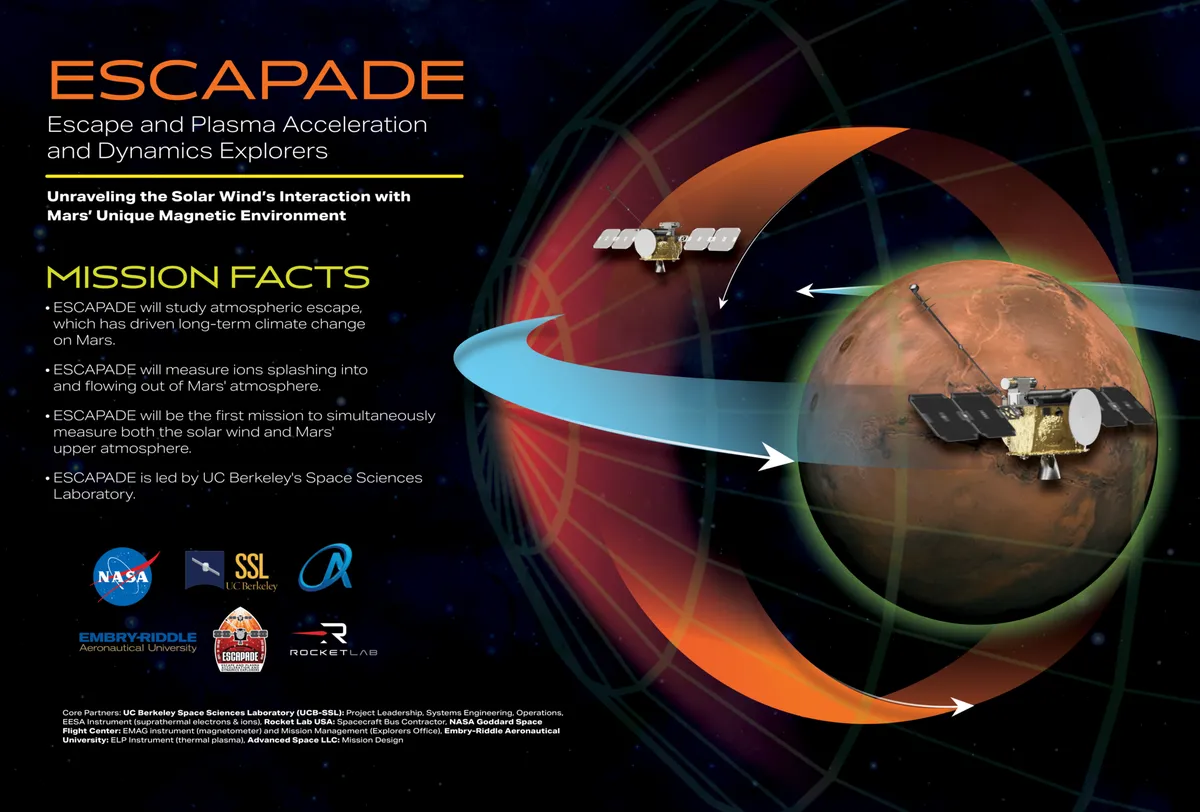
What happened: NASA's ESCAPADE orbiters Blue and Gold — built by Rocket Lab with UC Berkeley's Space Sciences Laboratory — have both fired their trans-Mars-injection burns during low Earth flybys, Generation NT reports, and are on course for a September 2027 Mars arrival. Blue ignited its engine over about nine minutes around 1,600 km up on November 7, 2026; Gold repeated the maneuver roughly 48 hours later at about 1,000 km, each combining the Earth's orbital speed with an Oberth burn. The pair is heading for Mars without waiting for the standard 26-month planetary alignment window, after spending nearly a year in a hold orbit near the Earth–Sun L2 point. Both craft must now fire their engines for about 11 minutes to slow into orbit after arriving a few days apart in September 2027, with science observations beginning in mid-2028 (NASA).
What's genuinely new: The escape maneuver itself is complete and worked: both burns executed, and SpaceNews (Rob Lillis, principal investigator) puts the pair on course for Mars. Generation NT adds the program-stakes read — the double success is a break for NASA's small-interplanetary-probe line after Janus was cancelled, Lunar Trailblazer was lost and LunaH-Map and Q-PACE failed. Arrivals are set for September 7 and 9, 2027, each followed by an 11-minute orbit-insertion burn.
Watch: Trajectory-check results in the days after the burns, the September 2027 arrival dates holding, and the June 2028 start of twin-craft space-weather science.