Space digest — Nov 9, 2026
Top line: Rocket Lab logs a record quarter — $268 million in revenue, a $3.57 billion backlog and eight fresh Neutron bookings at a higher $70 million price — plus a $150 million Pentagon loan commitment for Neutron production. Starship Flight 15 keeps its November 13 date, with Booster 22 rolling toward Pad 2 ahead of the first attempt to catch both stages.
- Starship Flight 15: the first double-catch attempt takes shape
- Rocket Lab logs a record quarter: $268 million revenue and a $3.57 billion backlog
- Neutron's manifest reaches 16 missions as the launch price rises to $70 million
- Pentagon commits $150 million in conditional loan financing for Neutron production
Starship Flight 15: the first double-catch attempt takes shape
Sources Gadget Review USA TODAY Gizmodo Astronomy NASASpaceflight NASASpaceflight, link 2 SpaceX published Nov 9, 5:47 PM ET
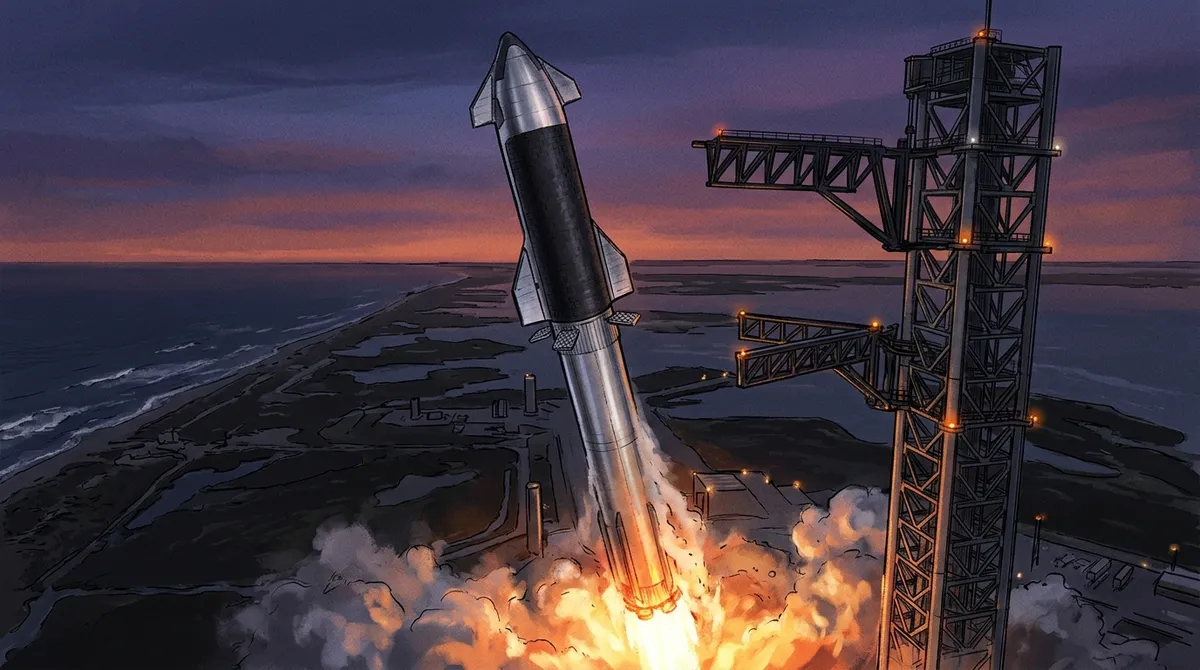
What happened: Flight 15 remains on course to lift off from Starbase on November 13, pending regulatory approval, with a 75-minute launch window opening at 5:45 p.m. Eastern and the first attempt to catch both the Starship upper stage and the Super Heavy booster with the launch tower's mechanical arms. The mission plans an orbit about 275 km up, more than 22 hours aloft across roughly 14 orbits, and 26 Starlink V3 satellites — three of them modified to photograph the heat shield during reentry, when ground observation is limited. The upper-stage catch is conditional: abort trajectories and ocean-splashdown options are built into the profile. SpaceX's own Flight 15 page sets a 75-minute window opening at 4:45 p.m. Central (5:45 p.m. Eastern) on Friday, November 13, and describes the mission as the first attempt to return both Starship and the Super Heavy booster to the launch site — which, if it works, would be the first full recovery of an orbital launch system (SpaceX). The ship is to orbit at about 275 km for roughly 14 orbits over more than 22 hours while deploying 26 Starlink V3 satellites, each adding one terabit of capacity so that the batch equals about ten Falcon 9 launches of Starlink V2 Minis, with three of the satellites fitted with cameras to scan the heat shield and send imagery to operators (SpaceX).
What's genuinely new: the launch-window time, the planned orbit profile, three Starlink V3 satellites modified to photograph the heat shield, and the built-in fallbacks that make the catch a planned objective rather than a guaranteed outcome; a preview also frames the contrast between the routine booster return and the upper stage's new demands — reach orbital velocity, survive reentry, and arrive at the tower correctly aligned. NASASpaceflight live coverage shows Booster 22, set to fly the mission, in transport on the road to Pad 2.
Watch: the hardware reaching Pad 2, the November 13 window opening, and whether both stages are caught or the fallbacks are exercised.
Rocket Lab logs a record quarter: $268 million revenue and a $3.57 billion backlog
Sources The New Zealand Herald Markets Insider 24/7 Wall St. Benzinga Benzinga, link 2 ad-hoc-news ad-hoc-news, link 2 TipRanks Barron's MarketWatch ABCMoney
What happened: Rocket Lab reported third-quarter 2026 revenue of $267.8 million — above its $250–265 million guidance and the ~$257 million consensus, up 73% year over year and 14% from the second quarter — while GAAP EPS of -$0.12 missed the -$0.07 estimate, with the net loss widening to $79.7 million from $18.2 million a year ago as Neutron delays added costs. Backlog grew 52% in a single quarter to a record $3.57 billion, built on roughly $1 billion of new launch contracts — including the company's largest-ever Electron order, 20 launches for Tokyo's Synspective — plus $470 million of Space Systems signings; the combined launch backlog across Electron, HASTE and Neutron now stands at 117 missions, and nine-month revenue of $702.2 million runs well ahead of the $422.1 million booked over the same stretch last year. Rocket Lab reported its first-ever positive cash flow, about $7 million for the quarter, and guided a record fourth quarter of $270–290 million in revenue with a $14–20 million adjusted EBITDA loss. The quarter closed with $4.4 billion in cash — against $828.6 million a year earlier — after raising debt and issuing shares for the roughly $8 billion Iridium purchase, whose shareholders approved the deal with a mid-2027 close expected. Shares rose 10.9% ahead of the print, then fell after the wider-than-expected loss: the stock closed at $55.02, down 5.55% on roughly twice its average volume, with FINRA's daily data showing short-sale volume climbing from 0.398 of traded volume on October 30 to 0.607 as the results landed.
What's genuinely new: the market's verdict — a wider-than-expected loss sent the shares lower despite the record top line, with short positioning building into the print — plus the 117-mission combined launch-backlog count and the nine-month revenue figure; alongside the print, the report notes eight further dedicated Electron launches booked for iQPS through 2030 and SEC Form 4 filings showing CFO Adam Spice exercised options on roughly 140,000 shares and sold the same number on November 2, with board member Nina Armagno selling 10,926 shares that day, both attributed to pre-arranged Rule 10b5-1 trading plans.
Watch: whether the Neutron debut target or concrete testing milestones firm on the strength of the quarter, how the stock settles as the loss-versus-growth trade repriced, the Iridium close runway, and whether iQPS bookings convert to flown missions.
Neutron's manifest reaches 16 missions as the launch price rises to $70 million
Sources MarketScreener The New Zealand Herald
What happened: Rocket Lab booked eight Neutron missions across five constellation operators in the quarter, totaling more than $515 million: ICEYE signed for three dedicated launches beginning in late 2028, Muon Space for two (2029 and 2030), and Starcloud — which plans data centers in space — for one in 2029; the other two quarter bookings are the dedicated flight for Kepler Communications, signed in the quarter and recently announced, and the United States Space Force mission under the SB-AMTI program, also signed in the quarter. The manifest now totals 16 missions, with the next available launch opportunities in the 2030s, and the base launch price has risen from $55 million to $70 million, which the company attributes to strong demand and tightening launch availability.
What's genuinely new: the named customers, their launch dates, the manifest count and the price increase — the first concrete movement on Neutron's commercial book since the Kepler reservation.
Watch: the 2027 debut holding, further bookings at the new price point, and the first-stage tank-structure qualification gate early in 2027.
Pentagon commits $150 million in conditional loan financing for Neutron production
Sources SpaceNews
What happened: The Pentagon announced a $150 million conditional loan commitment to Rocket Lab to help the company increase Neutron production, per SpaceNews — a fresh government financing line landing in the same quarter Rocket Lab booked eight Neutron missions — seven from commercial constellation operators and one for the US Space Force's SB-AMTI program — and raised the rocket's base list price from $55 million to $70 million.
What's genuinely new: the loan commitment itself — new Pentagon financing aimed specifically at scaling Neutron output, separate from the program's earlier Space Force contract work; the conditions attached and the disbursement schedule are still to be set out.
Watch: the loan's conditions and disbursement gates, what production capacity it funds, and how the financing lands against the 2027 debut and the early-2027 tank-structure qualification.
Brief
-
The FAA says the reentry license for Sierra Space's Dream Chaser is being issued "well in advance of Sierra Space's targeted spring 2027 mission date" (FAA statements, relayed by Jeff Foust) — the first named mission date since the license's October 30 report left its preceding launch an open question.
-
Rocket Lab's freshly formed robotics division has won a NASA technology demonstration, Foreign Policy Journal reports: the mission, designated NASA Fly Foundational Robots, is scheduled for late 2027 and will carry an autonomous robotic arm from Rocket Lab Robotics — the unit built from the $60 million purchase of Motiv Space Systems in May — into low Earth orbit on a dedicated spacecraft, where it will traverse the craft's exterior and install a component under zero gravity, with NASA engineers taking direct control in later phases. The spacecraft carries docking interfaces for visiting vehicles and further servicing demonstrations, and Rocket Lab says success would unlock follow-on missions from orbital infrastructure to deep-space support. The mission assignment has not yet been confirmed by NASA or Rocket Lab directly; any contracted follow-on work would come on top of this demonstration.
-
Voyager 1 reaches a first in spaceflight on November 18: at 5:16 am EST the spacecraft will be about 16.09 billion miles (25.9 billion kilometers) from Earth — one light-day away, the farthest any human-made object has ever traveled, with a one-way signal taking a full day. NASA is marking it with a "Shine Bright for Voyager's Light-Day" public event on November 17, inviting anyone with a flashlight or phone to flash the Morse code signal "VGR" skyward for a minute. The spacecraft, launched in September 1977, entered interstellar space in 2012 and resumed normal communication after a brief outage on October 18–19.
-
A new Starbase road delay is posted for Monday, 10 am to 2 pm, from the production site to the pad, per Erik Fraser — the kind of movement that would put the first Flight 15 hardware on its way to Pad 2, with the flight targeted for November 13.
-
Flight 15's remaining navigation warnings have been published, per SpaceNotices — including the first notice for Ship 42's catch attempt, a new contingency reentry area near Hawaii in case the planned deorbit burn is aborted, and the launch hazard area.
-
Flight 15's launch and reentry now carry the FAA's first schedule markers: both have been added to the FAA's Operations Advisory, launch no earlier than November 13 and reentry no earlier than November 14, per SpaceNotices.
-
Aerospace and Mechanical Insider says SpaceX is seeking federal authorization for up to 100 Starship launches and 200 landings a year from Starbase.
-
SpaceX's vice-president of launch Kiko Dontchev calls the company "fundamentally an infrastructure company at this point… building infrastructure on the ground and low Earth orbit, soon on the Moon, and obviously eventually Mars" (Ars Technica) — he says engineering tasks that took hours to days a year ago now take seconds to minutes with xAI's tools (SpaceX absorbed xAI earlier in 2026), foreign-object-debris inspection is largely automated with Grok, and the Falcon 9 — the world's preeminent launch vehicle for a decade — is "firmly on the road to retirement," with no timetable given.
-
A Stifel note argues SpaceX could profit from the post-midterm data-center permitting squeeze: the brokerage reiterated a Buy rating with a $190 price target (about 40% upside) and frames the company — with its investment-grade balance sheet and roughly $40 billion of committed GPU financing — as a potential buyer of stalled data-center projects that already have electricity access, citing analyst Jonathan Siegmann's read that state-level scrutiny could delay projects (Goldman Sachs reportedly estimates restrictions could affect about 45% of planned US data-center capacity expansion, and incoming Texas governor Gina Hinojosa has advocated a construction pause); the note also flags the November 13 Flight 15 dual-catch as a key reusability milestone (Stocktwits) — a broker's analysis, not a company disclosure.
-
AST SpaceMobile's plan to build its own "Blacklift" rockets is meeting skepticism even as the deal terms firm: New Street Research calls the late-2028 debut "aspirational," noting it typically takes about five years from a program's start to a first successful flight and pointing to New Glenn's and Neutron's slips as cautionary examples, while the Firefly engine deal comes with roughly $800 million up front ($400 million cash plus 10–14 million shares), $250 million for the first three rockets' engines and $250 million over three years for engineering support — with AST still leaning on Blue Origin, its largest external launch partner, just as New Glenn's return to flight slipped to January 2027 (Light Reading).
-
A Rocket Lab company post says Neutron's replacement Stage 1 forward dome has been built and cured — the concrete remediation step after the carbon-composite voids pushed the first flight to 2027 (carried by 24/7 Wall St.).
-
Earth-imaging operator Planet has booked launches with Stoke Space (SpaceNews, relayed by Jeff Foust).
-
United Launch Alliance's Vulcan is set to return to flight on November 13 from Cape Canaveral — its first launch in more than nine months, since a GEM-63XL solid booster broke loose on USSF-87 — carrying 40 Amazon Leo satellites as the first of 38 booked Vulcan missions for the constellation, while debuting the six-booster VC6L variant and the LEO-optimized Centaur V stage on a Space Force certification flight (NASASpaceflight).
-
Rocket Lab's Electron counts down to its 100th launch: "The Mountain God Rises" is set to lift off from the Māhia Peninsula on November 14, carrying another iQPS synthetic-aperture-radar satellite for QPS Inc — the same preview lists Falcon 9 missions with presumed Starshield payloads for the Space Force (USSF-627 on November 9, USSF-317 on November 13), South Korea's Mir making its first full-scale orbital flight on November 10, and Chinese launches on a Chang Zheng 2D (November 11) and a Kuaizhou 11 (November 12) (NASASpaceflight).
-
China placed its satellite internet Group 29 into the intended orbit with a Long March 12 launch from the Hainan commercial spaceport on November 9, per Xinhua — the spacecraft count, individual masses and orbital parameters were not disclosed, and the Philippine Space Agency issued debris warnings along the trajectory (remio).
-
Taiwan's second-largest single-day point gain on its main board lifted the space-themed First Gold Space Satellite ETF (00910) by 11.14% to NT$51.1 (about $1.56), reclaiming the NT$50 mark — its top holding GOGO, a satellite-connectivity provider, surged more than 70% after third-quarter results lifted by its in-flight Wi-Fi business, raised profit and cash-flow figures and commercialization progress with OneWeb and Starlink (BigGo).
-
CNSpaceflight passes a rundown of CASC's engine fleet — among it the YF-215, a full-flow staged-combustion methalox engine slated for the CZ-9, which has already hot-fired for up to 220 seconds, the strongest test figure cited for China's Raptor-class rival engine work.
-
Andrew Jones passes a slide of Chinese deep-space timelines: an asteroid redirect mission by December 2027, the Tianwen-3 Mars sample return launching in 2028 with samples back in 2031, the Tianwen-4 Jupiter mission in 2030, megaconstellation deployment across 2026–2034, and a deep-space exploration system reaching 80–100 astronomical units by 2049.