Space digest — Nov 8, 2026
Top line: SpaceX has confirmed November 13 for Starship's Flight 15 — the first attempt to catch both the booster and the Ship back at the launch tower. NASA detailed the money behind its Moon-base buildout: a $10 billion CLPS ceiling, a raised $4.2 billion contract cap, and named next missions. New Zealand confirmed its Starshield trial succeeded, moving toward a purchase.
- SpaceX targets November 13 for the first attempt to catch both Starship stages
- NASA books PROMISE a late-2028 ride to the lunar south pole
- FAA proposes to ease launch-abort and flight-safety requirements
- Galactic Energy's Ceres-2 flies its first confirmed successful orbit
- New Zealand completes Starshield trial and moves toward buying in
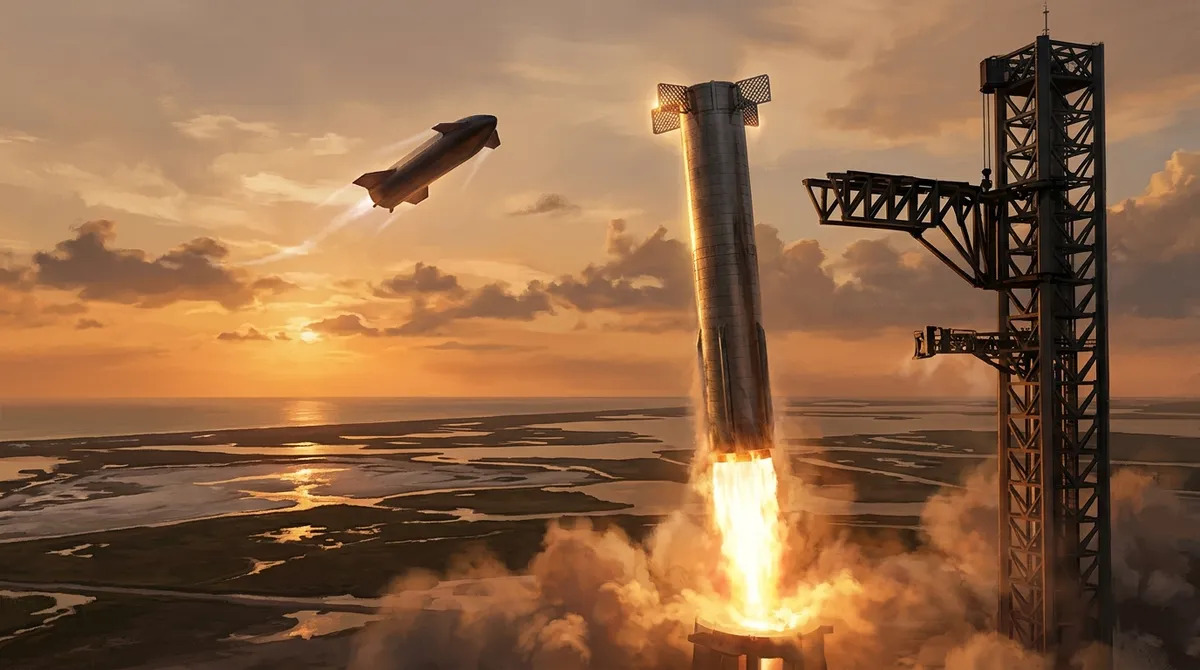
SpaceX targets November 13 for the first attempt to catch both Starship stages
Sources Starlust SpaceNews SpaceX KRGV WFTV
What happened: SpaceX has set November 13 — pending regulatory approval — for Starship's 15th test flight from Starbase, Texas, with a 75-minute window opening at 4:45 p.m., and published the plan for the first attempt to return both stages to the launch site for a tower catch. Ship 42 would orbit about 14 times over roughly 21–22 hours, deploy 26 Starlink V3 satellites (three carrying cameras to scan the heat shield), then fly back over the Rio Grande Valley for a bellyflop and an engine-guided placement between the tower's chopstick arms, with five sea contingency zones and return barred unless the vehicle meets internally developed, FAA-approved conditions (SpaceX). The return trajectory crosses inhabited parts of northern Mexico and southern Texas, banking around Rio Grande Valley cities and out over the Gulf of America before turning south to Starbase, and Cameron County residents may hear one or more sonic booms during both stage returns as Highway 4 and Boca Chica Beach close temporarily (KRGV). The booster making its first return and catch attempt is a Super Heavy V3 — SpaceX previously recovered three V1 boosters, two of which later flew again — and the heatshield carries upgrades born of Flight 14: added tile-retention mechanisms in the highest-risk areas, pathways that previously let plasma behind the tiles sealed shut, and curved tile sections that testing showed cut heating in the narrow gaps during reentry (WFTV). Separately, SpaceX has put the launch-tower catching arms through 30 consecutive tests, and recovered Ship 40 became the first vehicle ever rolled into the Starbase Gigabay.
What's genuinely new: The flight date is now company-confirmed and the full double-catch mission profile — orbit duration, payload, return corridor, abort options and catch criteria — is spelled out, alongside the 30-run arms-testing and Gigabay milestones; follow-up detailing adds the hardware layer — the catch will be the first for a Super Heavy V3 booster, and the post-Flight-14 heatshield upgrades are now spelled out in specifics.
Watch: FAA licensing before the launch, the outcome of both catch attempts, and whether a caught upper stage enables a Starship refly from 2027.
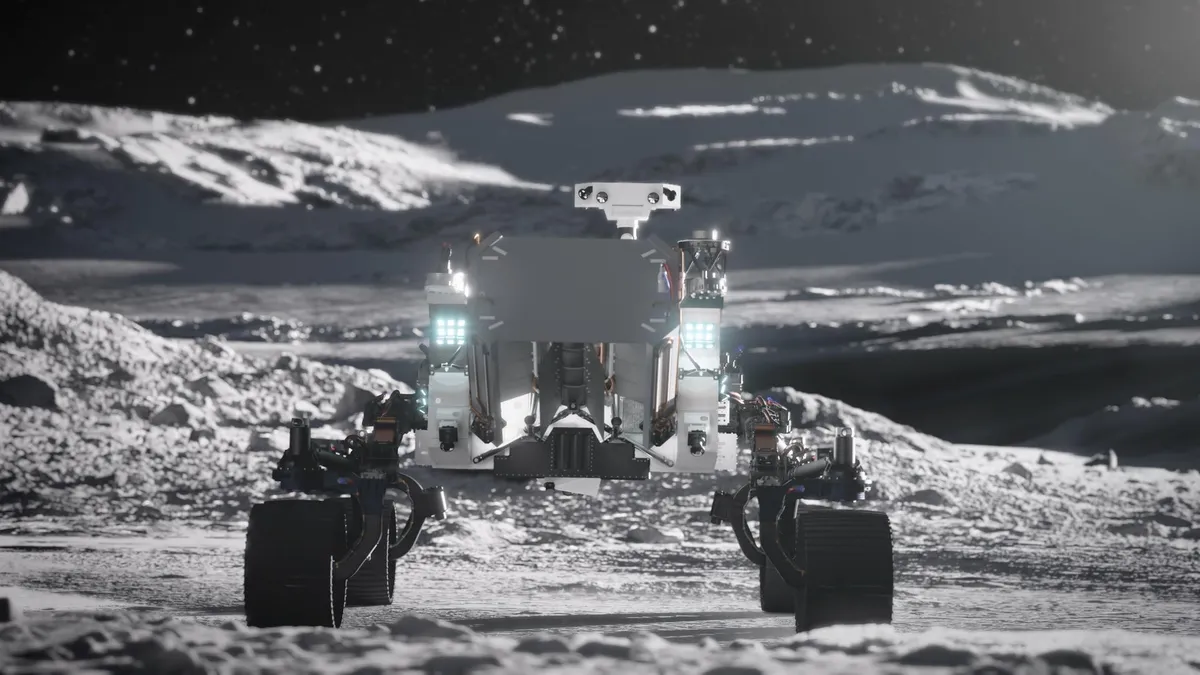
NASA books PROMISE a late-2028 ride to the lunar south pole
Sources NASASpaceflight Scientific American NASA JPL NASA New York Post Shattered Orlando Sentinel Starlust
What happened: NASA has booked its PROMISE lunar rover a ride to the Moon's south pole: the Polar Rover for Observation, Mapping and In-Situ Exploration will fly on Blue Origin's Blue Moon Mark 1 serial number five, targeting late 2028 for an 18-month prime mission, built from Curiosity's Earth-bound engineering test bed at JPL — its electronics, body structure and mobility system — supplemented by flight spares from Curiosity and Perseverance, and carrying a flight-spare radioisotope generator plus copies of VIPER's TRIDENT drill and spectrometers; program manager Carlos García-Galán put its cost below $400 million including surface delivery, with a $94 million base award and a $140 million performance option going to Blue Origin (NASA JPL, NASA). The update at Kennedy Space Center's MAX POWER expo also named six launch-and-transport task orders worth about $1.3 billion — CAPSTONE 2, Intuitive Machines communications satellites, three JPL "MoonFall" hopping drones, two Blue Ring/New Glenn orders and an Impulse Helios lunar-landing demo — plus miniCAST lunar power-and-communications towers from Honeybee Robotics, Redwire and Yank Technologies, and eight eligible providers for the next-generation Commercial Lunar Payload Services deliveries: Blue Origin, Firefly, Intuitive Machines, ispace U.S., Lockheed Martin, Northrop Grumman, SpaceX and Voyager Technologies, with Administrator Jared Isaacman saying they will "help us characterize an environment that we've really not visited in a very long time." The next-mission assignments are named too: Voyager — which bought Astrobotic — is tapped to fly the next CLPS mission, its Griffin lander targeting a launch window in early January 2027 with Astrolab's FLIP rover as primary payload, while SpaceX is to launch cislunar communications satellites aboard Starship in 2028; García-Galán described CLPS 2.0 as flipping NASA from customer to direct buyer of rockets and orbital transfer vehicles, with 22 lander task orders in place by the end of the year (Orlando Sentinel, Starlust). Follow-up reporting pins the money structure: the new CLPS framework is a task-order ceiling of up to $10 billion over ten years — not money already awarded — and NASA separately raised the ceiling on the existing CLPS contract from $2.6 billion to $4.2 billion to support the early Moon-base phase (New York Post); the science-delivery awards on the books total $590.4 million across four landings — Astrobotic $297.9 million for two deliveries, Firefly $144.2 million and Intuitive Machines $148.3 million — alongside lunar-terrain-vehicle awards of $219 million to Astrolab and $220 million to Lunar Outpost, all under a VADR parent contract with a $5 billion ceiling (Shattered).
What's genuinely new: The money-shape detail is now confirmed — the $10 billion CLPS 2.0 figure is a task-order ceiling rather than awarded funds, the current CLPS contract ceiling rises to $4.2 billion, and the science-delivery ($590.4 million), lunar-terrain-vehicle ($219/$220 million) and VADR ($5 billion ceiling) figures are enumerated — and the next-mission assignments are named: Voyager's Griffin flight with Astrolab's FLIP rover targeting early January 2027, SpaceX's 2028 Starship cislunar comms launch, and NASA's plan for 22 lander task orders by year-end.
Watch: Blue Moon Mark 1's first flight — the delivery sequence depends on it, as does the conditional VIPER delivery option on the second Mark 1, targeting late 2027; Voyager's Griffin launch window in early January 2027; NASA's separate solicitation for integrated miniCAST power systems, expected early 2027; the MoonFall, CAPSTONE 2 and Helios missions taking shape.
FAA proposes to ease launch-abort and flight-safety requirements
Sources Federal Register Federal Register, link 2 Federal Register, link 3 Federal Register, link 4 published Nov 9, 12:00 AM ET
What happened: Three FAA proposals dated to take notice in the Federal Register on November 9, with comments due December 9, 2026, would streamline commercial-space licensing rules: one clarifies the conditions under which a launch or reentry operator is not required to abort a flight (Federal Register), one clarifies how the flight-safety limits that trigger an abort are established (Federal Register), and one would let operators satisfy high-consequence-event protection during an uncontrolled atmospheric return by showing the vehicle would break up sufficiently, so a single failure could not produce multiple casualties (Federal Register). Alongside them, a final rule making non-substantive technical corrections to the commercial-space-transportation regulations — authority citations added under 51 U.S.C. 50924 and six corrections across parts 413, 414, 450 and 460 — takes effect November 9, 2026 (Federal Register).
What's genuinely new: The burden-reduction rulemaking stream now reaches the flight-abort and flight-safety-limit requirements themselves — three named dockets with a December 9 comment deadline — on top of the technical-corrections final rule that takes effect November 9.
Watch: comment-period filings from launch operators and safety groups, final-rule publication, and how the abort and uncontrolled-return clarifications apply to catch-style recoveries like Starship Flight 15's.
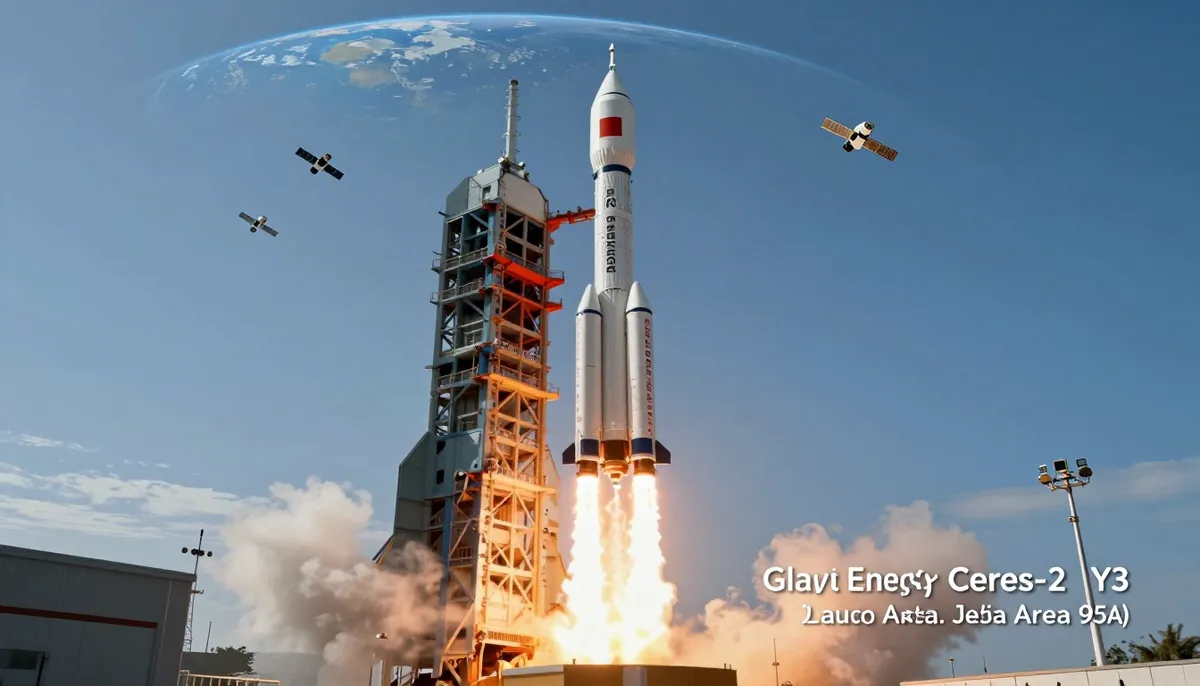
Galactic Energy's Ceres-2 flies its first confirmed successful orbit
Sources Tech Times Shattered
What happened: Galactic Energy's Ceres-2 Y3 rocket lifted off from Launch Area 95A at the Jiuquan Satellite Launch Center at 23:37 UTC on November 6 (7:37 am Beijing time on November 7) and placed four satellites into a 535 km sun-synchronous orbit — the vehicle's first confirmed successful flight after its January 17, 2026 debut failed shortly after liftoff. The payloads span earth observation (Guanlan Shiyan), weather nano-satellites (Yunyao-1 28, the newest in a GNSS-occultation constellation planned at 90 satellites, whose data China's national weather agency already uses operationally), a university technology demonstrator (Zhongbei Daxue-1) and an X-band radar-imaging satellite (Juntian-1 06A). A five-month investigation completed in June traced the January failure to a manufacturing flaw in the first-stage solid motor's nozzle throat liner — its inadequately supported rear section shifted under load and let hot gas destroy the nozzle — with corrective structural changes verified by ground testing before this flight (Tech Times, Shattered).
What's genuinely new: The first successful orbital mission and the in-flight validation of the nozzle fix; independent tracking databases confirm the corrected design holds the vehicle's stated ratings (up to 1.3 tonnes to 500 km sun-synchronous orbit).
Watch: The next Ceres-2 flight and whether the mission-count bookkeeping (Y2 as a ground-test article) resolves, and Galactic Energy's Pallas-1 booster landing attempt targeted for 2027.
New Zealand completes Starshield trial and moves toward buying in
Sources RNZ
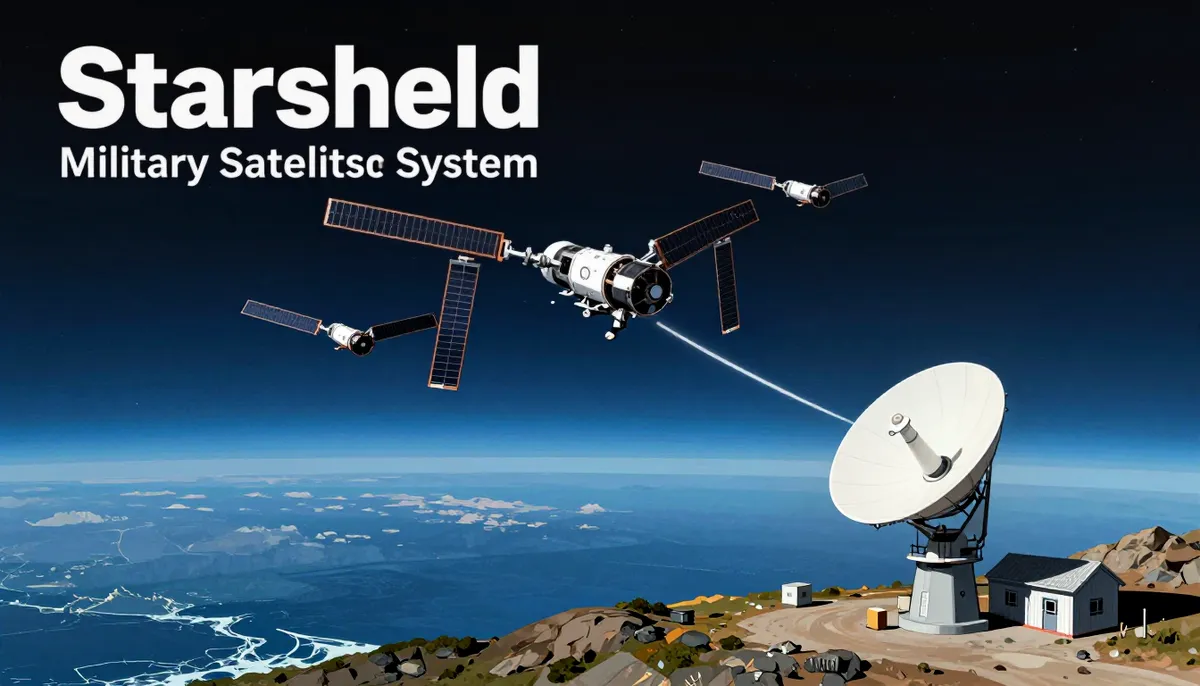
What happened: New Zealand's Defence Force has confirmed to RNZ that "a Starshield trial has been completed and showed potential utility for the NZDF" — the first government other than America's known to have trialled SpaceX's military-grade satellite system, and a step toward a purchase that would follow normal acquisition processes. Outcome details are withheld as prejudicial to national security. Documents released under New Zealand's Official Information Act show former defence minister Judith Collins signed the US Foreign Military Sales indemnity in December 2025 after Defence argued no other supplier could provide "secure military grade" internet and data transfer, with any liability unlikely to exceed $10 million. RNZ sets the story against the month's reduction of Ukraine's access to Starshield — which jeopardised some combat and air-defence missions — Europe's resulting reluctance to rely on privately owned US systems, and the Pentagon's $4 billion Golden Dome data-network "backbone" contract with SpaceX.
What's genuinely new: The trial's completion and its "potential utility" verdict are confirmed by Defence, opening the gate to a procurement decision; the indemnity and acquisition-chain detail from the OIA release is the paper trail behind it.
Watch: The procurement decision itself, RNZ's official-information requests for risk assessments and cost-benefit analysis, and whether other allied governments follow New Zealand's trial-purchase path toward Starshield.
Brief
- The UK Ministry of Defence says its Titania military observation satellite — built by BAE Systems and the Defence Science and Technology Laboratory under a £9.5 million (roughly $12 million) contract — has reached orbit after an October launch on a SpaceX rocket from California, the second spacecraft in the ISTARI programme after Tyche (2024), with Juno and Oberon planned; the government is committing more than £3 billion (roughly $4 billion) over four years to defence space, and separately announced trials of Project Inaros, three ground-based neuromorphic sensors in the UK, Australia and Cyprus built by Optera to watch for threats near satellites (Fish4News).
- Rocket Lab reports fiscal Q3 after Monday, November 9's close, guided to $250–265 million in revenue but an adjusted EBITDA loss of $17–23 million; shares jumped 15.4% to around $53 in the Friday session ahead of the print, still roughly 65% below the May 27 record close of $150.23, with a "Strong Buy" consensus and analyst targets near $100 against one prominent investor's $20 fair-value case, two months after the Neutron first flight slipped to 2027 with no replacement date. The detail around the print has filled in: Space Systems — satellites and components rather than launches — brought in 81% of the company's record $234 million second-quarter revenue, a record $266 million Space Force missile-defense contract landed in July, CFO Adam Spice sold $17.3 million of stock in roughly a month under a preset trading plan (director Nina Armagno also sold under one), and the company's 99th Electron flight carried a Japanese radar satellite for iQPS — its tenth straight success for that customer, with eight more dedicated launches booked through 2030 (TIKR, ad hoc news).
- SpaceX's plan to phase out Falcon 9 over the next few years in favor of Starship is now hitting its customers: Space Force launch contracts run only through 2028 and SpaceX has declined requests for capacity beyond that, companies are unable to book new Falcon 9 launches, and Falcon 9 carried 85% of US launches in 2025 — while the substitutes are hobbled, with Blue Origin's New Glenn suspended after a May 28 ground-firing explosion and ULA's Vulcan paused after a February solid-booster problem, leaving NASA, the Pentagon and satellite operators facing a potential launch gap (DongA Science).
- NASA's first ESCAPADE Mars orbiter has swung past Earth on its way to the red planet; the second performs its trans-Mars injection burn on November 9.
- Texas governor-elect Gina Hinojosa has asked the state's Parks and Wildlife Department to pause its decision to sell 1,300 acres of state park land to SpaceX.
- NASA has opened applications for its 25th astronaut class — the first call since 2024, when it drew more than 8,000 applications and selected 10 candidates — with applications closing December 3, 2026, selection expected in late 2027, and the class slated to train for low Earth orbit, lunar surface and Moon Base operations, with Administrator Jared Isaacman saying those picked "could walk on the Moon, live and work at the Moon Base" (Starlust, New York Times).
- Jeff Bezos argued the United States must beat China to the Moon — "Mars can wait," the Moon "packed with resources" for a permanent human presence in space — in remarks carried by Benzinga from the Up.Summit gathering.
- Starlink's end-of-life traffic is now steady and quantified: Orbital Radar counted 445 Starlink satellite reentries in 2026 through October 22 (Spaceweather's count reached 435 through October 27), roughly one or two a day, with the satellites designed for about five years of service before deorbit; the coverage revisits the 2024 case of a Starlink fragment found in a Saskatchewan field and flags the open question of aluminum-oxide pollution in the upper atmosphere as the megaconstellation era could eventually mean thousands of reentries a year (BGR).