NASA books PROMISE a late-2028 ride to the lunar south pole
From the Space digest for Nov 8, 2026
Sources NASASpaceflight Scientific American NASA JPL NASA New York Post Shattered Orlando Sentinel Starlust
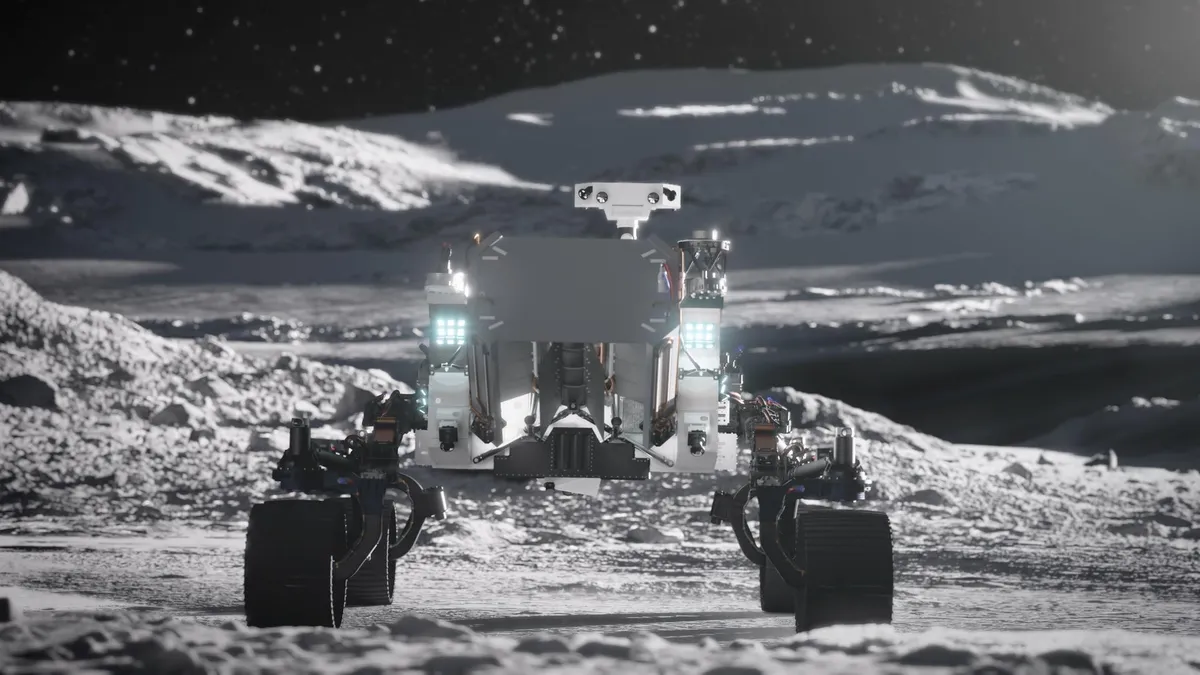
What happened: NASA has booked its PROMISE lunar rover a ride to the Moon's south pole: the Polar Rover for Observation, Mapping and In-Situ Exploration will fly on Blue Origin's Blue Moon Mark 1 serial number five, targeting late 2028 for an 18-month prime mission, built from Curiosity's Earth-bound engineering test bed at JPL — its electronics, body structure and mobility system — supplemented by flight spares from Curiosity and Perseverance, and carrying a flight-spare radioisotope generator plus copies of VIPER's TRIDENT drill and spectrometers; program manager Carlos García-Galán put its cost below $400 million including surface delivery, with a $94 million base award and a $140 million performance option going to Blue Origin (NASA JPL, NASA). The update at Kennedy Space Center's MAX POWER expo also named six launch-and-transport task orders worth about $1.3 billion — CAPSTONE 2, Intuitive Machines communications satellites, three JPL "MoonFall" hopping drones, two Blue Ring/New Glenn orders and an Impulse Helios lunar-landing demo — plus miniCAST lunar power-and-communications towers from Honeybee Robotics, Redwire and Yank Technologies, and eight eligible providers for the next-generation Commercial Lunar Payload Services deliveries: Blue Origin, Firefly, Intuitive Machines, ispace U.S., Lockheed Martin, Northrop Grumman, SpaceX and Voyager Technologies, with Administrator Jared Isaacman saying they will "help us characterize an environment that we've really not visited in a very long time." The next-mission assignments are named too: Voyager — which bought Astrobotic — is tapped to fly the next CLPS mission, its Griffin lander targeting a launch window in early January 2027 with Astrolab's FLIP rover as primary payload, while SpaceX is to launch cislunar communications satellites aboard Starship in 2028; García-Galán described CLPS 2.0 as flipping NASA from customer to direct buyer of rockets and orbital transfer vehicles, with 22 lander task orders in place by the end of the year (Orlando Sentinel, Starlust). Follow-up reporting pins the money structure: the new CLPS framework is a task-order ceiling of up to $10 billion over ten years — not money already awarded — and NASA separately raised the ceiling on the existing CLPS contract from $2.6 billion to $4.2 billion to support the early Moon-base phase (New York Post); the science-delivery awards on the books total $590.4 million across four landings — Astrobotic $297.9 million for two deliveries, Firefly $144.2 million and Intuitive Machines $148.3 million — alongside lunar-terrain-vehicle awards of $219 million to Astrolab and $220 million to Lunar Outpost, all under a VADR parent contract with a $5 billion ceiling (Shattered).
What's genuinely new: The money-shape detail is now confirmed — the $10 billion CLPS 2.0 figure is a task-order ceiling rather than awarded funds, the current CLPS contract ceiling rises to $4.2 billion, and the science-delivery ($590.4 million), lunar-terrain-vehicle ($219/$220 million) and VADR ($5 billion ceiling) figures are enumerated — and the next-mission assignments are named: Voyager's Griffin flight with Astrolab's FLIP rover targeting early January 2027, SpaceX's 2028 Starship cislunar comms launch, and NASA's plan for 22 lander task orders by year-end.
Watch: Blue Moon Mark 1's first flight — the delivery sequence depends on it, as does the conditional VIPER delivery option on the second Mark 1, targeting late 2027; Voyager's Griffin launch window in early January 2027; NASA's separate solicitation for integrated miniCAST power systems, expected early 2027; the MoonFall, CAPSTONE 2 and Helios missions taking shape.