NRC issues construction permit for four X-energy reactors at Dow's Texas chemical plant
From the Energy digest for Nov 10, 2026
Sources XenoSpectrum Oil Price US World Nuclear News Union of Concerned Scientists TechCrunch Canary Media X-energy Dow NRC published Nov 10, 3:30 PM ET
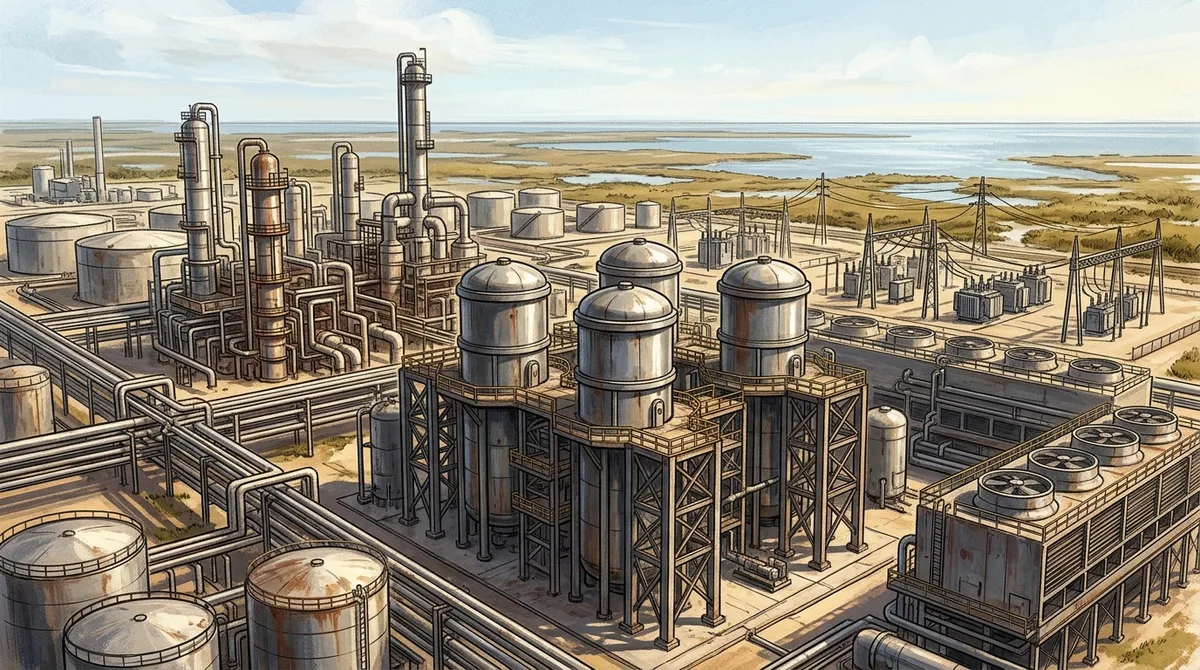
What happened: X-energy and Dow announced that the Nuclear Regulatory Commission has approved a construction permit for the proposed Long Mott Generating Station — four Xe-100 high-temperature gas-cooled reactors planned by Long Mott Energy, a wholly owned Dow subsidiary, at Dow's UCC Seadrift Operations chemical manufacturing site in Texas. Each Xe-100 unit is designed for 80 MWe of electrical output and 200 MWt of thermal output — 320 MWe and 800 MWt across the four units — and the reactors would supply both power and high-temperature industrial steam to the chemical complex, replacing its aging power and steam equipment over an anticipated 60-year operating life. The project runs under the Department of Energy's Advanced Reactor Demonstration Program, and the companies say it is the first construction permit issued for an advanced reactor at a US industrial site, the first for a high-temperature gas-cooled reactor in about 60 years, and the first approval ever for a pebble-bed reactor of this type. The permit does not represent a final decision by Dow to build, with engineering and design finalization and Dow board review still ahead; the company says construction could begin later this decade with startup early next decade. The NRC records the project as four modules totalling 800 MWth/320 MWe on about 1,537 acres adjacent to the Seadrift plant in Calhoun County, Texas, fed by graphite pebbles containing TRISO particle fuel.
What's genuinely new: Independent write-ups put the permit's fine print on the table: the permit authorizes construction only — it does not let Dow commit the money, and it does not authorize operation, which will require a separate NRC operating license before fuel loading and startup. The sequencing now reads plainly: a preliminary investment decision expected to be considered by Dow in 2027, a final investment decision still undecided, then construction and licensing. The permit followed an 18-month review after Long Mott Energy's March 31, 2025 application — docketed May 12, review schedule set June 10 — plus pre-application work since 2018 for X-energy (since 2023 for Dow), including more than a dozen approved technical reports that could speed later reviews of the same design. World Nuclear News adds the review's paperwork: the NRC issued its Final Safety Evaluation Report on October 30, and the permit also marks the agency's first approval of a multimodule advanced reactor facility, its first of a pebble-bed core, its first of a design with online refuelling, and its first high-temperature gas-cooled review under the risk-informed, technology-inclusive Licensing Modernisation Project framework. Chairman Ho K. Nieh said the agency "delivered on the 18-month schedule, proving we can do rigorous safety reviews on predictable timelines." X-energy's TRISO-coated particle fuel is expected to support a 400-metre emergency planning zone, against 16 kilometres for conventional light-water reactors, letting generation sit closer to the point of need. Oilprice.com adds that Dow says construction could begin later this decade if its corporate approvals land, with first energy delivery targeted for the early 2030s, and notes X-energy's wider pipeline of projects with Amazon and Centrica. Canary Media adds the permit's own dates and the fuel-supply dependency: the permit itself states that "the earliest date for the completion of the construction of the facility is July 1, 2033" — the concrete floor under the "early 2030s" target — and Dow is not expected to make a final decision on the multibillion-dollar project before 2028. The operating-license application, which the companies are likely to file during construction, could take another 18 months under the NRC's generic licensing schedule. Fuel is a remaining gate: X-energy cites a federal commitment for the high-assay low-enriched uranium it needs and a binding commercial agreement covering at least part of its 11-plus-gigawatt pipeline, but the plan depends on its Tennessee fabrication facility, which the company said in September is on track to open in early 2028. Canary Media also puts the design in its genealogy: the last two US high-temperature gas reactors, 40-MW Peach Bottom (1966–1974) and Fort St. Vrain (1979–1989), both retired early after funding and technical problems, and X-energy's regulatory-affairs vice president Robert Taylor calls the modern Xe-100 an "Edsel-to-a-Ferrari comparison" with those predecessors.
The approval also met its first safety fight: the Union of Concerned Scientists' director of nuclear power safety, Edwin Lyman, called the decision "reckless", saying the NRC accomplished its ahead-of-schedule review only "by pushing consideration of critical safety questions to a later date." His core objection is the design itself: the Xe-100 as approved has no physical containment structure, resting almost entirely on TRISO fuel containing radioactive materials even in severe accident scenarios — something he says has never been demonstrated — while X-energy's test campaign at the Idaho National Laboratory is still gathering fuel-performance data that won't be available for years, and the company has had quality problems during construction of its Tennessee fuel factory. He also cites political pressure from President Trump's Executive Order 14300, which directs the NRC to "establish stringent thresholds" for demanding design changes once construction is underway. TechCrunch carries the criticism and adds market context: no small modular reactor is in operation in the US yet, X-energy does not expect Dow's reactors to run before the early 2030s, and the company's shares — up modestly on the permit news — still trade at less than half their initial offering price after an April IPO that raised $1 billion, with Amazon having led X-energy's $500 million Series C-1 and committed to buying 5 gigawatts of capacity.
Watch: Dow's 2027 preliminary investment decision and, after design and engineering work and board review, the final investment decision — not expected before 2028; the operating-license application X-energy and Dow plan to file, with an 18-month review possible under the NRC's generic schedule; whether the fuel-test campaign or fuel-factory quality questions surface as issues in the operating-license review, and the Tennessee fuel facility's early-2028 opening; delivery against the permit's July 1, 2033 earliest-construction-completion date; licensing pace for later Xe-100 applications such as Energy Northwest's Cascade project.