Space digest — Oct 29, 2026
Top line: Starship Flight 15's dual-catch attempt has slipped to no earlier than November 12 in air-traffic-management paperwork — with the stack fully through static-fire checkout, the shift reads as regulatory approval trailing hardware — while Blue Origin has pulled its New Glenn return-to-flight target forward to November 2026 on a fully reconstructed LC-36 tower. Money and politics fill the rest of the day: United Launch Alliance's November 13 Vulcan comeback now carries a Space Force gate on military launches and the FCC's $11.5 billion Globalstar clearance stands with the iPhone's satellite SOS inside, SpaceX's quarterly filing shows a $14.6 billion quarter up 161% with AI lab Anthropic as its largest customer behind 34.5% of revenue, and locals near SpaceX's Starbase Louisiana have forced the company to backtrack on no-impact assurances. Separately, Putin calls Musk a "genius" and discloses "close contact" as Russia builds its own Starlink alternative, the Artemis III astronauts handed Trump a Moon rock as NASA's chief staked his job on beating China to the Moon, and startup Cowboy Space is building its own rocket — one whose upper stage stays in orbit as a megawatt-class data center.
- Flight 15 stack fully static-fire tested; Ship 42 named for the first tower catch
- Cowboy Space is building a rocket because it couldn't find one — and its upper stage stays in orbit as a data center
- Vulcan's grounding gets its cause: a mid-flight nozzle failure on a solid rocket booster
- FCC clears Amazon's $11.5 billion Globalstar buyout — Apple's 20% stake and the iPhone SOS service included
- Blue Origin targets November return to flight for New Glenn as the rebuilt LC-36 tower stands again
- Putin calls Musk a "genius" — and discloses "close contact" as Russia builds a Starlink alternative
- SpaceX's quarterly filing names Anthropic as its largest customer — 34.5% of a $14.6 billion quarter
- SpaceX's Louisiana assurances to locals fall apart — the Gulf Coast spaceport's neighbor problem goes public
- Artemis III astronauts hand Trump a Moon rock as NASA's chief says he will be fired if China wins the Moon race
Flight 15 stack fully static-fire tested; Ship 42 named for the first tower catch

What happened: SpaceX's Starship Flight 15 pre-flight test campaign is now complete on both sides of the stack. Booster 22 fired all 33 Raptor engines at Pad 2 on October 25, and SpaceX's own channel confirmed Ship 42's campaign at the Massey's test site — a full-duration six-engine static fire plus a single-engine burn simulating a deorbit burn. Tracking feeds showed Ship 42 leaving Massey's on Highway 4, headed back to the production site after finishing testing. A roundup article states Elon Musk has singled out Ship 42 as the vehicle designated to achieve the first-ever tower catch of a Starship upper stage. The launch target, meanwhile, has moved: an air-traffic-management slide lists Flight 15 as no earlier than November 12 (SpaceNotices (X)) — a slip from the November 8 date circulated earlier — and NASASpaceflight reads the shift as regulatory approval for the catch attempts coming into play, with vehicle readiness looking good (NASASpaceflight (X)).
What's genuinely new: The circulated November 8 target for the first dual-catch attempt has slipped to NET November 12 — and the read on the slip is regulatory, not hardware: with both halves of the stack through a complete static-fire checkout, the holdup is approval for the catch attempts themselves.
Watch: FAA approval for the catch attempts, the rollout of the combined stack to Pad 2, whether the November 12 date holds, and the catch attempt itself — the first time SpaceX would try to recover both stages of a Starship.
Links: Basenor · NASASpaceflight (X) · NASASpaceflight (X) · SpaceNotices (X) · NASASpaceflight (X) · Oct 29, 10:36 AM ET
Cowboy Space is building a rocket because it couldn't find one — and its upper stage stays in orbit as a data center
Sources SatNews
What happened: SatNews reports on startup Cowboy Space, which is developing its own launch vehicle, "Big Iron," because it says it could not find an existing rocket suited to its needs. The distinctive design choice: Big Iron's upper stage does not come back. Instead of being recovered or expended on return, it stays in orbit and becomes a megawatt-class power platform — described in the report as a megawatt-class data center.
What's genuinely new: Cowboy Space and its Big Iron vehicle are new to the record, with an orbital-data-center payoff built into the launch architecture itself: the upper stage is designed never to deorbit, instead converting to an in-orbit power/data platform. The company frames the whole vehicle around that end state rather than treating the upper stage as throwaway mass. No launch date, funding figures, or technical specifications appear in the available report, and only one outlet has covered it so far.
Watch: Any funding announcement, technical detail on the megawatt-class power system, a payload or customer commitment, and whether independent outlets follow on.
Vulcan's grounding gets its cause: a mid-flight nozzle failure on a solid rocket booster
Sources Spaceflight Now NASASpaceflight (X) Talk of Titusville MSN
What happened: Spaceflight Now reports United Launch Alliance has announced a mid-November return to flight for its Vulcan rocket — the first launch for the heavy-lift vehicle since a mid-flight nozzle failure on one of its GEM 63XL solid rocket boosters. The mission is the "Vulcan Leo 1" flight on November 13, 2026, pending range approval, carrying the next batch of Amazon Leo production satellites (NASASpaceflight (X), Talk of Titusville). Per additional reporting, the Space Force will judge Vulcan by the Leo 1 data before clearing military launches — making the mission a gate for future national-security flights (MSN).
What's genuinely new: The grounding cause is now named to the specific hardware — GEM 63XL solid-rocket-booster nozzle failures — and the return flight gains a national-security stake: military launch clearances ride on how the Leo 1 flight performs.
Watch: Whether the November 13 date holds and range approval comes through, the booster fix's performance on the return flight, which military missions clear on the back of the Leo 1 data, and how the Amazon Leo batch lands against the constellation's open 2026-vs-2027 service-start conflict.
FCC clears Amazon's $11.5 billion Globalstar buyout — Apple's 20% stake and the iPhone SOS service included

Sources Mashdigi
What happened: Mashdigi reports the FCC has approved Amazon Leo's $11.5 billion acquisition of Globalstar, the satellite operator behind the iPhone's emergency SOS feature. The deal is reported to include taking over Apple's roughly 20% stake in Globalstar and the arrangement that provides iPhone Satellite SOS, positioning Amazon Leo as a rival in satellite-to-phone service.
What's genuinely new: The approval now carries a named asset breakdown beyond the buyout itself — Amazon acquires Apple's roughly 20% equity stake in Globalstar and inherits the partnership behind the iPhone's satellite emergency messaging, the first time the Apple stake and the SOS service have appeared as specific parts of the transfer alongside the already-reported FCC clearance.
Watch: What Amazon does with Globalstar's consumer business and the Apple SOS relationship, how the constellation's direct-to-phone capability builds on the spectrum already cleared for it, and the deployment make-up schedule against the open 2026-vs-2027 service-start conflict.
Blue Origin targets November return to flight for New Glenn as the rebuilt LC-36 tower stands again
Sources SatNews
What happened: SatNews reports Blue Origin has reconstructed the Launch Complex 36 vehicle access tower at Cape Canaveral and is preparing to resume New Glenn flight operations as early as November 2026.
What's genuinely new: The return-to-flight target has moved and firmed — from the December 28, 2026 date in an air-traffic advisory to, most recently, a "first half of December" pad-ready timeline — to a named November 2026 start for flight operations, with the tower reconstruction complete as the enabling step.
Watch: Whether a November launch actually happens, the LC-36A pad-activation date, and how the return sits against Blue Origin's pledge to fly New Glenn again before the end of 2026.
Putin calls Musk a "genius" — and discloses "close contact" as Russia builds a Starlink alternative
What happened: CNBC reports Russian President Vladimir Putin has called SpaceX CEO Elon Musk a "genius" and revealed the two are in "close contact," as Russia develops its own Starlink alternative. The remarks carry a Ukraine edge in the article's own framing — the satellite service's role in the war is the backdrop, and it lands beside Ukraine's hunt for a substitute of its own with Nokia and satellite maker ICEYE.
What's genuinely new: A head of state publicly praising Musk and disclosing personal contact with him — and naming Russia's own Starlink-style project as in development — both first-appearing on the topic.
Watch: What Russia's system actually is — named partners, satellites, timeline — what "close contact" amounts to in practice, and the fallout for Starlink's and Starshield's role in Ukraine.
Links: CNBC · Oct 29, 4:20 PM ET
SpaceX's quarterly filing names Anthropic as its largest customer — 34.5% of a $14.6 billion quarter

Thread: space — Anthropic is SpaceX's largest customer — 34.5% of the Q3 10-Q's $14.6B quarter · new
What happened: SpaceX's quarterly financials are out, and the biggest single customer is an AI company. Per ShiftDelete, citing Bloomberg's read of the SpaceX 10-Q, the previously mysterious "Customer B" is Anthropic — behind 34.5% of Q3 2026 revenue, making the Claude-maker SpaceX's largest customer. Morningstar's earnings read puts Q3 revenue at $14.6 billion, up 161% since 2025, with Starlink revenue up 69.5% — and the striking growth driver is AI revenue quintupling sequentially, on "neocloud rentals" of compute capacity to AI labs. Morningstar raised its fair-value estimate on the scaling data-center business.
What's genuinely new: The customer identification — a single AI lab alone accounts for over a third of the quarter's revenue — and the growth engine behind the number: AI compute rentals, not satellite broadband alone.
Watch: Customer B's spend carrying into Q4, the size and shape of the neocloud-rental contracts, whether another outlet independently identifies the customer from the filing, and what largest-customer concentration does to the growth narrative.
Links: ShiftDelete · Morningstar · Oct 29, 4:20 PM ET
SpaceX's Louisiana assurances to locals fall apart — the Gulf Coast spaceport's neighbor problem goes public
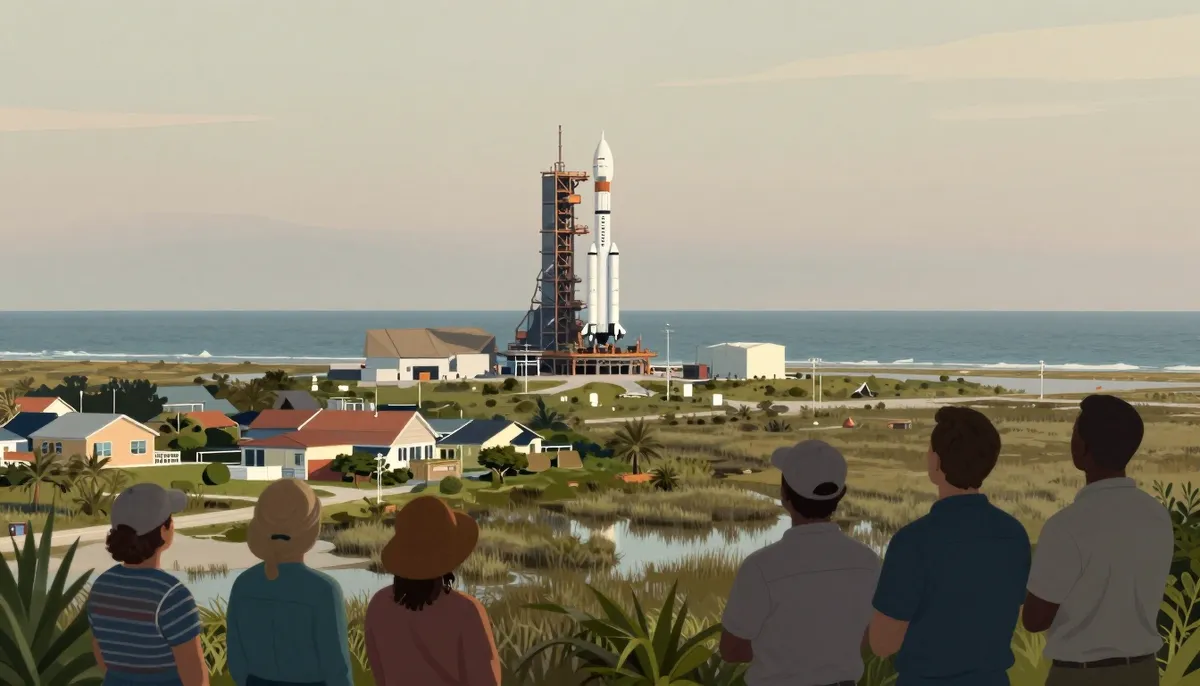
What happened: Daily Yonder, carrying an independent report from the Mississippi River Basin Ag & Water Desk, details SpaceX telling Louisiana locals there would be no bad impacts from the Starbase Louisiana spaceport build-out — then being forced to backtrack on those assurances.
What's genuinely new: A first community-impact conflict for the Vermilion Parish megaproject: public no-impact assurances walked back, and a story built so far around land, incentives, and launch cadence now has a community-and-environment friction line of its own.
Watch: The specific local impacts at issue, any state or federal regulatory response, opposition organizing around the site, and whether the backtrack hardens into formal commitments or filings.
Links: Daily Yonder · Oct 29, 4:20 PM ET
Artemis III astronauts hand Trump a Moon rock as NASA's chief says he will be fired if China wins the Moon race
What happened: Starlust reports the Artemis III astronauts met with President Trump in the Oval Office and presented him with a Moon rock — "a little reminder of where we're going," per the visit's framing. In the policy layer, MSN's exclusive carries NASA Administrator Jared Isaacman framing the Moon race as an explicitly geopolitical goal against China's and Russia's lunar plans — and staking his tenure on the outcome: if China beats NASA to the Moon, "I'll be fired."
What's genuinely new: Both are firsts on the program's political layer here: a presidential audience for the next Moon-landing crew with a ceremonial Moon-rock gesture, and the administrator publicly tying his own job to beating China.
Watch: Whether the White House backing translates into budget or schedule movement, the Isaacman interview's full content on the China timeline, and how the race framing shapes the Artemis III schedule as it approaches.
Links: Starlust · MSN · Oct 29, 4:20 PM ET
Brief
- Virgin Galactic rolls out its new suborbital spaceplane: SpaceNews reports the vehicle's public rollout (relayed by Jeff Foust) — a move past the "wheels down" landing coverage that preceded it; no technical detail beyond the headline available.
- Rendezvous Robotics raises $20 million: for self-assembling spacecraft, per SpaceNews, relayed by Jeff Foust.
- Vietnam signs the Artemis Accords: per SpaceNews, relayed by Jeff Foust — the Accords' signatory roster keeps expanding.
- Rocket Lab launches a Japanese radar satellite: An Electron rocket carried QPS-SAR-12 — nicknamed Kushinada-I — from Rocket Lab's New Zealand site, per MSN on October 29. Another mark on Electron's busy 2026 manifest beside the Rocket Lab–Iridium storyline's cadence record.
- SpaceX's independence from NASA, in analysis: An Ars Technica analysis argues SpaceX no longer needs NASA — a problem for the agency — and flags that SpaceX could yet stop flying Falcon 9 for NASA missions, against the backdrop of late-October NASA Aerospace Safety Advisory Panel discussion. Analysis rather than a dated event; watched beside the Falcon 9 endgame storyline.
- Cape Canaveral's "boom cycle": An MSN feature reports launches from Cape Canaveral, Florida, now outpace those of the Apollo era, calling it "a new Apollo moment."
- Rocket Lab stock eyes its best week in a month: RKLB shares are headed for their strongest week in a month as Neutron hardware reached its test site, Electron missions stack up, and NASA updates land — though retail investors remain hesitant per Stocktwits' market recap. A market-recap restatement of the hardware-to-Wallops shipments already on the record in October 27 coverage; the Neutron first-flight target remains 2027.
- Artemis II commander moves to Caltech/JPL: Artemis II Commander Reid Wiseman is joining Caltech as Associate Vice President and JPL Deputy Director, per Caltech's announcement relayed by Jeff Foust on X.
- Starbase rollover pace: With Ship 42 back in its hangar after its two static fires, eight vehicles rolled at Starbase in the five days through October 29, by NASASpaceflight (X)'s count — the busiest stretch yet against the parallel Flight 15 and Flight 16 flows.