Space digest — Oct 30, 2026
Top line: NASA put a commercial servicing mission for the Hubble Space Telescope back into play — a SAM.gov contract listing plus a new Request for Information seeking industry ideas. Google's Suncatcher prototype has booted its TPUs in orbit and sent back a response from an onboard Gemma 4 model, SpaceX finished Starship Flight 15's static-fire campaign with the first ship catch awaiting FAA approval, SpaceX was reported declining Falcon 9 launch contracts as analysts call the coming launch shortage more severe than anticipated, and the FAA licensed Sierra Space's Dream Chaser for a re-entry to Vandenberg. The Space Force shifted six Vulcan national-security launches to SpaceX, SpaceX mapped its proposed Florida Starship gas pipeline, Blue Origin's year-end New Glenn flight picked up Artemis IV stakes, and Amazon's CEO reaffirmed the Starlink rival Leo is on track to debut this year.
- NASA signals a commercial Hubble servicing mission is back in play
- Blue Origin's year-end New Glenn flight now carries Artemis IV stakes
- FAA licenses Dream Chaser for an orbital return to Vandenberg
- Amazon's CEO says the Starlink rival Leo is on track to debut this year
- Space Force shifts six Vulcan national-security launches to SpaceX
- SpaceX maps its proposed gas pipeline for Florida Starship launches
- SpaceX turns away Falcon 9 customers as analysts find the launch shortage worse than expected
- Google's Suncatcher prototype answers a prompt from orbit
- Starship Flight 15 testing is done, with the first ship catch awaiting FAA approval
NASA signals a commercial Hubble servicing mission is back in play

What happened: NASA has both posted a contract listing on SAM.gov, the federal procurement site, and issued a Request for Information asking industry about in-space servicing capabilities to support the Hubble Space Telescope — the agency's own move, reported in SpaceNews under the headline "NASA seeks ideas for Hubble servicing mission" and relayed with the NASA announcement by Jeff Foust. A NASASpaceflight relay carrying reporter Irene Klotz's headline put it earlier as "NASA reopens prospect of commercial Hubble Space Telescope servicing mission." It comes after a first-of-its-kind commercial rescue attempt on NASA's Swift telescope ended unsuccessfully this summer, a result that left the servicing question about Hubble explicitly open.
What's genuinely new: NASA now speaks on it directly — a Request for Information soliciting ideas and capabilities, sitting alongside the federal listing — turning a mission long treated as a maybe into an active solicitation. Neither the listing nor the request commits NASA to a flight, and no bidder, mission scope or funding figure appears in the available material.
Watch: which companies respond to the Request for Information, what it defines as the mission scope (a robotic boost versus something more ambitious), and whether NASA follows with funding.
Links: NASASpaceflight on X · SAM.gov · NASA · SpaceNews · Jeff Foust on X · Oct 30, 11:03 AM ET
Blue Origin's year-end New Glenn flight now carries Artemis IV stakes
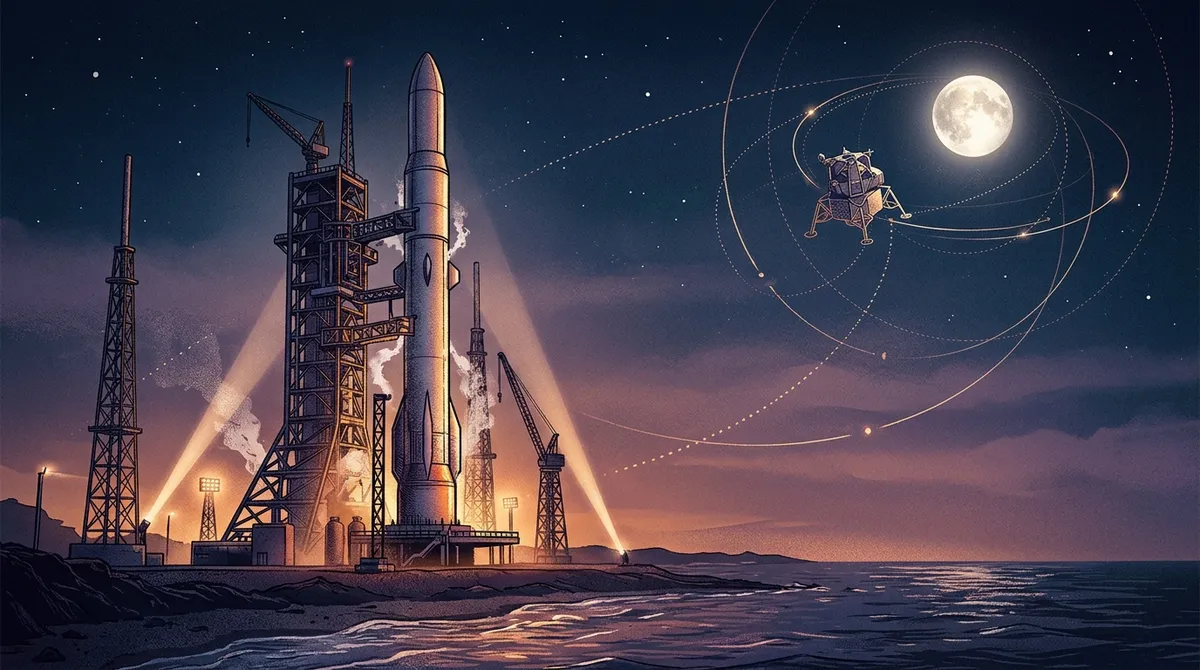
What happened: NASASpaceflight reports Blue Origin is moving toward a potential return to flight for New Glenn by late 2026, and the article for the first time ties that flight to NASA's Artemis IV selection process — the company is framed as eyeing how its rebuilt rocket factors into the lander-selection picture. The late-2026 target sits within the week's established reporting: the reconstructed LC-36A pad at Cape Canaveral with its vehicle-access tower stacked again, pad activation planned for early-to-mid December, and a return to flight described as possible as early as November on the upgraded facilities.
What's genuinely new: The first explicit framing that couples Blue Origin's year-end flight with Artemis IV — until now the return-to-flight coverage has centered on the pad rebuild and scheduling, with the Artemis IV selection treated as a separate question NASA says it won't settle until Earth-orbit test results are in (per its own briefing on October 24). Consolidating the November-to-December return timeline into a single named objective is the article's second addition.
Watch: whether New Glenn actually flies before the end of 2026, and how NASA sequences the Artemis IV lander selection against the year-end flight.
Links: NASASpaceflight · Oct 29, 5:02 PM ET
FAA licenses Dream Chaser for an orbital return to Vandenberg

Thread: space — Dream Chaser's FAA re-entry license for a Vandenberg return · new
What happened: Sierra Space's Dream Chaser spaceplane has received a re-entry license from the FAA, NASASpaceflight reports in a post crediting Ryan Caton, authorizing a return from Earth orbit to Vandenberg Space Force Base. The post adds the catch plainly: re-entry requires Dream Chaser to launch first, and when — or whether — that happens is "a very open question."
What's genuinely new: A federal re-entry authorization is a hard regulatory milestone for the lifting-body spaceplane's return profile to a named American landing site, clearing the landing leg even as the launch leg stays unscheduled.
Watch: when and on what vehicle Dream Chaser launches, since the license alone does not put a mission date on the calendar.
Links: NASASpaceflight on X · Oct 29, 5:01 PM ET
Amazon's CEO says the Starlink rival Leo is on track to debut this year
Sources MSN Benzinga Stocktwits
What happened: Amazon CEO Andy Jassy confirmed during the company's Q3 2026 earnings call that Leo — the satellite internet constellation, formerly known as Kuiper, built to compete with Starlink — is "on track" to arrive this year (MSN, carrying Benzinga). Market coverage reports SpaceX, AST SpaceMobile and Rocket Lab shares sliding overnight heading into Friday as the reaffirmation circulated, with retail investors weighing Leo as a competitive threat (Stocktwits).
What's genuinely new: The first CEO-level, earnings-call reaffirmation of the 2026 service debut lands against the reporting friction earlier in October — coverage that had floated a "by 2027" launch and softer "later" timing on the service start. The market reaction also ties the constellation's debut directly to competitor share prices for the first time in the coverage.
Watch: whether the 2026 debut happens — deployment cadence before any service start, and how SpaceX, AST SpaceMobile and Rocket Lab shares trade around Leo's milestones.
Space Force shifts six Vulcan national-security launches to SpaceX

Sources MSN
What happened: The U.S. Space Force has shifted six near-term national-security launches from United Launch Alliance's Vulcan Centaur to SpaceX, with the reallocation reported as coming during a grounding of defense launches (MSN). The available material — MSN-syndicated coverage whose original outlet is not identified — does not name the missions, their timelines, or the cause of the grounding.
What's genuinely new: Six national-security launches leaving Vulcan for SpaceX is the largest single manifest shift reported on the Vulcan lane. It lands while Vulcan still awaits its return to flight: ULA set the Leo 1 launch for November 13, 2026, pending range approval, and the Space Force has said it will judge Vulcan by that flight's data before clearing military launches (as reported October 29) — though the available material does not state whether the grounding derives from that pending flight.
Watch: whether the November 13 Leo 1 flight holds its date, and whether the six missions return to Vulcan's manifest or stay with SpaceX.
SpaceX maps its proposed gas pipeline for Florida Starship launches
Sources Florida Today
What happened: SpaceX's proposed natural-gas pipeline for feeding Starship launches from the Cape would be a 16-inch steel line drawing from Florida Gas Transmission Co.'s interstate transmission system, with the proposed path through Brevard County now mapped — and SpaceX hopes the pipeline is operating by August 2027 (Florida Today).
What's genuinely new: The pipeline's supplier, route and a target in-service date get their first specifics — earlier reporting put the line at roughly 32 miles through Brevard County and sized it for up to 76 Starship launches a year, without naming where the gas would come from or when the line might run.
Watch: permitting and any FAA action on the Starship-Florida build-out the pipeline supports, and whether the August 2027 operating hope holds.
SpaceX turns away Falcon 9 customers as analysts find the launch shortage worse than expected

Sources Fortune (via ua.news) Ars Technica
What happened: SpaceX is declining some Falcon 9 launch contracts so it can concentrate on Starship, leaving satellite operators to look for rides on competing rockets, according to Fortune reporting carried by ua.news. The report lands alongside a fresh Ars Technica treatment of the industry's launch-capacity studies, whose authors conclude the coming squeeze is "more severe" than anticipated — and name SpaceX's own behavior as the biggest open variable.
What's genuinely new: The first confirmation in top-tier, independent reporting that SpaceX is actively turning customers away by its own choice, against the October background of commercial Falcon 9 bookings closed beyond 2028 and a reported request from the Space Force for three missions that SpaceX turned down. The Ars coverage adds a new severity reading on the shortage itself, with what SpaceX does cast as the decisive swing factor.
Watch: which customers leave and where they go (Rocket Lab's Neutron, Isar and Arianespace are the alternates earlier coverage named), the original Fortune report's specifics, and whether SpaceX's behavior shifts once Starship flights prove out.
Google's Suncatcher prototype answers a prompt from orbit
What happened: Google's Suncatcher prototype — a satellite carrying four TPU chips that the company describes as a space data center — is online and has transmitted a response processed by its onboard Gemma 4 model, after launching to orbit in early October. Google says the initial goal was to see whether the chips could turn on in space, process a prompt and transmit an answer back to Earth — and this week the answer came back (AI Weekly, with Google's announcement carried by Jeff Foust).
What's genuinely new: the first completed on-orbit test cycle for Google's project — power on, process a prompt, transmit back — moves the TPU-satellite idea from launched payload to working hardware in the growing set of first-generation orbital-compute satellites now in orbit.
Watch: Google's promised follow-up on how the TPUs tolerate space conditions (radiation and thermal data), and how the project scales against the launch volume Google itself says orbital data centers need.
Links: AI Weekly · Google announcement via Jeff Foust · Oct 30, 3:04 PM ET
Starship Flight 15 testing is done, with the first ship catch awaiting FAA approval
What happened: SpaceX has wrapped the static-fire campaign for Starship Flight 15 — NASASpaceflight reports three static fires in three days, completing all engine testing for the flight in eight days — clearing Booster 22 and Ship 42 for the launch expected in November. The flight's headline maneuver is the first-ever attempt to catch both Starship stages, and per coverage of the campaign carried by MSN that first ship catch attempt is now awaiting FAA approval.
What's genuinely new: the engine-testing campaign is formally complete and the last gate for the flight's defining maneuver has a name — FAA approval for the ship catch, a regulatory step on top of the flight's own scheduling.
Watch: FAA approval for the catch attempt, and whether Flight 15 flies in November on the hardware now cleared.
Links: NASASpaceflight · MSN · Oct 30, 5:53 PM ET
Brief
- Telesat's Lightspeed has lost the planned launch slot for its pathfinder satellite, per MSN-syndicated coverage; the available text does not name the launch provider or confirm the compressed launch schedule its headline describes.
- Eight of the 18 military communications satellites Rocket Lab is building for the Space Development Agency are now in production on its Long Beach factory floor, the company says (Hoodline).
- SpaceX confirmed six-engine testing of Starship's Ship 42 on October 28, 2026, including one Raptor firing simulating a deorbit burn (ad-hoc-news).
- Blue Origin is expanding in its home state of Washington with a new facility in Des Moines, in a period when its major investments have gone to Texas and Florida (Seattle Times).
- Rocket Lab's 100th Electron rocket has shipped, per MSN-syndicated market coverage that also highlights a NASA repair robot associated with Rocket Lab and notes Neutron's second stage and thrust module have reached Virginia ahead of ground testing (MSN).
- Virgin Galactic's first Delta-class rocket plane has reached its home port after setting out from Arizona, per Ars Technica's Rocket Report; the rounded-up item does not name the port or a flight schedule.
- Starship's Booster 23 is back in Mega Bay 1 at Starbase after a roll to Massey's for testing, closing out a busy week of hardware movements between Starbase facilities (NASASpaceflight relay).
- Satellogic and HEO have extended their non-Earth imaging contract (SpaceNews).
- India launched its NVS-03 navigation satellite (IRNSS-1L) on a GSLV Mk II from the Satish Dhawan Space Centre (SpaceNews).
- The EU has released updated text of its draft European Union Space Act, with stakeholder feedback invited (announcement carried by Jeff Foust).
- Musk pitched Starbase Louisiana alone as a site that could handle 10,000 Starship launches a year — as many as the FAA expects for U.S. launches and reentries from all providers combined by 2035 — with SpaceX calling the FAA the bottleneck (Yahoo Finance).