AI digest — Nov 5, 2026
Top line: The blue wave reaches AI's ground game: winning or leading candidates for governor in 12 states have called for data-center pauses, with Texas Democrats taking the governorship and a Senate seat for the first time in decades. In financing, Apollo will buy about $40 billion of Nvidia Vera Rubin chips and lease them to SpaceX's expanding AI cloud.
- Data-center pauses now promised in 12 states after the Democratic sweep
- Apollo to buy and lease $40 billion of Nvidia chips as SpaceX scales its AI cloud
- A specialized OpenAI model found a datacenter-wide flaw in Canonical software
Data-center pauses now promised in 12 states after the Democratic sweep
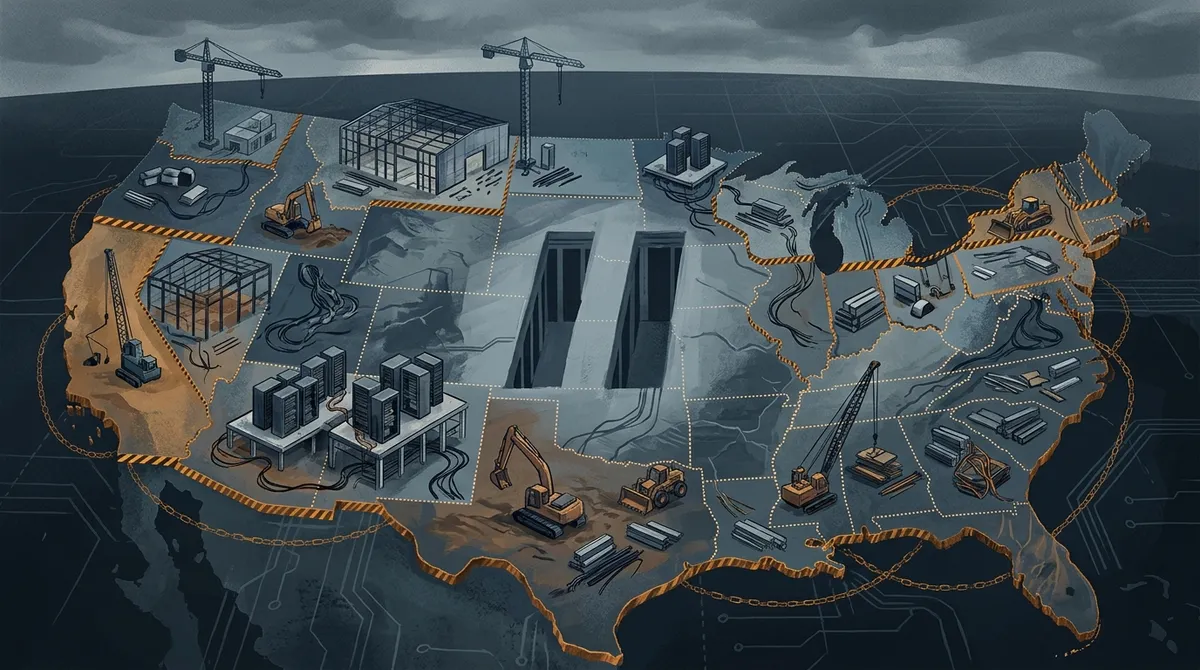
What happened: In 12 states — Alaska, Georgia, Kansas, Maine, Michigan, New Hampshire, New Mexico, New York, Ohio, Oregon, Texas and Wisconsin — the winning or leading candidate in the November 3, 2026 gubernatorial races called for a pause on data-center development, and winners in even more states have pledged other restrictions, including ratepayer protections, environmental limits and the elimination of tax incentives for data-center builders. In Texas, Democrats won the governorship (Gina Hinojosa) and a US Senate seat for the first time in decades, leaving the state's fast-growing data-center industry — and its most prominent tech investor, Elon Musk — facing regulatory uncertainty.
What's genuinely new: The named 12-state map of moratorium-supporting governorships is the first full geography the reporting attaches to the post-election backlash, and the companion analysis argues the Democratic victories were at least partly driven by voter anxiety about AI and tech, with data-center regulation likely among the winners' first legislative priorities. In California, Proposition 40 — the one-time 5% tax on billion-dollar fortunes — was trailing with 56.5% of voters against as about half the ballots were counted. Big-tech stocks rallied after the vote as investors read any AI-buildout slowdown as hurting smaller AI companies more than incumbents.
Watch: whether the winning governors actually move pauses, permitting limits and grid/water cost rules into law; whether announced Texas projects are rerouted or cancelled; and whether Proposition 40's count holds in its final tally.
Links: The Information · The Information · The Information · The Information · Nov 4, 12:09 PM ET
Apollo to buy and lease $40 billion of Nvidia chips as SpaceX scales its AI cloud

Thread: ai — SpaceX AI cloud · new
What happened: Apollo Global Management, the private-equity and lending giant, will buy roughly $40 billion of Nvidia Vera Rubin chips through a subsidiary and lease them to SpaceX, extending the chip-leasing deal SpaceX has already announced. Coverage builds that onto a projection that SpaceX could stand up about 13 GW of AI cloud capacity within roughly 18 months, repurposing its rocket-ship campus sites and putting a datacenter at the Terafab chip site in Texas.
What's genuinely new: The Apollo arrangement is spelled out as purchase-and-lease rather than debt, with Apollo described as vastly outspending the neoclouds on AI chips — a new heavyweight entering AI-chip financing beside the hyperscalers. The 13 GW, 18-month scale estimate is analyst projection, not a SpaceX-documented build plan.
Watch: Apollo's other AI-chip financing deals and their terms; whether SpaceX grounds the 13 GW projection in named sites and power contracts; how this sits beside the Terafab fab and SpaceX's separate orbital-compute push.
Links: The Information · SemiAnalysis · Nov 4, 9:00 AM ET
A specialized OpenAI model found a datacenter-wide flaw in Canonical software
What happened: Max Justicz, chief technology officer of Charge Robotics, says he used a specialized OpenAI model to discover a vulnerability in popular open-source software maintained by Canonical, the British company behind Ubuntu — a flaw he says would let someone hack into major datacenters. Justicz says he alerted Canonical.
What's genuinely new: This is a named person, a named software maintainer and a concrete disclosed vulnerability — the AI-led vulnerability-discovery story moving from OpenAI's own pipeline-run numbers to an independent researcher's real-world find against infrastructure that datacenters rely on. Canonical's response and the specific component are not in the reporting.
Watch: Canonical's confirmation, patch or advisory; which software component and what severity; and whether the "specialized OpenAI model" is the unreleased cyber model OpenAI's own November pipeline run pointed to.
Links: The Information · Nov 4, 7:00 AM ET
Brief
- India's cybersecurity agency Cert-In has warned banks, non-bank lenders and fintech firms that an AI-assisted attack campaign it calls "Crafty Falcon" is escalating: attackers use freely available offensive-AI tools — the LLM-based ARTEX family, the PentAGI autonomous pentesting system, the Cairn attack search engine and CyberStrikeAI — to generate and adapt attack scripts at machine speed, and the agency says attacks continue even at institutions that hardened after its October 9 advisory. Attackers test fund transfers with transactions as small as ₹1 (about one US cent) before moving larger sums, exploit payment aggregators' merchant-settlement APIs, and have stolen wallet keys from cryptocurrency exchanges. The agency's own advisory text is not included in the reporting.
- New OpenAI models could ship as soon as Friday, potentially the next generation of its Astra, Sol and cyber-focused models, according to people with knowledge of the models cited by The Information — unconfirmed, and the company has not announced anything.
- The Information adds detail to OpenAI's announced acquisition of Pierre Computer Company: it is a three-year-old startup building developer tools for managing and reviewing code, and OpenAI's Codex coding agent already uses its open-source tools, including Code Storage.
- Palo Alto Networks is in talks to buy Clutch Security, a three-year-old Israeli startup whose software tracks the passwords and authentication codes used by AI agents, for around $500 million, per people familiar with the matter — talks, not a signed deal.
- While the largest US banks such as JPMorgan restrict AI agents' access to consumer bank accounts, some smaller banks are going the other way and granting agents more access, seeing agentic banking as a growth area.
- SemiAnalysis has published GDPx, a benchmark that scores frontier models across economically valuable domains including hardware design, cyber, bio, finance, chip design and quant trading.