Robots digest — Nov 13, 2026
Top line: J.P. Morgan forecasts US humanoid production reaching 300,000–400,000 robots a year by 2030, with hands, actuators, compute and factory capacity the binding bottlenecks. Figure AI now carries a $39 billion valuation. AgiBot's six store-shift humanoids: four of the six robots passed its 1,730-task Shanghai convenience-store evaluation — the mobile jobs failed.
- J.P. Morgan sizes US humanoid output: up to 400,000 robots a year by 2030
- ASUS details Gallop, its first humanoid, in a factory packing trial
- AgiBot's Shanghai store trial scores itself: four of six robots passed
- Foundation Future pitches a machine-gun-carrying MK 2 as its Gaza talks continue
J.P. Morgan sizes US humanoid output: up to 400,000 robots a year by 2030
Sources Android Headlines Reuters DC Velocity
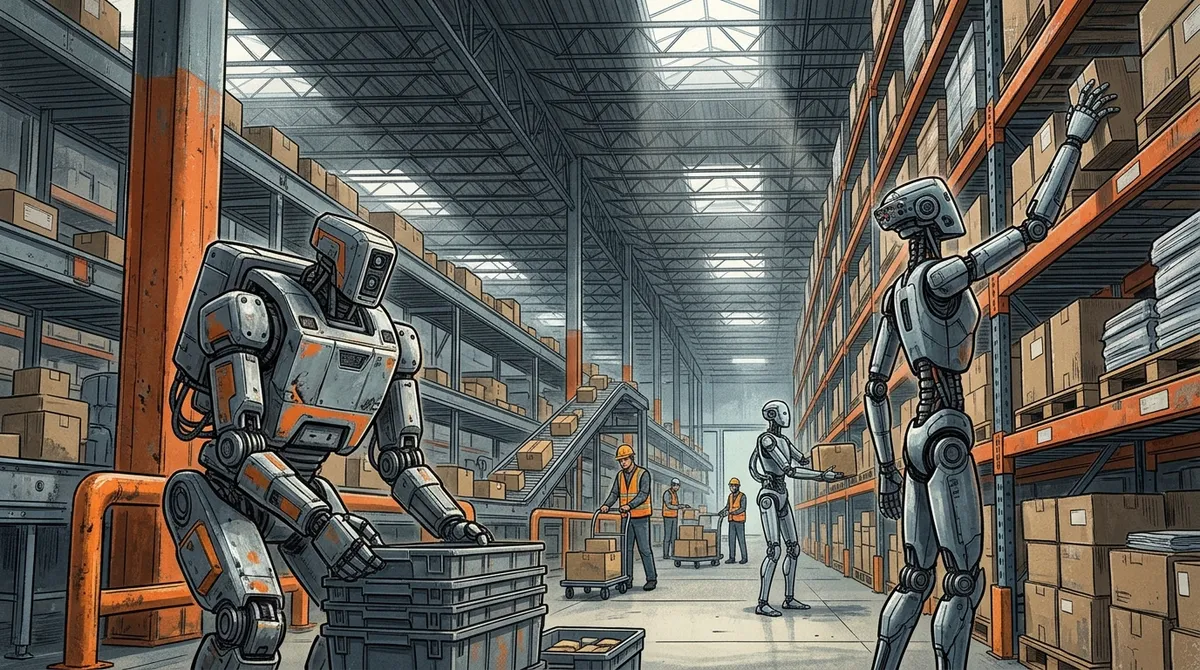
What happened: J.P. Morgan, in new research on the humanoid industry, forecasts US humanoid robot production of 300,000–400,000 units annually by 2030, growing to about 1.5 million units by 2035, as manufacturing, logistics and warehousing shift from demonstrations to commercial deployment against labor shortages. J.P. Morgan expects US humanoid robot production to reach 300,000–400,000 units a year by 2030 and about 1.5 million units by 2035, as the industry shifts from demonstrations to commercial deployment in manufacturing, logistics and warehousing (Reuters). The brokerage says near-term growth is supply constrained by "hands, actuators, the brain, and production capacity," with most US manufacturers other than Tesla targeting just 10,000–30,000 units annually, while robot costs near parity with labor and can save a customer about $100,000 a year across multiple shifts (Reuters). One concrete sign of that ramp came the same week, when GXO Logistics said it could deploy up to 1,000 Apptronik Apollo humanoid robots over four years, starting with trials in warehouse picking and tote and case movement (DC Velocity).
What's genuinely new: The brokerage's numbers and where it puts the friction: humanoid costs approaching parity with labor costs, with about $100,000 a year in savings for a customer running robots across shifts; binding near-term bottlenecks at hands, actuators, onboard computing and production capacity; most US makers outside Tesla still targeting just 10,000–30,000 units annually; and a key-components market (actuators, motors, vision systems) approaching $30 billion by 2035, with Timken, Robotis, Leader Drive, Orbbec and Cognex named as positioned suppliers. Tesla's Optimus, Agility's Digit, Boston Dynamics' Atlas, Figure and Apptronik's Apollo are named among the key US players, and the report expects the Trump administration's national-security finding on imported robots to favor domestic production through tariffs or other measures.
Watch: actual production counts against the 2030 range, whether the hands/actuators/compute bottlenecks ease, tariff and onshoring policy moves, and order books at the named component suppliers.
ASUS details Gallop, its first humanoid, in a factory packing trial
Sources ASUS Unite.AI Interesting Engineering RobotsBeat published Nov 13, 10:14 AM ET
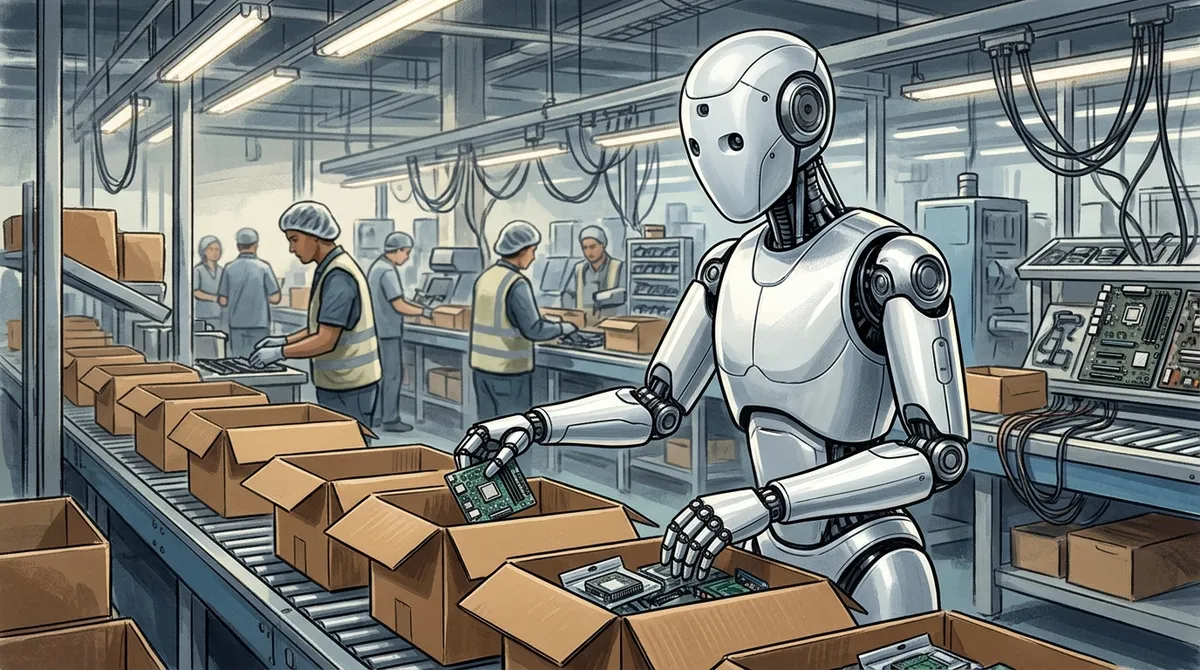
What happened: ASUS has detailed Gallop, its first humanoid robot, which is learning to pack 15 motherboard accessories at a group electronics factory. The company targets 99.5% task success within 20 seconds, matching a human worker's cycle time. Those figures are targets; ASUS has not published a measured success rate or a full-shift production result (ASUS). Training combines head-mounted-camera recordings of experienced workers, simulation and VR-guided practice. ASUS plans customer pilots in 2027, a showing at Computex 2027, and market availability in the second half of 2028, with electronics manufacturing as the first target (Unite.AI).
What's genuinely new: The first detailed public account of the robot's design. Its AI is split into four layers (planning, supervision, skills and control) joined by fixed interfaces, so models can be swapped without rebuilding the machine. A single NVIDIA Jetson AGX Thor computer runs the system. ASUS builds the body and dexterous hands in-house. The current robot has a fixed two-arm base; a wheeled version and the in-house tactile hand are planned over the coming year (Interesting Engineering · RobotsBeat).
Watch: measured cycle time, success rate and recovery at the factory station; the wheeled version and tactile hand; and the 2027 customer pilots.
AgiBot's Shanghai store trial scores itself: four of six robots passed
Sources note.com AgiBot The Robot Report
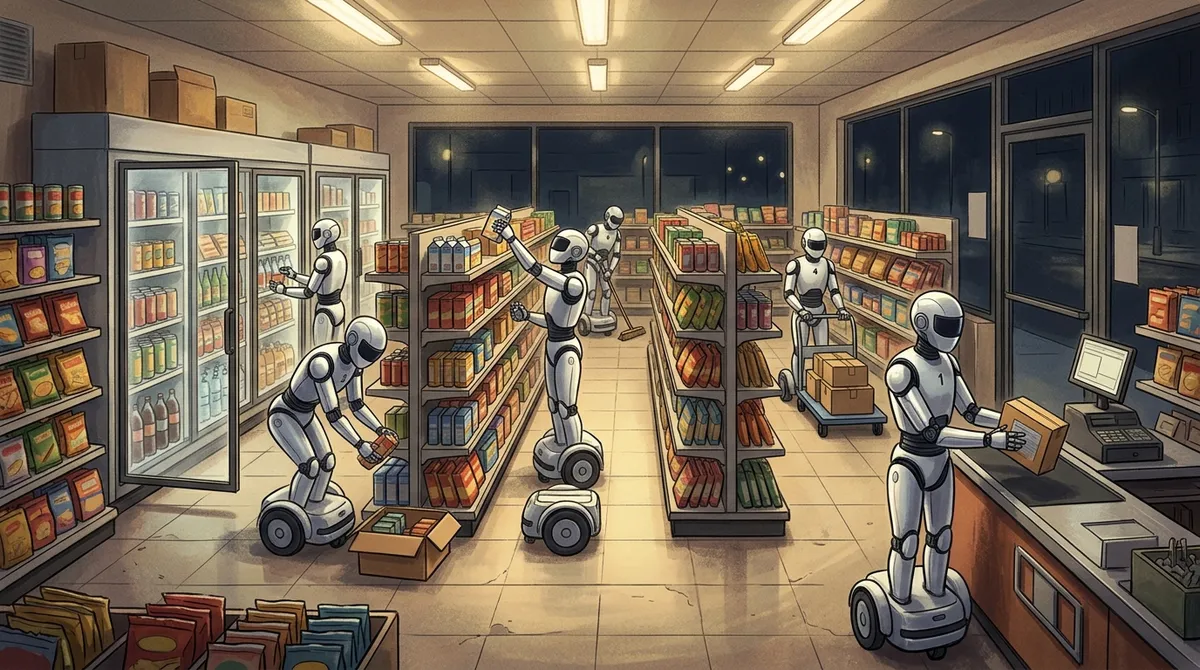
What happened: AgiBot has published the evaluation behind its November 2–3 trial, in which six wheeled Spirit G2 humanoid robots worked a 24-hour shift at an operating convenience store in Shanghai's Xuhui district (AgiBot). Across 1,730 tasks at six stations, four of the six robots passed; the failures were the shelf-patrolling and table-cleaning units (note.com). Fixed-station work — coffee, checkout, handover — passed, while tasks requiring the robots to move around the store stumbled. Reports say the cleaning robot, blocked by a full trash bin, went off course, left the store and never returned.
What's genuinely new: the trial's first pass/fail result, broken out by station: greeting and customer service 683 tasks, handover 369, shelf restocking 277, coffee 147, cleaning 128 and breakfast 126, performed under examiner challenges such as deliberately rearranged gum displays and aisles blocked with people and boxes. Companies rarely publish their 2-out-of-6 failures; what was not published is per-task success rates, human interventions and charging downtime. The disclosed failures sit awkwardly beside AgiBot's June factory livestream claim of 99.99% success, and beside Sichuan's Hongqi Chain grocery chain, which cancelled its robot-staffing pilot citing failure to meet large-scale commercial standards and return on investment.
Watch: per-task success rates and human-intervention data, whether the same store trial continues, and any commercial deployment to follow.
Foundation Future pitches a machine-gun-carrying MK 2 as its Gaza talks continue
Sources Fox News Daily Caller
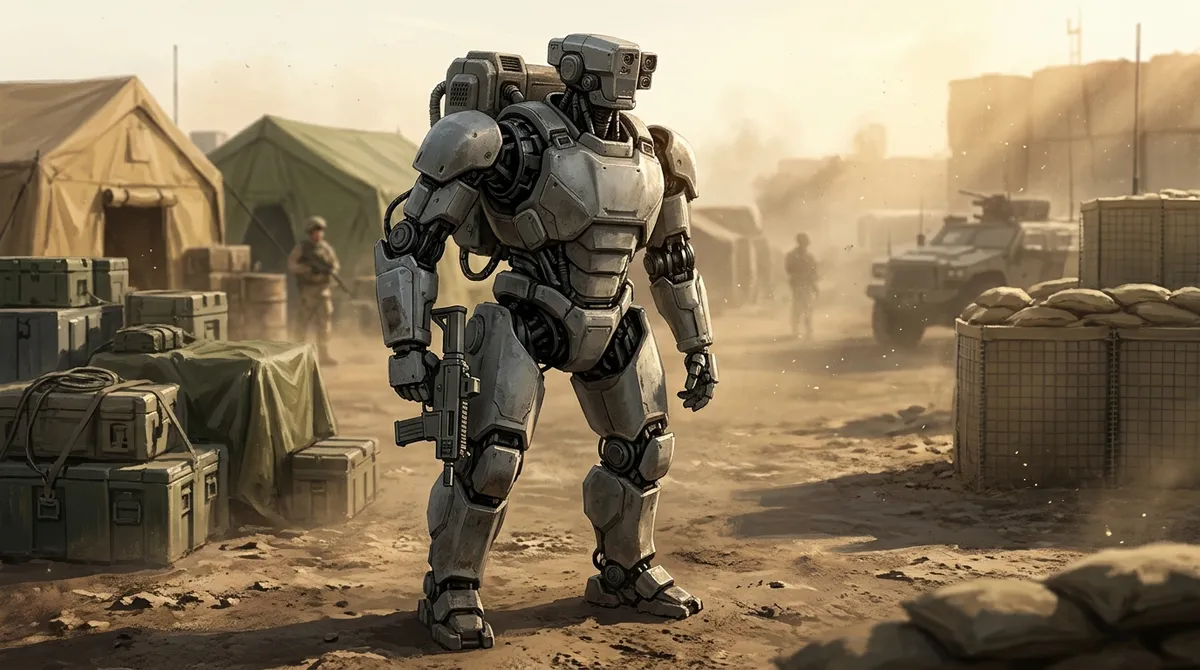
What happened: Co-founder Mike LeBlanc, a former Marine Corps officer, told Fox News Digital the company's next Phantom, the MK 2 — 6 feet tall, 185 pounds, able to lift an adult — is "already close to shipping" and is meant to engage enemies with small and medium machine guns, with Ukraine likely the first deployment (Fox News). The company says its February MK 1 shipments to Ukraine made it the first to deploy humanoids in a combat zone, in a supplementary role for ordnance, loading and manual labour. It remains in preliminary talks with the Israel Defense Forces over up to 1,000 Phantom MK1 robots for Gaza's tunnel network; Israel's Defense Ministry declined to comment (Daily Caller).
What's genuinely new: the MK 2's armament claim and a named first-deployment plan, plus the Daily Caller's additions that the two MK1s sent to Ukraine in February worked transport and reconnaissance with no reported weapons engagement and that the in-development MK 2 will use AMD processors. LeBlanc forecasts humanoids, ground vehicles and drones doing "most of the major fighting" within five to 10 years, says humans will never disappear from the battlefield entirely, and rejects Senator Elizabeth Warren's corruption framing of the roughly $24 million Pentagon contract won after Eric Trump joined as chief strategic adviser.
Watch: whether the Israel talks become a signed contract, any MK 2 deployment in Ukraine, and the congressional scrutiny LeBlanc says he expects from January.
Brief
- FF EAI Robotics (Nasdaq: FFR) reports its first results since completing its October 23 acquisition of Faraday Future's robotics business: about $2.3 million in unaudited combined revenue for the nine months ended September 30 at roughly 26% gross margin, a monthly record of 351 robots sold and shipped in October (1,168 cumulative through end-October), a company-claimed top rank for its FF OmniMind robotics models on the RoboColiseum benchmark as of November 6, and plans for a Physical Cloud platform and a "Productivity Token" during the CES period plus a 100-city robotics education initiative — while the Q3 earnings-call transcript keeps a going-concern warning and regulatory risks standing beside the growth claims (FF EAI Robotics Ecosystem).
- TIKR's Tesla analysis re-runs Elon Musk's November 6 estimate that matching US goods-and-services output would take about 20 to 30 million humanoid robots, showing his arithmetic (roughly 120 million productive Americans at five times a human's output) and printing the counterpoint from Moonshots co-host Dave Blundin that 10 million would suffice since 45% of US jobs are manual (TIKR).
- Post-listing analyst framing for Agility Robotics: Gartner's Bill Ray calls its manufacturing-and-logistics focus "far more practical" than general-purpose rivals ("Today, you cannot actually buy a robot like Tesla's Optimus"), ABI Research's George Chowdhury calls Agility "the most commercially mature humanoid company going after enterprise markets" with about 100 Digit robots "at work," and both argue investors still pay up for promised futures rather than present deployments (TechTarget).
- Xiaomi's eight-hour car-factory humanoid demonstration gets more mechanical detail in a Japanese-language round-up of Chinese coverage: the two robots charged twice, at the 3-hour 2-minute and 6-hour 3-minute marks, to log 8 hours 5 minutes sorting flexible center-console side panels in production sequence, with one dropped part retrieved by a wheeled robot — and Xiaomi itself calls the effort an "initial verification of production-line-level work capability," not practical deployment (note.com).
- Web Summit 2026 in Lisbon featured nine Chinese AgiBot humanoids performing a synchronised dance and, for the first time, humanoid robots as official speakers; the conference drew around 70,000 participants from 164 countries (Euronews).
- OpenAI has disbanded its stand-alone robotics team, moving the researchers onto its main research team under Chief Research Officer Mark Chen and the applied robotics and hardware teams into its Applied organization under President Greg Brockman, the company confirmed to Fortune. A spokesperson says robotics remains core to its long-term vision and that general-purpose models such as GPT-6 Astra can now be applied directly to robots; OpenAI is still developing its own humanoid, with Sam Altman targeting a first public demonstration in 2027 (Fortune). (single source)
- Figure AI is hiring an overnight coordinator — $40 to $45 an hour, contract-to-hire, Santa Clara, with a weekend requirement — to troubleshoot malfunctioning humanoid robots, organise shifts and guide staff on a 10:30 p.m. to 7 a.m. schedule, part of a hiring push that also includes robot operators whose job is testing and verifying new skills and behaviors; the write-up also counts the company at a $39 billion valuation after a $1 billion Series C led by Parkway Venture Capital, and cites PitchBook's tally of $33.4 billion invested in robotics and physical AI in the first half of 2026, topping the $28.7 billion raised across all of 2025 (The Cool Down). (single source)
- A new preprint by University of Milan physicist Alessio Zaccone, Exeter mathematical biologist Thomas Tunstall and Rockefeller University's Jesse Ausubel models human and android population growth and concludes human-run factories alone will likely never produce enough humanoids to match the human headcount — but if robot-assisted manufacturing switches on around 2050, android numbers could pass 10 billion around 2083, near the UN-projected human peak; the paper leans on the International Federation of Robotics' count of about 7,000 full-size humanoids sold worldwide in 2025, and ran on the anniversary of the 1960 "Doomsday: Friday, 13 November, A.D. 2026" paper (ZME Science). (single source)
- NVIDIA has released new GR00T 2 demonstration videos showing skills learned from human demonstrations carried across different robot bodies: toy-truck assembly transferred from handheld-gripper demos to a YAM robot arm at 60% success, two-handed breakfast preparation taught through wearable-hand recordings, and the lighter GR00T 2 Turbo running onboard a Jetson Thor computer on a Unitree G1 humanoid serving popcorn and clearing tables; the company's November 9 CoRL update names Foxconn applying GR00T 2 to server-manufacturing automation, Siemens evaluating industrial cases and Nexuni testing robotic laundry handling, with model code listed for December release (RobotsBeat). (single source)
- A reported leak describes Tesla's Optimus training program, in which workers allegedly wear 24-pound suits fitted with up to 40 cameras and 3D sensors; the account comes from an unnamed tech insider and has no independent confirmation (MSN).
- SE3, a Munich spatial-AI software company for drones and ground vehicles, raised a $30 million Series A led by Accel, with Keen Venture Partners, Lakestar and Seedcamp; the company says it has shipped thousands of systems over two years and plans a UK office (RobotsBeat).
- Qvyon, a Montreal company, emerged from stealth with MIMIC Core, software that turns camera, lidar and radar recordings into repeatable test scenarios for robots and autonomous vehicles, backed by $8 million in financing that closed in April (RobotsBeat).