Robots digest — Nov 14, 2026
Top line: Tesla opened personal Cybercab orders at $29,990, with a required $299-a-month autonomy subscription. OpenAI folded its stand-alone robotics team into core model work, and Toyota specified a 400,000-robot rollout backed by about ¥1 trillion a year from 2028.
- Tesla opens Cybercab personal orders: $29,990 plus a required $299-a-month autonomy subscription
- Toyota prices its robot bet: ¥1 trillion a year from 2028 for 400,000 robots
- DARPA sent four autonomous ground vehicles hunting for targets without GPS — with a human deciding on force
- Humble Robotics raises $51 million for self-driving electric freight "haulers"
- OpenAI folds its stand-alone robotics team into core model work
Tesla opens Cybercab personal orders: $29,990 plus a required $299-a-month autonomy subscription
Sources Electrek Paul Tan's Automotive News Teslarati
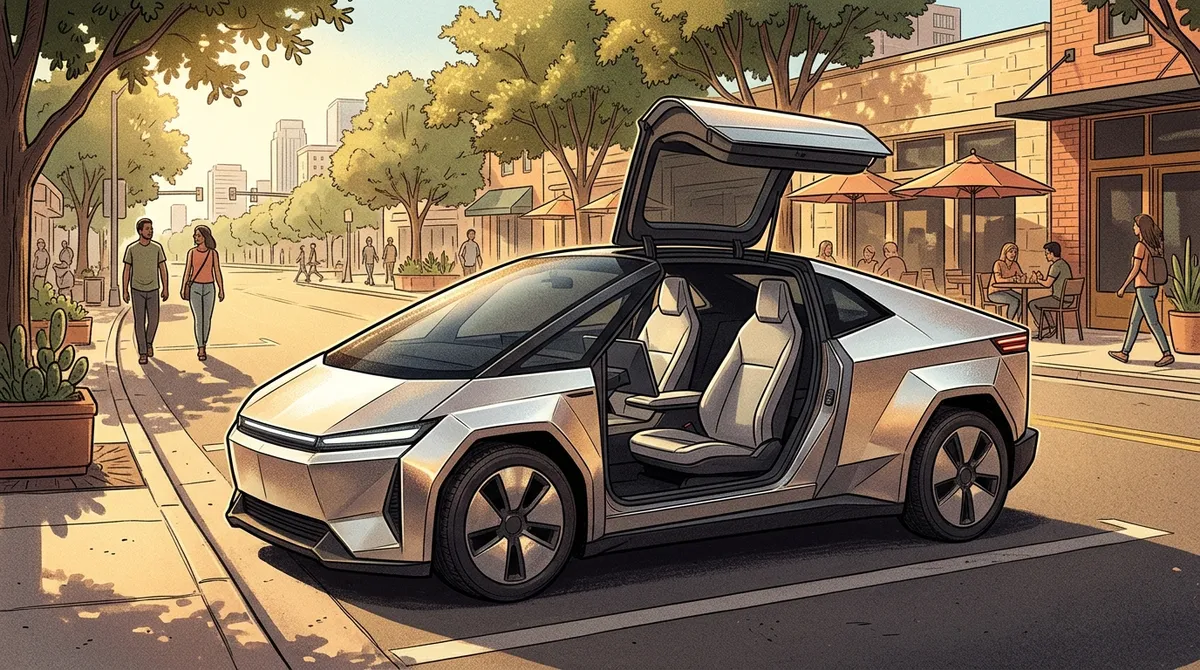
What happened: Tesla began inviting selected customers to buy a two-seat, controls-free Cybercab for personal use at $29,990 before taxes, with a $1,000 non-refundable deposit and estimated December 2026 delivery in Austin, Texas. The car will not operate without a $299 monthly Autonomy Subscription and runs only inside Robotaxi service areas in eight Texas and Florida cities. Contracts bar resale or transfer without Tesla's written permission, and touchscreen controls allow only short moves at up to about 2 mph.
What's genuinely new: Musk said on X that the $299 fee is too high and should fall to about $115 a month, with nationwide availability only as regulators approve. Electrek puts the combined five-year cost at about $47,600 — the $29,990 price plus $3,588 a year in subscription fees. Independent checker Koby Pierce measured working pickup areas at 59–78% of advertised geofences, about 59% in Austin. Tesla answered NHTSA's order on federal safety standards confidentially, and the regulator has not ruled.
Watch: Whether open orders follow the invitations, subscription renewal and price cuts, measured service coverage against the advertised maps, and how the federal review treats consumer sales of a controls-free car.
More context: Paul Tan's Automotive News says the Autonomy Subscription agreement states the Cybercab "will not operate without an active Autonomy Subscription," and that Tesla can restrict where and in what weather the car runs, with a month's notice before any price change. The same report says doing a resale without permission carries damages of at least US$50,000 and lets Tesla disable the vehicle.
Toyota prices its robot bet: ¥1 trillion a year from 2028 for 400,000 robots
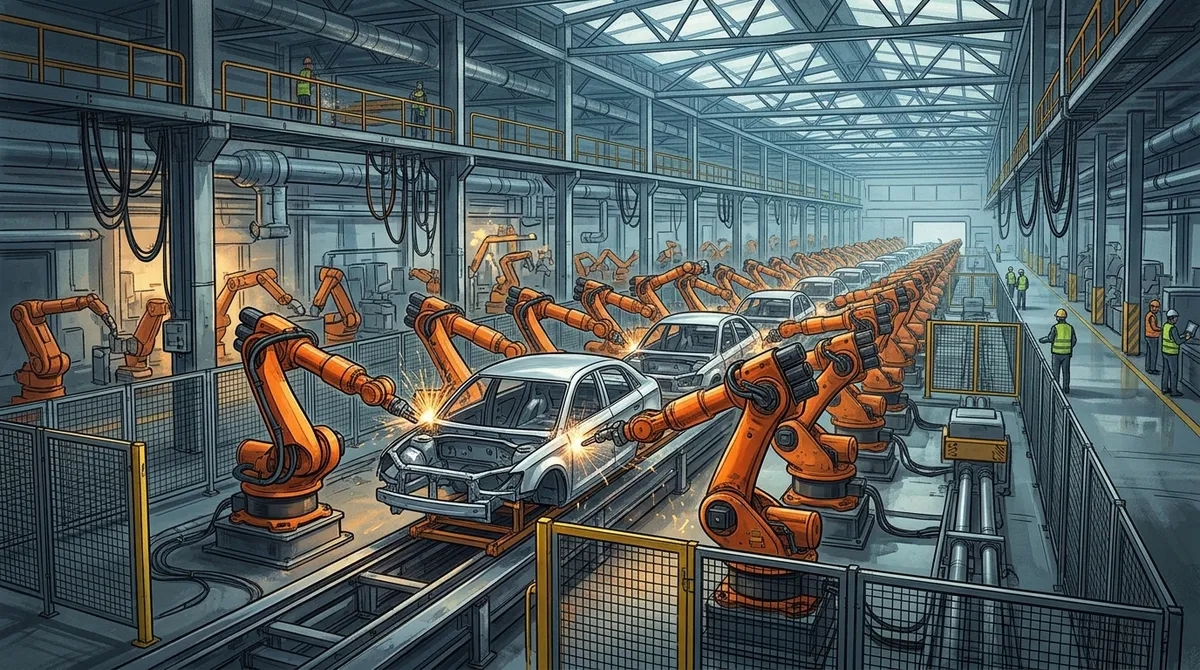
What happened: Toyota and its supplier base plan to spend about ¥1 trillion (about $6.4 billion) annually from 2028 to replace ageing production equipment, money that will back a rollout of some 400,000 robots across the production network — around 150,000 units at Toyota and Toyota Group facilities and 250,000 at supplier sites.
What's genuinely new: The split of the 400,000-robot target between Toyota plants and suppliers is now specified, and Toyota says it intends in time to sell its robotics technologies to other manufacturers and outside industries as a standalone business line. The programme follows a three-stage strategy — conventional robots for repetitive tasks, synchronised end-to-end production and logistics, then collaborative environments where humans and robots work side by side — connected through an integrated Factory Control Platform.
Watch: The 2028 spending gate, the humanoid share of the 400,000 units, the first plants to convert, and whether the robotics-supply business takes real external orders.
More context: Toyota estimates factory automation could cost 1 trillion yen ($6.4 billion) annually from 2028 as the world's biggest carmaker accelerates automation and robotics deployment, Reuters reports.
DARPA sent four autonomous ground vehicles hunting for targets without GPS — with a human deciding on force
Sources Business Insider
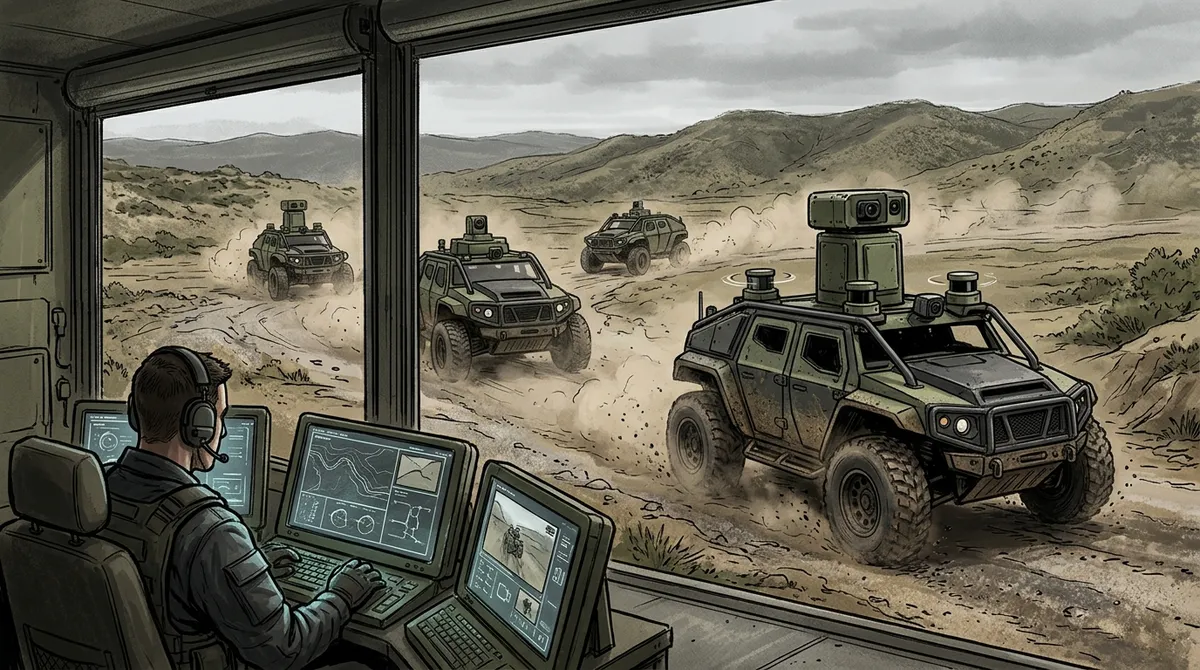
What happened: DARPA's Robotic Autonomy in Complex Environments with Resiliency (RACER) program last month ran four autonomous uncrewed ground vehicles through an exercise at Fort Knox, Kentucky. The robots drove, built their own maps from onboard sensors alone — no GPS — and searched independently for enemy forces for a human operator located away from the action, working together or separately depending on the scenario. In one demonstration, a UGV stopped in place after spotting a closed box holding a drone; the operator then launched a simulated rocket at it.
What's genuinely new: The software lets uncrewed vehicles move fast and find targets on their own in terrain where GPS and signals are jammed or denied — a capability the US military says it needs, with lessons drawn in part from Russia's war in Ukraine. DARPA technical advisor Jason Gregory says the operator was kept "out of harm's way" while humans "maintained control and custody and situational awareness at all times." The software ran on both four-wheel all-terrain and tracked vehicles, and the five-year program is sharing its lessons across the US military and with industry.
Watch: Whether RACER's autonomy reaches fielded programs or units, follow-on exercises with larger fleets or harder terrain, and the human-oversight boundary holding as the software widens.
Humble Robotics raises $51 million for self-driving electric freight "haulers"
Sources FreightWaves
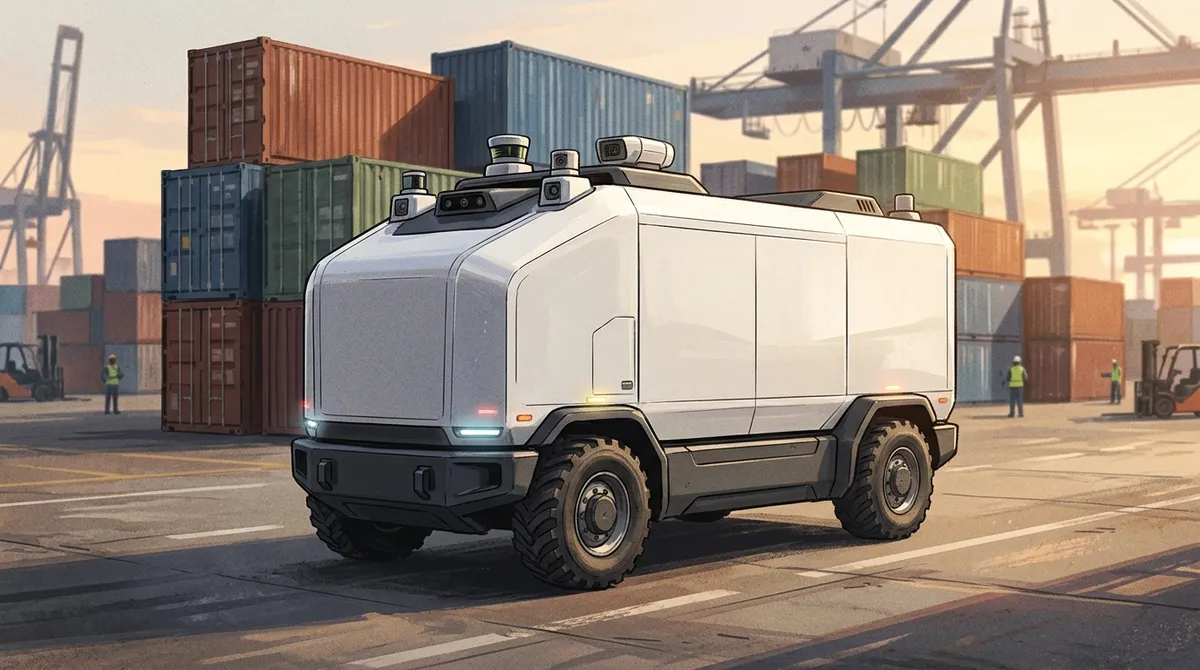
What happened: Humble Robotics closed a $51 million Series A — bringing total funding to $75 million including a prior $24 million seed — to fund customer pilots and early manufacturing of its autonomous electric freight vehicle. The "hauler" is a flat, self-propelled chassis, effectively a trailer that moves itself, that carries an intermodal container or fitted box body; merging tractor and trailer makes it roughly 20% lighter than a conventional combination. The just-over-a-year-old company targets commercial operations in Q3 2027, with pilots first.
What's genuinely new: Alongside the funding, the vehicle's full spec and market plan surfaced: a 200-mile range chosen because 87% of US truck-tonnage routes run shorter than 250 miles, and target lanes like port-to-transload moves, warehouse-to-warehouse hauls and on-terminal operations. Founder and CEO Eyal Cohen says charging is far simpler to automate than diesel refueling, and sensor-fitted conventional trucks will map customer routes before any autonomous hauler deploys — with sensors and AI co-designed with the chassis rather than retrofitted.
Watch: The first named pilot customer, the Q3 2027 commercial-operations date, and unit counts or route volumes once haulers deploy.
OpenAI folds its stand-alone robotics team into core model work

Sources Fortune OfficeChai CASRAI
What happened: OpenAI broke up its stand-alone robotics team, a reorganization the company confirmed to Fortune. The robotics research team now sits within the core research organization under Chief Research Officer Mark Chen, while the applied robotics and hardware teams moved to the Applied arm under President Greg Brockman. An OpenAI spokesperson said robotics remains central to the company's long-term plans.
What's genuinely new: OpenAI says its general frontier models, including GPT-6 Astra, can be applied directly to robot control. In an Nvidia study, an Astra-powered agent succeeded on 74.8% of tasks in a simulated manipulation benchmark, against 51.0% for the best specialized robotics models. The company is developing its own humanoid, and Altman targets a first public demonstration in 2027. Commenters split: Carnegie Mellon's Guanya Shi reads the move as robotics no longer being a special problem, while MIT's Russ Tedrake argues robots that already work in real places hold a data edge.
Watch: A first public OpenAI humanoid demonstration against the 2027 target, Astra's robot-control results holding outside simulation, and whether the reorganization keeps OpenAI in humanoid hardware.
More context: OpenAI had a robotics group in its early days but wound it down in 2020, rebuilt a dedicated team in 2024 and ended its Figure humanoid partnership in February 2025; OfficeChai reports the reorganization lands while the company trims side projects under reported quarterly losses of $10.9 billion. Fortune places the move beside Tesla's early Optimus production and Agility Robotics' Nasdaq debut.
Brief
- At a robotics conference in Austin, Texas in November, Tesla's Optimus handed out snack packets to attendees while a human operated it remotely, according to event footage and reporting — early production is running at Fremont, with Musk expecting outside-company deliveries around the end of 2027. Interesting Engineering
- ABB Robotics launched its first end-to-end vision-based physical-AI package for fashion logistics, integrating AI Robot Trainer into its Fashion Inductor sorting module — pre-trained, fashion-specific vision models it says cut engineering and commissioning effort by up to 75%, with throughput of up to 1,300 items per hour per cell. Robotics & Automation News
- An industry post describes the contract between UBTECH and dealership group Yongda Automobiles covering some 400 humanoid robots for sales and service use. note.com
- The San Francisco Standard profiles Foundation Future Industries, the San Francisco humanoid maker courting the Pentagon: the unreleased Phantom MK-2 is a 200-pound, six-foot aluminum-encased robot co-founder Sankaet Pathak says could "pick a human up," an MK-1 failed a mortar-shell loading task across 15 minutes of tries, and the 2025 pivot from logistics to weaponry prompted resignations among staff uncomfortable with war work. San Francisco Standard
- DARPA's Robotic Autonomy in Complex Environments with Resiliency (RACER) program ran four autonomous ground vehicles through an exercise at Fort Knox, Kentucky. The robots mapped terrain without GPS and searched for enemy forces while a human operator stayed away from the action, and the software is being shared across the US military and with industry. Business Insider
- Humble Robotics closed a $51 million Series A, bringing total funding to $75 million, to fund customer pilots and early manufacturing of a self-propelled electric freight "hauler" chassis. The company targets commercial operations in Q3 2027, with pilots first. FreightWaves