Robots digest — Nov 15, 2026
Top line: OpenAI dissolved its standalone robotics team on November 13, 2026, moving research under Chief Research Officer Mark Chen and applied hardware under President Greg Brockman. Smaller items include robot dogs in a joint Haiti–El Salvador operation and a new Skydio drone design.
OpenAI dissolves its standalone robotics team and moves staff into two organizations
Sources The Times of India Shattered
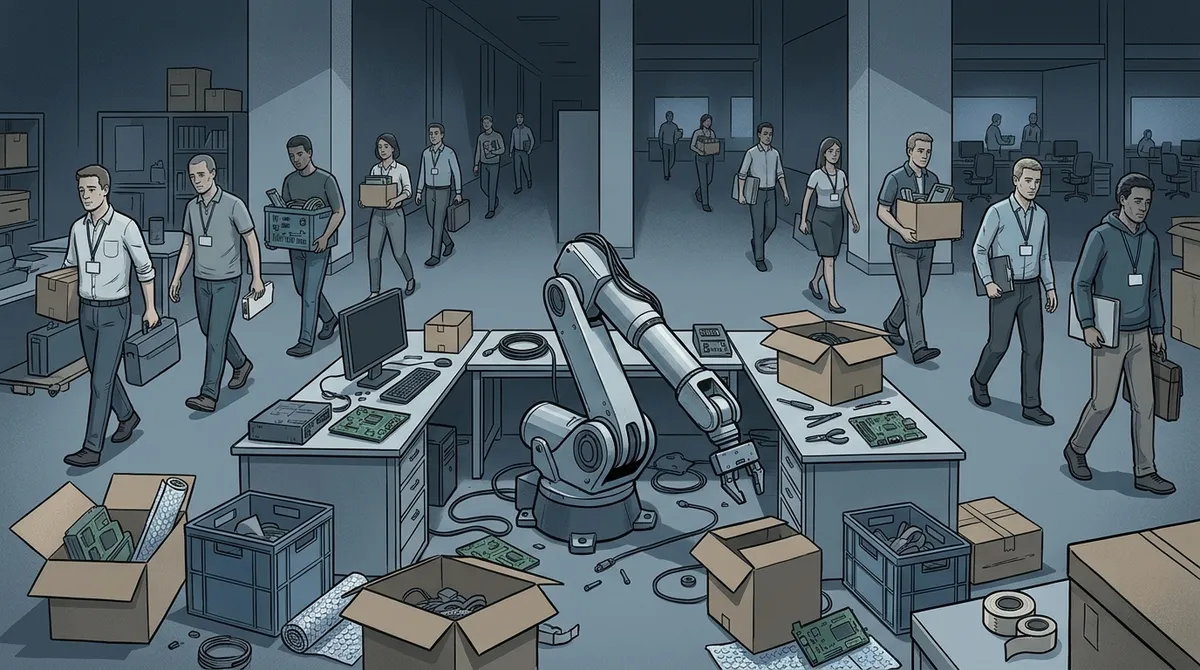
What happened: OpenAI confirmed on November 13, 2026 that it had dissolved its standalone robotics team. Robotics research now sits in its main research organization, reporting to Chief Research Officer Mark Chen. Applied robotics and hardware teams moved to the Applied organization under President Greg Brockman. The company says robotics remains part of its long-term plans and describes the change as a way to speed progress.
What's genuinely new: The Times of India, citing Fortune's reporting, says OpenAI's rationale is that its newest general models, including GPT-6 Astra, now apply directly to robot tasks. The company says its researchers first expected robotics progress to come from Sora, the video model it has since dropped to free up compute. Reported losses reached $10.9 billion in the latest quarter, and the company is preparing a possible IPO in early 2027. Experts are divided. Carnegie Mellon's Guanya Shi says robotics is "no longer a special problem," while MIT's Russ Tedrake argues robotics firms keep an edge in real-world deployment data.
Watch: Whether robotics research keeps its compute inside Chen's organization, the public humanoid demonstration Sam Altman has targeted for 2027, and whether OpenAI discloses any headcount or further structural changes.
Brief
- Foundation Future Industries missed its October 30 payroll, and employees had not been paid as of the report. CNBC reports that CEO Sankaet Pathak borrowed $4.6 million from the company in 2025 to buy a home. Pathak told staff in a memo he is working to secure money for back wages (uInterview, relaying CNBC).
- MIT News profiles Robust AI's Carter, a wheeled cart robot built to work alongside warehouse and factory staff, which the company has described publicly since 2022. The profile is based on company interviews and gives no funding, deployment counts or productivity measurements (MIT News).
- Nidus, a New York defense robotics AI startup founded in March, raised $30 million in a round led by Kleiner Perkins and Costanoa, and reports more than $1 million in bookings with unnamed defense manufacturers, starting with wire-harness work (news.lavx.hu).
- Swiss company Embodied AI unveiled AIR, a wheeled humanoid built to work beside factory staff, at Humanoid Europe 2026. Its operators start each job and the robot learns the task from recorded runs, typically within a month. The company says AIR is being tested with global manufacturers and that CE marking is planned for 2027; no customers or delivery numbers are named (Robotics and Automation News) (single source).
- Xinhua visits a PrimeBOT production line in China, where daily assembly capacity rose from 10 to 240 humanoid robots in 37 days, and the company has built its 10,000th humanoid robot. The report gives no independent verification of the figures (Xinhua) (single source).
- Researchers from the Shanghai AI Laboratory and several Chinese universities released FORGE, a control framework that lets a humanoid walk, balance and manipulate objects while sensing contact forces without wrist force sensors. In the preprint's tests on a Unitree G1, command latency was 22 ms against 197 ms for TWIST2, and box-squeezing force was 8.52 N against 17.16 N; these are the authors' own benchmark results (CASRAI) (single source).
- University of Pennsylvania engineers published a study in Advanced Functional Materials describing artificial muscle fibers made of liquid crystal elastomer, graphene and an embedded copper coil that serves as both heater and sensor. A 3D-printed hand played piano keys at set force levels, and a pair of robotic eyes held a gaze; the work is at laboratory demonstration stage (Popular Science).
- J.P. Morgan research, as relayed in a Hoodline article, forecasts U.S. humanoid robot production of 300,000 to 400,000 units by 2030 and about 1.5 million by 2035, and says humanoid costs are nearing parity with labor costs. The bank names hands, actuators, onboard computing and manufacturing capacity as the binding constraints (Hoodline) (single source).
- Haitian and Salvadoran forces used robot dogs, some with rifles mounted on them, in a joint operation under their bilateral security agreement to retake Haiti's Sylvio Cator Stadium from gangs. The Sun reports the same deployment and cites President Nayib Bukele's posts on X; it is unclear how the robots were used in the operation (MSN · The Sun).
- DHL Supply Chain says it has begun introducing AI orchestration software into operational warehouses after a proof of concept, and is testing adaptive AI-powered robots that adjust their actions to changing conditions. The company reports more than 9,000 robots installed across its network but gives no results from the new pilots (Robotics and Automation News) (single source).
- OpenMind's humanoid Iris has part of her control loop run through living human neurons grown on electrode arrays in labs in Australia and Switzerland, linked remotely by a team led by Stanford bioengineer Jan Liphardt. In nearly 500 simulations, fresh flat cultures reached 94% decoding accuracy with responses in 150 to 240 milliseconds; spheroid cultures reached 91% but sometimes took two seconds. Flat cultures stayed viable for more than 100 days, while spheroids survived only a few days (The Gadgeteer) (single source).
- Skydio's F10 Lightrunner is a fixed-wing camera drone with its camera mounted on one wingtip, which makes the aircraft asymmetrical. It flies up to 100 miles per hour for a maximum of two hours, and its MegaDock uses a robot arm to launch and recover up to five drones (IEEE Spectrum) (single source).