AI digest — Nov 18, 2026
Top line: Anthropic priced its IPO at $83 a share, above its $70–$78 range, putting the Claude maker's valuation near $1.5 trillion ahead of Nasdaq trading on November 19. Google shipped Gemini 4 Neon, the generation's fourth model, broadly available on day one. OpenAI reported researchers' agent use rising roughly elevenfold, with safety work expanding fastest.
- Google ships Gemini 4 Neon, the fourth model of its Gemini 4 generation
- DeepMind's robotics plugin ties Gemini 4 Hydrogen to real robot arms
- Anthropic prices its IPO at $83 a share, above range
- OpenAI's research-acceleration report: agent use keeps rising, safety work fastest-growing
Google ships Gemini 4 Neon, the fourth model of its Gemini 4 generation

Sources Google DeepMind Google DeepMind on X published Nov 18, 4:35 PM ET
What happened: Google shipped a fourth Gemini 4-generation model, Gemini 4 Neon, positioned between Carbon and Hydrogen and available immediately in the Gemini API and Google AI Studio, in Gemini for business, and in the Gemini app and Google Antigravity for paid AI Pro and Ultra subscribers. Pricing is $3 per million input tokens ($0.15 for cached input, a 95% discount) and $15 per million output tokens, with a million-token context window.
What's genuinely new: Unlike Argon's and Carbon's defender-gated launches, Neon ships broadly on day one. Google claims #3 overall (61) on Artificial Analysis's intelligence index at its "xhigh" setting, #2 on the Vals Index, #1 on its coding-agent index (58.6) and 65.2% on Terminal-Bench 4.1, with state-of-the-art security results for a separate Neon for cyber tier — and says Neon posts its lowest fabrication rate yet in internal testing.
Watch: whether the Neon for cyber tier reaches Fairwind defenders in the coming days as promised, and independent checks of the benchmark claims now that the API is open.
More context: A separate cost claim: at its default high setting Neon pairs its intelligence score with 32% lower cost per task than Carbon, and 50–80% lower than top competing frontier models on the Vals and Agent Arena boards, at a #2 debut (1336) on Arena's new Agent Arena Index across 4,200+ agent sessions. The cyber tier claims state-of-the-art on WebExploitBench v1.2 (51.26%), SEC-bench Pro (90.5%) and the hard tier of AutoBaxBench (76%).
DeepMind's robotics plugin ties Gemini 4 Hydrogen to real robot arms
Sources Google Developers Blog published Nov 17, 2:03 PM ET
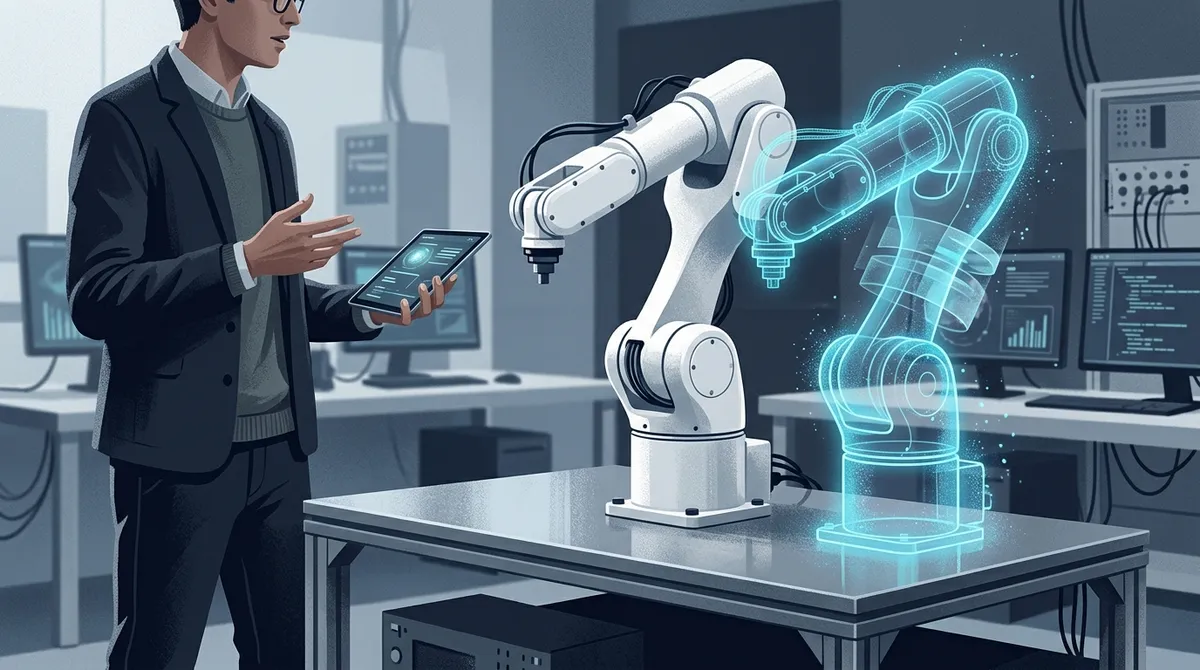
What happened: Google DeepMind says the new robotics plugin for Google Antigravity, running on Gemini 4 Hydrogen, lets users connect a supported robot arm, have it practice in the MuJoCo simulator, and run the task in the real world by describing it in plain conversation — the company bills it as a much faster way to teach robots new tasks.
What's genuinely new: It is the first concrete workflow pairing Gemini 4 Hydrogen, which shipped to everyone on November 13, with DeepMind's robotics line, and it extends the Gemini Robotics 2.5 launch of November 10 from partner deployments toward a user-facing tool. A general supported-arms list, availability dates and pricing have not been published yet — only the demonstration hardware named below.
Watch: the supported-arms list, availability and pricing, and whether named partner deployments adopt the workflow.
More context: Installing the Robotics plugin from Antigravity's Build With Google shelf lets a developer plug in a robot arm and a depth camera, calibrate it and run test motions in about 10 minutes, Google Developers Blog says. The Google Developers Blog names the hardware the workflow was demonstrated on: an I2RT YAM desktop arm, a low-cost SO-ARM101 and Franka's industrial-grade FR3 Duo. On the Artificial Analysis Robotics 0.1 benchmark, Gemini 4 Hydrogen scores 58 controlling a real six-axis arm through eight everyday tabletop tasks, close to the larger Argon model at a lower cost per token, according to the Google Developers Blog.
Anthropic prices its IPO at $83 a share, above range

Sources Anthropic The Information Anthropic on X published Nov 17, 7:00 PM ET
What happened: Anthropic has priced its initial public offering at $83 a share, several dollars above the $70–$78 range, a level that values the company at around $1.5 trillion (The Information). Trading is expected to begin on Nasdaq on November 19 under the ticker "ANT" — making the Claude maker the first, and biggest, top AI model developer to go public.
What's genuinely new: Pricing is confirmed on the company's own channels, not just by reporting: the offering is 980,000,000 Class A shares — 956,351,354 sold by Anthropic and 23,648,646 by selling stockholders, whose shares bring Anthropic no proceeds — with a 30-day underwriter option on up to 147,000,000 more, enlarged from 123,750,000 at the roadshow launch. The SEC declared the registration effective November 18, the offering is expected to close November 20, and Goldman Sachs and Morgan Stanley are the prospectus agents.
Watch: the first Nasdaq trading day on November 19 and the valuation against the $1.5 trillion estimate, and whether the enlarged 147-million-share option is exercised.
OpenAI's research-acceleration report: agent use keeps rising, safety work fastest-growing

Sources OpenAI OpenAI on X published Nov 18, 3:00 AM ET
What happened: OpenAI has published new data on how AI tools are changing its research organization: the median researcher now spends about $2,400 a day on agentic tools at API list prices — the top 10% about $23,000 — and agent use per researcher has grown roughly elevenfold since September, to 5.7 eight-hour agent workdays per researcher per day. By mid-October more than two-thirds of researchers averaged a daily peak of at least four agents working concurrently, and agentic spending now runs about twice researchers' non-equity pay.
What's genuinely new: The report extends OpenAI's September edition with new process measures, and pairs the growth with safety staffing: documented contributions to Safety & Alignment nearly doubled in 2026, the largest rise of any research area, with the inflection following July's Hugging Face incident. OpenAI again argues AI labs should be required to publicly track indicators of recursive self-improvement — AI accelerating the development of future AI — while cautioning the figures are not an intention to pursue it, and that human involvement remains central as agents take on longer tasks.
Watch: whether other labs adopt comparable RSI disclosures and what regulators make of the reporting call.
Brief
- The Information reports Nvidia's sales team introduced Alibaba to Alice Huang — the Megaspeed executive US officials suspect of spying for China — on two occasions across several months in 2022, months before the US export controls on advanced chips took effect, helping her company land Alibaba as a customer, according to three people with direct knowledge (The Information). No independent report confirming the introductions has surfaced, and Alibaba and Nvidia are not named as responding in the reporting.
- Nvidia has stopped shipping licensed Hopper data center products to China — interim CEO Colette Kress said on the company's November 17 earnings call that guidance includes no licensed Hopper products and the company is no longer shipping them to China, walking away from H200 sales the White House approved in December last year; she gave no reason and did not say whether Nvidia will pursue other business with China. The report notes vetting concerns over approved Chinese buyers and, per Reuters, around 600,000 H200 chips stuck in Hong Kong after Beijing withheld import approval (The Verge) (single source)
- At an all-hands meeting, Nvidia interim CEO Colette Kress told employees to expect pay raises and more equity by the end of the year, in an effort to reassure staff and head off a potential talent exodus, according to people present (The Information) (single source)
- New York, Los Angeles and Chicago school districts are weighing dropping Google Search after Google said it will disable Search for schools that opt out of its Gemini-powered AI features starting next year; Google vice president of education Chris Phillips told The New York Times that "Search and AI are deeply integrated" (The Verge)
- Meta has paused plans to issue its new class of non-voting shares — floated as a way to raise more capital for AI spending — while pending shareholder lawsuits play out, saying in a court filing it will not issue Class C shares during the litigation (The Information) (single source)
- The independent cost picture on GPT-6.2 Astra, released November 17, comes in below OpenAI's launch claim: Artificial Analysis measured cost per task down 36% — $4.00 against $6.24 for GPT-6 Astra — and Vals AI measured about 50%, $10.68 against $21.28 — OpenAI's launch claim was a cost under a third of the prior model's, i.e. a cut of more than two-thirds; the testers attribute part of the gap to assumptions about cache use and output volume (Astra's blended rate fell only about 24%, $7.70 to $5.88 per million tokens), and put Astra level with Anthropic's Claude Fable 5.2 at reduced effort while costing under a third as much per task ($4.00 against $14.83) (Tech Times) (single source)
- Palo Alto Networks plans to acquire Applied Compute, an AI startup founded by three former OpenAI researchers that helps businesses train and run customized versions of open source AI models, for $4.5 billion in stock, announced November 18 — no independent confirmation of the terms yet (The Information) (single source)
- Sierra, the AI customer-support startup founded by former Salesforce co-CEO Bret Taylor, has been in talks to raise around $1.5 billion at a roughly $30 billion valuation — nearly double the $15 billion-plus from its last round announced in May — according to two people with knowledge, with Lightspeed Venture Partners, Greenoaks and Benchmark reported among the investors (The Information)
- The Verge frames President Trump's Manila visit, which began November 17, around a US-backed AI hub in the Philippines, presented as the newest piece of the administration's Pax Silica bloc for chips and AI (The Verge)
- A Senate Judiciary subcommittee hearing called for ending forced arbitration for online harms, with Roblox the immediate target over child-safety complaints, and lawmakers pushing protections for deepfake victims before the end of 2026 (The Verge)
- Perplexity has launched three APIs over the last few days — Perplexity Monitor, programmable alerts on events; Perplexity Orchestrator, task-based routing across frontier and open-weight models; and Perplexity Context, batch-mode transformation of URLs into usable content for agents — and says its API business has grown 4.3x year on year to a nine-figure annual run rate (Arav Srinivas)
- Elon Musk says "Grok 4.8" is currently several different model variants in beta, with xAI not yet sure which will go to wide release (Elon Musk on X)
- Elon Musk says SpaceX is adding terrestrial AI compute at about 0.5 GW a month — a pace he says is equivalent to roughly 220,000 Nvidia GB300s plus CPUs, networking and cooling, measured at the power-plant level — and aims to bring online more than 1 GW a month by the end of 2027 (Elon Musk on X) (single source)
- Perplexity's Teammates agents and Multiagent effort have rolled out to the Perplexity iOS and Android apps, with voice control of Teammates, available today for Max subscribers (Arav Srinivas)
- Epoch AI's analysis of Anthropic's IPO filing puts the company's compute-spending growth at about 4x a year, outpacing reports of roughly 3x at OpenAI; the S-1 disclosed $447.5 billion in spending commitments — "substantially all" compute and infrastructure — from September 2026 through the end of 2030 (around $100 billion a year), against $18.8 billion of compute spend in the first nine months of 2026, with customer-inference spending falling from 38% of the total in 2025 to 26% (Epoch AI)
- RadixArk, a new lab, released its first model DaisyRose-27B under Apache 2.0: a 27B agent model built on Qwen3.8-27B, trained with reinforcement learning in 18 days on 144 H200s using 1,200 curated long-horizon tasks, lifting Terminal-Bench 4.1 pass@1 from 5.6% to 12.0% (Hugging Face)
- Abundant Labs introduced FrontierRSI, a new recursive self-improvement benchmark that evaluates agents on a broad range of AI research and engineering work and post-trains models on multi-step agentic tasks (quasicoh on X)
- AWS has added full fine-tuning to SageMaker AI's serverless model customization: a single training-type parameter switches a job from LoRA to updating every model weight, with no GPU provisioning or cluster setup — AWS reports 90% semantic correctness on a coding test using more than 100,000 examples, and cautions that aggressive learning rates caused catastrophic forgetting, with MMLU accuracy dropping to 3.6% (Unite.AI)
- Cloudflare released open-weight updates to its Clairic data-extraction models: an updated 27-billion-parameter Clairic and a new 9-billion-parameter model (Unite.AI) (single source)
- New research finds AI-generated hospital discharge summaries earn higher clinical ratings than doctor-written versions, meeting and in some respects exceeding current standards of care (Medical Xpress)
- A conference report from Japanese medical-informatics researchers describes open-weight LLMs structuring hospital records in-house: GPT-OSS-Swallow-120B scored 94.6% on the 2026 Japanese national medical licensing examination with no medical-specific training, and a test pipeline structured 1,044 records into JSON at an average 43 seconds each, with the LLMs kept air-gapped inside the hospital and patient data moved only on encrypted drives (note.com) (single source)
- Goa's state cabinet approved 10 crore rupees (about $1.1 million) for five schemes under its AI Policy 2026, focused on student training and startups (Mirror Now)
- Le Groupe Figaro and OpenAI announced a partnership bringing Le Figaro journalism — current reporting and archive content across news, business, culture and lifestyle — into ChatGPT through summaries and excerpts with links to the original stories; the publisher keeps editorial independence (OpenAI)
- Suno launched Visuals, turning its AI-generated songs into video clips of up to 15 seconds that lipsync to lyrics, plus prompt-based image generation for thumbnails and album artwork, on web, iOS and Android — powered by a model based on MiniMax's H3, with filters intended to block generating specific artists' and public figures' likenesses and separate paid "Visuals credits" on top of song credits (The Verge)
- IEEE Spectrum reports Epic Games is redesigning Unreal Engine 6 for a world of AI coding agents: dropping the Blueprints visual-scripting system, which large language models handle poorly, moving all gameplay code to the text-based Verse language, and exposing engine systems through APIs and scriptable tooling so AI can manipulate the editor directly (IEEE Spectrum)
- Humyn Labs, an Indian startup building a data platform for physical AI that replicates warehouses, dark stores and factories to test how robots perform in real-world conditions, raised $47 million in Series A funding — $26 million equity led by Accel plus $21 million venture debt — and claims more than $50 million in annualized revenue within six months and 12 paying clients (Mint)
- Osmo, a startup spun out of Google Brain that is building what it calls the first foundation model for smell, claims the model has reached what it defines as human-level olfactory intelligence and is already used by fragrance-industry clients, having assembled more than 10 million human odor labels and 800 million "scent tokens"; smell scientists question parts of the company's marketing claims and note its patents still rely on human sensory panels (MIT Technology Review)
- Disney Imagineering R&D revealed three Audio-Animatronic prototypes based on the Anzellan characters from The Mandalorian and Grogu; they use hidden cameras and microphones, with AI models running on Amazon's AWS cloud, to pick responses to guests, while every movement and line of dialogue is prewritten by Imagineers. The characters will make their first public appearance at the AWS re:Invent conference in Las Vegas (The Verge) (single source)
- Google DeepMind says Genie 4 is now available in Project Genie, with native audio, real-time editing and a new agent that builds worlds through conversation; the update is open to eligible Google AI Ultra subscribers, with a waitlist for Google AI Pro (Google DeepMind)
- OpenAI says its models improved the circuit design of Jalapeño, its first custom inference chip, with gains verified on silicon, and that working with AMD they found up to 14% performance-per-area improvement on AMD's flagship GPU IP in under five months; OpenAI reports AMD has already included some of these changes in a recent design sent for manufacturing. OpenAI is also partnering with Synopsys on a model that uses electronic design automation tools (OpenAI) (single source)