Space digest — Nov 22, 2026
Top line: BepiColombo is confirmed in orbit around Mercury, though a software issue shortened the orbit-insertion burn; the orbiter pair separates December 9–10. Falcon 9's classified NROL-136 launch capped a 32-hour Vandenberg pad turnaround, now confirmed by SpaceX. And Mexico is pressing SpaceX to take responsibility for booster debris washing ashore after the November 13 Starship explosion.
- House intelligence threat puts SpaceX's federal contracts — and its one customer too big to lose — under scrutiny
- BepiColombo confirmed in orbit around Mercury
- Perseverance's failed antennas pause the rover's science
- Falcon 9 launches classified NROL-136 on a record-fast Vandenberg turnaround
House intelligence threat puts SpaceX's federal contracts — and its one customer too big to lose — under scrutiny

What happened: Rep. Jim Himes, the Connecticut Democrat who takes the House Intelligence Committee gavel in January, sent a classified letter to Director of National Intelligence Jay Clayton warning that "our committee cannot authorize funds for the development of government systems that the government will not fully control," and a separate letter to Elon Musk saying SpaceX's "potentially unilateral modification of a U.S. Government contract" and its poor responsiveness to oversight "calls into question every contract the U.S. Government has with SpaceX."
What's genuinely new: The report sizes the exposure on both sides. The Starshield vehicle Himes's committee can reach holds only about $476 million obligated across six task orders — 3.3% of one quarter's $14.575 billion of revenue — while his panel cannot touch most of the federal work: the Pentagon awarded SpaceX $6.45 billion for two Golden Dome pieces in May, and the company flew 11 of 12 national-security launches and all five NASA station missions in 2025. Meanwhile the valuation rests on Customer B — 34.5% of Q3 revenue, about $5 billion, on contracts terminable on 90 days' notice once noncancelable periods end in January and March 2027; the largest publicly disclosed one is Anthropic's up to $120.5 billion, reported November 19.
Watch: Ring-fence language in the annual Intelligence Authorization Act, SpaceX's response, and the January committee chairmanship.
More context: Jim Himes, the Connecticut Democrat who takes the House Intelligence Committee gavel in January, warned in a classified message to Director of National Intelligence Jay Clayton that "our committee cannot authorize funds for the development of government systems that the government will not fully control," according to CNN. The most obvious tool at his disposal is known as "ring fencing," which lets the committee legally restrict funding for specific projects in the annual Intelligence Authorization Act until certain conditions are met, CNN reports. Lawmakers from both parties asked the Pentagon's inspector general to investigate whether the Starshield slowdown put American personnel at risk, but the watchdog declined and told them to direct their questions to the relevant military service branches, according to CNN.
BepiColombo confirmed in orbit around Mercury
Sources Starlust Associated Press ESA Jeff Foust on X NASASpaceflight on X published Nov 22, 1:15 PM ET
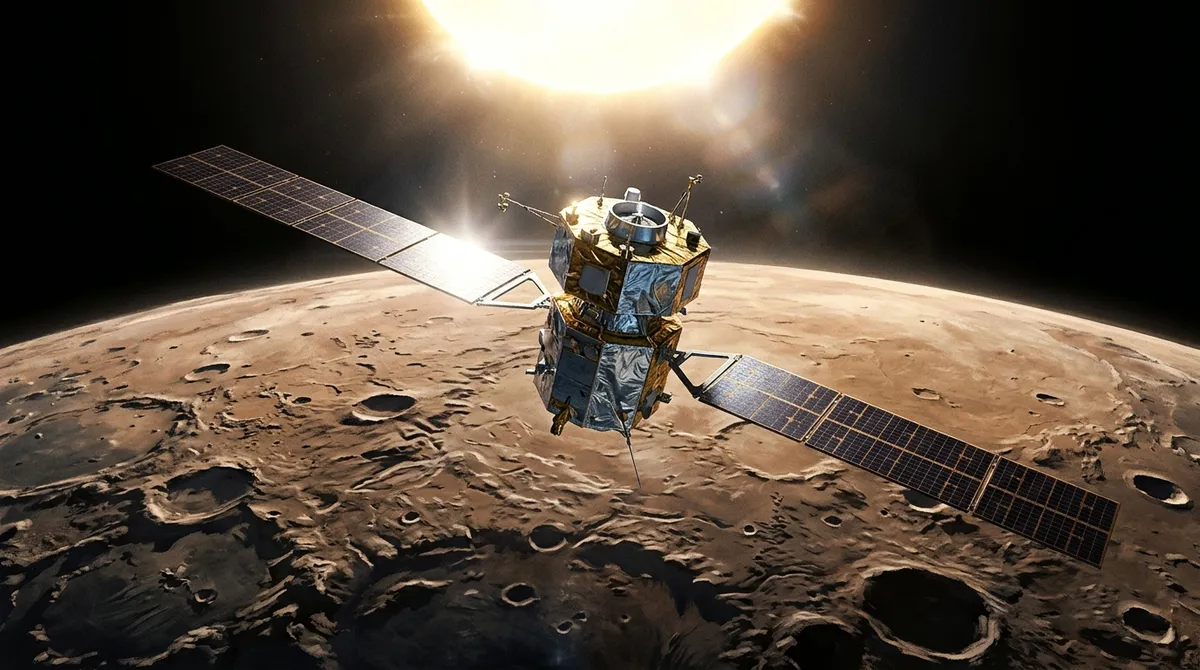
What happened: ESA confirmed BepiColombo's orbital insertion at Mercury is complete and the spacecraft is in contact with mission controllers — but the thruster burn that slowed it into orbit ended shorter than planned following a software issue, the agency says. BepiColombo is safe and ESOC teams are working to understand what happened, with ESA promising updates on Monday. NASA Administrator Jared Isaacman greeted the orbital news on X with "Wonderful to read."
What's genuinely new: The software issue behind the short burn — disclosed by ESA Operations and relayed by beat reporters. With orbit achieved, BepiColombo — ESA's Mercury Planetary Orbiter paired with JAXA's Magnetospheric Orbiter, Mio — is the second spacecraft in history to orbit Mercury after NASA's MESSENGER (2011–2015). Launched October 20, 2018 from French Guiana, it took eight years, one Earth flyby, two of Venus and six of Mercury to arrive. The still-stacked orbiters separate December 9–10 and begin science in April 2027.
Watch: Monday's ESA update on the software issue and the spacecraft's health; the December 9–10 separation and the burn campaign to final orbits through March 2027.
More context: A European spacecraft and a smaller Japanese one slipped into orbit around Mercury on Saturday after an eight-year cruise through the inner solar system, the Associated Press reports, with a series of thruster firings slowing the pair enough for the planet's weak gravity to hold them on a mission costing about $2 billion. Controllers in Germany, 94 million miles from Mercury, spent several anxious hours poring over data before they could confirm the linked craft had achieved orbit, and BepiColombo is only the third spacecraft ever to visit Mercury and the first in more than a decade, the Associated Press reports. ESA Operations says the manoeuvre's thruster burn was shorter than planned after the software issue, with the spacecraft safe and ESOC teams working to understand what happened, and ESA updates promised Monday (Jeff Foust on X · NASASpaceflight on X). The still-attached Mercury Planetary Orbiter and JAXA's Mio orbiter are scheduled to separate from each other on 9–10 December 2026, with the mission's science phase set to begin in April 2027, ESA says.
Perseverance's failed antennas pause the rover's science

Sources Air&Cosmos NASA Science
What happened: NASA said November 19 that its teams are working to resolve two distinct faults — the UHF antenna on the Perseverance rover and a separate problem with the Mars Odyssey orbiter — and the rover's science activities are suspended while the fixes are attempted.
What's genuinely new: The rover's fault traces to October 30, when the main radio link sent no ping during a routine power-up; Perseverance cut power to the UHF antenna and switched to its backup link, and after bringing the rover out of safe mode the Jet Propulsion Laboratory team found the backup antenna also does not work perfectly.
Watch: JPL's diagnosis and repair of the UHF links, how long the science pause lasts, and the Odyssey orbiter's status.
More context: NASA Science says the backup UHF radio on Perseverance was transmitting at only about half its expected power, and that both radios are now shut down until engineers judge one or both safe to operate again. NASA Science reports that Odyssey's separate problem is a reaction wheel that stopped spinning, and that after 25 years in orbit the orbiter may have only enough hydrazine to keep itself oriented without reaction wheels for one to two months while its instruments stay offline.
Falcon 9 launches classified NROL-136 on a record-fast Vandenberg turnaround

Sources SpaceX via Jeff Foust on X ad-hoc-news published Nov 22, 1:50 PM ET
What happened: A Falcon 9 lifted the classified NROL-136 mission from SLC-4E at Vandenberg Space Force Base on November 22 — SpaceX says liftoff came just 32 hours after teams launched USSF-317 from the same pad, "completing our fastest turnaround between launches from the same pad." NASASpaceflight's launch coverage put the pad turnaround at 1 day, 8 hours, 3 minutes and 21 seconds between the two missions, with booster B1097-14 flying its 14th mission for a first-stage touchdown at the launch site; the NRO confirmed the payload reached low Earth orbit with a landing back at Vandenberg.
What's genuinely new: SpaceX's own confirmation naming the intervening mission — the U.S. Space Force's USSF-317 — and the 32-hour figure, putting the company's word behind the fastest pad turnaround NASASpaceflight counted, which beat the previous SLC-4E mark by about 23 hours. The pace came from pad re-use rather than booster re-use: USSF-317's booster landed on a drone ship while NROL-136's returned to land. The NRO says it was the agency's fourth launch of 2026. No payload or orbit details beyond low Earth orbit have been disclosed.
Watch: any payload or orbit disclosure, further NROL missions on Falcon 9, and whether sub-33-hour turnarounds repeat.
Brief
- The November 15 Vulcan failure investigation keeps pointing away from Blue Origin's engines — ULA's preliminary view is that the fuel supply to the BE-4 engines, not the engines themselves, starved the first stage on a flight that destroyed all 40 Amazon Leo satellites aboard, while the Centaur upper stage and its RL10s performed nominally. If confirmed, Blue Origin's New Glenn, which shares the BE-4, may not be affected. The same analysis counts Amazon's remaining lanes — its Atlas V stock nearly exhausted, SpaceX's Falcon 9 booked through 2028 — leaving Leo dependent on a repaired Vulcan against its deployment deadline (The Motley Fool).
- Ariane 64 flies the next Amazon Leo deployment on November 23 — 36 satellites on Ariane 6's most powerful configuration from Europe's Spaceport in French Guiana, in a 29-minute window opening 6:09 a.m. EST — after Arianespace confirmed the launch readiness review passed and the encapsulated payload moved to the pad (Starlust).
- SpaceX's chip-financing and ground data-center lanes moved together: Apollo and Goldman Sachs set terms for roughly $44 billion of senior and subordinated notes, upsized after oversubscription, to buy Nvidia Vera Rubin chips and related equipment with leasing to begin alongside first-half 2027 delivery, while Arizona's attorney general urged Cochise County to hold its December 9 permit vote on a proposed SpaceX data center until state and federal reviews finish — after Cameron County, Texas officials voted 3–2 on November 17 against a public hearing on a $24 billion project near Brownsville (ad-hoc-news).
- SpaceX's Starmind AI-satellite project has its first named solar supplier: Singulus Technologies, a 325-person German machine maker, signed a contract on November 10 worth more than €60 million (about $67 million) for a turnkey heterojunction solar-cell production line, slated for delivery in the first half of 2027 — while the widely traveled "$1 trillion a year" figure is arithmetic on renting 100 gigawatts of orbital compute at $10 a watt endorsed by Musk in a "Yup" reply, not a contract or forecast, per the analysis (Ainvest).
- Musk said SpaceX will retire Ship 42 — the first Starship upper stage caught by the launch tower's arms, on November 14 — rather than refly it, keeping it for public display at a site yet to be confirmed, likely Starbase, because of its historic significance (NewsBytes).
- Atomic-6 tested its Space Armor Lite debris-shielding tile at Texas A&M University's hypervelocity lab: a ballistic torso behind the tile took a 3-millimeter aluminum sphere at about 16,100 mph with no visible damage or penetration, while a solid aluminum plate comparison left fragments embedded — the company now explores spacesuit applications, with curved-geometry tests planned (Satellite Evolution).
- SpaceX's uncrewed Dragon capsule splashed down in the Pacific near Los Angeles at 2:03 p.m. PST, closing NASA's 35th SpaceX commercial resupply mission with more than 6,300 pounds of returned cargo — frozen tumor organoids treated aboard the station, a 3D-bioprinted blood-vessel experiment, antibiotic-resistance microbial samples and a sleep-research lighting rig that spent more than three years in orbit, after undocking from the International Space Station on November 20 (SciTechDaily).
- A Citi note argues SpaceX's launch lead over rivals — Amazon, AST SpaceMobile and Rocket Lab included — is "increasingly becoming a 20 year advantage" after the Starship upper-stage catch, crediting Starlink with a 40.7% operating margin on $5.21 billion of operating income for the first nine months of 2026 (up from 38.6% a year earlier, with a one-time tariff-refund boost in the quarter) even as average revenue per subscriber fell; analysts' revenue path runs from $49.0 billion in 2026 toward an estimated $336 billion in 2028, driven mainly by compute (TIKR).
- Mexico's environmental protection agency, PROFEPA, and its protected-areas commission, CONANP, are pressing SpaceX to take responsibility for debris washing ashore after the November 13 Super Heavy booster explosion over the Gulf, when an automated abort diverted the booster from a planned catch — crews collected about 4.4 pounds of fragments at Bagdad Beach on the first day, now held at Mexican Navy facilities "until the company responsible for their generation collects them," with the conservation group Conibio Global reporting fragments marked by what it attributes to sea turtle bites; SpaceX says its ground partners found very little debris, calls widespread claims "either outright fabrications or intentionally misleading," and says independent tests show no toxicological risk (Chron).
- Stoke Space's Nova Stage 1 has arrived at SLC-14 at Cape Canaveral, per the company — the booster that shipped from Moses Lake, Washington on November 4, moving the Nova Pathfinder campaign toward final mating and pad testing against a launch target around mid-2027 (NASASpaceflight on X).