Space digest — Nov 21, 2026
Top line: BepiColombo is in orbit around Mercury after a 37-minute orbit-insertion burn on November 21, with contact regained two hours late. Starship's Flight 17 hardware — Booster 24 and Ship 44 — is through cryogenic testing at Starbase, and Apollo and Goldman priced about $44 billion of notes for SpaceX's Nvidia-chip leases at steep yields.
- SpaceX's Nvidia-chip financing prices steep as the stock sinks below its IPO price
- Starship's next flight hardware begins cryogenic testing at Starbase
- Rocket Lab shares extend the slide after a strong quarter
- BepiColombo is in orbit around Mercury
SpaceX's Nvidia-chip financing prices steep as the stock sinks below its IPO price

Sources 247wallst Benzinga International Business Times Australia Apollo
What happened: Apollo Global Management and Goldman Sachs priced about $44 billion of senior and subordinated notes on November 20 to buy Nvidia's Vera Rubin AI chip racks for SpaceX to lease — Apollo calls it the largest GPU financing executed to date, upsized on strong investor demand. The largest tranche is $25.17 billion of senior secured notes due April 2033 at 8.259%, with $4.4 billion due April 2031 at 7.66% and $2.564 billion of subordinated notes due April 2033 at 8.36% — about $32.1 billion named so far, the rest unbroken out; an earlier tally put the sale at $32 billion on November 19.
What's genuinely new: each chip delivery gets its own lease schedule of five to five-and-a-quarter years, with rent paid quarterly in advance at roughly one-twentieth of the financed cost plus a fixed annual rate set at this pricing — schedules start when the GPUs arrive in the first half of 2027, before that compute earns revenue. Lenders priced the chips' obsolescence into steep yields. SpaceX closed November 20 at $127.79, down 7.69% — below its $135 June IPO price for the first time in weeks — during a broad technology sell-off and amid coverage of lender safeguards, including keeping the financed hardware on Earth.
Watch: SpaceX's next 8-K disclosing final pricing terms, lease closure by December 31, 2026, GPU deliveries starting in the first half of 2027, and the December 8 IPO lock-up expiration, when up to 797.6 million shares become eligible to sell.
More context: Apollo says it and Goldman Sachs priced about $44 billion of oversubscribed senior and subordinated notes to fund Nvidia Vera Rubin chips and related equipment for SpaceX's terrestrial compute buildout, calling it the largest GPU financing executed to date, with lease schedules due to begin as the hardware is delivered in the first half of 2027.
Starship's next flight hardware begins cryogenic testing at Starbase
Sources Jerry Pike on X Erik Fraser on X Elisar Priel on X NASASpaceflight Space
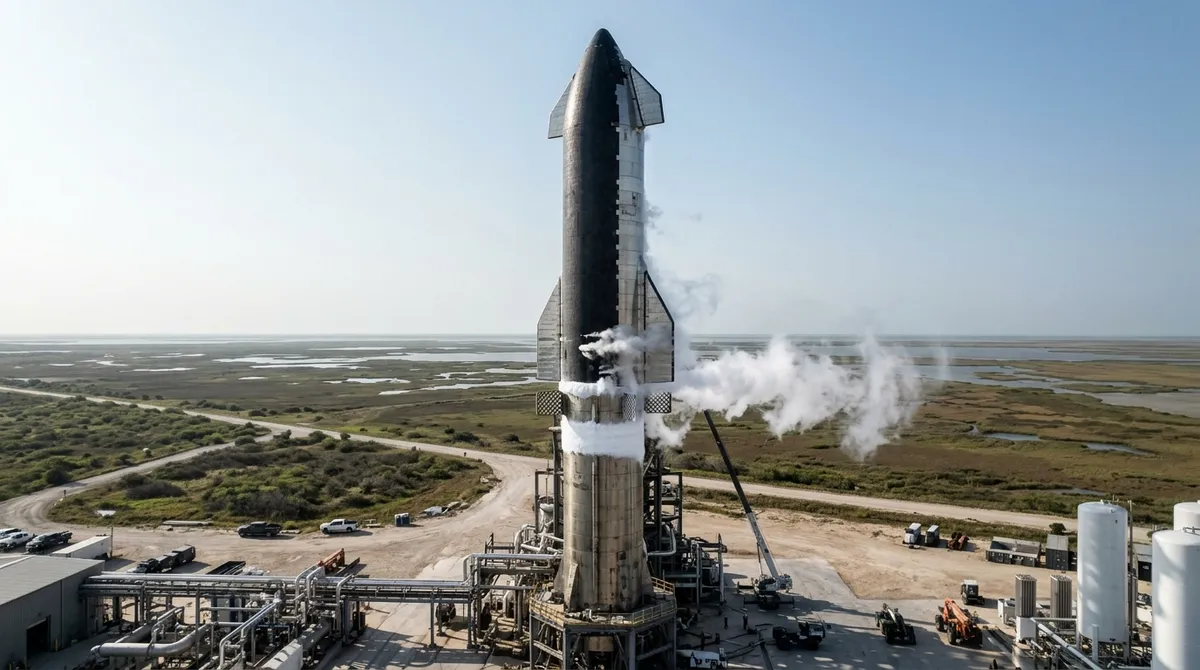
What happened: The Booster 24 and Ship 44 pairing slated for Starship Flight 17 was staged together at the Massey test site at Starbase on November 20 and began cryogenic testing, per NASASpaceflight's live coverage, with frost visible on Ship 44's methane tank as propellant levels rose. Ship 44 went on to complete two cryogenic tests over the afternoon and into the night, with Booster 24's turn expected next.
What's genuinely new: Ship 44's two completed pressure tests are the first hardware results for Flight 17 since Flight 15's upper stage was caught at the pad on November 14 — the buildout is rolling straight into the next vehicle set. Observers flagged that the two ships "could be the first vehicles heading to the Cape," which would be Starship's East Coast debut — speculation, not confirmation. Booster 24 is the sixth Block 3 Super Heavy, its landing tank installed in mid-October.
Watch: Test outcomes at Massey's, whether Booster 24 and Ship 44 ship to Kennedy Space Center, and the Flight 17 manifest slot.
More context: If Flight 16 flies from Starbase instead, Booster 24 and Ship 44 will likely take the honor of the first Starship launch from Kennedy Space Center's LC-39A, NASASpaceflight reports, with an East Coast flight otherwise slipping to at least February. Ship 44 reached the Massey's test site a full week sooner after stacking than Ship 43 did, NASASpaceflight reports, a measure of the shortening build times behind SpaceX's climbing flight cadence. Ship 42, the first Starship upper stage ever caught by its launch tower's chopsticks, will be retired rather than reflown and kept for public display, Elon Musk said, Space reports.
Rocket Lab shares extend the slide after a strong quarter
Sources Blockchain.News Timothy Sykes News The Motley Fool
What happened: Rocket Lab's shares fell about 11% on November 20, continuing a slide that began after the November 9 third-quarter report, and neither the company nor any filing explained the session's drop, per Timothy Sykes News. Reports differ on the exact close — Motley Fool printed $45.42, down 10.92%, while a Blockchain.News tally put it at $48.82 on a $56.94–$48.80 range — but all agree shares were down more than 10% and had traded around $60 five sessions earlier.
What's genuinely new: Derivatives positioning leans long — global Binance accounts 67.7% long — so traders are betting on a bounce the equity tape hasn't delivered. The quarter itself was strong: record $268 million revenue, record $3.57 billion backlog and positive operating cash flow. The pullback is the market digesting that strength rather than reacting to new bad news.
Watch: The remaining gates to the mid-2027 Iridium close (FCC review, the Ligado objection, the GAO protest), and Neutron's first flight, now set for 2027.
BepiColombo is in orbit around Mercury
Sources ESA Operations on X ESA Operations on X, link 2 BepiColombo on X Jay Keegan on X Jay Keegan on X, link 2 Ryan Caton on X AP the Guardian ESA published Nov 21, 5:25 PM ET
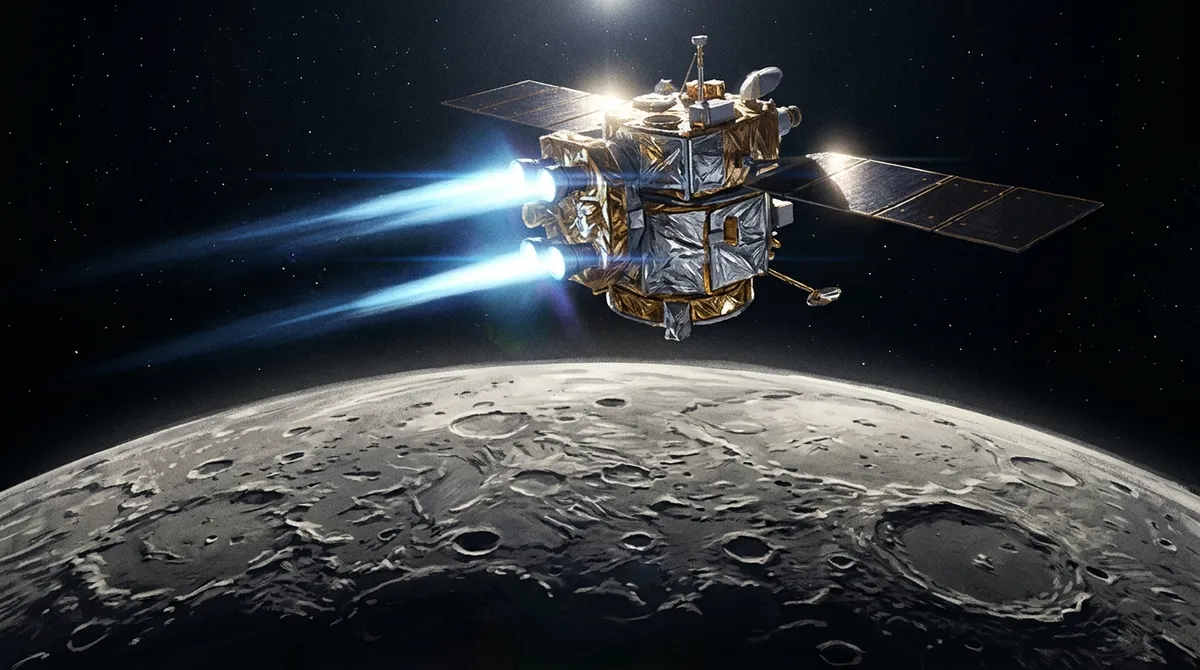
What happened: ESA's BepiColombo fired its Mercury orbit insertion burn on November 21: the Mercury Planetary Orbiter's four thrusters ran a 37-minute burn through the spacecraft's closest approach to Mercury at an altitude of 635 km, after which the MPO and JAXA's MMO orbiter would be permanently in Mercury's grasp. Ground controllers expected to reacquire the spacecraft through ESA's deep-space station at New Norcia, Australia, a couple of hours after the burn ended.
What's genuinely new: The expected reacquisition was missed by two hours with no word from ESA — then the spacecraft came back into contact and ESA's flight dynamics confirmed it is now in orbit around Mercury, the first mission from ESA and JAXA at the innermost planet. ESOC teams are assessing telemetry, with the next mission update planned early in the week of November 23.
Watch: The early-week update from ESA and what the telemetry assessment says about the spacecraft's health and its orbit.
More context: BepiColombo's pair of spacecraft have slipped into orbit around Mercury after an eight-year cruise through the inner solar system, with a series of thruster firings slowing them enough to be captured, AP reports. The €1.6bn European-Japanese mission is only the second in history to circle Mercury, and researchers expect it to explain how the planet formed so close to the Sun, why it has a magnetic field and what makes up the ice in its permanently shadowed craters, the Guardian reported ahead of arrival. ESA's Mercury Planetary Orbiter and JAXA's Mio, now travelling together around the planet, separate on 9–10 December, with the mission's science phase set to begin in April 2027, ESA says.
Brief
- Falcon 9 booster B1100-11 launched the Space Force's classified USSF-317 mission from pad SLC-4E at Vandenberg at 11:20 p.m. EST on November 20, its webcast ending after the booster's drone-ship landing left the payload and destination undisclosed — Falcon 9's 121st launch of 2026 and SpaceX's third Space Force mission of the month (NASASpaceflight on X · Daily Galaxy).
- Wider coverage consolidates the Google–Blue Origin launch agreement for Project Suncatcher: a dedicated New Glenn flight targeting sun-synchronous orbit in the first quarter of 2029, following October's successful Transporter-18 prototype rideshare, with a two-satellite inter-satellite optical-link test planned for 2027 — the TPU chip counts, satellite builder and contract value remain undisclosed (Silicon UK · Xenospectrum).
- SpaceX's Falcon 9 is scheduled to launch the National Reconnaissance Office's NROL-136 mission from Vandenberg Space Force Base on November 22, a 30-minute window opening 4:16 a.m. PT — the 15th launch of the NRO's "proliferated architecture" to low Earth orbit and the first since mid-June — with the booster, on its 14th flight, returning for a rare launch-site landing at Landing Zone 4, SpaceX's first there since October 10; residents near Vandenberg have been warned of louder-than-usual sonic booms from the landing (USA Today · USA Today · Ventura County Star).
- SpaceX's Cargo Dragon CRS-35 splashed down off the southern California coast near Los Angeles at about 2:05 p.m. PT on November 21, completing SpaceX's 35th Commercial Resupply Services mission to the station, with cargo including lab-grown tumor samples, frozen tumor organoids and a 3D-printed blood-vessel model for cardiovascular and cancer research (New York Post · SpaceX on X · NASASpaceflight on X).
- A financial deep-read of AST SpaceMobile's Q3 10-Q prices the launch-queue delay: quarterly revenue of $42.3 million, up 188% year over year, but $20.6 million of it gateway equipment and $21.8 million government-services work — no recurring subscriber revenue yet — with full-year guidance of $150–200 million reaffirmed November 9, the filing's $21–23 million per-satellite cost target standing against analyst estimates near $50 million and BlueBird 7's roughly $158 million gross write-off, and $4.16 billion of convertible notes struck at conversion prices of $72.07–$116.30 against a stock at $26.16, down about 63% this year (AInvest) (single source)
- SpaceX's second-quarter 2026 results report more than $6 billion in multiyear US government contracts for Starshield, primarily two Space Force constellation awards, while the Ukraine control dispute continues: on November 13 senators Jeanne Shaheen and Chris Coons asked SpaceX to preserve records and answer by November 30 on reported service restrictions affecting Ukrainian forces including air-defense communications, and at the November 18 DealBook Summit Elon Musk denied Zelenskyy's disruption claims, saying Starshield is a system controlled by the US government (Webtech360) (single source)
- Elon Musk called the Flight 15 catch "the last major piece of the puzzle," agreed with Sequoia's Shaun Maguire that it all but guarantees orbital AI compute launched by Starship, and predicted about $500,000 refueling costs and 200-ton payloads once full reusability arrives, repeating his V4 claims of roughly 70 metres and more than 60% more propellant (Benzinga, via Yahoo).
- FAA administrator Bryan Bedford told a Washington summit on November 20 that the agency has "operationalized" AI: a "space data integrator" in the FAA's SMART platform let regulators watch SpaceX's November 14 Starship upper-stage catch and its reentry trajectory in real time, and the agency is also experimenting with AI for certifying novel aviation technology and for improved weather prediction (FLYING).
- Elon Musk says the first Starship upper stage SpaceX ever caught with the launch tower will not fly again and will go on display (Space.com).
- SpaceX's cargo vessel "You'll Thank Me Later" took on a Ship Transport Stand and other stands at Kennedy Space Center, probably on its way back to Starbase — a logistics movement read as early preparation for ships travelling between the two sites (Elisar Priel on X).
- SpaceX board member Steve Jurvetson, on Peter Diamandis's podcast, says the defining competition of this era is compute rather than AI models and frames SpaceX's compute bet as delivering at roughly 60% of industry cost; most of the wide-ranging conversation is investment commentary on the Anthropic and SpaceX listings (BigGo News).
- A syndicated video report says Rocket Lab secured a US Space Force contract with a potential value of up to $397 million and is expanding into spacecraft and defense (MSN).
- An explainer on Amazon Leo puts initial consumer service at 2027, with no consumer pricing announced for hardware or service — an enterprise preview began with selected business customers in November 2025, planned Leo-powered Delta aircraft Wi-Fi starts in 2028, and a separate FCC filing covers a direct-to-device constellation of up to 5,105 satellites, with deployment not expected to begin until 2028 (Stuff.tv).