AI digest — Nov 27, 2026
Top line: OpenAI has countersued Apple in their four-month-old trade-secret fight, alleging Apple stole its secrets. AWS's Trainium3 chip drew both a hands-on video-generation demo and a SemiAnalysis deep dive claiming better price-performance than NVIDIA's GB300. Anthropic's stock remains under its US$83 IPO price as commentators sharpen the argument that the AI trade is unwinding.
- Anthropic slips below its IPO price as the AI sell-off argument sharpens
- AWS Trainium3 runs real video generation, and an analyst calls it a GB300 challenger
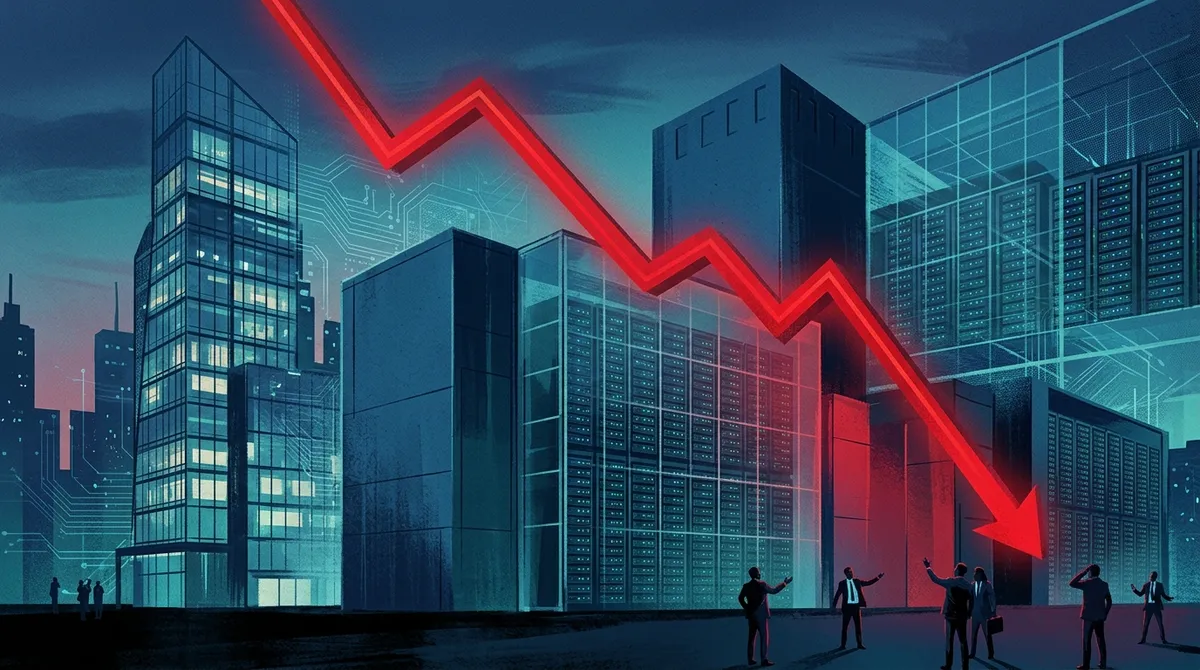
Anthropic slips below its IPO price as the AI sell-off argument sharpens
Sources Roger Montgomery Reuters Breakingviews heise online
What happened: Anthropic's stock now trades at about US$82, under the US$83 at which its Nasdaq IPO priced, despite closing its first session at US$97 — with both of the day's market reads, from fund manager Roger Montgomery and Reuters Breakingviews, pointing to the same pressures: heavy cash burn and close to US$1 trillion in long-term data-centre commitments. The Nasdaq is in correction territory after a single-day drop of more than 5%, and Nvidia remains roughly 40% below its highs, about US$3 trillion of market value gone.
What's genuinely new: Roger Montgomery's essay "Has the great AI unwind begun?" assembles the financial plumbing behind the slide — 10-year Treasury yields up more than 30% from February lows to touch 5.27%; roughly US$13 trillion of gross hedge-fund assets against US$4 trillion net, with top funds borrowing US$11 per dollar managed and the US$45 billion AI-focused Situational Awareness fund having liquidated positions; Oracle issuing an unsolicited X statement that it had secured every dollar needed for its OpenAI contracts while its stock sat at a 52-week low, with the essay putting Oracle's debt and obligations at roughly US$465 billion against US$16 billion of annual negative cash flow. It also flags US plans to tighten semiconductor export controls. Reuters Breakingviews reads Anthropic's choice to fund itself with equity — at 10–11% borrowing costs — as the market's own verdict that Claude's math breakthroughs, including help proving the Riemann hypothesis two days after its Nasdaq debut, don't yet beat the stock market.
Watch: whether the selling resumes after the US Thanksgiving break and Anthropic's next sessions; independent confirmation of the export-control change; Oracle's follow-up on OpenAI funding; and Jensen Huang's December 1 congressional testimony as a sentiment test.
More context: Within days of Anthropic's roughly 17.4-million-line Lean proof of the Riemann hypothesis being published, Claude helped compress it by more than 99% to about 113,000 lines, heise online reports, and the shorter versions were independently verified by computer.
AWS Trainium3 runs real video generation, and an analyst calls it a GB300 challenger
Sources Hugging Face SemiAnalysis TokenPost published Nov 26, 7:00 PM ET
What happened: Hugging Face engineers, with a month's access to an AWS Trainium3 machine (64 NeuronCores), got Lightricks' LTX-2.5 video-and-sound generator running entirely on the chip: a 10-second 2048×1024 clip with sound produces in 22–23 seconds on half a machine, matching and slightly beating the 23.7 seconds LTX claims for its own API. SemiAnalysis separately published a technical deep dive arguing Trainium3 delivers better performance per dollar than NVIDIA's GB300.
What's genuinely new: The first storyboarded multi-shot films generated on Trainium3 through open diffusers pipelines — a 14× speed-up over a first working attempt via tensor-parallel and sequence-parallel fixes plus host-side optimization — and SemiAnalysis's independent price-performance and microarchitecture read, citing high MFU/MBU and UBenchX benchmarks.
Watch: official AWS Trainium3 benchmarks and availability; independent checks of the SemiAnalysis cost claims; more Hugging Face models ported to the silicon.
More context: TokenPost reports that Trainium3 led Nvidia's GB300 NVL72 by 4% in an agentic inference benchmark and delivered up to 2.28 times better performance per dollar, at $1.05 per Trainium3 chip-hour versus $2.31 for GB300 NVL72, though Nvidia's system returned its first token sooner (1.8 seconds against 4.5 seconds at the 90th percentile).
Brief
- OpenAI filed a countersuit against Apple on November 27 alleging Apple stole its trade secrets, four months after Apple accused the ChatGPT maker of stealing trade secrets in the same legal battle (The Information).
- Apple pulled MiniMax's popular Talkie AI companion app from its App Store worldwide after a media report alleged the product used sexualized content to hook young users (The Information).
- Singapore is negotiating with the United States to retain access to advanced semiconductors after Washington tightened export restrictions, Deputy Prime Minister Gan Kim Yong said; the city-state is also reviewing its processes to guard against chip diversion (The Information).
- Sakana AI announced Namazu Small, a 30-billion-parameter reasoning model (3 billion active) built on NVIDIA's open Nemotron 3 Nano, tuned for web research and long-document Q&A; it self-reports a 60.1 average across 25 benchmarks versus 56.2 for NVIDIA's 120B Nemotron 3 Super, and 73.5 on BrowseComp against Super's 36.1, while acknowledging weakness on closed-book knowledge (6.8 on SimpleQA Verified). Weights are not yet released, with on-prem deployment details promised for December 2026. Marktechpost has the details.
- Taiwan's digital affairs minister Lin Yi-jing, speaking at an AI conference in Singapore, laid out the island's sovereign-AI playbook: the government will be the first customer for small, specialised models fine-tuned from open US models to reflect traditional Chinese, Taiwanese culture and local regulations — Taiwan's AI Evaluation Center benchmarked 188 language models in its latest round, and over a dozen financial institutions began building a finance-sector model trained on Taiwanese rules in April. Lin said money and technology are not the obstacle to a native model, but the sustainability loop is: only the US and China have the ecosystems to fund the next generation. He also put Taiwan's share of global GPU server production above 95% and warned that a sudden drop in AI demand could inflict Dutch disease on an economy expected to grow 11.05% in 2026, its fastest since 1987, on chip demand. (single source) Computer Weekly