Space digest — Nov 27, 2026
Top line: SpaceX's stock barely moved after its first full session under the FCC's million-satellite Starmind license: the order licenses radio links only, with four of six shells grounded until a debris plan. Rocket Lab's 101st Electron flight carried Synspective's 14th radar satellite — a record 22nd launch of the year.
- The million-satellite license barely moved SpaceX — and the fine print shows why
- Stoke Space's first Nova booster is on the pad ahead of a 2027 debut
- Rocket Lab's 101st Electron flight lifts Synspective's 14th radar satellite
The million-satellite license barely moved SpaceX — and the fine print shows why

Sources Latin Times AInvest The Conversation American Astronomical Society Spaceflight Now CNBC Insurance Business ThePricer TIKR Daily Excelsior
What happened: SpaceX finished its first full session after the FCC's November 25 Starmind authorization up 1.3% at $127.44, after dipping more than 10% intraday — a muted reaction for a company worth about $1.73 trillion, and a measured one: the FCC licensed radio links, not an economics case, and explicitly declined to judge whether the venture makes sense.
What's genuinely new: The order's fine print clarifies what the million-satellite headline obscures: only the two shells below 600 km can fly until a final debris plan covers the four higher shells; hitting 100,000 satellites by November 25, 2035 implies roughly 79 satellites per launch at SpaceX's cadence; and Amazon's rebuttal — a million satellites could take more than 220 years — survives an independent check. The capital side strains too — $19.6 billion of third-quarter spending, negative trailing free cash flow of $40.2 billion, and Anthropic's contract for up to $120.5 billion through 2029 implying nearly half or more of SpaceX's installed compute already spoken for.
Watch: whether the rejected opponents (Amazon, Viasat, the American Astronomical Society) escalate beyond petitions to formal challenge, SpaceX's 30-day window to accept the grant, the final debris plan for the higher shells, and the first-satellite deadline of November 25, 2033.
More context: The Conversation carries an astronomer's assessment of what the authorization would mean for the sky: at five-year satellite lifetimes, a million-strong Starmind means launching and deorbiting roughly 500 satellites a day; reentering satellites already deposit more aluminium, titanium, copper and lead into the upper atmosphere than meteors do, and alumina from that stream could destroy upper-atmosphere ozone; each Starmind satellite would be 75 metres wide and brighter than any star in the early-evening sky, with hundreds above the horizon wherever you are. American Astronomical Society said the one-million-satellite constellation involves larger and more numerous objects at higher altitudes that would be visible as extremely bright objects for longer periods of the night sky, and warned that waste heat from orbital data centres would raise the sky's infrared background. Spaceflight Now reports that Elon Musk told a Baron Capital event he expects the first Starmind satellites to launch in the third quarter of 2027, well ahead of the order's November 25, 2033 deadline for a first operational satellite, with SpaceX building them in Bastrop, Texas in partnership with Nvidia. CNBC reports that Jeff Bezos' Blue Origin petitioned the FCC in March to launch up to 51,600 satellites in a low-Earth-orbit constellation called Project Sunrise, and that Earthjustice attorney Jan Hasselman criticised the SpaceX approval for coming in a holiday week without environmental review. Insurance Business adds who would carry the risk: the global launch and in-orbit insurance market has maximum theoretical capacity of about $709 million for launch and $669 million for in-orbit cover per Aon's Q1 2026 report — around $300 million actively competed for — Wood Mackenzie estimates a one-gigawatt orbital data centre would cost about $170 billion, more than three times a ground-based equivalent with launch costs needing to fall roughly 70% to compete, and the rival FCC queue holds Starcloud's application for up to 88,000 satellites and Cowboy Space's for 20,000. ThePricer stacks an illustrative unit-cost model on top: roughly $7–8 million of Nvidia Vera Rubin NVL72-class computing hardware plus $2–4 million of the rest of the spacecraft, with launch at $200–3,600 per kilogram, puts a deployed Starmind satellite at $9.5–20.6 million (central scenario $13.2 million) — about $1.32 trillion for the first 100,000 satellites and a theoretical $9.5–20.6 trillion for the full million at unchanged unit costs — while the first SINGULUS solar-cell production line SpaceX has committed to already costs more than €60 million (about US$70 million). TIKR runs the same math from the launch side: at Starship-era prices of $250 per kilogram an AI1 satellite carrying 175 kilowatts of compute lands in orbit at about $21 million per megawatt, versus $34 million at Falcon prices — but the chips cost the same in orbit as on the ground, at about $29 million per megawatt of GPU and server hardware on IREN's Microsoft-contract rate, and Musk answered the analysis that SpaceX is "beating the rest of the world by an order of magnitude," with Baron Capital's Ron Baron estimating SpaceX builds a gigawatt for $35 billion against an average $60 billion for data centers built by others. Daily Excelsior adds what rivals are doing meanwhile: the European Union's Horizon Europe ASCEND feasibility study found sun-powered orbital data centres technically and economically viable, proposing 10 megawatts in orbit by 2036 and one gigawatt by 2050, with launch cost the main obstacle.
Stoke Space's first Nova booster is on the pad ahead of a 2027 debut
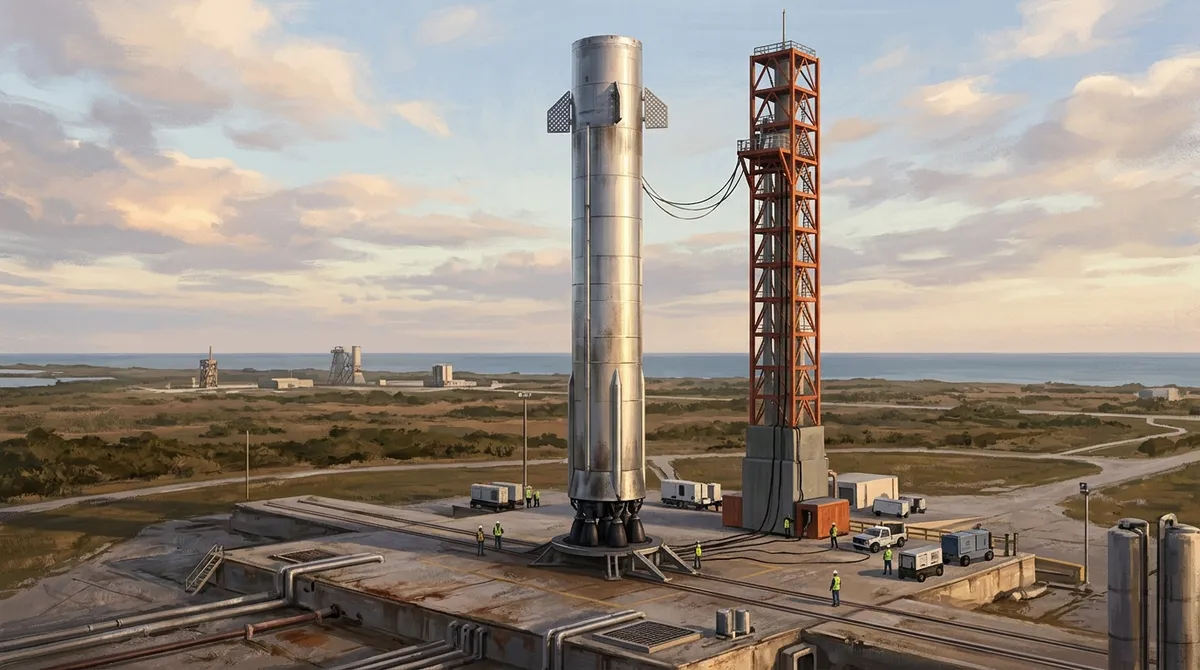
Sources NASASpaceflight published Nov 27, 9:52 AM ET
What happened: Stoke Space's Nova Pathfinder first stage arrived at Space Launch Complex 14 at Cape Canaveral Space Force Station on November 22 after a 17-day road trip from Washington — the first rocket to occupy the historic pad since the 1960s — and has entered the Horizontal Integration Facility to begin a pad-in-the-loop wet dress rehearsal campaign that activates the rebuilt complex.
What's genuinely new: The path to an early-2027 debut now has dated test steps: after the wet dress rehearsals the stage rolls back to have the remaining three of its seven Zenith engines installed — four have passed acceptance testing — then returns to the pad for a static fire. The hydrogen-fueled second stage, already through cryogenic proof testing and a full launch-sequence rehearsal at Moses Lake, gets a static fire in December once mated with its Andromeda engine, whose actively cooled metallic heat shield has logged about 10,000 seconds of hot fire in qualification. Block 2, a fully reusable 15-tonne-to-low-Earth-orbit follow-on, is targeted for 2029 with Planet Labs among its booked launch customers.
Watch: the wet dress rehearsals and Stage 1 static fire at SLC-14, the December Stage 2 static fire at Moses Lake, and a firm launch date for the debut flight.
Rocket Lab's 101st Electron flight lifts Synspective's 14th radar satellite
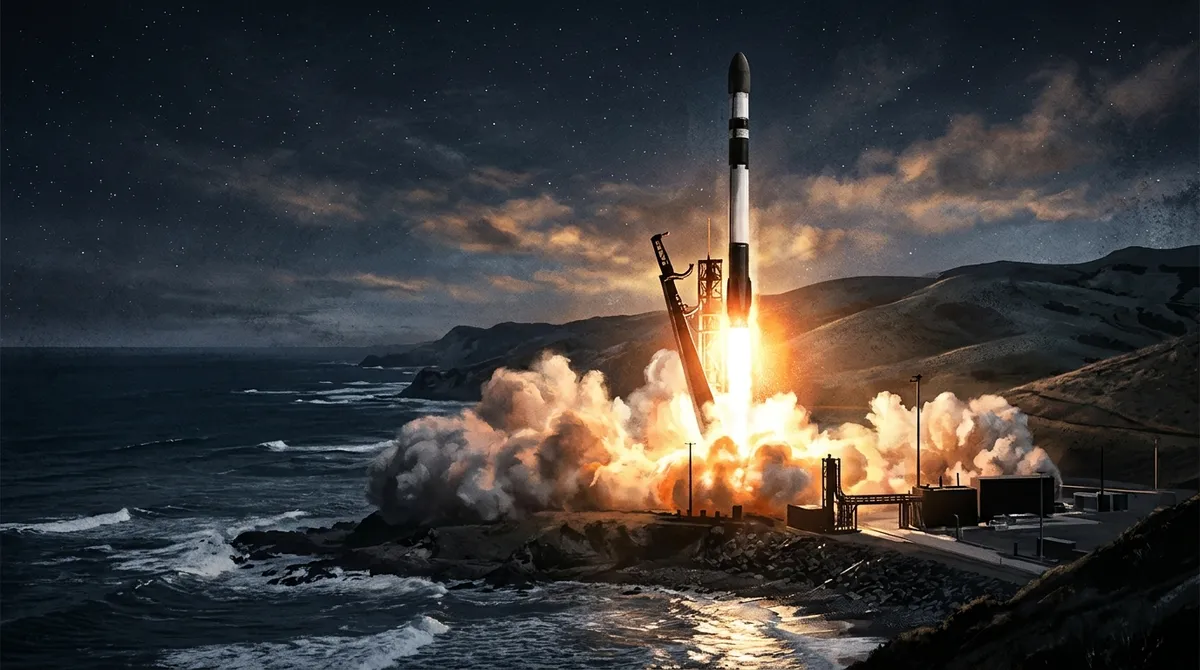
Sources Quiver Quantitative Markets Insider Rocket Lab on X
What happened: Rocket Lab flew a dedicated Electron mission, "Night Owls Never Sleep," from Launch Complex 1 in New Zealand, delivering the 14th StriX synthetic-aperture-radar satellite for Synspective into a 569 km orbit. The company counts the flight as its 101st Electron mission — 22 launches in 2026, the most Electron has flown in any calendar year — with deployment confirmed.
What's genuinely new: Synspective is confirmed as Rocket Lab's largest launch customer, all 14 StriX satellites launched at 100% success under a 47-mission contract with 33 flights still scheduled through 2031. The new annual high lands against the company's own stated 2026 target of at least 27 orbital missions, now clearly out of reach with the year nearly done — and Electron retains its standing as the most frequently launched small-lift orbital rocket.
Watch: any remaining 2026 flights against the 27-mission target, the Synspective backlog converting from contract to launch through 2031, and the eight booked iQPS flights through 2030.
Brief
- Berenberg downgraded AST SpaceMobile from Buy to Hold and cut its price target from $92 to $30, citing launch delays: the firm now expects about 100 satellites deployed by 2028 and held at that level until positive free cash flow in 2030, against the faster build toward 248 it first assumed; three BlueBirds still await a SpaceX launch date and the next three are booked on Blue Origin's New Glenn, whose return to flight Berenberg calls the swing factor for revisiting the rating after April's New Glenn failure lost BlueBird 7; the brokerage cut its 2027 revenue estimate to $561 million from $748 million and widened the expected 2027 loss to $1.65 a share. (Stocktwits · TIKR)
- A CADENA space-operations presentation lists Blue Origin's New Glenn return to flight no earlier than January 22, 2027 — about two weeks behind the January 8 date chief executive Dave Limp gave earlier in the month — with a second New Glenn mission listed for February 20. (Starlust)
- Bulgaria's EnduroSat has booked two dedicated New Glenn launches with Blue Origin, the first planned for 2029 from Cape Canaveral, both carrying satellites exclusively for EnduroSat's clients, with the company supplying the spacecraft and overseeing integration through orbital operations — a full-mission model that recently won it orders from TrustPoint and Vantor. (Novinite)
- SpaceNews reports engineers have developed a workaround for the software issue that cut short BepiColombo's Mercury orbit-insertion burn on November 21; ESA had described the spacecraft as safe while teams worked the problem, with the orbiter separation still ahead on December 9–10. (SpaceNews)
- China's Long March 6A launched the Yaogan-50 04 satellite from Taiyuan, lifting off at 13:05 UTC on November 27. (CNSpaceflight on X)
- MDA Space has completed its acquisition of Blue Canyon Technologies. (MDA Space on X)
- Governments invested about $71.8 billion in space defense and security in 2025 per Novaspace's Space Defense & Security report, with the United States, China, Russia, Japan and France accounting for roughly 90% of the spending, and about $33.6 billion contracted to industry — led by secure satellite communications, counterspace, and intelligence, surveillance and reconnaissance procurement. (SpaceNews)
- SpaceX is planning a Falcon 9 liftoff from Vandenberg carrying classified satellites in the days after Thanksgiving. (Ventura County Star)
- Mexican President Claudia Sheinbaum says SpaceX needs authorization from Mexico's aviation agency to use Mexican airspace during launches and that the launch site could be moved away "if necessary," with Mexico seeking a meeting through the US embassy between US and Mexican airspace authorities; SpaceX says independent tests confirm Starship and Super Heavy materials pose no chemical, biological or toxicological risk. (Benzinga)
- The OpenRSI Foundation announced it has found 127 candidate trans-Neptunian objects — "and counting" — and is open-sourcing the full candidate list. (OpenRSI Foundation on X)