Energy digest — Nov 13, 2026
Top line: SoftBank's roughly $7 billion quarterly loss includes $3.7 billion in nonrefundable gas-turbine down payments for SB Energy's planned 10-gigawatt AI data center at the Portsmouth, Ohio cleanup site. At COP31, nuclear industry leaders press for nuclear to be named in the summit's 35-by-35 electrification pledge. Centrus–Oklo fuel contracts and the IAEA's World Fusion Outlook continue.
- Centrus and Oklo lock in HALEU fuel contracts for Meta's Ohio reactor campus
- SoftBank's $7 billion loss carries $3.7 billion in gas-turbine down payments for the Ohio AI campus
- IAEA World Fusion Outlook tallies the global fusion buildout
- Nuclear industry presses COP31 to name nuclear in the 35-by-35 electrification pledge
- Akkuyu unit 1 containment passes strength and leak tests
Centrus and Oklo lock in HALEU fuel contracts for Meta's Ohio reactor campus
Sources World Nuclear News published Nov 13, 5:41 AM ET
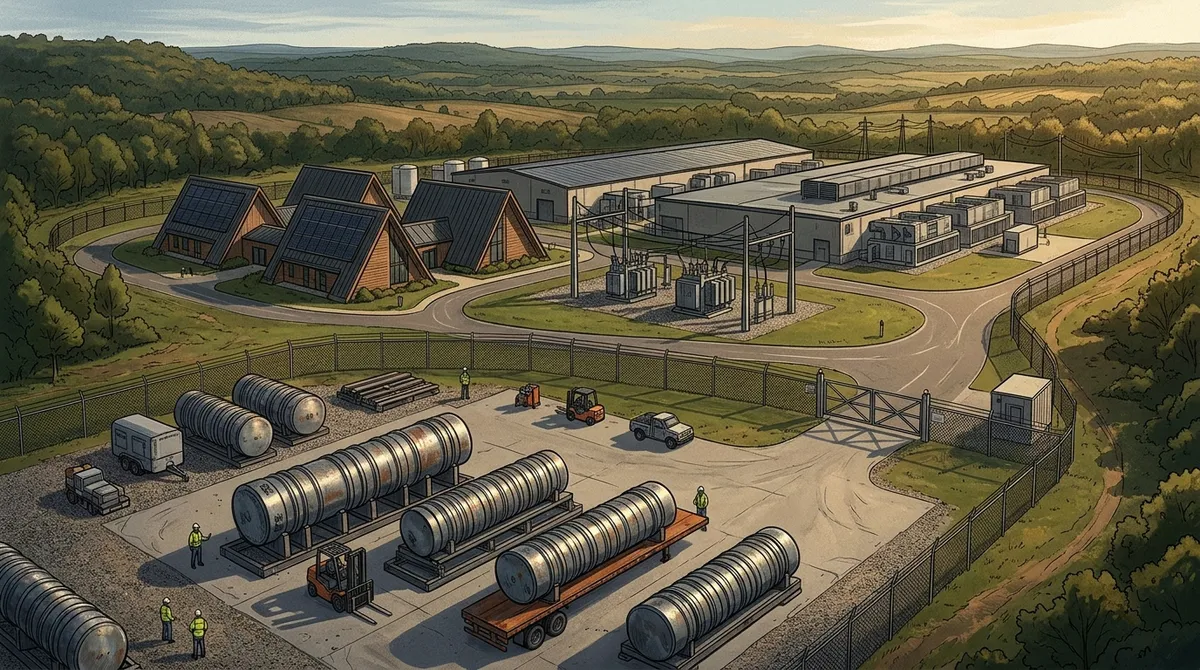
What happened: Centrus Energy and Oklo have finalised definitive purchase agreements for high-assay low-enriched uranium to fuel up to five Aurora powerhouses at Oklo's planned 1.2-GW power campus in Pike County, Ohio, built to supply Meta's data centres. Deliveries from Centrus's American Centrifuge Plant are scheduled to begin in 2029, with Oklo making prepayments to help build out new US enrichment capacity.
What's genuinely new: World Nuclear News's account names the client — Meta — and adds a company-sourced total: Centrus says it has now secured $5.4 billion in customer contracts and commitments to purchase low-enriched and high-assay low-enriched uranium from its expanded capacity. The agreements follow a June letter of intent between the two companies, and the fuel purchase rests on Meta's prepayment for future Oklo power — one of three agreements Meta signed in January covering up to 6.6 GW of nuclear capacity.
Watch: first Centrus deliveries in 2029 against the campus's first-phase target, the pace of Centrus's Piketon centrifuge build-out, and the campus schedule inside Meta's 6.6-GW agreements.
SoftBank's $7 billion loss carries $3.7 billion in gas-turbine down payments for the Ohio AI campus
Sources ANS Nuclear Newswire published Nov 13, 11:30 AM ET
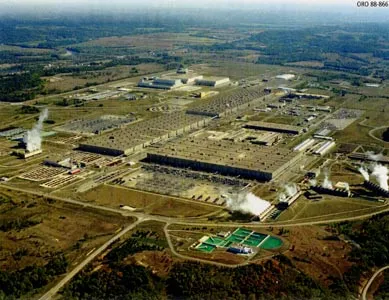
What happened: Parent company SoftBank Group posted a net quarterly loss of roughly $7 billion for July–September, and much of it traces to its Ohio megaproject: SB Energy is developing the PORTS Technology Campus at the former Portsmouth Gaseous Diffusion Plant in Pike County, Ohio — what the Department of Energy calls the world's largest AI data center, a planned 10-GW campus announced in March.
What's genuinely new: The Financial Times reports, citing sources, that $3.7 billion of the loss was nonrefundable down payments on gas turbine equipment for the campus. Alongside that, SB Energy is funding more than $30 billion of gas power generation and more than $5 billion of new electrical transmission at the site, under DOE's American Energy Hub initiative to redevelop cleanup sites including Portsmouth, Hanford, Oak Ridge and Paducah for manufacturing, energy production and advanced computing; DOE estimates the campus alone would create about 10,000 construction jobs and 2,000 permanent ones. Reuters reports the development timeline unchanged: the campus is a FAST-41 project eligible for expedited permitting and licensing reviews, with its environmental review and licensing expected to be completed by January 29, 2027. The loss disclosure also came days after the November 3 midterms, at which voters opposed data-center projects in 44 of 45 state and local ballot measures — in Ohio alone, eight local bans of large data centers passed and no supportive measures did.
Watch: the January 29, 2027 environmental-review and licensing completion, further financing and down-payment detail, and the campus's construction schedule.
IAEA World Fusion Outlook tallies the global fusion buildout
Sources Engineering News Devdiscourse ANS Nuclear Newswire published Nov 13, 9:38 AM ET
What happened: The International Atomic Energy Agency launched the fourth edition of its World Fusion Outlook at the Third High-Level Meeting of its World Fusion Energy Group in Vienna. The report counts 174 fusion facilities worldwide — about 56% of them operating, with 111 public (85 operating) and 63 private (13 operating) — and 26 sites for planned fusion power plants, with announced electricity target dates ranging from the early 2030s to the 2050s. Private fusion companies have raised $21.9 billion in committed capital, more than 90% of it in the past five years.
What's genuinely new: The IAEA lays out six trends in the sector: companies raised a record $4.5 billion in new private funding in the 12 months to July, and 2026 could end with a record $7.6 billion — though private money is still only 36% of total fusion investment, with public funding at 64%. Ecosystem-builder FusionX estimates commercialising fusion will need another $80 billion of private investment over the next 20 years and expects consolidation among the 92 private companies. Private companies spent more than $350 million with suppliers last year, but industrial activity is exposing gaps in manufacturing capacity. Google DeepMind's contribution says AI is already accelerating fusion experiments, with the IAEA launching a Fusion Data Lake to free up data; and EUROfusion scenarios see fusion supplying anywhere from a few percent to 15–20% of global electricity by the end of the century depending on deployment pace. The American Nuclear Society's read of the 128-page report adds the plant-level breakdown: of the 26 planned power plants, seven private and one public target electricity by the early 2030s, eight private and one public by the late 2030s, one private and one public in the 2040s, one public in the 2050s, and six have no dates yet; and of the 174 facilities, 111 are public (85 operating) against 63 private (13 operating), with private facility numbers tripling since 2021.
Watch: the funding pace against the $7.6 billion projection, siting and target dates for the 26 planned power plants, and the next edition of the report.
Nuclear industry presses COP31 to name nuclear in the 35-by-35 electrification pledge
Sources World Nuclear News published Nov 13, 7:51 AM ET
What happened: Nuclear industry leaders at COP31 in Turkey are asking the climate summit to acknowledge nuclear power in its draft "35 by 35" Global Electrification Pledge — the goal of raising electricity's share of total final energy consumption to 35% globally by 2035. The September draft text lists renewables, efficiency and electrification but does not name nuclear. A letter to COP31 president and Turkish environment minister Murat Kurum, coordinated by Nuclear for Climate with more than 150 associations worldwide, urges that nuclear be advanced as a low-carbon, firm, reliable and affordable source and be expressly included in the summit's Climate Implementation Bridge.
What's genuinely new: The World Nuclear Association's World Nuclear Outlook Report, published in full ahead of the summit, counts 423 GWe of global nuclear capacity at the end of 2025 and 88 GWe under construction, notes about half of today's fleet will be 60–80 years old by 2050, and calls life extensions of existing reactors the most cost-effective form of additional low-carbon generation. The declaration to triple nuclear capacity by 2050, launched at COP28, now has 39 signatories — six added since COP30: Belgium, Brazil, China, Italy, South Africa and Togo. Figures cited at the conference put delivering the 35% goal at more than 15,000 additional terawatt-hours of global generation, needing roughly 3,000–5,000 GWe of new capacity.
Watch: whether the final COP31 text names nuclear, and further signatories to the tripling declaration.
Akkuyu unit 1 containment passes strength and leak tests
Sources World Nuclear News published Nov 13, 5:33 AM ET
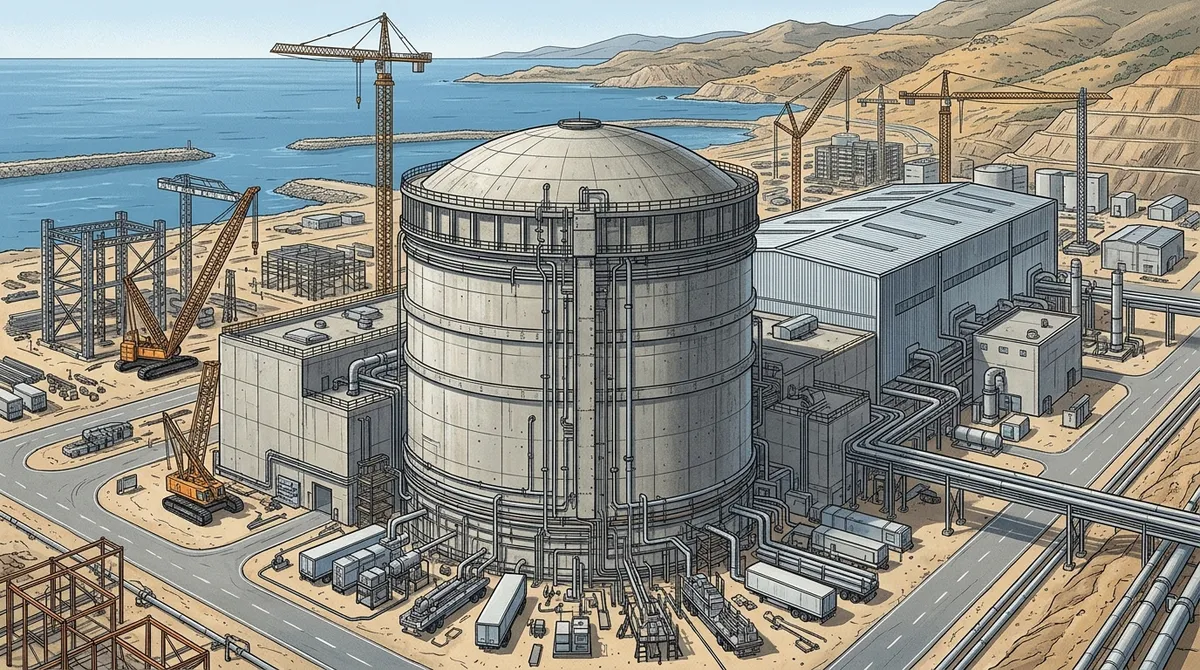
What happened: Turkey's first nuclear power unit — Rosatom's VVER-1200 at Akkuyu, being built under a build-own-operate model — completed eight-day pre-start-up strength and leak tests on its internal containment building. Air pressure was raised to 0.46 MPa, a load equivalent to about 47 tonnes per square metre, then reduced in stages including below atmospheric, with leak-tightness checked at both elevated and reduced pressure.
What's genuinely new: Akkuyu Nuclear JSC says the results clear the unit for the next commissioning stage: cold and hot functional testing of the reactor plant. Unit 1's target remains first grid supply by the end of 2026, and the 4,800-MWe four-unit plant is meant to meet about 10% of Turkey's electricity needs; Turkey also aims to add 5 GWe of small-modular-reactor capacity by the equivalent of at least 16 units by 2050.
Watch: cold and hot functional testing at unit 1, and first grid supply against the end-2026 target.
Brief
- India has its first firm fusion deadline: Atomic Energy Commission chairman Ajit Kumar Mohanty told the Third High-Level Meeting of the IAEA World Fusion Energy Group in Vienna on November 12 that India aims to build a tokamak-based demonstrative fusion pilot plant generating 100–150 MW of net electricity by 2040–2042, the first time the head of the Atomic Energy Commission has set a time-bound target for net electricity from a domestic fusion reactor; India has delivered more than 75% of its in-kind commitments to ITER, and draft rules under the new SHANTI Act already carry provisions for deuterium-tritium fusion facilities (NDTV)
- Commonwealth Fusion Systems' Massachusetts prototype is about 80% complete and due to start up in 2027, CEO Bob Mumgaard told Semafor, with the July $1 billion raise bringing total funding to $4 billion — which he says is enough to build the prototype and prepare for a utility-scale plant in the early 2030s. A 400-MW plant planned in Virginia has Google and Italian energy company Eni as buyers, and Abu Dhabi's government-owned fusion fund Plynth Energy took a minority stake worth more than $100 million in the company this year (Semafor)
- UKAEA has installed a 12-ton double beam box on its MAST Upgrade fusion machine that will double neutral beam heating from 4.4 to 8.8 MW, lifting plasma temperatures from about 30 million to 60 million degrees Celsius for research the authority says is crucial for STEP, the UK's planned prototype fusion power plant; remaining hardware is due inside the vessel by the end of autumn 2027 and experiments begin in 2028 (The Engineer)
- The US Department of Energy's INFUSE program has selected New Zealand-founded OpenStar Technologies and Columbia University to design the world's first divertor — the exhaust system that clears extreme heat and particles — for a levitated dipole fusion machine: Columbia will pair its TokaMaker and the open-source Hermes-3 edge-modeling code against data from OpenStar's levitated-magnet prototype Junior, and the design is due to debut on OpenStar's next machine, Tahi, which is initially to produce neutrons for medical radioisotopes (Interesting Engineering)
- Peak Nano Films is investing $20 million in a new extrusion line at its Macedonia, Ohio plant to lift its NanoPlex HDC capacitor-film output twentyfold, to 3 million pounds a year by 2028 — film used in pulsed-power fusion systems (Plastics News)