Energy digest — Nov 14, 2026
Top line: Canada's energy minister defends the federal $2-billion stake in the Darlington small modular reactor after Ontario Power Generation confirmed the first unit will blow past its October 2030 target and C$7.7-billion budget. The NRC's review of Orano's Oak Ridge enrichment project slips to mid-2027. And North America's nuclear fleet is putting an industry-built AI assistant, NIVA, to work.
- Ottawa defends its Darlington SMR stake as cost and schedule slip
- NRC review of Orano's Project Ike enrichment plant slips to mid-2027
- North America's nuclear fleet puts NIVA, an industry-built AI assistant, to work
Ottawa defends its Darlington SMR stake as cost and schedule slip
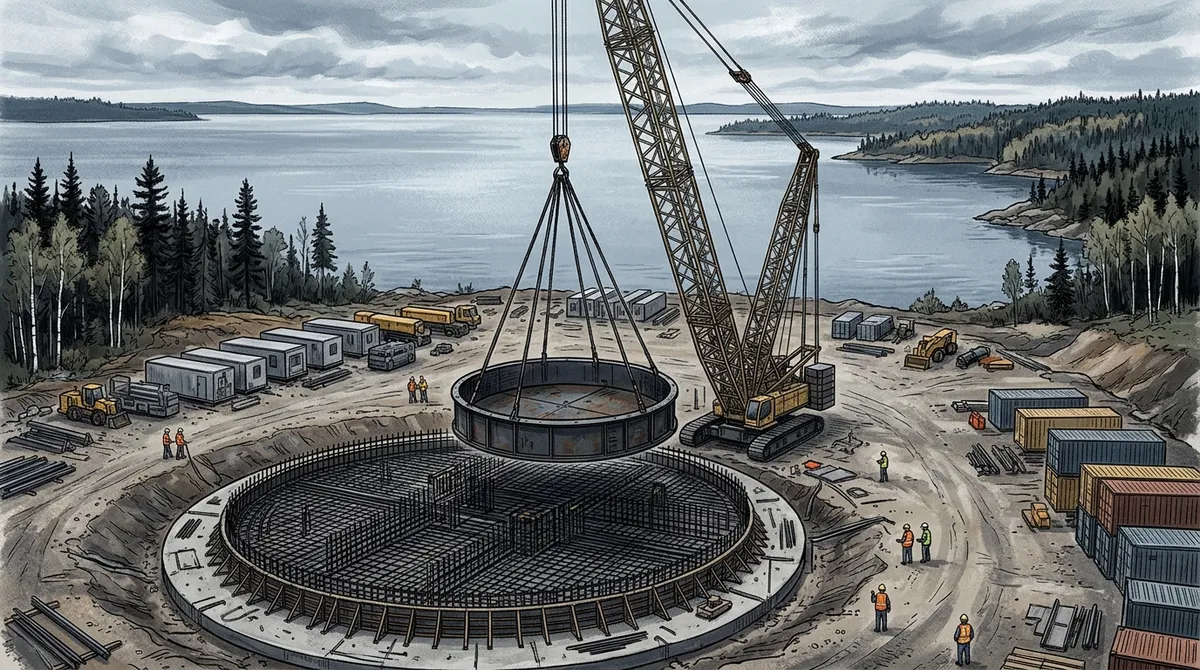
Sources The Globe and Mail Power Engineering OPG
What happened: Canada's energy minister is defending the federal government's $2-billion equity investment in Ontario's Darlington small modular reactor after Ontario Power Generation confirmed the first of four planned BWRX-300 reactors will miss both its October 2030 completion target and its C$7.7-billion (US$5.5 billion) budget. Energy Minister Tim Hodgson called the setbacks "a reality in all first-of-a-kind projects," saying it is important that Canada "not balk" on such investments. GE Vernova Hitachi, whose ongoing engineering on the first-of-a-kind design OPG blamed, says inflation and geopolitical risks contributed too.
What's genuinely new: The federal risk-sharing mechanics are now on the table: the Canada Growth Fund says its capital deploys in two tranches tied to project milestones — one for the first reactor unit, one for the remaining three — and Hodgson says "on and off ramps" protect the fund. Power Engineering adds spending detail: C$2.86 billion (US$2 billion) spent through September 30, about 37 percent of the C$6.1-billion Unit 1 allocation within the C$20.9-billion (US$15 billion) four-unit project, with cooling-water-tunnel excavation to begin in Q4 2026. OPG has also withdrawn most of its requested Darlington approvals from its Ontario Energy Board rate application for 2027–2031, with costs instead tracked through variance accounts subject to review.
Watch: OPG's revised cost and schedule, with its comprehensive assessment expected substantially complete by mid-2027; the Ontario Energy Board's handling of the withdrawn rate-case approvals; and whether the reassessment reshapes cost assumptions for the wider BWRX-300 pipeline.
More context: OPG says its Darlington Unit 1 reactor is no longer expected to hit its October 2030 commercial operation date or its C$7.7-billion cost estimate, which includes systems and services shared with the three units to follow, citing GE Vernova Hitachi's unfinished engineering on the first-of-a-kind design.
NRC review of Orano's Project Ike enrichment plant slips to mid-2027
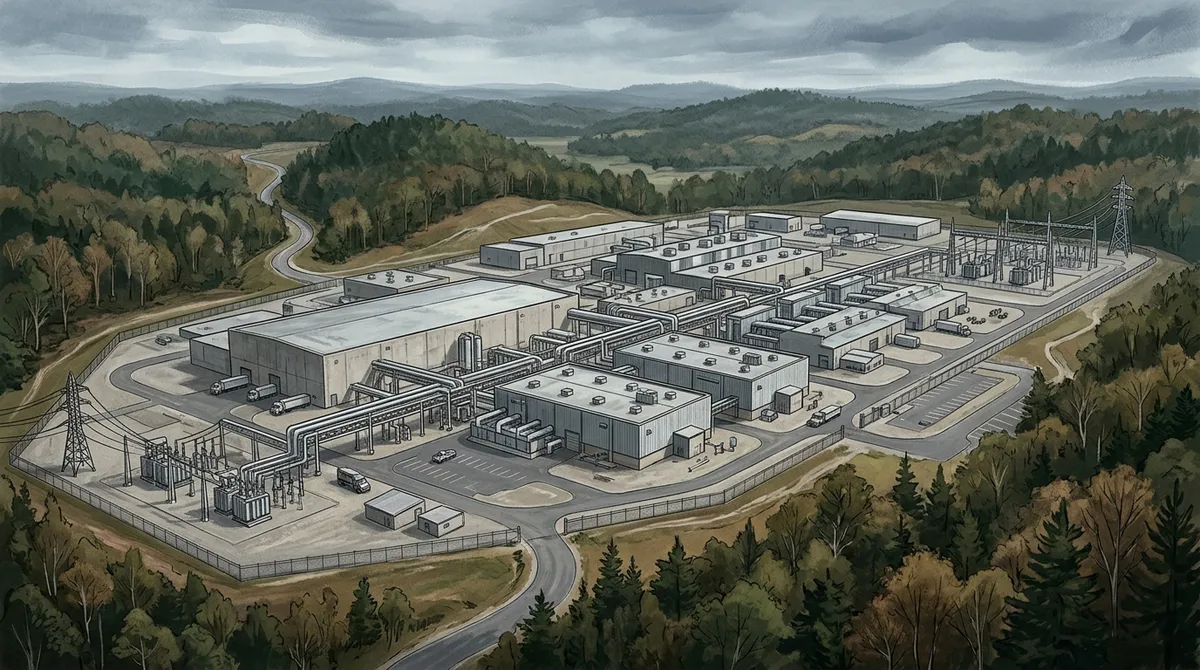
Sources ANS Nuclear Newswire published Nov 13, 2:41 PM ET
What happened: The Nuclear Regulatory Commission has given Orano Enrichment until December 14, 2026 to answer remaining information requests on its license application for Project Ike, the company's planned uranium enrichment facility in Oak Ridge, Tennessee — adding roughly two months to the accelerated technical review, which the NRC now estimates will be complete by June 2027. Orano asked for the delay on October 7 after answering about half the requests.
What's genuinely new: The NRC's October 27 extension letter lays out what the review found missing: Orano's structural design criteria are flagged as a "high-impact technical issue," with more information needed on hydrology, fire and chemical safety and integrated safety analysis. A promised crosswalk against the terminated Eagle Rock enrichment licence never arrived — and the NRC says the two facilities share fewer similarities than anticipated, limiting how much precedent it can reuse. Despite the added time, Orano says enrichment operations should still begin in 2031, and the review stays inside the licensing-pace push ordered by Executive Order 14300 in May 2025; the NRC also accepted General Matter's competing Paducah enrichment application on October 29, targeting no review completion earlier than April 2028.
Watch: Whether all information requests land by December 14, 2026; the June 2027 review completion; whether 2031 operations hold; and General Matter's Paducah schedule against GLE's licence recommendation at the same site.
North America's nuclear fleet puts NIVA, an industry-built AI assistant, to work

Sources ANS Nuclear Newswire published Nov 13, 4:06 PM ET
What happened: NIVA, the Nuclear Industry Virtual Assistant built jointly by the Institute of Nuclear Power Operations, EPRI and the Nuclear Energy Institute with vendor Atomic Canyon, is out of beta testing and in use at nuclear power plants across North America. Plant staff use it as a knowledge, operating-experience and troubleshooting assistant over the three organizations' document collections — including frequent NRC rule and guidance updates, which it serves at the current revision while keeping older versions plants are licensed to.
What's genuinely new: The design choices are now public: a retrieval-augmented federated tool querying separate databases (EPRI alone holds more than 7,000 reports) rather than a fine-tuned model, so members see only what they already have rights to; answers carry downloadable citations. Atomic Canyon's FERMI models were trained on Oak Ridge National Laboratory's Frontier supercomputer over more than 53 million pages of public NRC data, and in late September a Model Context Protocol integration was being tested at EPRI, letting utilities plug NIVA into enterprise AI tools such as Copilot, Gemini or Claude. The project began after Constellation CEO Joseph Dominguez challenged and funded an industry-wide approach following ChatGPT's 2022 launch.
Watch: The MCP integration's rollout across utilities; whether owners-group data sets for pressurized and boiling water reactors join; and whether plant-specific access in INPO's confidential IRIS system materializes.
Brief
- Radiant says the Department of Energy approved its Documented Safety Analysis for full-power testing of the Kaleidos microreactor at Idaho National Laboratory, allowing it to proceed to DOE's Readiness Review before nuclear operations can begin; the company plans to run the same design and fuel as its customer units through criticality and 60 effective full-power days over several months, which it bills as the industry's only full-power extended-duration microreactor demonstration to date. Company announcement, no regulator confirmation yet (Energies Media).
- Wisconsin's Dairyland Power Cooperative signed a letter of intent in October with Applied Atomics to study deploying its 100–150-MW light-water small modular reactors at the retired Genoa nuclear site, with a feasibility study and a power-purchase decision expected in about nine months; federal tax incentives would require online operation by 2032 (NRECA).
- American Electric Power is proposing three to five small modular reactors, each 70–300 megawatts, at its 600-acre Joshua Falls site in Campbell County, Virginia, and is building an early site permit application that does not depend on a chosen technology; it estimates 150–200 permanent jobs per unit averaging $116,000 a year and about $20 million in annual local business activity (WDBJ7).
- On Darlington's overruns, TVA says "it would be premature to speculate on any direct impact to TVA's potential projects," citing a disciplined approach and cost management to protect customers for its Clinch River BWRX-300, which holds an NRC construction permit but no announced construction date (The Globe and Mail).
- The IAEA's World Fusion Outlook financing chapter estimates a further US$80 billion in private capital could be needed over the next 20 years to reach fusion commercialisation, on top of the US$21.9 billion already committed, and Google DeepMind's chapter says AI could accelerate plasma simulations and control but flags limited access to usable research data as the main barrier (Green Building Africa).