Space digest — Nov 19, 2026
Top line: Google picked Blue Origin's New Glenn to launch its orbital AI computing satellites in 2029, the day's main independent story. Starship's Flight 15 aftermath also continues, with Musk saying Ship 42 will likely go on public display and booster debris washing up on a Mexican beach.
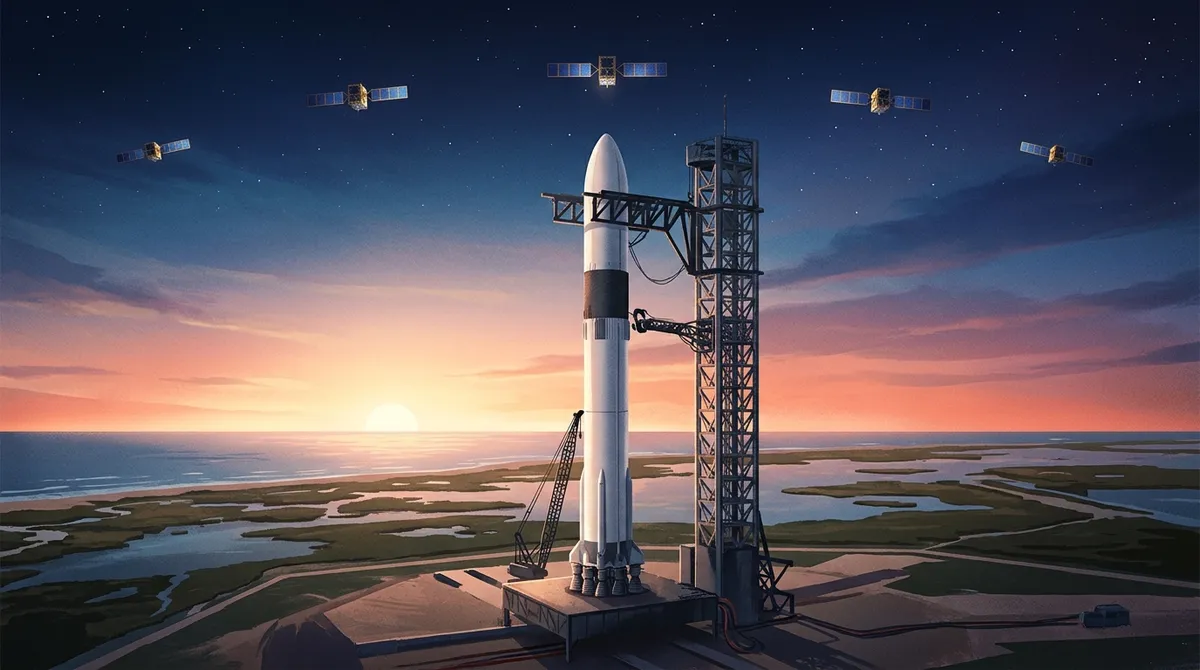
Google books Blue Origin's New Glenn for Project Suncatcher satellites in 2029
Sources The Verge SatNews The Next Web Blue Origin says
What happened: Google has signed a launch services agreement with Blue Origin for its New Glenn rocket to carry Project Suncatcher satellites into sun-synchronous orbit in the first quarter of 2029, the companies announced on November 19. Each satellite carries Google's Tensor Processing Units and roughly the computing power of one data-center rack. Neither company disclosed the value of the deal.
What's genuinely new: The mission is the first dedicated heavy-lift launch for Project Suncatcher, which so far has flown only as a rideshare; its prototype reached orbit in October on a SpaceX Falcon 9 rideshare. New Glenn has been grounded since the May hotfire anomaly at its launch pad, and an internal memo from CEO Dave Limp — reported by Reuters — puts the return to flight in January 2027. Google says orbital solar panels can produce up to eight times more power than panels on Earth, a claim the company has not independently verified. Next steps include thermal and radiation testing and a planned 2027 milestone linking two satellites.
Watch: Whether New Glenn returns to flight in January 2027 as planned, and whether the 2027 two-satellite test and its radiation data arrive on schedule.
More context: Google and Blue Origin have signed a launch services agreement for New Glenn to carry Project Suncatcher satellites into sun-synchronous orbit, with the launch targeted for the first quarter of 2029. Blue Origin says its May hotfire anomaly originated at the main oxygen valve on one of its BE-4 engines, and that a modified valve has passed qualification and is being rolled out across the fleet.
Brief
- SpaceX's Falcon 9 mission USSF-317 for the Space Force has moved from Wednesday to Thursday, November 19, from Vandenberg Space Force Base in California. The booster is due to fly for an 11th time and is slated to land on a droneship in the Pacific. A backup opportunity is listed for November 20. Source: Barchart.
- Rocket Lab's stock rose nearly 2% overnight as CNBC's Jim Cramer called it "too cheap" on Mad Money — a reversal from his October sell call — with Electron's 100 launches reached in about nine and a half years, roughly a year faster than Falcon 9 took to the same mark, and the stock down 24% year to date. Newsable Asianet News
- Starlink's satellite-to-phone service is headed to Botswana in early 2027 through a partnership with carrier BTC, which will sell it as BTC Satellite for messaging apps, location sharing and more in cellular dead zones such as the Central Kalahari; it launched with carriers in Uganda and Kazakhstan in September. Teslanorth
- FIBERPRO, a South Korean maker of space-grade fibre-optic gyroscopes flight-proven on the NEXTSat satellites and the Nuri rocket, promoted its satellite attitude-control sensors at Space Tech Expo Europe in Bremen. AVING News
- Elon Musk says Ship 42 — the first Starship upper stage ever caught by the launch tower, retrieved after Flight 15's roughly 22-hour flight — will likely be preserved for public display instead of reflown, because "what it has done is historic"; SpaceX had planned to refly an upper stage by early 2027, so another Ship will have to be recovered first. The same article adds that the next Starship mission is targeted for December, possibly from the new Kennedy Space Center pad, though the booster first needs work after Flight 15's engine-restart and guidance failures ended with Booster 22 exploding just above the Gulf of Mexico. (single source) Starlust
- Debris from Flight 15's booster, which exploded just above the waves during its offshore splashdown on November 13, is washing up on Bagdad Beach in Mexico alongside dead dolphins and turtles, according to environmental group Conibio Global, whose president says it will be impossible to collect all the fragments; Mexico's environmental protection agency PROFEPA has sent inspectors and says SpaceX "will be asked to take responsibility," though the animals' cause of death is not yet determined and SpaceX has been approached for comment. (single source) The Independent