Energy digest — Nov 25, 2026
Top line: Westinghouse moved to qualify Canada's BWXT to make key AP1000 components as China poured first concrete for Taishan's third reactor. Proxima Fusion's German partners finished the first structural plate for its stellarator magnet, Rosatom delivered Leningrad II steam generators, and TVA's filing detailed the $1.7 billion data-center deal.
- Taishan unit 3 construction begins in Guangdong
- First radial plate built for Proxima Fusion's stellarator magnet
- Westinghouse moves to qualify BWXT Canada for AP1000 component manufacture
- Framatome opens a reactor-internals workshop at Le Creusot
- Steam generators delivered for Leningrad II's third unit as MBIR hardware completes
Taishan unit 3 construction begins in Guangdong
Sources World Nuclear News published Nov 25, 9:50 AM ET
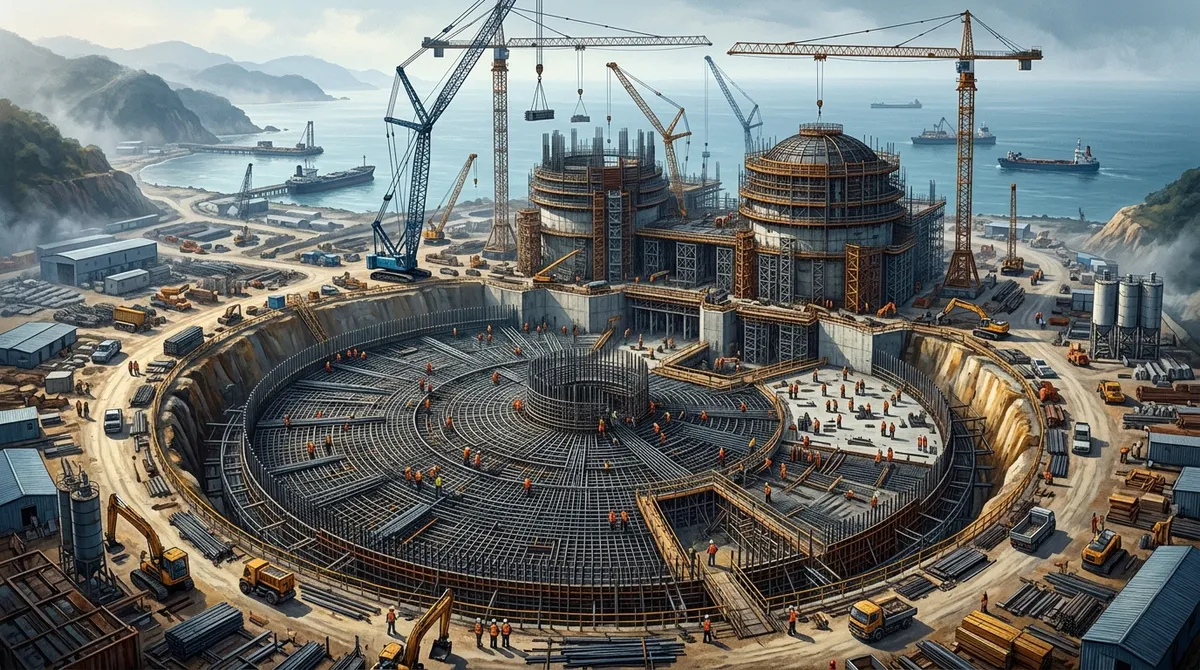
What happened: China General Nuclear poured the first concrete for the nuclear island of unit 3 at the Taishan plant in Guangdong province, starting the civil construction phase — twin HPR1000 (Hualong One) reactors in the plant's second phase, among ten new units approved by the State Council on April 27, 2025. CGN says it is the fourth nuclear power unit the company has started this year. Taishan's first two units, EPRs, became the first reactors of that design to enter commercial operation, in 2018 and 2019.
What's genuinely new: The construction start itself, plus the engineering choice for phase 2 — natural-draft cooling towers that rely on atmospheric heat traps and recycle cooling water, which CGN frames as protecting the marine environment at a plant slated to grow to six units across three phases.
Watch: Twin unit 4's first concrete and construction pace across the six-unit site.
First radial plate built for Proxima Fusion's stellarator magnet
Sources World Nuclear News published Nov 25, 6:15 AM ET
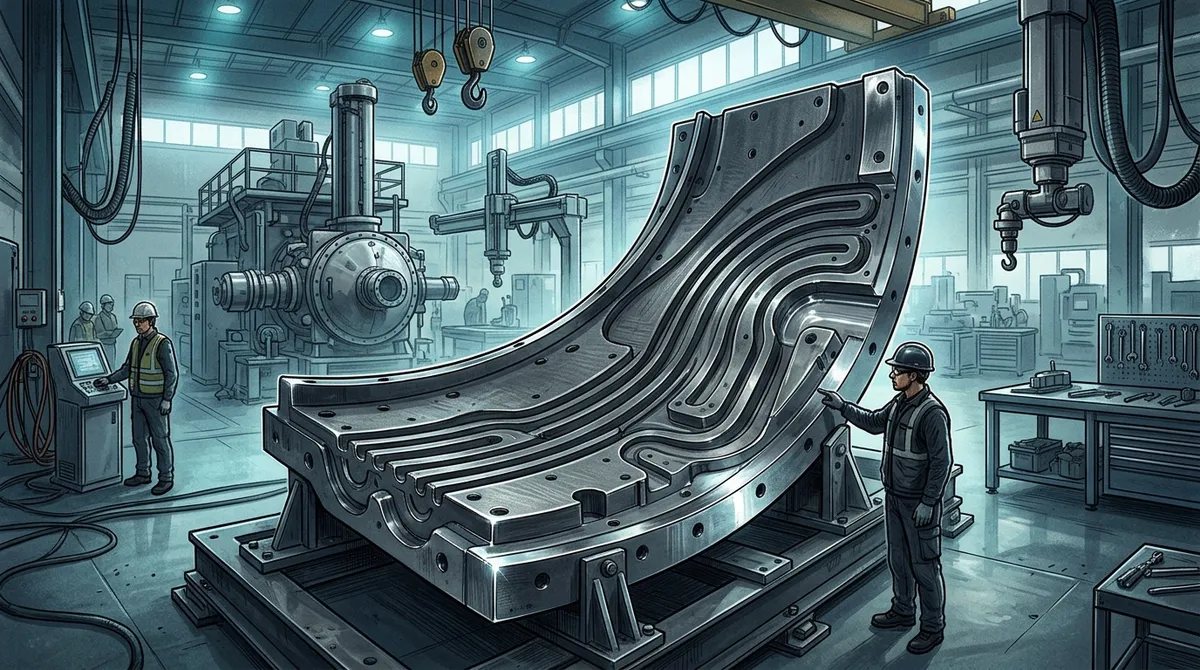
What happened: Three German industrial companies — Rolf Kind GmbH (base material), Pro Beam GmbH (electron-beam welding) and Mühlbauer Maschinenbau (precision machining) — completed the first of many radial plates for the Stellarator Model Coil designed and engineered by Munich-based Proxima Fusion. Radial plates are the structural backbone of a superconducting magnet, holding high-temperature superconducting cables in place; in a quasi-isodynamic stellarator the coils are twisted in three dimensions, and making such non-planar plates to industrial quality is a defining manufacturing challenge.
What's genuinely new: The first plate itself, built by three members of Proxima's Alpha Alliance of more than 50 industrial partners on the way to Alpha, its net-energy-gain demonstrator planned near Garching with operation in the 2030s, and to Stellaris, the commercial power plant planned for the former Gundremmingen nuclear site under Proxima's February agreement with Bavaria, RWE and the Max Planck Institute for Plasma Physics.
Watch: Further radial-plate deliveries as the Stellarator Model Coil takes shape, and supply-chain growth toward Alpha.
Westinghouse moves to qualify BWXT Canada for AP1000 component manufacture
Sources World Nuclear News published Nov 25, 7:51 AM ET
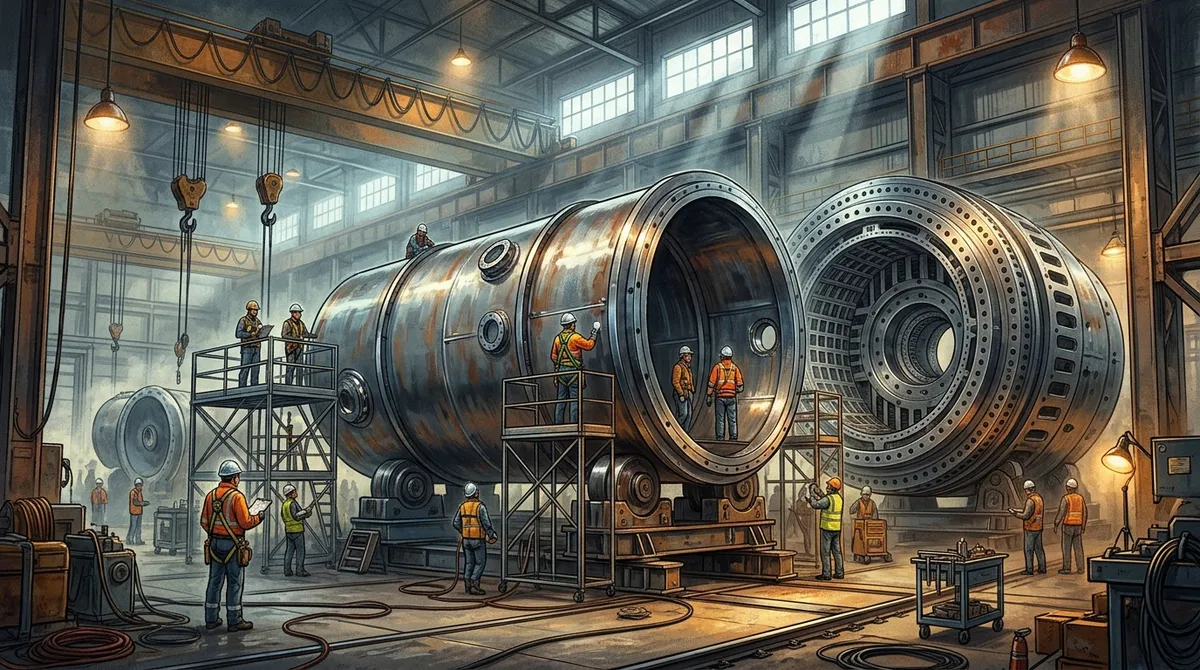
What happened: Westinghouse has awarded BWXT Canada manufacturing qualification contracts to fabricate demonstration pieces for AP1000 components — steam generators at the company's Cambridge, Ontario plant and reactor vessel internals at York, Pennsylvania. Qualification would let the partners make large nuclear-grade components in Canada and the US for AP1000 projects worldwide. BWXT recently completed a CAD 80 million (US$56 million) expansion of its Cambridge facility.
What's genuinely new: The contracts themselves. Six AP1000 reactors are in operation in the US and China and 14 are under construction in China, with further units in contract phases in Poland, Ukraine and Bulgaria — so adding a second qualified North American fabricator widens the manufacturing base behind those builds.
Watch: Whether the demonstration pieces qualify on schedule and which AP1000 projects first draw on BWXT-made components.
Framatome opens a reactor-internals workshop at Le Creusot
Sources World Nuclear News published Nov 25, 8:13 AM ET
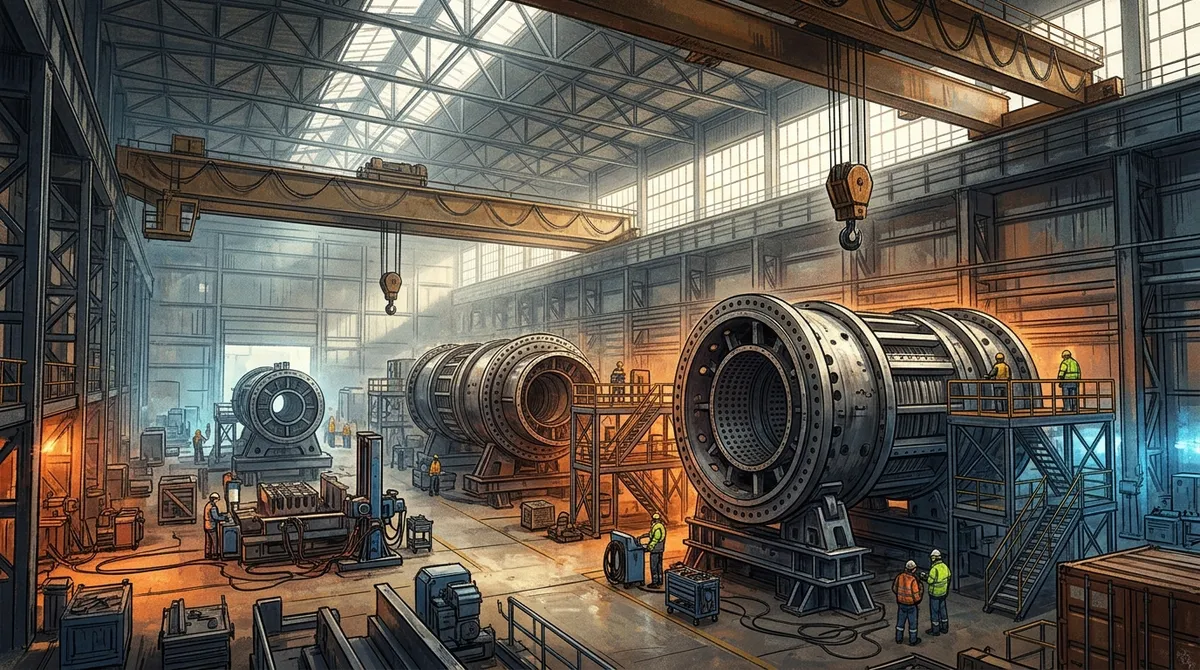
What happened: Framatome has inaugurated a workshop at its Le Creusot plant in France dedicated to manufacturing and assembling reactor pressure-vessel internals — the structures that support fuel assemblies and guide the control-rod drive mechanism inside the vessel. The project represents investment of nearly €100 million (US$110 million), transformed about 15,000 square metres of industrial space and created roughly 50 jobs; the ceremony drew Industry minister Sébastien Martin and EDF chairman and CEO Bernard Fontana.
What's genuinely new: The workshop itself, framed by Framatome as reinforcing French and European sovereign nuclear capacity. First productions began in July as part of France's programme for six EPR2 reactors, with initial deliveries scheduled to start in 2032 — each internals set involves the precision assembly of nearly 7,600 pieces.
Watch: Production pace against the EPR2 delivery schedule, and whether further contracts extend Le Creusot's role.
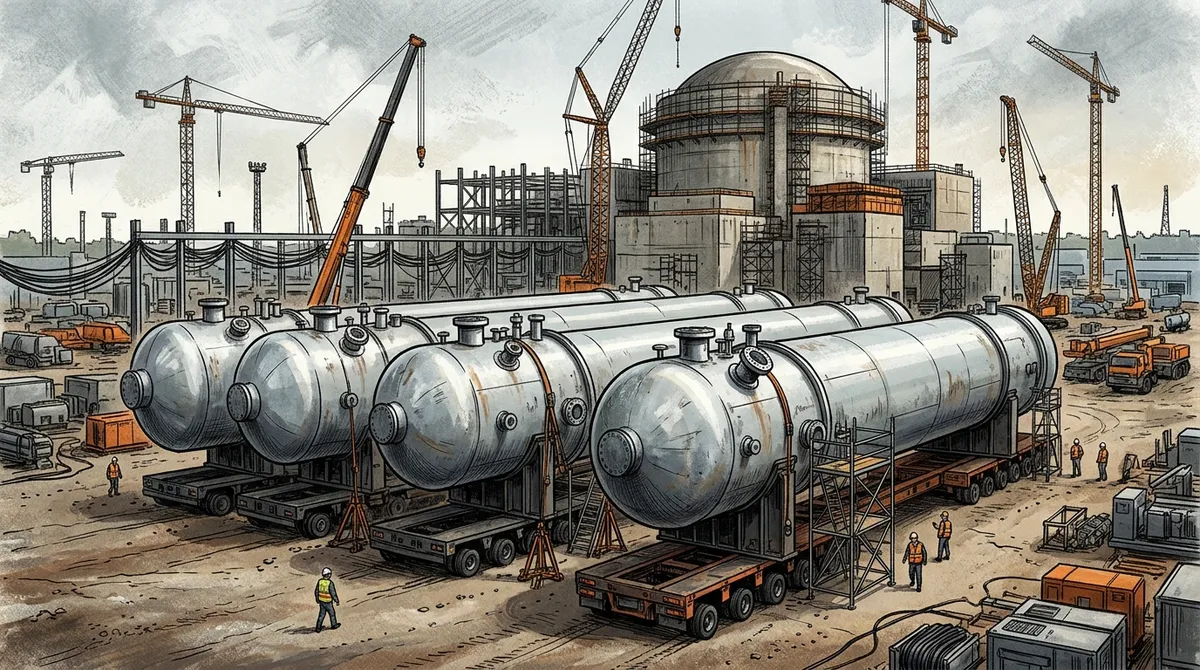
Steam generators delivered for Leningrad II's third unit as MBIR hardware completes
Sources World Nuclear News published Nov 25, 5:28 AM ET
What happened: Rosatom says four steam generators — 13 metres long, 4.2 metres in diameter, more than 1,300 tonnes combined — have been delivered for the third unit of the Leningrad II phase, ready for inspection before installation at their design positions; eight supports are planned by spring 2027, and the unit's reactor vessel is slated for installation in the third quarter of 2027. Two completed reverse steam generators were also shipped for the MBIR, a 150-MWt fast research reactor at Dimitrovgrad scheduled to start up in 2027, replacing the BOR-60.
What's genuinely new: The deliveries themselves at two Rosatom builds. Leningrad II's first two VVER-1200 units were commissioned in 2018 and 2021; the third and fourth now under construction will replace the site's four RBMK-1000 units, with third-unit concrete poured in March 2024. The MBIR steam generators follow the reverse-flow design proven on BOR-60, which has operated on the site since 1969.
Watch: Leningrad II unit 3's 2027 installation programme and MBIR's start.
Brief
- US pledge: an SMR control-room simulator for Indonesia. The US Embassy in Jakarta says the simulator, pledged at the East Asia Summit in Manila on November 17, comes under the State Department's FIRST programme, alongside reactor siting studies, licensing support, university nuclear-engineering links and radioactive-waste training — with the stated aim of making Indonesia a regional hub trained on US designs. It fits a grid still 69% coal-powered in 2023 and plan targets that put nuclear as low as 0.4–0.5% of the primary energy mix in 2032, with the first units pencilled in for Sumatra-Bangka (2032) and Kalimantan (2033). Kontan quotes Pushep executive director Bisman Bakhtiar warning the support "must come with technology transfer so it does not become a dependence on foreign parties," and flagging big investment costs against an uncertain market. Intellinews
- Korea's fusion institute and Samsung C&T join on a "Korean-style" fusion reactor. The Korea Institute of Fusion Energy signed a memorandum of understanding with Samsung C&T's construction division to cooperate on the design, construction and core technology of a Korean-style innovative fusion reactor, plus AI-based modelling, analysis and design automation — pairing the state fusion research body with the engineering firm's nuclear plant and SMR construction experience. Partnership-grade: no project site, schedule or budget announced. Korea Herald
- X-Energy shares slide on profit-taking and a price-target cut. The stock fell 12.78% on November 24 to $8.63 as investors took profits after the previous day's big rally and the Nasdaq slipped 1.48%; Guggenheim cut its price target 26.3% to $42 from $57 while keeping a buy rating, citing updated valuations across the nuclear sector. Third-quarter revenue of $66.34 million and a $59 million attributable net loss were already known. Insider Monkey
- Amentum's nuclear expansion flags a first buyback. The government services company reported fiscal 2026 normalized revenue of $13.8 billion, authorized its first $500 million share repurchase, and has opened a global nuclear headquarters in Oak Ridge, Tennessee, positioning small modular reactor work as a longer-term growth vector beside a $48 billion contract backlog. The Motley Fool
- TVA filing details the $1.7 billion data-center deal — and the Clinch River wait. TVA's SEC filing says the unnamed data-center customer will pay aggregate capacity commitment charges of about $1.5 million per MW of requested capacity above 5 MW under the large-load tariff that took effect October 1 and phases in through 2029. The same filing says TVA "has not yet decided whether to construct a reactor" at Clinch River despite holding the country's first SMR construction permit for a BWRX-300, and notes a board-approved 1.5-GW gas plant targeted for 2032 and a $13 billion three-year capital plan, with supply-chain pressures flagged into 2027. Utility Dive
- Oklo and NuScale slide as the AI selloff spreads to nuclear. The two reactor developers each fell about 8% on November 25, both down more than 75% this year, after October core-PCE inflation came in at 3.3% — cementing expectations of a December Federal Reserve rate hike that weighs on cash-burning growth names. Oklo, still pre-revenue with its Aurora fast reactor, cites a roughly 14-gigawatt customer pipeline led by a 12-GW master power agreement with Switch, with first commercial power targeted for late 2027 to early 2028; NuScale holds a $1.90 billion cash cushion. 24/7 Wall St.
- A Columbia report sets out why Vogtle 3 and 4 ran late. The Center on Global Energy Policy's report on the plant's construction delays, issued November 15 and built from the independent construction monitor's 2009–2023 testimony, names three primary causes: an unrealistic integrated project schedule, failure to meet NRC quality-assurance requirements, and Westinghouse's incomplete and changing AP1000 design during construction — only 40% of plant engineering documents were issued when the combined licence arrived in 2012. Its lessons: require a complete Level 3 schedule and suppliers with prior nuclear-grade manufacturing experience. American Nuclear Society
- An industry-led process for the UK's fusion market framework. The Fusion Industry Association will convene government, investors, project financiers, insurers, developers, utilities and offtakers from December 14 in a six-month process to shape the market and finance framework the UK government committed to in its March 2026 Fusion Strategy — aimed at financing and operating the first commercial fusion plants in the 2030s. Fusion Industry Association
- Lithuania weighs a return to nuclear via SMRs. The country is studying small modular reactors after the Ignalina closure, with no decision date set. Energynews
- The NRC schedules a third workshop on new reactor licensing pathways. NRC