Energy digest — Nov 11, 2026
Top line: The heaviest news is in Canada: Ontario Power Generation says the first Darlington BWRX-300 will miss both its October 2030 target and its CAD 7.7 billion (US$5.4 billion) budget. In the US, the Department of Energy cleared Oklo's Groves-1 test reactor for unrestricted operations, and Indiana's budget committee approved US$20 million toward the land under Oklo's planned Lebanon isotope site.
- Darlington's first BWRX-300 slips past October 2030 and its CAD 7.7 billion budget
- Department of Energy clears Oklo's Groves-1 test reactor for unrestricted operations
- Dome installed on Pakistan's Chashma unit 5
- Study weighs the economics of a first Greek nuclear plant
- Rosatom proposes UN carbon credits for small modular reactors
- IAEA peer review finds Jordan's nuclear regulator well established
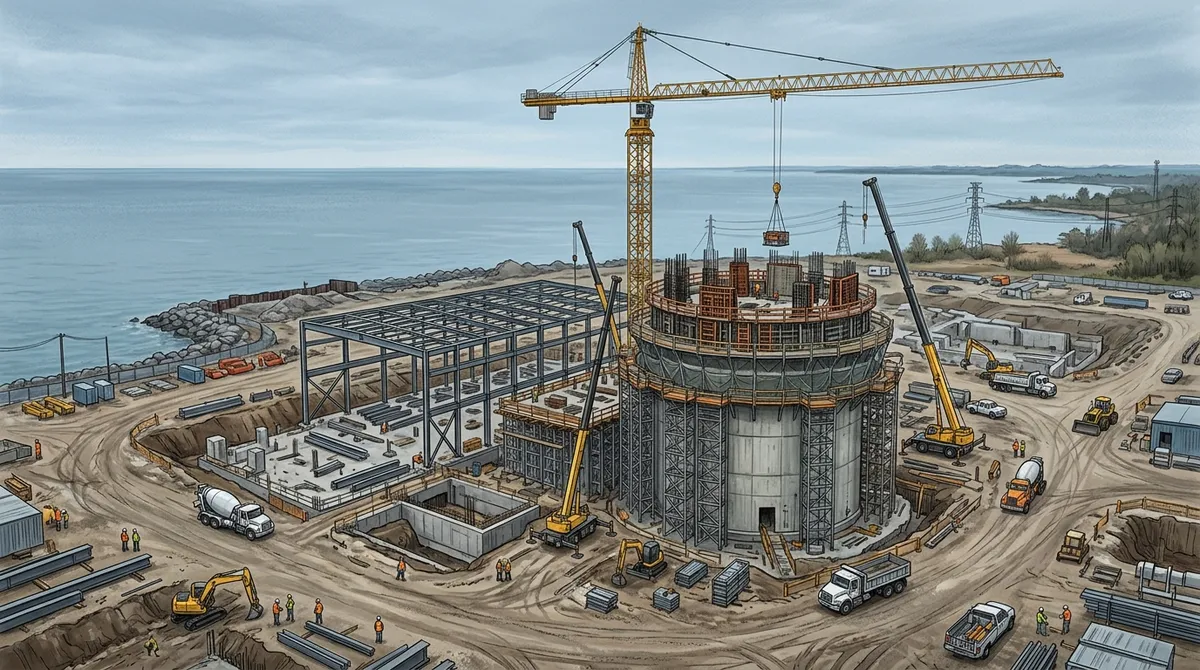
Darlington's first BWRX-300 slips past October 2030 and its CAD 7.7 billion budget
Sources World Nuclear News Canary Media published Nov 11, 2:00 PM ET
What happened: Ontario Power Generation says the first of four GE Vernova Hitachi BWRX-300 small modular reactors at the Darlington New Nuclear Project east of Toronto will no longer reach commercial operation by the previously disclosed target of October 2030, nor be completed within the previously estimated CAD 7.7 billion (US$5.4 billion). No new targets were shared — a comprehensive reassessment of unit 1's cost and schedule is under way, to be substantially complete by mid-2027.
What's genuinely new: The disclosure came in OPG's third-quarter 2026 results, and it is the project's second slip: when OPG announced the design in late 2021, it said the reactor could be completed as early as 2028. OPG attributes the slip to GE Vernova Hitachi's ongoing engineering for its first-of-a-kind design, which affects construction execution and supply-chain performance, with updated market conditions — inflationary and geopolitical risk — also weighing. Unit 1 would be the first new nuclear build in Canada in more than three decades; the CNSC issued the construction licence in April 2025, Ontario approved the CAD 20.9 billion (US$15 billion) four-unit budget and construction start the following month, and federal and provincial funds have since committed up to CAD 3 billion (about US$2.1 billion) for minority stakes. GE Vernova Hitachi spokesperson Jonathan Allen pointed to "multiple interconnected contributions" across engineering, procurement and construction. Canary Media adds the wider stakes: the TVA received an NRC construction permit for a BWRX-300 in September and developer Blue Energy has started an NRC application for one in Texas, only two SMR plants operate commercially worldwide (in Russia and China), and the last large US nuclear build — Georgia Power's Vogtle units 3 and 4 — ran seven years late and US$17 billion over.
Watch: The revised cost and schedule outlook by mid-2027, completion of the outstanding engineering scope, and whether the overruns chill the other BWRX-300 projects in flight.
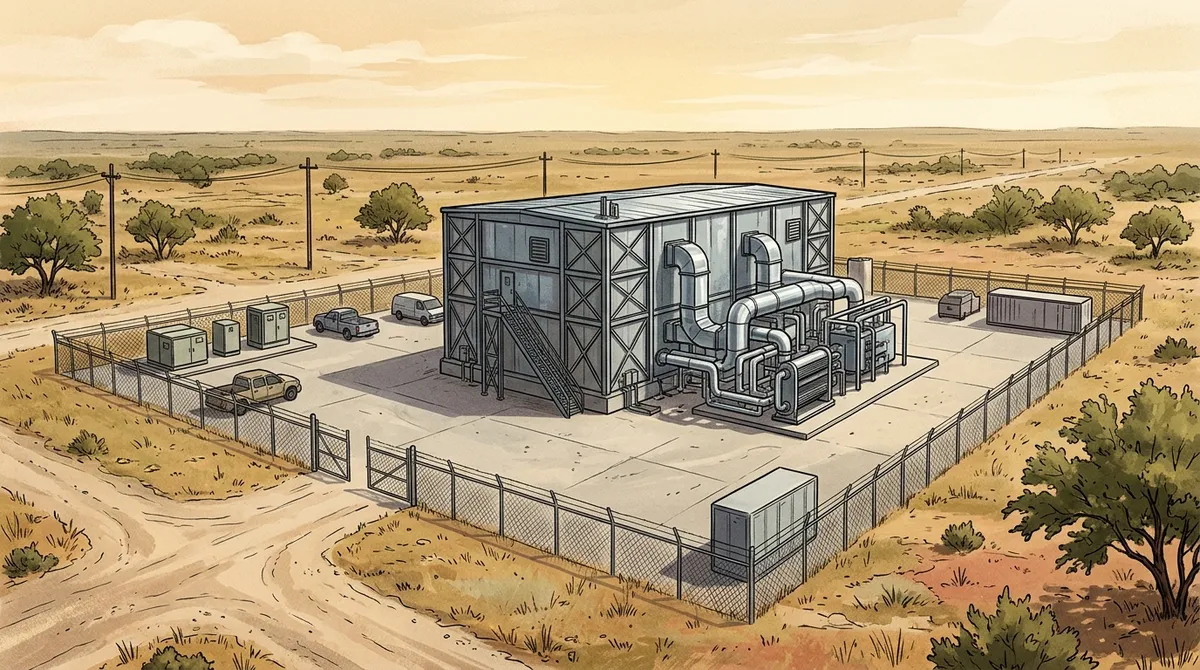
Department of Energy clears Oklo's Groves-1 test reactor for unrestricted operations
Sources Business Wire TIKR
What happened: The US Department of Energy has cleared the final operations hold point for Oklo's Groves Isotope Test Reactor — Groves-1, built at Lockhart, Texas under the DOE Reactor Pilot Program — allowing the facility to advance into its research, testing and training phase with no remaining operating restrictions.
What's genuinely new: The company announced the clearance in a November 11 release, which notes the test reactor brings Oklo no direct sales — its value is as a training and qualification platform for the crews meant to run future deployments, including the Aurora powerhouse at Idaho National Laboratory targeted for 2028 or 2029. Oklo says the next phase builds on first criticality at low power less than a year after groundbreaking, with operators already wearing eye-tracking glasses during a startup to record where they look and for how long, informing the facility's human-machine interface and future designs. Groves-1 also moves into continued control rod drive mechanism evaluations and criticality and reactivity benchmarking that Oklo says will support its isotope production, engineering and design models and potentially the wider light-water reactor fleet. DOE acting Deputy Assistant Secretary for Nuclear Reactors Chimi Zacot said the Reactor Pilot Program has "reset the nuclear industry's expectations" for how quickly an advanced reactor moves from design to demonstration. TIKR's coverage adds Oklo shares rose about 4% on the news.
Watch: Benchmarking results for Oklo's isotope and Aurora programs, operator qualification work on the reactor, and Groves-2 Forge progress.
Dome installed on Pakistan's Chashma unit 5

What happened: The inner safety dome has been installed on the containment building of unit 5 at the Chashma nuclear power plant in Punjab, Pakistan — the third Hualong One (HPR1000) reactor China National Nuclear Corporation is building in the country, and its largest power-producing unit at 1,200 MWe. Prime Minister Shehbaz Sharif attended the dome ceremony.
What's genuinely new: The hoisting came less than three and a half years after the July 2023 groundbreaking — ahead of schedule, per Shehbaz, who said he expects commissioning earlier than planned too. The unit is targeted to start generating electricity in September 2030, under a USD 4.8 billion construction deal with China signed in June 2023; the Pakistan Nuclear Regulatory Authority issued the construction licence on December 26, 2024. Pakistan's six operating reactors, 3,262 MWe combined, supply about 17% of the country's electricity.
Watch: Fuel loading and startup against the September 2030 target, and whether the "earlier than planned" commissioning claim holds.
Links: World Nuclear News · Nov 11
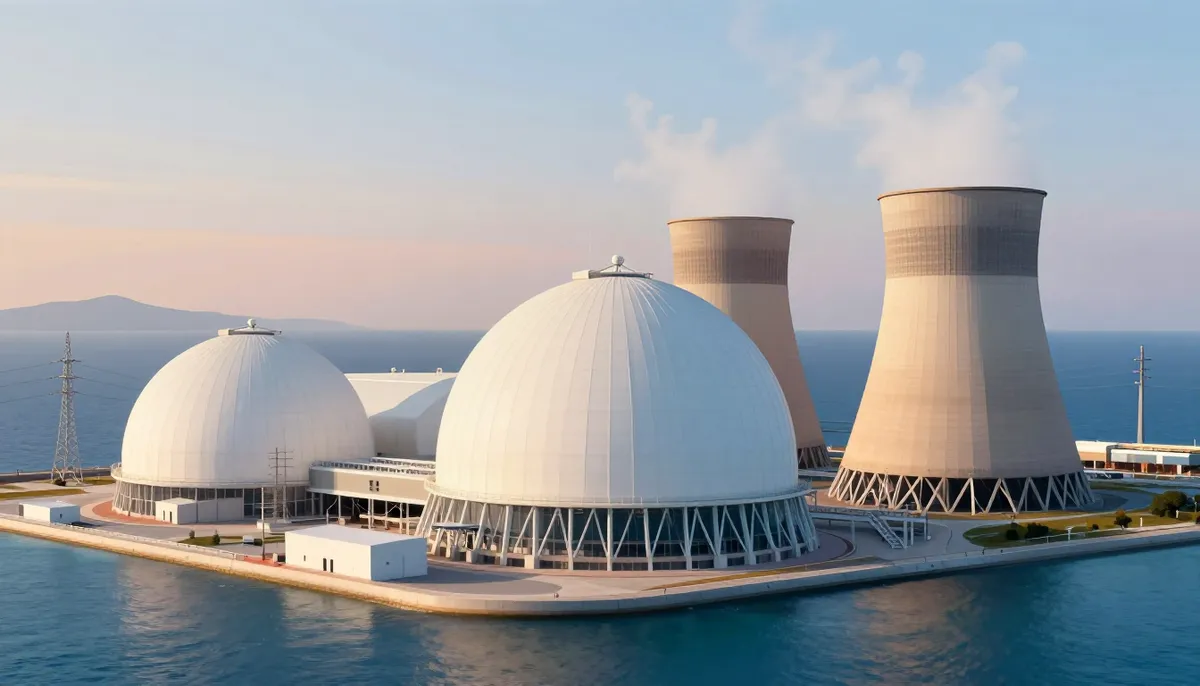
Study weighs the economics of a first Greek nuclear plant
Sources World Nuclear News published Nov 11, 6:17 AM ET
What happened: A study by Greece's Athlos Energy and consulting firm Helixos estimates that building a 1,600 MW nuclear plant would add about EUR 4.5 billion (US$5 billion) to Greek GDP over the construction period, on investment of roughly EUR 11 billion (~US$12 billion), with peak employment near 12,000 jobs, tax revenues of about EUR 1.2 billion (~US$1.3 billion) during construction and EUR 160 million (~US$180 million) a year during operation.
What's genuinely new: The analysis, part of Athlos Energy's groundwork for a first Greek nuclear programme, also models a 300 MW small modular reactor scenario contributing about EUR 590 million (~US$655 million) to GDP with about 2,100 jobs at peak construction, and suggests phased SMR expansion. It follows Prime Minister Kyriakos Mitsotakis's March announcement at the Paris nuclear summit that Greece would examine small modular reactors, and an Inter-Ministerial Committee set up in August.
Watch: Whether the assessment leads to siting, a technology choice, or concrete government steps toward a first project.
Rosatom proposes UN carbon credits for small modular reactors

Sources World Nuclear News published Nov 11, 7:54 AM ET
What happened: Rosatom has proposed to the UN's climate secretariat an international methodology that would let small modular reactors up to 300 MW — on land or on floating power units — qualify for carbon credits under Article 6.4 of the Paris Agreement, ahead of the COP31 gathering in Turkey.
What's genuinely new: No climate project based on a nuclear power plant has ever been registered in any national or international carbon market, and no approved methodology exists, Rosatom chief sustainability officer Polina Lion said; the proposal would yield at least USD 1 million a year in credit revenue for a hypothetical 100 MW SMR and help SMR debt financing. The draft goes to public consultation under the UNFCCC framework, with Rosatom expecting approval in the first half of 2028 if it clears review.
Watch: The consultation and review steps in the Article 6.4 process, and Rosatom's first-half-of-2028 approval expectation.
IAEA peer review finds Jordan's nuclear regulator well established

Sources World Nuclear News published Nov 11, 3:49 AM ET
What happened: An International Atomic Energy Agency Integrated Regulatory Review Service mission — 12 experts from 12 countries — has found Jordan has a "well-established regulatory framework for nuclear and radiation safety," while suggesting further enhancements in line with international standards.
What's genuinely new: The mission reviewed authorisation, inspection and enforcement, emergency preparedness and other functions at the Energy and Minerals Regulatory Commission, citing seven areas of good performance and four for improvement — including the integrated management system, consistency of core regulatory functions and modernised record-keeping. Jordan operates a research and training reactor, uses radiation sources in medicine and industry, holds significant uranium resources and is considering small modular reactors for nuclear power; the completed report goes to Jordan's government in about three months.
Watch: The report's handover to the government and Jordan's follow-up on the four suggested improvements.
Brief
- Simply Wall St.'s stock-screener feature pegs X-Energy at about US$4.5 billion in market value after the Seadrift permit approval and relays Terrestrial Energy's updated IMSR unit-economics framework — about US$2.7 billion in lifetime revenue per plant, with 79% of it tied to post-construction core-unit and fuel-salt contracts (Simply Wall St. via Yahoo Finance).
- Maharashtra Chief Minister Devendra Fadnavis says the Indian state is drawing up a dedicated nuclear energy policy centred on small modular reactors, to host both large nuclear projects and SMRs through private and state-owned participation; it follows May 2026 memoranda of understanding aimed at 25,400 MW of nuclear capacity and investment of Rs 6.5 lakh crore (about US$74 billion) (The Hawk)
- Morning Overview's recap of the November 9 Seadrift construction permit adds the April 2026 engineering, procurement and construction contract with Fluor, the February licensing of X-energy subsidiary TRISO-X's TRISO fuel-fabrication facility at Oak Ridge (described as the country's first Category II fuel fabrication licence), a US$2.4 billion project cost shared 50/50 under the Department of Energy's Advanced Reactor Demonstration Program, site ratings of 320 MWe and 800 MW thermal for the four Xe-100 modules, and the reminder that the permit authorizes construction only ahead of a separate operating licence (Morning Overview)
- Indiana's State Budget Committee voted 4–1 on November 10, over members' complaints about the project's secrecy, to contribute US$20 million (US$8 million from the general fund, US$12 million from the deal-closing fund) toward Oklo's purchase of about 440 acres at US$160,000 an acre — roughly US$70 million in all — in Lebanon's LEAP District — the land for a proposed US$1.8 billion radioisotope production project pursued under the codename Project Phoenix through subsidiary Bigfoot Metals Development. The state reports US$498 million spent on the LEAP project so far; Oklo has not formally announced the Lebanon project, still needs city zoning approval, and holds a public open house on November 16 (The Lebanon Reporter)
- An Oilprice feature sets the Proxima Fusion supply-chain story in an industry-money frame: private fusion investment reached a record US$4.48 billion last year, up 69%, bringing the sector's total since 2021 to US$14.24 billion, and the Fusion Industry Association found 71% of the 56 private fusion companies it surveyed expect to deliver grid power by the 2030s — alongside Proxima's €411 million July round and its planned €140 million (about US$160 million) superconducting-tape plant in Lower Saxony under its October 28 Tokyo agreements with Fujikura and Kyoto Fusioneering (Oilprice) (single source)