Space digest — Nov 24, 2026
Top line: Shenzhou-24 lifted off carrying Pakistani payload specialist Muhammad Zeeshan Ali, Tiangong's first foreign visitor. Amazon Leo's Ariane 6 flight was a clean success with all 36 satellites in contact, and Amazon is accelerating its Falcon 9 launches after the Vulcan failure. NASA also opened bidding for its first Moon reactor and set SR-1 Freedom's deep-space nuclear propulsion demo for 2028.
- NASA opens bidding for the first Moon reactor
- Rocket Lab says "no debt" as it plans to pay the Iridium deal down fast
- Starship debris washes ashore in Mexico and the government steps in
- Amazon Leo's broadband push hits a launch bottleneck
- NASA's Moon-base transport orders get mission-level detail
- Tiangong set to welcome its first international visitor
- Northrop books a sixth Falcon 9 for Cygnus as Antares 330 waits
- Progress MS-36 set for the final Russian cargo run of 2026
- Stoke Space's Nova Pathfinder hardware arrives at Cape Canaveral
- SpaceX shifts rideshare sales to wholesale integrators as Falcon 9 winds down
NASA opens bidding for the first Moon reactor
Sources Stocktwits NASA NASA on X published Nov 24, 5:04 PM ET
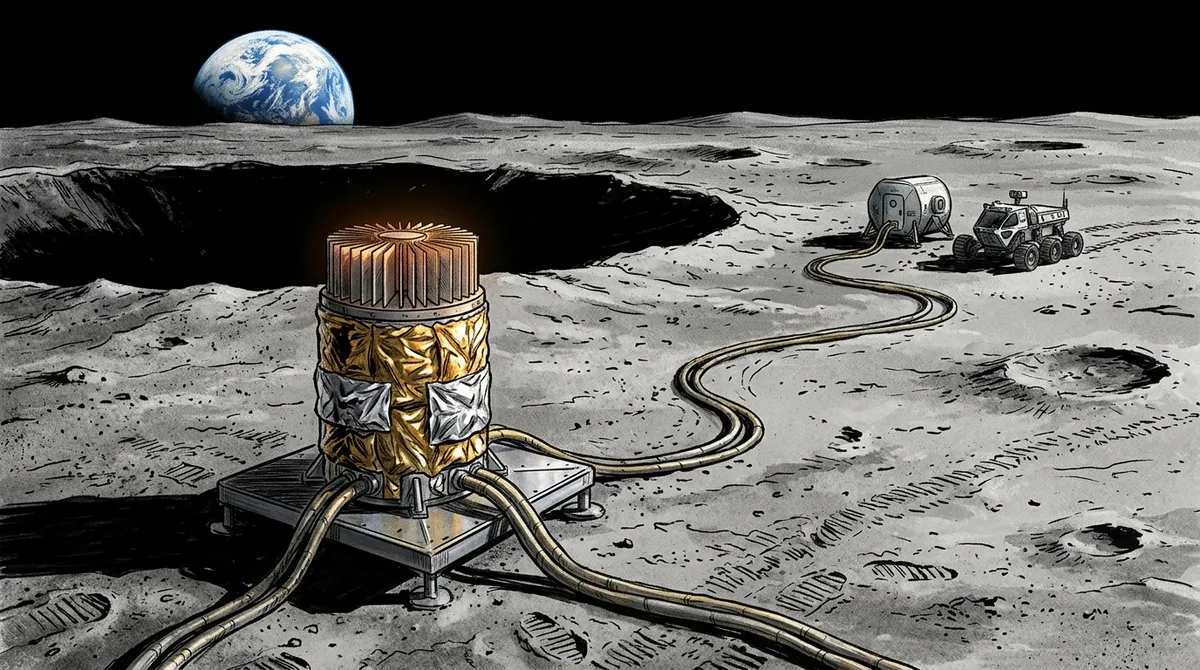
What happened: NASA opened bidding for Lunar Reactor-1 (LR-1), a 20-kilowatt nuclear fission reactor designed to launch by 2030 and supply continuous electricity on the Moon for at least five years. Proposals are due December 21 under a framework co-managed with the Department of Energy. NASA program manager Brian Giblin called reliable, abundant energy vital to future exploration of the lunar and Martian surface.
What's genuinely new: The tender is now open with a dated deadline, the first concrete procurement step for lunar surface fission power. Unlike solar panels, fission runs through the roughly 14-Earth-day lunar night and in permanently shadowed polar craters, powering habitats, rovers and science payloads; space and nuclear stocks rallied, a space-sector ETF up about 8%. Alongside, NASA says it has decided key design features and mission details for SR-1 Freedom — set to launch in 2028 as the first fission-powered spacecraft to travel beyond Earth orbit, demonstrating nuclear electric propulsion in deep space.
Watch: Which companies bid and win, how the design draws on Idaho National Laboratory's SR-1 development line, and whether the 2030 launch-ready date and SR-1's 2028 launch hold.
More context: NASA says its Lunar Reactor-1 will be the first fission power system on the lunar surface, generating electricity for a Moon Base near the lunar South Pole through the long lunar nights rather than depending on sunlight.
Rocket Lab says "no debt" as it plans to pay the Iridium deal down fast
Sources Advanced Television
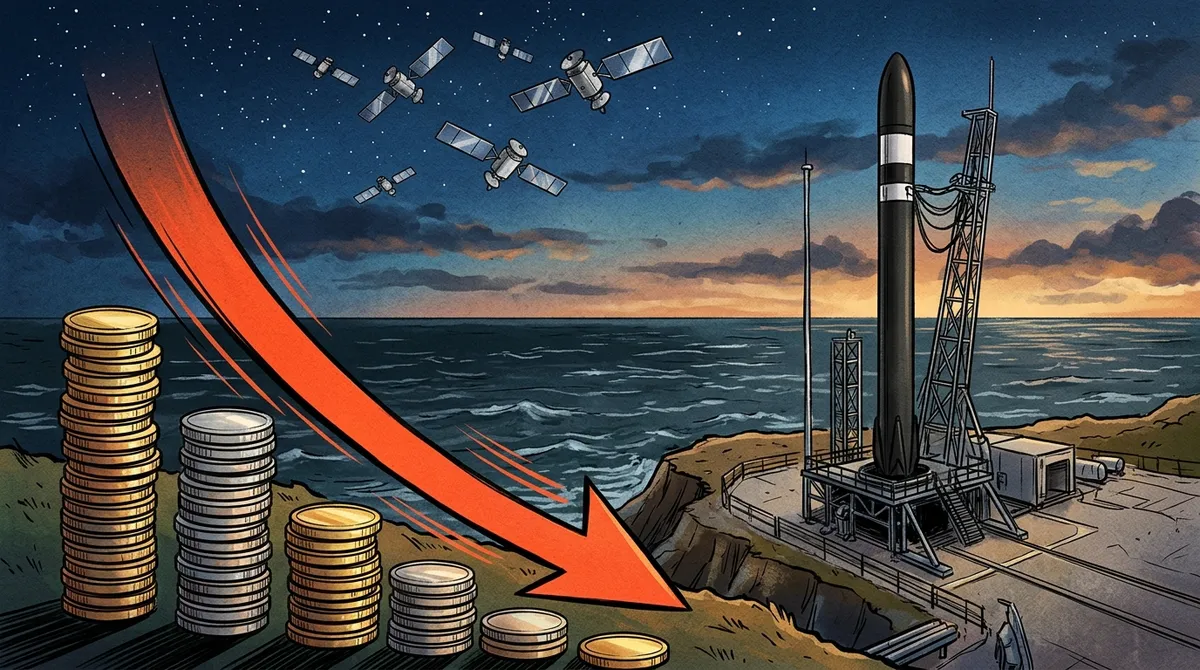
What happened: Rocket Lab CFO Adam Spice, speaking on the financing behind the $8 billion Iridium acquisition, said the company holds ample cash and "we do not like debt": once the deal closes — by mid-2027 at the latest — profits will go to paying the debt down quickly, with $1–1.5 billion of liquidity expected to survive and revenues expected to reach about $2 billion in 2027. Doubling backlog again in 2026 over 2025, he added, "is looking like we're going to be able to do that."
What's genuinely new: The money answers are new for a deal announced in June 2026. The company also laid out its launch-side expansion: six pads across three sites — two in New Zealand, two at Wallops Island, two in Alaska, where ground works have begun with the first Alaska launch targeted for readiness in 2027 — plus a sea-recovery barge named "Return on Investment," with Neutron to serve Iridium's own constellation and a faster capacity ramp under study. CEO Peter Beck said Archimedes has completed duration testing, thrust-vector movement and mixture-ratio work, with formal qualification still to run. The shares slid to $45 after the November 20 technology selloff, from $68 on November 11.
Watch: FCC action on the license-transfer applications, the close date, Neutron's first flight, and the Alaska readiness target.
Starship debris washes ashore in Mexico and the government steps in

What happened: Rocket debris from SpaceX's South Texas operations is washing ashore along Mexico's Tamaulipas coast, and the Mexican government is now involved: the federal environmental agency PROFEPA reports collecting 6 kilograms (about 13 pounds) of suspected rocket debris and transferring it to the Mexican Navy, while volunteers with the environmental group Conibio Global have gathered more than 1,500 fragments, some bearing SpaceX markings. FOX San Antonio cameras filmed the November 13 Super Heavy booster explosion over the Gulf after the booster aborted its return to the launch site.
What's genuinely new: SpaceX's dispute and the environmental question now sit with both governments: a November 19 company statement to Mexican media says the booster executed a safe abort maneuver, disputes reports of widespread debris and says independent testing shows no chemical, biological or toxicological risk — without water or sediment results. No scientific link connects launches to the dead dolphins, sea turtles and manatees reported along the coast or to fishermen's accounts of a 60% catch decline, but an April 2025 FAA environmental assessment acknowledged potential harm to sea turtles in launch failures.
Watch: PROFEPA's review of the SpaceX materials, an independent veterinary review of the dolphin footage, and any disclosure of water or sediment testing after the November 13 explosion.
More context: Mexico's federal environmental protection agency, Profepa, says it will ask SpaceX to take responsibility for the suspected rocket fragments recovered on Tamaulipas beaches, and has kept the area under watch with the Mexican Navy since the Nov. 13 explosion, Aristegui Noticias reports. Conibio Global identified the debris arriving at Playa Bagdad as large plastic fragments coated in metallic tape plus black rubber it attributes to the booster's internal propulsion components, with the heaviest concentrations 17 to 18 kilometers south of where the booster exploded, Aristegui Noticias reports.
Links: FOX San Antonio · Newsmax · Nov 24 · Aristegui Noticias
Amazon Leo's broadband push hits a launch bottleneck

Sources The Wall Street Journal Spaceflight Now NASASpaceflight on X Bloomberg Telesatellite SpaceNews Ars Technica WESH Orlando published Nov 24, 6:15 AM ET
What happened: The Ariane 64 flight carrying 36 Amazon Leo satellites lifted off from Kourou, French Guiana, on November 24 — a day later than planned after a November 23 ground-equipment problem — and completed the deployment: contact has been established with all 36 satellites after release into a roughly 460 km orbit, from where each rises to its 630 km operating altitude. Arianespace says its four Leo missions this year have placed 136 satellites in under ten months, and the fleet stands near 432 against more than 11,000 for Starlink — the first launch since the November 15 Vulcan failure destroyed 40 satellites.
What's genuinely new: Amazon is accelerating the Falcon 9 flights it bought from SpaceX: the next Leo launch on Falcon 9 has moved up to December from next year, with several more to follow in rapid succession and hundreds of satellites waiting in storage. Seventeen of the 102 contracted launch flights are complete with one failure; Vulcan stays grounded for months, and New Glenn, out since a May pad explosion, could resume early next year. The Wall Street Journal puts each satellite at about $2 million and this year's Leo spend at $4 billion or more, with 3,232 spacecraft still to fly by July 30, 2029 and a year-end service start riding on the pace.
Watch: The December Falcon 9 flight, the year-end service start, Vulcan's and New Glenn's return-to-flight dates, and deployment pace against the July 2029 deadline.
NASA's Moon-base transport orders get mission-level detail
Sources Spaceflight Now
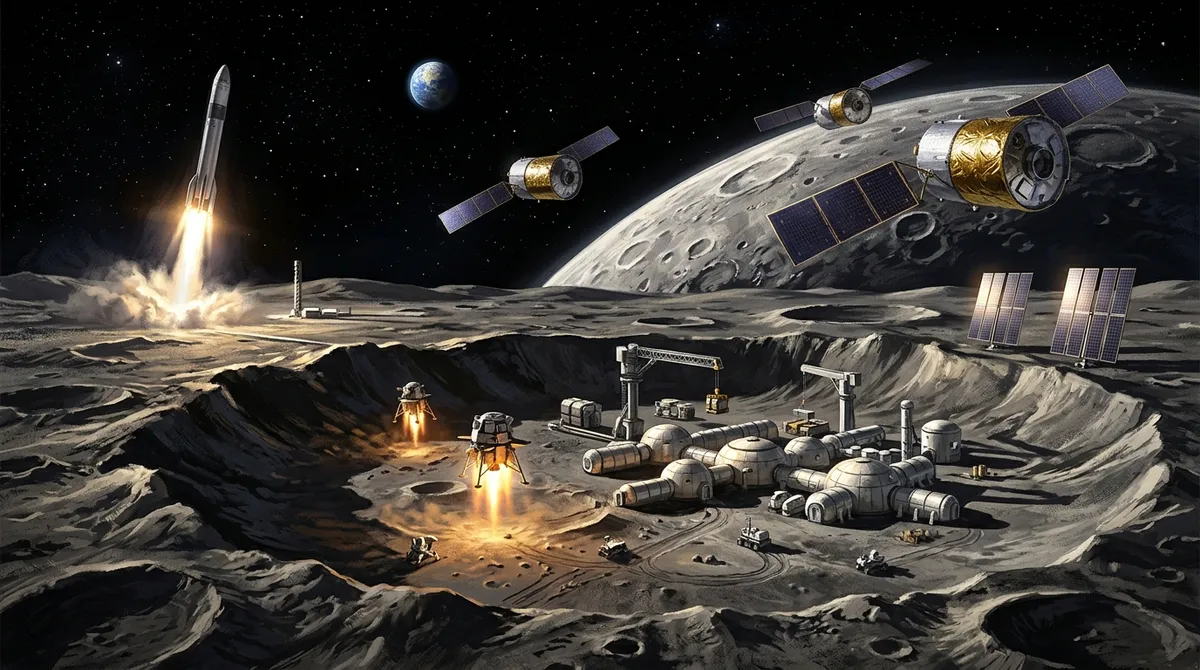
What happened: Spaceflight Now laid out the six task orders — about $1.3 billion combined — under which NASA is buying rockets and orbital transfer vehicles to build a permanent presence at the lunar south pole. NASA Moon Base manager Carlos García-Galán described the approach as flipping from buying individual missions to holding transportation on standby, matching ready payloads to landers and transport as needed.
What's genuinely new: The missions now have names and shapes: a $185 million CAPSTONE 02 flight on a Falcon 9 using Quantum Space's Ranger transfer vehicle in 2027–2028; Intuitive Machines communications satellites lofted on another Falcon 9 with Impulse Space integrating; three NASA MoonFall hopper drones carried toward the Moon in 2028 by Firefly's Elytra transfer vehicle on a New Glenn; two New Glenn flights using Blue Origin's Blue Ring; and an Impulse Space lunar-lander descent demo on Relativity's Terran R, the only rocket in the set yet to fly.
Watch: Terran R's expected 2027 debut, Blue Origin's New Glenn return to flight, and how the orbital transfer vehicles mature through these missions.
Tiangong set to welcome its first international visitor
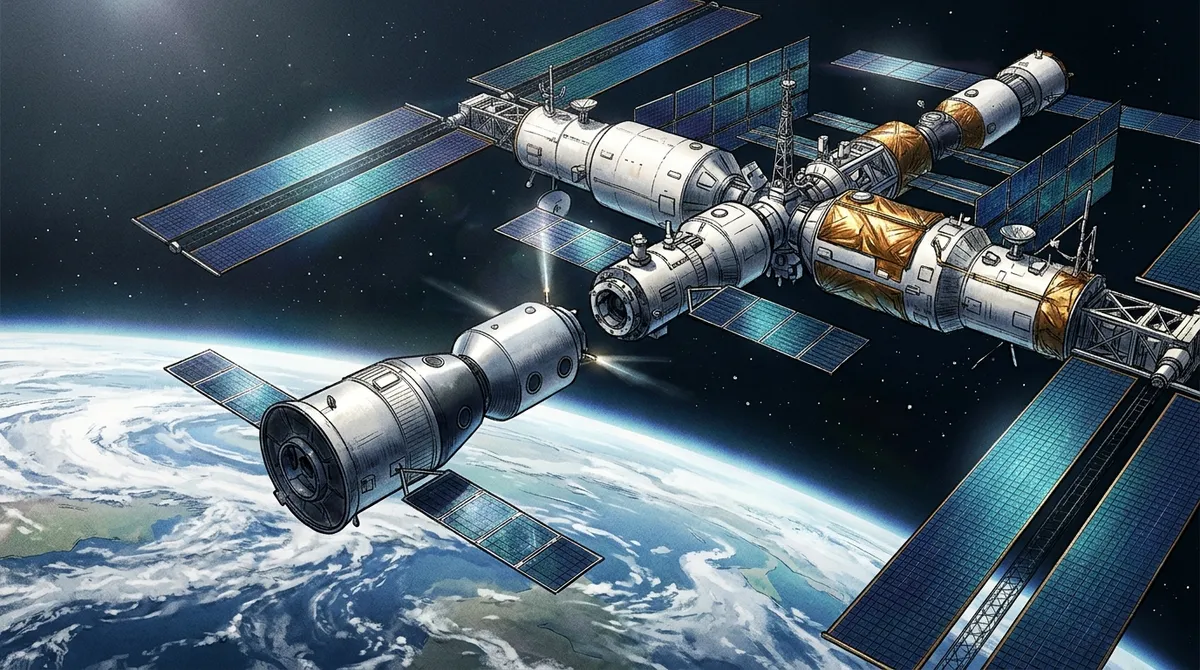
What happened: Shenzhou-24 launched from Jiuquan Satellite Launch Center atop a Chang Zheng 2F/G, lifting off at 7:18 PM ET on November 24 (00:18 UTC on November 25) with commander Tang Hongbo, flight engineer Wu Yi and Pakistani payload specialist Muhammad Zeeshan Ali — the first foreign national set to enter the Tiangong station. Ali has trained at the China Astronaut Research and Training Center since April under a February 2025 agreement between the two countries, will stay about a week and return to Earth aboard Shenzhou-23.
What's genuinely new: The launch is confirmed, with the spacecraft docking at Tianhe's forward port roughly 3.5 hours after liftoff on the fast rendezvous profile — China's first joint flight with an international astronaut and its 18th crewed spaceflight. The China Manned Space Agency named the crew at a news conference the day before flight, with Khurram Daud as Ali's backup and Tang Hongbo becoming the first astronaut to visit Tiangong three times.
Watch: Docking confirmation, Ali's experiments and sample installs aboard the station, and Shenzhou-23's return with Ali aboard.
Links: NASASpaceflight · NASASpaceflight on X · NASASpaceflight on X · Nov 24 · Nov 24, 7:20 PM ET
Northrop books a sixth Falcon 9 for Cygnus as Antares 330 waits
Sources NASASpaceflight published Nov 23, 6:28 PM ET
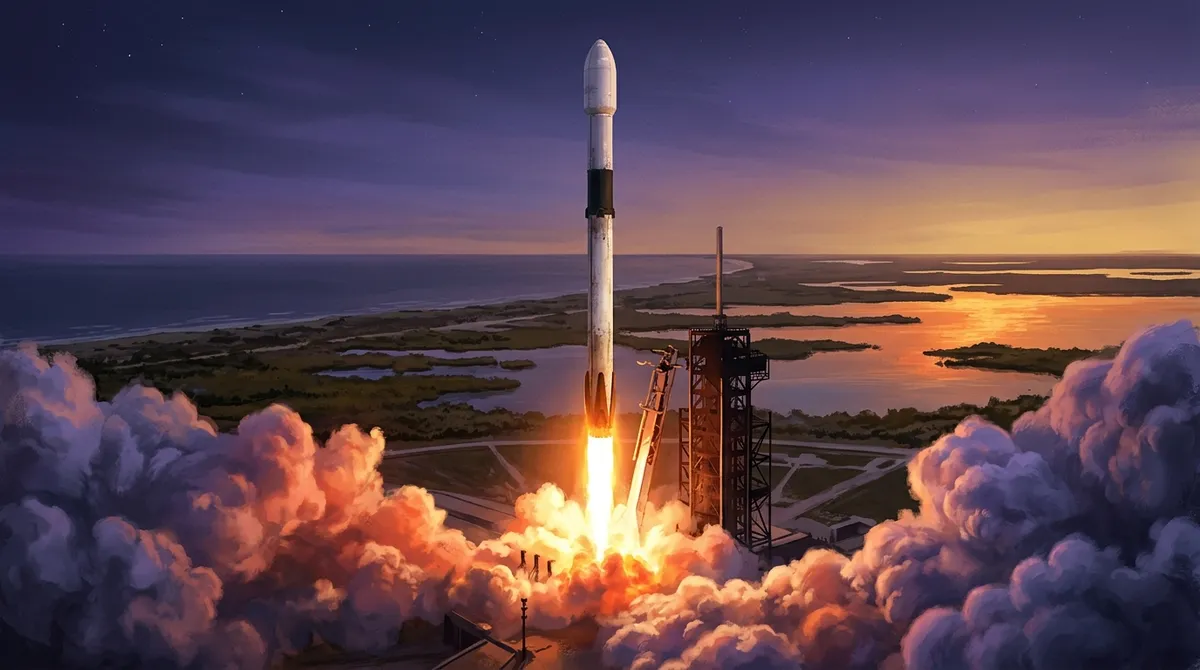
What happened: Northrop Grumman has contracted a sixth Falcon 9 launch for its Cygnus cargo spacecraft, extending its reliance on SpaceX while its own Antares 330 rocket remains unavailable. Vice president Dave Schiller confirmed the added slot ahead of the NG-25 mission — the Cygnus XL named S.S. James A. Lovell, carrying about 11,000 pounds of cargo — scheduled for launch on November 29 from Cape Canaveral, with capture at the station planned for December 1.
What's genuinely new: A fifth Falcon 9 flight was already booked; the sixth confirms Antares 330 will not be ready for the near-term manifest, and Northrop offered no update on hardware status, engine testing or a first-flight target. The damaged NG-22 pressurized cargo module, written off from its June 2025 mission after shipping damage, still has no repair date — only a promise it will fly eventually. Northrop says it does not anticipate a gap in Cygnus coverage.
Watch: Antares 330's readiness signal, the NG-22 repair timeline, and whether the Falcon 9 dependence deepens further.
Progress MS-36 set for the final Russian cargo run of 2026
Sources NASASpaceflight SpaceNews published Nov 24, 5:18 AM ET
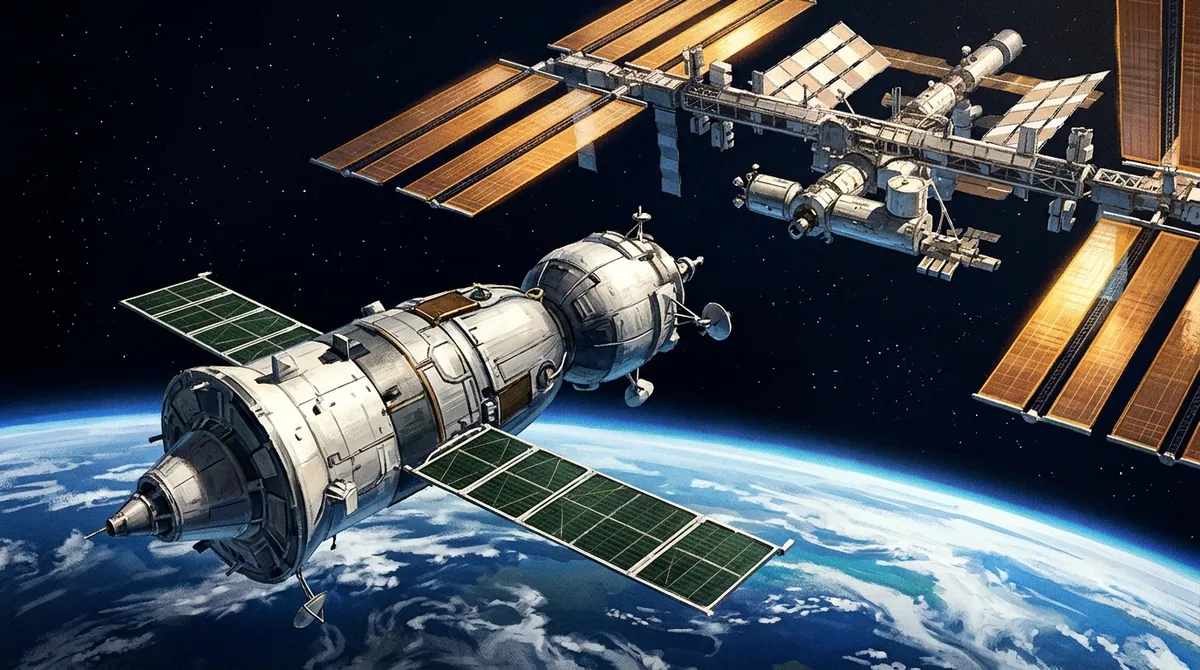
What happened: Progress MS-36 launched from Baikonur's Site 31/6 on November 24 at 10:13 UTC atop a Soyuz 2.1b, carrying roughly 2,500 kg of food, water, fuel and scientific equipment toward a docking at the Poisk module about 48 hours later and resupplying the Expedition 75 crew. Roscosmos offered sharply reduced public coverage; SpaceNews describes a launch marked by unusual secrecy.
What's genuinely new: The launch is confirmed — the fourth and final Russian cargo mission of 2026 is underway. The ship is the first scheduled to leave Poisk and move to the Zvezda module after unloading, a change forced by the permanent June 2026 closure of the leak-plagued PrK airlock behind Zvezda, a risk NASA's matrix rated at the top level. The liftoff also marks a year of recovery at Site 31/6 after the November 2025 pad incident.
Watch: Docking confirmation, whether Progress MS-36 relocates to the Zvezda aft port, and Jared Isaacman's floated extension of the station past its planned 2031 retirement.
Stoke Space's Nova Pathfinder hardware arrives at Cape Canaveral
Sources Orlando Sentinel Stoke Space on X Stoke Space published Nov 24, 8:57 AM ET
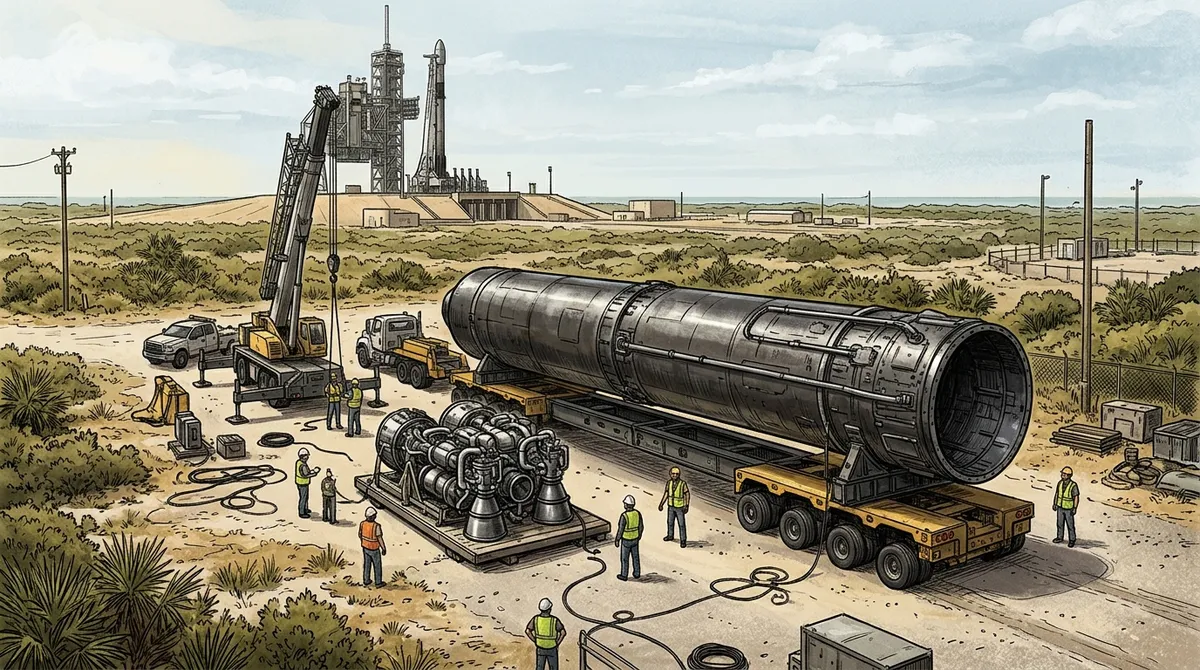
What happened: Stoke Space shipped the first stage and the first Zenith engines of its Nova Pathfinder to Cape Canaveral Space Force Station's SLC-14 in early November — the company's own post marks it as the first rocket at SLC-14 in 60 years. The debut is on track to launch before the summer of 2027, which would make Stoke the first new rocket company to fly from the Space Coast since New Glenn's debut in early 2025. The maiden payload is AstroForge's Autonomy-1, which also flies NASA's COMPASS heliophysics mission, plus human remains for Celestis' "Infinite Flight."
What's genuinely new: Engines joining the stage at the pad marks the move from factory to launch site at SLC-14 — the pad that sent John Glenn to orbit in 1962 — with the arrival confirmed by Stoke founder Andy Lapsa as well as the company account. Nova Pathfinder stands 132 feet tall with seven Zenith engines and 700,000 pounds of liftoff thrust, a 5,500-pound payload and both stages designed to return to the launch site; Pathfinder flies into 2028, with the 33,000-pound-class Nova Block 2 targeting first launch in 2029. The debut comes amid a Space Coast lull: 61 launches in 2026 against last year's record 109, SpaceX shifting Florida capacity toward Starship, Vulcan grounded and New Glenn aiming for an early-2027 return.
Watch: A firm launch date, the second-stage return profile, and New Glenn's and Vulcan's return-to-flight dates.
SpaceX shifts rideshare sales to wholesale integrators as Falcon 9 winds down
What happened: SpaceX is handing its rideshare business — the Falcon 9 flights that carry dozens of small satellites for universities, researchers and independent operators — over to wholesale launch integrators such as Texas-based SEOPS, instead of selling and integrating the rides itself. Momentus' quarterly 10-Q filing describes the squeeze: SpaceX "has reportedly stopped accepting rideshare reservations for launches after 2028," prices have "increased significantly," and a late payload "may be unable to rebook," with SpaceX reportedly planning to wind down Falcon 9 once Starship is operational.
What's genuinely new: The mechanism is the change: SEOPS has booked a third dedicated Falcon 9 for late 2028 and calls the "capacity crunch real," while its president says SpaceX's rideshare was "a gift to the industry" and customers now face "a more honest, true-to-cost price" through middlemen. SpaceX lists $7,500 per kilogram for 2027 flights; integrator quotes run higher, set case by case on size, weight and complexity. The same squeeze has operators building, buying or merging their way to rockets — ICEYE bidding for Avio, AST SpaceMobile starting its own rocket line, and Rocket Lab buying Iridium.
Watch: Whether Starship reaches regular flight by 2028 and restores a mass-market rideshare option, and where wholesale pricing settles.
Links: Advanced Television · SatNews · Nov 24
Brief
- The right-hand door of Starbase's Giga Bay high bay closed for the first time, a step toward enclosing the facility that will build and stage future Starship vehicles (NASASpaceflight on X).
- NASA's ESCAPADE Mars spacecraft photographed Earth during last week's gravity assists: visible-light and infrared images taken on November 9 from about 38,500 miles out with the mission's camera, which Southern Arizona University built, plus pictures of both craft taken by a Vantor WorldView Legion satellite on November 7 and 9 (Primetimer).
- Ship 44 and Booster 24, leading candidates for Starship Flight 17, completed cryogenic proof testing at Massey's and rolled back to production at Starbase (NASASpaceflight on X).
- The Financial Times reports five directors — three from Tesla, two from SpaceX — are negotiating how many SpaceX shares Tesla shareholders would receive in a potential all-stock merger that could value the combined company at $3.5 trillion, with Elon Musk barred from formally taking part; SpaceX stock slipped below its IPO price last week and is down 15% over the past month, with a remaining IPO lock-up expiring December 8 (247wallst)
- Space stocks gave back Monday's rally — AST SpaceMobile down 11% (down 68% year to date after a Q3 revenue miss and its ~45-BlueBird target slipping to mid-2027), Rocket Lab down 9% at $45.15 after falling 13% over the past week with no news of its own, and SpaceX down 6% to $125.07, with rate and sector rotation pressures cited; SpaceX's Q3 capex of $19.6 billion topped its $14.6 billion of revenue (TIKR · 247wallst).
- India's first privately built rocket nears its pad: ISRO chairman V Narayanan says PSLV-N1, the first of five rockets the Larsen & Toubro–Hindustan Aeronautics consortium is building under a NewSpace India contract signed in September 2022 for 8.6 billion rupees (about $100 million), is targeted for a maiden launch in the first quarter of 2027 after slips from 2025 and 2026; he also says Gaganyaan "is not delayed," with the rocket ready and the orbital module in final work (The Times of India)
- Falcon 9 launched the classified USSF-266 mission for the U.S. Space Force from Vandenberg Space Force Base's SLC-4E, on booster B1081-29 (NASASpaceflight on X).
- Simera Sense, Spacemanic, Zaitra and World from Space signed a memorandum to offer an end-to-end dual-use Earth-imaging mission solution — camera, platform, deployer, onboard AI processing and analytics — from one group (SpaceNews).
- Starlink will introduce a global-business merchant tier for merchant ships from 2027 at $4,650 a month — more than double the current $2,150 global priority plan — promising unlimited data and gigabit speeds on its V3 satellites with no speed guarantees, per-vessel service lines tied to IMO numbers, and discounts for early adopters applying by the end of 2026; shipowners voice concern over operating costs while rivals such as Telesat and Amazon Leo are not expected to offer global services until 2028 (Riviera Maritime Media).
- Satellite tracker Jonathan McDowell's breakdown counts the Starshield fleet at 449 satellites so far across at least four distinct programs — the Space Force's SDN communications and radar satellites, the Space Development Agency's missile-tracking backbone and the NRO's proliferated architecture (its communications variant alone at 238) — clarifying that "Starshield" is a militarized Starlink satellite bus, not a single program, with the fleet likely to pass 1,000 (BASENOR).
- NASA Administrator Jared Isaacman says two stacked rockets sit in the Vehicle Assembly Building — Artemis III's booster-and-core-stage short stack was completed October 26, with rollout next ahead of integrating the Orion spacecraft (NASAAdmin on X).
- NASASpaceflight's BepiColombo account adds that the 37-minute Mercury orbit-insertion burn on November 21 was cut short by a software glitch, with the trajectory planned with enough margin that little corrective action is needed; the spacecraft's signal was reestablished hours after the expected post-burn window passed quietly (NASASpaceflight).
- Firefly Aerospace says construction of Launch Complex 3 is underway at Esrange Space Center in Sweden with partner SSC, building European launch infrastructure (Firefly Aerospace on X).
- Rocket Lab's 101st Electron launch — a synthetic aperture radar satellite for Synspective named "Night Owls Never Sleep" — is set for November 27 from the Mahia Peninsula, part of next week's ten-launch stretch including three station missions and a Chinese launch quadruple-header (NASASpaceflight).